Introduction
Modern software delivery demands speed and agility, but rapid deployments frequently introduce security vulnerabilities when safety checks are left as final-stage activities. Traditional security testing at the end of the development lifecycle creates massive bottlenecks, delays releases, and increases remediation costs exponentially. The widespread adoption of cloud computing, microservices, containerization, Kubernetes, Infrastructure as Code, and automated CI/CD pipelines requires security to evolve alongside software engineering. DevSecOps addresses these challenges by embedding security controls directly into development and operations workflows from the very beginning. Learning these concepts through structured DevSecOpsSchool educational resources enables technical professionals to build secure applications without slowing down deployment velocity. Completing hands-on DevSecOps Training equips software engineers, system administrators, and security specialists with practical automation skills needed in modern enterprise technology environments. Earning a recognized DevSecOps Certification validates your ability to automate vulnerability scanning, secure cloud infrastructure, and establish continuous compliance across complex delivery pipelines.
Understanding DevSecOps
DevSecOps represents the seamless integration of security practices into the core DevOps paradigm of development and operations. Instead of treating security as an isolated auditing phase managed by a separate team, DevSecOps establishes security as a shared responsibility across the entire engineering organization. The foundational philosophy rests on shifting security left, meaning security checks, automated scanning, and architectural reviews occur at the earliest stages of software creation. Continuous security automation ensures that every code commit, configuration change, and infrastructure update undergoes automated policy evaluation before reaching production environments. Traditional security relies heavily on manual penetration testing, periodic audits, and delayed ticket generation, which inevitably disrupts release schedules. In contrast, DevSecOps replaces manual friction with automated static analysis, dynamic testing, dependency auditing, container scanning, secret detection, and runtime monitoring directly inside developer workflows.
Importance of DevSecOps Skills
The demand for specialized security engineering skills has surged due to radical shifts in modern software architecture and deployment patterns. Microservices architectures, container orchestration platforms like Kubernetes, and Infrastructure as Code frameworks allow teams to spin up complex cloud environments in minutes, expanding the potential attack surface. Modern applications depend heavily on open-source packages, third-party libraries, and external APIs, making software supply chain security a top enterprise priority. Security responsibilities are no longer confined to dedicated security operation centers; instead, they are distributed across development, DevOps, platform engineering, and site reliability engineering teams. Technical professionals who master automated security scanning, policy as code, secrets protection, and cloud governance become vital assets capable of protecting mission-critical digital assets while preserving deployment speed.
Core Areas Covered in DevSecOps Training
Comprehensive security training programs must cover every dimension of the modern software delivery ecosystem to build actionable engineering skills. A well-rounded curriculum spans secure software development, continuous static and dynamic vulnerability analysis, open-source risk management, secrets governance, container security, and infrastructure automation. Learners gain practical exposure to cloud-native platforms, policy enforcement engines, and automated compliance tools across multi-cloud environments. Mastering these domains ensures that practitioners can design resilient architectures, write secure code, and automate defensive controls within existing continuous integration pipelines without creating operational bottlenecks.
Secure Software Development Lifecycle
Integrating security into the development lifecycle requires embedding threat awareness, architectural risk analysis, and automated compliance checks into every development phase. During initial planning and architecture, teams define security requirements, conduct threat modeling, and evaluate potential attack vectors before writing code. Throughout development, automated static code scanners and IDE linting tools provide developers with immediate feedback on code vulnerabilities. As software progresses through staging and testing environments, deployment controls ensure that only validated, cryptographically signed artifacts move forward into production systems. Continuous runtime monitoring completes the lifecycle by observing live application behavior, capturing telemetry, and feeding real-world threat insights back into early planning stages.
Static Application Security Testing
Static Application Security Testing (SAST) analyzes source code, binary files, and configuration scripts without executing the underlying application. SAST tools inspect the code base for structural flaws, memory leaks, cross-site scripting vulnerabilities, SQL injection paths, and insecure API usages early in the development cycle. Integrating tools such as SonarQube, Semgrep, and Snyk directly into source control repositories and CI/CD pipelines ensures immediate feedback upon code commit. A practical DevSecOps Course emphasizes teaching engineers how to configure scanner rule sets, suppress false positives, and embed automated gate checks within pull request workflows rather than simply viewing raw vulnerability dashboard reports.
Dynamic Application Security Testing
Dynamic Application Security Testing (DAST) evaluates running applications from an outside-in perspective, simulating real-world malicious attacks against exposed HTTP endpoints and interfaces. Unlike static analysis, DAST detects operational flaws, authentication weaknesses, session management issues, input validation failures, and server configuration errors that manifest only during execution. Utilizing automated scanners like OWASP ZAP within staging and integration environments allows engineering teams to identify runtime vulnerabilities before releasing code to production. Embedding automated DAST scans into delivery pipelines ensures that API endpoints and web interfaces undergo rigorous testing whenever release candidates are deployed to testing environments.
Software Composition Analysis
Modern application code bases consist largely of open-source libraries, frameworks, and third-party dependencies, which introduces significant software supply chain risks. Software Composition Analysis (SCA) automatically inventories third-party components, identifies known Common Vulnerabilities and Exposures (CVEs), and tracks transitive dependencies across application builds. SCA tools evaluate licensing compliance risks, flag outdated or unmaintained dependencies, and suggest secure patch updates within developer workflows. Mastering dependency analysis during DevSecOps Certification Training enables engineers to secure their software supply chain, remediate inherited vulnerabilities, and implement automated policy checks that prevent compromised open-source packages from reaching production environments.
Secrets Management
Hardcoding credentials, private encryption keys, database passwords, and API tokens directly into application source code or repository configuration files creates extreme security exposure. Attackers actively scan public and internal code repositories for exposed credentials, making automated secrets management a mandatory security requirement. Centralized secret management platforms like HashiCorp Vault securely store, encrypt, and control access to sensitive credentials using strict identity-based access policies. DevSecOps workflows implement dynamic secrets generation, automated credential rotation, and secure injection mechanisms at application runtime. Automated pre-commit hooks and pipeline scanning engines continuously audit source code to detect and block committed secrets before code reaches remote repositories.
Infrastructure as Code Security
Infrastructure as Code (IaC) tools like Terraform allow engineering teams to programmatically provision and manage complex cloud environments using declarative configuration files. However, misconfigured IaC templates can rapidly deploy exposed database instances, open storage buckets, and overly permissive security groups across enterprise environments. Security scanning engines like Checkov static-analyze IaC templates prior to execution, detecting misconfigurations, unencrypted storage volumes, and weak network policies before infrastructure provisioning occurs. Enforcing strict IaC security checks within integration pipelines prevents drift, maintains centralized compliance standards, and ensures that cloud resources adhere strictly to foundational security baselines.
Container Security
Containerization abstracts applications into lightweight, portable units, but containers present unique security challenges across image building, storage, and execution. Base image selection requires utilizing minimal, hardened distributions to drastically minimize the available attack surface and remove unnecessary utility binaries. Container security scanners such as Trivy analyze Docker container images during build processes, identifying operating system package vulnerabilities and application layer defects. Implementing container security requires signing trusted images using cryptographic tools, storing artifacts in private registries, restricting root privilege execution, and continuously monitoring containerized runtimes against unauthorized filesystem or network access attempts.
Kubernetes Security Training
Managing containerized applications at scale using Kubernetes requires robust security configurations across master nodes, worker nodes, cluster networking, and container runtimes. Comprehensive Kubernetes Security Training equips engineers with practical skills to secure cluster components, isolate workloads, control API access, and manage runtime behavior. Securing Kubernetes environments requires applying defense-in-depth principles across every infrastructure layer, ensuring that compromised container workloads cannot escalate privileges or traverse cluster networks laterally.
Kubernetes RBAC
Kubernetes Role-Based Access Control (RBAC) regulates API authorization by assigning explicit permissions to user accounts, groups, and automated service accounts within specific namespaces. Applying the principle of least privilege ensures that applications and cluster administrators receive only the exact permissions required to perform designated tasks. Custom Roles, ClusterRoles, RoleBindings, and ClusterRoleBindings must be periodically audited to eliminate over-privileged service accounts, prevent privilege escalation risks, and restrict cluster management commands to verified, authenticated entities.
Container Image Security
Securing container images within Kubernetes demands strict registry access controls, continuous image vulnerability scanning, and automated image provenance validation. Clusters should ingest images exclusively from trusted, secure private registries that enforce automated vulnerability scanning upon artifact upload. Implementing image footprint reduction techniques and using cryptographic signing tools ensures that Kubernetes nodes execute only verified, uncorrupted images. Automated image policies automatically block unsigned or highly vulnerable image deployments before scheduling containers onto cluster worker nodes.
Admission Controls
Kubernetes admission controllers act as security gatekeepers by intercepting API requests to validate or mutate object specifications before object persistence occurs. Validating admission webhooks enforce organizational security policies, such as mandating non-root container execution, restricting host network access, requiring resource limits, and blocking unapproved image registries. Utilizing admission control engines prevents non-compliant or insecure workload configurations from entering cluster state, serving as a powerful automated governance mechanism across multi-tenant clusters.
Runtime Security
Container runtime security focuses on monitoring live container workloads to detect, log, and mitigate anomalous behavior in real-time. Runtime defense engines observe kernel-level system calls, monitoring for unauthorized process execution, file modifications, privilege escalation, or unusual outbound network sockets. Implementing runtime security controls allows platform engineers to immediately flag suspicious container activity, isolate compromised pods, and collect forensic data without interrupting remaining cluster microservices.
Policy as Code
Policy as Code decouples governance policies from application logic and cloud platforms by defining compliance requirements using standardized domain-specific declarative languages. Frameworks like Open Policy Agent (OPA) allow teams to express security guidelines, operational rules, and regulatory controls directly as code. This approach enables automated policy enforcement across CI/CD builds, Kubernetes admission checks, API authorization gateways, and cloud infrastructure deployments. Examples include enforcing mandatory resource tagging, blocking public cloud storage buckets, restricting root user execution in containers, requiring payload encryption, and restricting incoming traffic to authorized corporate IP subnets.
DevSecOps and CI/CD Pipeline Security
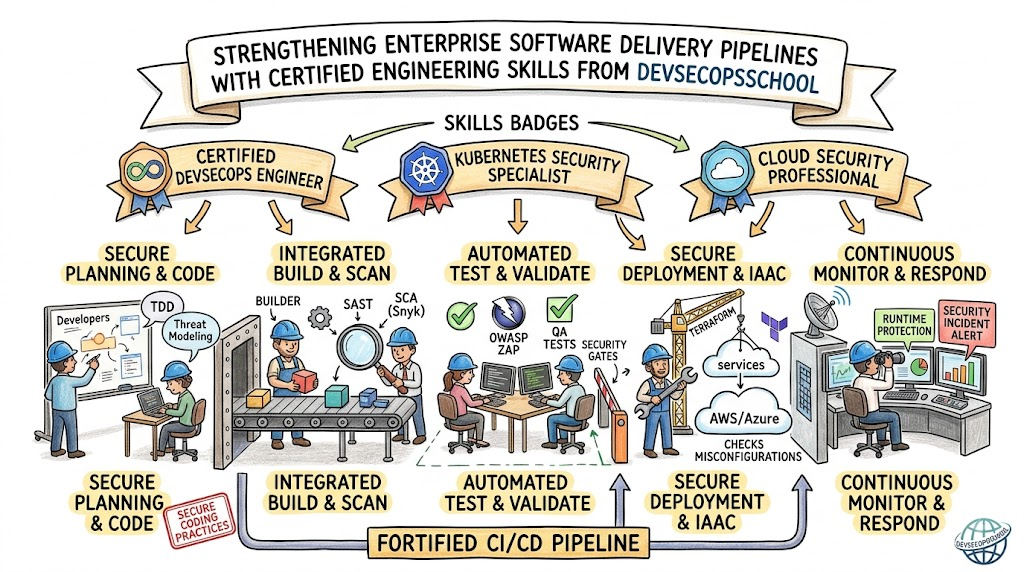
Automating security checks within continuous integration and continuous delivery (CI/CD) pipelines ensures that code releases undergo continuous, hands-free security verification. Automation engines such as Jenkins, GitHub Actions, and GitLab CI execute pipeline stages sequentially, triggering automated tools to inspect code, dependencies, containers, and infrastructure definitions. An optimized delivery pipeline follows a structured path:
Source Code → Secrets Scan → SAST → Dependency Scan → Build → Container Scan → IaC Scan → Test Deployment → DAST → Policy Validation → Production
Source code commits trigger immediate secret detection, followed by static code analysis and dependency vulnerability assessments. Upon passing early gates, the pipeline compiles artifacts, builds container images, performs container vulnerability scanning, and inspects IaC templates. Finally, the application deploys to an isolated staging environment where dynamic security testing and policy compliance checks run before production deployment approval.
Security Gates and Vulnerability Prioritization
Failing continuous delivery pipelines for every minor security finding creates severe developer friction, reduces productivity, and leads to security alert fatigue. Organizations must establish risk-based security gates that prioritize vulnerabilities according to severity, exploitability, asset critical nature, and business impact. High-risk issues must stop pipeline progression immediately, whereas minor informational findings can generate automated tracking tickets without interrupting continuous deployment flows.
| Severity | Suggested Response |
| Critical | Stop deployment immediately and require mandatory hotfix investigation |
| High | Block pipeline progression until security team approval or patch implementation |
| Medium | Create an automated remediation task for resolution within current sprint cycle |
| Low | Track vulnerability in backlog for scheduled routine maintenance updates |
| Informational | Record finding in security dashboard for periodic architectural review |
Risk policies must align with regulatory standards, organizational risk tolerance, exposure parameters, and asset sensitivity to balance release speed with infrastructure protection.
Cloud Security in DevSecOps
Integrating security into cloud ecosystems requires applying continuous security controls across Amazon Web Services (AWS), Microsoft Azure, and Google Cloud Platform (GCP). Cloud security practices center around stringent Identity and Access Management (IAM), enforcing strict least privilege access, multi-factor authentication, and short-lived session credentials. Encryption must be enforced for data at rest across storage volumes, object stores, and databases, alongside cryptographic encryption for data in transit. Pursuing a specialized DevSecOps Certification prepares engineers to configure cloud security posture management tools, automate central logging, configure network firewalls, and detect cloud infrastructure drift across multi-cloud environments.
DevSecOps Toolchain Overview
Building an effective security toolchain requires combining specialized automated security tools across each layer of the software development lifecycle.
| Security Area | Common Technologies |
| CI/CD Orchestration | Jenkins, GitHub Actions, GitLab CI |
| SAST Analysis | SonarQube, Semgrep |
| Dependency Security | Snyk, Software Composition Analysis tools |
| DAST Testing | OWASP ZAP |
| Container Scanning | Trivy |
| Infrastructure as Code | Terraform |
| IaC Security | Checkov |
| Secrets Management | HashiCorp Vault |
| Policy as Code | Open Policy Agent (OPA) |
| Container Engine | Docker |
| Orchestration | Kubernetes |
| Cloud Platforms | AWS, Microsoft Azure, Google Cloud Platform |
Engineers must prioritize underlying security principles, architecture patterns, and automation workflows over simple command line tool memorization.
Skills Developed Through DevSecOps Certification Training
Completing comprehensive DevSecOps Certification Training builds practical engineering capabilities directly applicable to enterprise technology production environments. Practitioners master secure pipeline architecture design, automated static and dynamic vulnerability scanning, secret detection, and centralized vulnerability management. Training develops proficiency in container security, Kubernetes admission controls, Infrastructure as Code auditing, cloud IAM governance, and automated policy implementation. Furthermore, engineers acquire critical skills in software supply chain protection, automated compliance monitoring, and telemetry logging, preparing them to defend modern cloud-native software architectures against evolving cyber threats.
DevSecOps Engineer Certification and Career Development
Earning a recognized DevSecOps Engineer Certification accelerates professional career growth by formally validating hands-on proficiency in security automation, cloud security, and secure delivery pipelines. Certification programs complement real-world experience by offering structured learning paths that validate knowledge across four foundational engineering disciplines:
- Development Skills: Mastering Git repository management, RESTful API design, software build systems, application architecture, dependency structures, and source control workflows.
- Operations Skills: Proficient administration of Linux environments, CI/CD pipeline creation, containerization, Kubernetes cluster orchestration, infrastructure monitoring, and log aggregation.
- Cloud Skills: Configuring cloud platforms (AWS, Azure, GCP), implementing granular IAM policies, designing virtual networks, and securing cloud-native compute instances.
- Security Skills: Conducting static and dynamic code scanning, dependency security checks, secrets governance, cloud posture auditing, and container runtime threat analysis.
Achieving status as a Certified DevSecOps Professional demonstrates an ability to bridge traditional technical silos, design resilient delivery mechanisms, and drive security automation across enterprise engineering teams.
Professionals Who Can Benefit from DevSecOps
Cross-functional engineering roles across modern enterprise IT organizations benefit significantly from mastering integrated security principles and automation practices:
- Developers: Write secure code from day one, remediate code vulnerabilities early, understand secure dependency usage, and utilize automated linting within local IDEs.
- DevOps Engineers: Embed automated security gates into build pipelines, manage secrets infrastructure, secure container build processes, and standardize IaC deployments.
- Security Engineers: Transition from manual security audits to automated policy authoring, build scalable scanning systems, and monitor continuous cloud compliance.
- Cloud Engineers: Enforce IAM least-privilege policies, secure cloud network configurations, automate infrastructure scanning, and encrypt multi-cloud storage assets.
- SRE Professionals: Maintain system availability while embedding runtime security, monitor threat telemetry, manage incident response, and enforce platform resiliency standards.
- Platform Engineers: Build secure internal developer platforms, integrate policy enforcement engines, and offer pre-configured secure deployment pipelines to engineering teams.
- Kubernetes Professionals: Secure cluster APIs, enforce namespace isolation, build RBAC policies, configure network policies, and run container runtime security checks.
- Software Architects: Design resilient cloud-native architectures, establish threat models, choose secure communication patterns, and integrate software supply chain protections.
- Engineering Managers: Promote security ownership across engineering, improve remediation velocity metrics, reduce audit compliance overhead, and manage risk balances.
Individual Training vs Corporate DevSecOps Training
Individual learning paths focus primarily on career transition, gaining foundational skills, passing certification exams, and executing hands-on lab projects to demonstrate practical capability. Conversely, custom Corporate DevSecOps Training aligns educational content directly with an enterprise’s unique technology stack, security policies, and organizational objectives. Tailored corporate programs address proprietary CI/CD environments, internal cloud architectures, regulatory compliance mandates, and cross-team collaboration challenges between development, operations, and security departments. Establishing a shared technical foundation allows enterprises to accelerate security maturity, standardize automated controls, and build sustainable DevSecOps cultures across engineering groups.
DevSecOps Online Training
Interactive DevSecOps Online Training provides distributed engineering teams and working professionals with flexible, high-impact learning experiences without geographical restrictions. Effective online programs combine live instructor-led technical sessions with hands-on, cloud-hosted laboratory environments where learners solve real-world security challenges. Participants configure CI/CD pipelines, write custom policy rules, remediate container vulnerabilities, and secure Kubernetes clusters through practical scenarios. Prioritizing project-driven laboratory exercises over theoretical lectures ensures that engineers gain immediate, job-ready technical skills that translate directly into modern software delivery environments.
DevSecOps Training in India
The demand for specialized security engineering education has grown significantly across technology hubs, driven by global cloud adoption, platform engineering, and cybersecurity requirements. Enrolling in structured DevSecOps Training in India allows software professionals, system administrators, and security specialists to acquire competitive skills in automated pipeline security and cloud governance. Prospective students should evaluate educational offerings based on curriculum depth, lab infrastructure quality, practical project scenarios, container security coverage, and certification alignment. Selecting rigorous, lab-focused training ensures that practitioners acquire job-ready capabilities required by top-tier enterprise technology employers globally.
Selecting a DevSecOps Course
Choosing an effective DevSecOps Course requires carefully auditing curriculum depth to ensure comprehensive coverage of modern application security and cloud automation practices. A rigorous program must include hands-on instruction covering Git security, SAST, DAST, Software Composition Analysis, secret scanning, container security, and Kubernetes hardening. Additionally, the curriculum must cover Infrastructure as Code scanning, cloud IAM governance, Policy as Code, CI/CD pipeline automation, and software supply chain protection. Prioritizing courses that offer live laboratory access and real-world implementation projects ensures that engineers learn to solve complex production security issues effectively.
Practical Learning vs Tool Memorization
Effective security engineering requires mastering fundamental architectural principles and risk management frameworks rather than simply memorizing command-line syntax for specific tools. Technical professionals must master a systematic operational workflow: identify business risks, select appropriate security controls, automate scanning mechanisms, implement tool integrations, and measure remediation efficacy. For example, understanding container security concepts enables an engineer to apply vulnerability scanning principles across Trivy, Docker Bench, or Snyk interchangeably. Focusing on transferable architectural concepts ensures that engineers can adapt to evolving cloud technologies and toolchains throughout their careers.
Important DevSecOps Metrics
Tracking objective engineering metrics enables organizations to evaluate security efficiency, optimize pipeline performance, and foster collaborative accountability between development and security teams. Essential metrics include tracking critical vulnerability counts, mean time to remediation (MTTR), vulnerability recurrence rates, and total percentage of repositories covered by automated scans. Teams should also measure container image scanning coverage, secret exposure incidents, pipeline build failure rates due to security gates, and SLA compliance metrics. Utilizing metrics to inform process improvements rather than penalize engineering teams builds a healthy security culture and accelerates vulnerability resolution speeds.
DevSecOps Learning Roadmap
Mastering security automation requires following a structured, step-by-step learning progression that builds technical depth across software delivery, infrastructure, and automation domains.
Stage 1 – DevOps Foundations
Begin by mastering core software delivery tooling, including Git version control systems, Linux system administration, shell scripting, basic networking, and foundational continuous integration concepts. Acquire a clear understanding of cloud computing principles across major providers, focusing on virtual networks, compute instances, storage, and basic IAM permission structures. Establishing strong foundational engineering capabilities ensures a smooth transition into complex security automation tasks.
Stage 2 – Application Security
Focus on fundamental application security principles, exploring the OWASP Top 10 vulnerabilities, secure coding practices, and common web application security risks. Learn to configure, run, and integrate SAST and DAST scanners into development environments while interpreting vulnerability execution reports. Develop proficiency in Software Composition Analysis to audit third-party open-source dependencies and implement automated secret scanning tools across code repositories.
Stage 3 – Infrastructure Security
Transition into infrastructure automation and cloud security by mastering containerization with Docker and container orchestration using Kubernetes. Learn to harden base images, implement container vulnerability scanning, configure Kubernetes RBAC policies, establish network isolation rules, and manage cluster secrets securely. Study Infrastructure as Code tools like Terraform, applying automated static analysis tools to identify infrastructure misconfigurations prior to deployment.
Stage 4 – Security Automation
Learn to integrate security tools directly into automated CI/CD pipelines using platforms like Jenkins, GitHub Actions, or GitLab CI. Build complete, multi-stage delivery pipelines that automatically execute SAST, DAST, dependency scanning, container checking, and IaC verification sequentially. Configure automated security gates that fail builds upon detecting high-severity defects, ensuring that unvalidated code artifacts cannot progress to production environments.
Stage 5 – Advanced DevSecOps
Advance into enterprise-grade security governance by studying Policy as Code engines like Open Policy Agent to write declarative compliance rules across infrastructure and Kubernetes. Implement Software Bill of Materials (SBOM) generation tools to enforce software supply chain transparency and combat malicious package tampering. Explore container runtime security monitoring tools, automated continuous compliance platforms, and centralized vulnerability management dashboards.
Stage 6 – Certification and Projects
Consolidate technical knowledge by designing and executing end-to-end practical capstone projects that showcase automated security integration across complex cloud environments. Build a public portfolio containing secure pipeline definitions, custom policy libraries, IaC scanning configurations, and hardened Kubernetes cluster templates. Finally, prepare for recognized industry certification exams to formally validate technical capabilities and accelerate career advancement opportunities.
Structured DevSecOps Learning Programs
Engineers and corporate technology teams seeking structured guidance can explore comprehensive educational options at DevSecOpsSchool. The platform offers curated educational paths covering secure SDLC, pipeline security, cloud security governance, container protection, Kubernetes security, and policy automation. Learners gain practical, hands-on experience by completing cloud-hosted laboratory exercises, practical projects, and automated security pipeline scenarios. Training formats include individual self-paced modules, live instructor-led online classes, specialized corporate team programs, and targeted certification preparation tracks designed to build job-ready security automation capabilities. Prospective students should evaluate program curricula, lab quality, instructor experience, and career alignment when choosing a learning path.
Frequently Asked Questions
1. What is the primary difference between DevOps and DevSecOps?
DevOps focuses on automating software delivery to increase deployment speed and operational efficiency between development and operations teams. DevSecOps builds upon this foundation by integrating security automation, continuous vulnerability testing, and policy enforcement directly into every stage of the software delivery pipeline, ensuring speed without compromising security.
2. Do I need programming experience to learn DevSecOps?
Having basic scripting or programming experience in languages like Python, Go, or Bash is highly beneficial for writing automation scripts and understanding source code vulnerabilities. However, beginners can start by learning version control, system administration, and basic security concepts before progressing into advanced code analysis and pipeline scripting.
3. How does DevSecOps handle open-source software risks?
DevSecOps manages open-source risks by embedding Software Composition Analysis (SCA) tools into development workflows and CI/CD pipelines. These tools automatically scan third-party dependencies against vulnerability databases, flag outdated libraries, detect licensing compliance issues, and alert developers to available security patches before deployment occurs.
4. What role does Kubernetes play in a DevSecOps environment?
Kubernetes orchestrates containerized workloads at scale, requiring robust security automation across cluster components, container images, network communications, and API access. DevSecOps practices apply RBAC controls, automated admission webhooks, network isolation policies, secret management, and runtime security monitoring to keep production Kubernetes clusters secure.
5. Why is hardcoding secrets in code repositories dangerous?
Hardcoding credentials, API tokens, or encryption keys in source repositories exposes sensitive system access to anyone with code repository read permissions. Malicious actors continuously scan public and private code bases for leaked credentials, which can lead to severe data breaches, unauthorized infrastructure access, and compromise of enterprise resources.
6. How do security gates prevent vulnerable deployments without slowing releases?
Security gates evaluate scan results against pre-established risk thresholds, automatically blocking deployments only when critical or unhandled high-severity vulnerabilities are detected. Non-critical findings are automatically converted into tracking tickets for future remediation, enabling engineering teams to maintain rapid deployment speeds while preventing high-risk code from reaching production.
7. What is Policy as Code and why is it useful?
Policy as Code defines security governance, operational rules, and compliance policies in declarative code files using tools like Open Policy Agent. This approach enables automated, repeatable policy evaluation across cloud configurations, CI/CD builds, and Kubernetes admission controllers, replacing manual auditing with continuous automated compliance enforcement.
8. How long does it take to complete a DevSecOps course?
The duration of a comprehensive course varies based on learning format and schedule, typically ranging from four weeks of intensive training to three months of part-time study. Programs emphasizing hands-on laboratory exercises, real-world projects, and certification preparation ensure learners develop practical engineering capabilities effectively.
9. What is the value of obtaining a DevSecOps certification?
Earning a industry-recognized certification validates practical skills in security automation, pipeline security, cloud hardening, and container protection to potential enterprise employers. Certification complements practical engineering experience, demonstrating a comprehensive understanding of integrated security principles across modern cloud-native deployment environments.
10. Can traditional security professionals transition into DevSecOps roles?
Yes, traditional cybersecurity professionals can successfully transition by learning Linux administration, continuous integration tooling, container orchestration, cloud platforms, and basic scripting. Combining existing risk management expertise with modern pipeline security automation enables security specialists to transition into high-demand cloud and pipeline security engineering roles.
11. What is the importance of Infrastructure as Code scanning?
IaC scanning inspects configuration templates like Terraform scripts for security misconfigurations, unencrypted storage, and overly permissive firewall rules before infrastructure is deployed. Automated IaC checks prevent cloud configuration drift, reduce manual auditing overhead, and ensure that deployed cloud environments adhere strictly to security standards.
12. How does corporate DevSecOps training benefit enterprise teams?
Corporate training aligns educational content directly with an organization’s proprietary software stack, deployment workflows, cloud architecture, and internal compliance mandates. This tailored approach fosters technical collaboration between development, security, and operations teams, enabling enterprises to accelerate security maturity and standardize compliance automation across business units.
Conclusion
Integrating security automation directly into continuous software delivery workflows is mandatory for modern organizations operating across cloud, container, and microservice architectures. Mastering core DevSecOps principles, static and dynamic analysis, dependency scanning, secrets management, container protection, Kubernetes security, and Policy as Code enables technical professionals to defend complex applications without sacrificing deployment velocity. Achieving professional certification complements practical, hands-on engineering experience, validating your ability to build resilient pipelines, enforce cloud compliance, and establish proactive security automation across enterprise delivery environments.
