Introduction
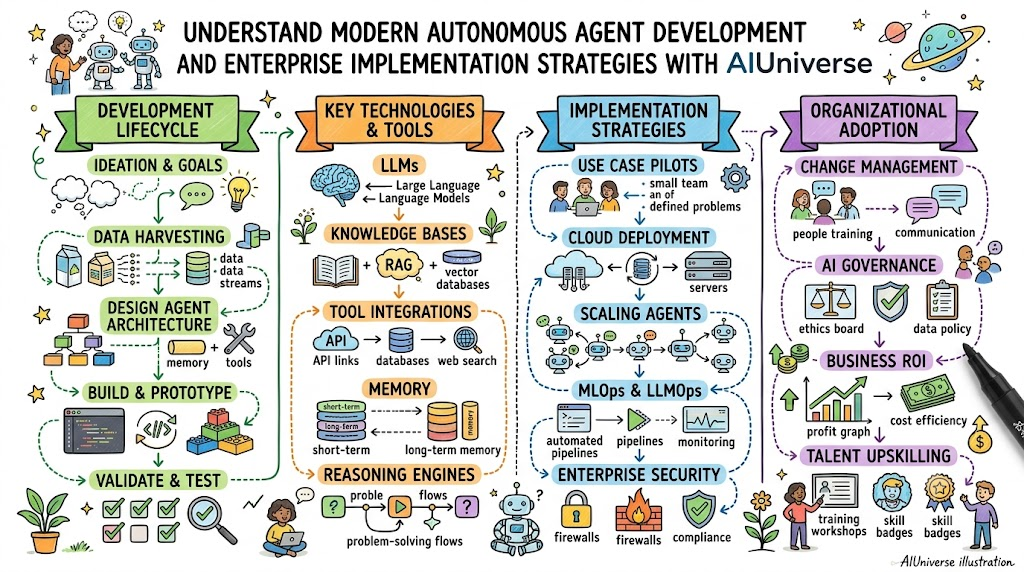
Artificial intelligence is undergoing a massive transformation by moving far beyond traditional, simple conversational chatbots. Modern systems are no longer limited to generating basic text replies or fetching static summaries. Today, autonomous AI agents can actively reason, break down complex goals into step-by-step plans, interact with software tools, and execute intricate business workflows with minimal manual intervention. Because of this shift, gaining practical expertise in building and governing these systems is fast becoming a vital requirement for technology professionals. Enrolling in a structured program like an AIUniverse helps learners move from theoretical concepts to building production-ready systems. This comprehensive guide details core agent capabilities, architectural patterns, tool integrations, governance practices, and real-world deployment strategies.
What Is Agentic AI?
Agentic AI refers to intelligent systems designed to autonomously pursue specific goals by reasoning through complex scenarios, formulating multi-step plans, using external software tools, maintaining context via dynamic memory, and continually reflecting on their performance to achieve desired outcomes under human supervision. Unlike standard machine learning models that simply output a static prediction or generate text based on immediate prompts, an autonomous agent actively evaluates its environment, determines which sequence of actions to take, interacts with external databases or APIs, checks its intermediate outputs for errors, and adjusts its approach until the assigned task is fully completed. For example, in an enterprise scenario, a human supervisor can request an agent to reconcile an vendor invoice gap; the agent autonomously retrieves the invoice PDF, queries the internal ERP database to cross-check purchase orders, identifies line-item discrepancies, sends a structured clarification email to the vendor, and queues the final resolution for human approval.
How Agentic AI Differs from Traditional AI and Generative AI
Understanding the evolution of modern artificial intelligence requires distinguishing between classical automation, generative content creation, interactive systems, and autonomous agentic workflows. Traditional rule-based automation follows rigid, pre-programmed logic paths that fail as soon as an unexpected variance occurs, while generative AI focuses primarily on producing human-like text, code, or images from single user prompts. Conversational AI expands on generative models by maintaining back-and-forth multi-turn chats, but it lacks the capability to execute multi-step external actions or dynamically alter software systems without direct continuous guidance. In contrast, Agentic AI combines reasoning, memory, tool access, and goal-oriented planning, enabling it to complete full multi-step business procedures independently while operating within specified governance parameters and human oversight.
| Technology Type | Main Capability | Level of Autonomy | Common Example |
| Traditional Automation | Executes hardcoded, rule-based scripts | Zero autonomy; relies strictly on pre-defined logic | Scheduled database backup scripts |
| Generative AI | Creates text, code, or media from user inputs | Low autonomy; responds strictly to given prompts | Drafts email copy or basic software functions |
| Conversational AI | Maintains interactive multi-turn dialogue | Moderate autonomy; guides user conversations | Customer service query resolution bots |
| Agentic AI | Plans, reasons, calls external tools, and completes goals | High autonomy; acts independently with human safety rails | Autonomous software debugging and deployment agents |
Why Agentic AI Skills Matter for Working Professionals
Acquiring specialized skills in agentic systems provides software developers, DevOps specialists, data scientists, cloud architects, and business analysts with the technical edge required to transform traditional software applications into fully autonomous operational workflows across various business units. Software engineers learn to build resilient tool-calling frameworks; DevOps and cloud specialists integrate agents into automated infrastructure provisioning; and data scientists leverage multi-agent setups to automate complex data preparation, feature engineering, and statistical modeling tasks. Beyond core technical departments, professionals in cybersecurity, finance, customer service, and project management can design domain-specific automation systems that handle routine investigations, financial reconciliations, and ticket routing, allowing human teams to focus on strategy, innovation, and critical decision-making.
What Is an Agentic AI Certification Course?
An Agentic AI certification course is an educational program designed to teach learners how to architect, develop, evaluate, deploy, and govern production-grade autonomous agent systems through structured curriculum, expert instruction, interactive labs, real-world capstone projects, and rigorous technical assessments. Rather than simply focusing on high-level theoretical concepts or simple API calls, a comprehensive training program guides students through advanced agent design patterns, vector search integration, tool usage mechanisms, state management, safety rails, and enterprise orchestration frameworks. Learners build portfolio-ready projects demonstrating real-world utility while learning production deployment, observability, cost tracking, and security governance, recognizing that holding a certificate is only valuable when backed by demonstrable, practical software engineering experience.
Who Should Take an Agentic AI Certification Course?
- Working Professionals: Connect agentic workflows with current enterprise systems, automating repetitive daily tasks and creating immediate organizational efficiency.
- AI Beginners: Establish a foundational understanding of programming, language model architectures, context handling, and basic software design without requiring decades of prior machine learning experience.
- Developers and Engineers: Master advanced tool-calling integrations, multi-agent communication protocols, API wrappers, vector indexing, and scalable cloud deployment pipelines.
- Managers and Business Leaders: Gain strategic clarity on selecting high-value use cases, managing AI risk, calculating ROI, ensuring compliance, and leading organizational transformation smoothly.
- Enterprise Teams: Build standardized internal skill sets around security controls, shared architecture frameworks, prompt management, and unified development standards across department initiatives.
Skills Covered in an Agentic AI Certification Program
Artificial Intelligence Fundamentals
Understanding artificial intelligence fundamentals provides the necessary core concepts, including classical machine learning paradigms, foundational neural network architectures, representation learning, loss functions, optimization strategies, and standard statistical models required to grasp how modern autonomous agents make data-driven predictions and decisions.
Python Programming
Mastering Python programming forms the practical foundation for building modern software integrations, enabling engineers to cleanly manipulate data structures, implement robust object-oriented patterns, manage async event loops, call rest APIs cleanly, and gracefully catch runtime errors across complex AI agent application codebases.
Large Language Model Fundamentals
Grasping foundational large language model concepts allows developers to optimize context window utilization, calculate token usage costs effectively, store high-dimensional embeddings, structure output schemas with strict type hints, and engineer mitigation strategies against unwanted model hallucinations during live agent execution runs.
Prompt Engineering
Developing advanced prompt engineering techniques empowers practitioners to write precise system instructions, establish operational context, set rigid boundary constraints, implement few-shot execution patterns, define persona roles, and enforce clean JSON or XML outputs from language models consistently across varying execution environments.
Prompt Management
Implementing systematic prompt management practices involves utilizing the best prompt management tools to systematically store prompt templates, track version variations across team deployments, execute regression test suites, compare output drift, foster collaborative prompt design, and monitor active prompt performance live within production software pipelines.
API and Tool Integration
Connecting agents with external systems relies on seamless API integration mechanics, allowing model systems to pass formatted payloads to SQL databases, enterprise CRM platforms, cloud server instances, corporate ticketing platforms, and third-party APIs using deterministic tool-calling frameworks safely and reliably.
Retrieval-Augmented Generation
Constructing enterprise knowledge pipelines requires retrieval-augmented generation techniques, combining vector database indexing, chunking strategies, semantic embedding models, semantic reranking algorithms, and precise document filtering to deliver accurate, trustworthy, and domain-specific knowledge to language agents in real-time.
Agent Memory
Building persistent agent memory frameworks demands balancing short-term working context buffers, vector-based episodic long-term storage, dedicated scratchpads for task steps, and user preference state trackers to maintain continuous operational coherence across multi-turn, multi-day enterprise business conversations and workflows.
Planning and Reasoning
Designing advanced planning and reasoning mechanisms requires implementing architectural patterns like ReAct, Tree of Thoughts, and Plan-and-Solve strategies, allowing autonomous agents to decompose broad objectives into ordered sub-tasks, evaluate progress dynamically, and dynamically revise failed tactical execution paths.
Agent Evaluation
Evaluating agent systems systematically requires measuring response accuracy, task execution success rates, tool call efficiency metrics, token consumption costs, end-to-end processing latency, structural output consistency, and human escalation rates using rigorous automated testing frameworks and evaluation datasets.
Security and Governance
Establishing security and governance rules demands enforcing granular least-privilege API authorization policies, maintaining detailed immutable audit trail logs, setting up obligatory human-in-the-loop review nodes, building prompt injection defenses, and restricting direct database access to secure enterprise environments.
Agentic AI Learning Roadmap for Beginners
| Learning Stage | Main Topics | Practical Outcome |
| AI Fundamentals | Neural networks, data types, machine learning basics | Grasp foundational theoretical concepts |
| Python & APIs | Python basics, async logic, REST requests, JSON | Build basic scripts that process API data |
| Generative AI | Model architectures, tokenization, contextual limits | Interface directly with major model APIs |
| Prompt Engineering | System prompts, formatting, context setting | Create reliable structured outputs from prompts |
| Retrieval-Augmented Generation | Chunking, embeddings, vector search, reranking | Build a domain-specific document search engine |
| Agent Design | ReAct framework, state managers, decision logic | Construct an autonomous single-agent assistant |
| Tool Integration | API wrappers, database execution, file handling | Connect an agent to external tools securely |
| Multi-Agent Workflows | Agent communication protocols, task delegation | Orchestrate multi-agent collaborative workflows |
| MLOps & LLMOps | Model monitoring, versioning, deployment | Deploy scalable agent applications to cloud |
| Security & Governance | Guardrails, prompt injection checks, permission controls | Implement safety rails for production agents |
| Capstone Project | End-to-end design, implementation, and evaluation | Deliver a fully working production agent portfolio |
Single-Agent and Multi-Agent Systems
Single-agent systems utilize one central reasoning model that executes tasks sequential by deciding which tools to call, making them straightforward to build, simple to debug, highly cost-effective, and ideal for linear workflows such as document summary generation, basic data extraction, or guided customer interaction. However, single-agent systems struggle when managing massive, multi-faceted business tasks that require conflicting skill sets or exceed context boundaries, making multi-agent systems necessary. Multi-agent systems delegate sub-tasks across multiple specialized agents—such as a researcher agent, a code writer agent, and a code reviewer agent—that communicate using defined messaging protocols under an orchestrator model; for instance, in a software development workflow, a manager agent receives a feature request, assigns specification writing to a analyst agent, passes specifications to a developer agent, routes generated code to a tester agent, and sends final builds to a deployment agent, requiring beginners to always master single-agent designs before attempting complex multi-agent architectures.
Connection Between Agentic AI and MLOps
Connecting agentic applications with traditional MLOps principles requires leveraging specialized operational frameworks covered in an MLOps certification course to manage continuous model updates, handle system prompt version controls, execute regression testing, automate build deployments, and maintain overall production application stability. Selecting the best MLOps tools for your platform depends heavily on current infrastructure setups, team engineering capacity, enterprise security mandates, cloud provider dependencies, existing tool integration requirements, horizontal scaling capabilities, and long-term cloud operational costs. These tools allow teams to track experimental prompt variations, log exact model inputs and outputs, manage automated deployment rollbacks when errors occur, track API latency spikes, and monitor real-time inference drift, ensuring that autonomous agent workflows perform dependably without breaking core business logic.
Connection Between Agentic AI and AIOps
Integrating agentic execution into infrastructure management relies heavily on techniques taught in an AIOps certification course, where artificial intelligence models actively analyze enterprise operational telemetries, correlate disparate system logs, detect real-time resource anomalies, prioritize urgent alerts, identify underlying root causes, predict potential hardware bottlenecks, and execute automated corrective actions across distributed cloud software systems. For instance, in an IT incident management pipeline, an AIOps agent can monitor server load metrics, detect an unusual memory surge, cross-reference application error logs, trace the issue to a memory leak in a recent code deployment, automatically trigger a rollback to the previous stable release, and post an incident summary into an internal support channel. Because automated infrastructure changes carry inherent risks, production AIOps implementations must always mandate granular permission access rules, clear human approval steps, real-time safety checks, automated rollback procedures, and continuous immutable auditing logs.
Role of Federated Learning Platforms
Utilizing specialized federated learning platforms allows organizations to train and refine shared machine learning models across decentralized edge nodes or isolated data centers without ever centralizing sensitive raw business metrics or private customer records. This distributed learning paradigm provides tremendous privacy advantages by ensuring strict data residency compliance, making it invaluable across highly regulated industries like healthcare, international banking, telecommunications, and defense, where sharing raw data is prohibited by law. While federated systems prevent confidential data leakage during continuous agent training phases, engineering teams must navigate major technical hurdles including network communication bottlenecks, variable edge device compute power, adversarial security risks, non-standardized dataset quality, and complex overall governance management.
Practical Agentic AI Use Cases Across Industries
Customer Service
- Business Task: Resolving customer product refund requests, subscription tier changes, and order tracking inquiries dynamically across multiple communication channels.
- Agent Role: Autonomous agents verify user account identities, query current order status databases, apply standard policy validation logic, and trigger automated account updates or refunds directly.
- Human Approval: Mandated whenever refund values exceed set limits, policy edge cases occur, or negative user sentiment is detected.
- Risks & Limitations: Potential for hallucinating incorrect refund policies or incorrectly modifying subscription status without proper input validation.
Software Development
- Business Task: Identifying runtime software bugs, writing unit test coverage, drafting documentation, and reviewing code pull requests against internal standards.
- Agent Role: Software agents analyze repository codebases, reproduce reported bug logs locally, write corrective code patches, generate unit test files, and present changes for review.
- Human Approval: Mandated before merging any agent-generated code branch into production repository branches.
- Risks & Limitations: Generating unoptimized code loops, missing subtle architectural edge cases, or introducing unexpected security vulnerabilities.
IT Operations
- Business Task: Monitoring system uptime, managing user access provisioning, processing internal service desk tickets, and executing routine server maintenance routines.
- Agent Role: Operational agents analyze incoming ticket text, categorize urgency, check infrastructure log streams, clear temporary server caches, and reset expired credentials.
- Human Approval: Required prior to executing system restarts, modifying domain security group permissions, or deleting storage volumes.
- Risks & Limitations: Executing improper system commands that could cause unintended platform outages or data deletion.
Sales and Marketing
- Business Task: Qualifying incoming sales leads, researching potential target accounts, drafting personalized outreach campaigns, and scheduling demonstration calls.
- Agent Role: Agents retrieve public company records, evaluate lead qualification criteria against ideal customer profiles, generate tailored email drafts, and manage scheduling links.
- Human Approval: Required before sending any automated marketing communication to high-value enterprise sales leads.
- Risks & Limitations: Generating awkward text framing, misinterpreting prospective buyer information, or sending excessive outreach emails.
Finance and Accounting
- Business Task: Processing vendor invoices, flagging anomalous expense claims, reconciling monthly bank statements, and preparing draft financial audit summaries.
- Agent Role: Financial agents extract structured line items from unstructured invoice documents, verify purchase order matches, flag duplicate charges, and queue payments.
- Human Approval: Absolutely mandatory prior to authorizing external bank transfers, approving expenses, or finalizing balance sheets.
- Risks & Limitations: Misreading numeric values on poor-quality document scans or misclassifying transaction entries in reporting tools.
Human Resources
- Business Task: Screening resume submissions against job descriptions, scheduling applicant interviews, answering employee policy questions, and managing onboarding checklists.
- Agent Role: HR agents assess candidate skill matches objectively, coordinate interview times across team calendars, and answer common internal leave policy queries.
- Human Approval: Essential for all final candidate hiring decisions, candidate rejections, and formal offer letter approvals.
- Risks & Limitations: Potential algorithmic bias in resume evaluation or communicating outdated internal benefit policy details.
Cybersecurity
- Business Task: Analyzing system event logs, detecting potential phishing attempts, isolating suspicious network devices, and gathering incident threat intelligence.
- Agent Role: Security agents parse real-time event logs, correlate suspicious IP addresses with threat databases, compile incident timelines, and draft isolation requests.
- Human Approval: Required prior to blocking major internal network segments, terminating user accounts, or shutting enterprise infrastructure down.
- Risks & Limitations: Triggering false-positive alerts that block legitimate employee work or missing sophisticated anti-detection security threats.
Healthcare
- Business Task: Summarizing patient medical notes, organizing clinical trial documentation, cross-checking prescription drug interaction risks, and streamlining insurance claims.
- Agent Role: Clinical agents extract pertinent details from clinical notes, verify insurance code alignment, and cross-reference pharmaceutical interaction databases.
- Human Approval: Strictly required for all medical recommendations, clinical diagnostic interpretations, and treatment plan changes.
- Risks & Limitations: Extracting inaccurate patient data from handwritten records or making erroneous safety assertions regarding complex drug interactions.
Manufacturing
- Business Task: Monitoring assembly line equipment sensor telemetry, predicting maintenance schedules, managing component inventory levels, and tracking shipping logistics.
- Agent Role: Industrial agents monitor temperature and vibration sensor streams, predict component failure schedules, draft maintenance work orders, and order parts.
- Human Approval: Required before stopping active factory production lines or executing major inventory purchase commitments.
- Risks & Limitations: Misinterpreting sensor anomalies, leading to unneeded production halts or missing critical machinery wear signals.
Business Analytics
- Business Task: Querying relational data warehouses, generating weekly executive metric dashboards, identifying sales trend variations, and drafting operational summaries.
- Agent Role: Analytics agents convert plain language questions into SQL queries, execute calculations against data warehouses, visualize metric trends, and write analytical summaries.
- Human Approval: Needed before presenting data insights to executive boards or acting on strategic market changes.
- Risks & Limitations: Writing incorrect SQL join clauses that yield inaccurate financial summaries or drawing erroneous correlation assumptions from complex datasets.
Best AI Tools for Business Evaluation Guide
Navigating the ecosystem of modern enterprise applications requires leveraging structured frameworks found within a best AI tools for business evaluation guide to assess software tools based on technical integration, compliance standards, and overall organizational alignment. No single software solution can address every business challenge; therefore, organizations must conduct systematic cross-department evaluations before deploying commercial AI applications into live production processes.
| Evaluation Area | Questions Businesses Should Ask |
| Business Fit | Does this tool address a clearly defined operational bottleneck and deliver quantifiable metric value? |
| Data Privacy | Is customer data encrypted in transit and at rest, and is data explicitly excluded from public model training? |
| Security | Does the software support Single Sign-On (SSO), fine-grained role-based access control, and comprehensive SOC2 compliance? |
| Integration | Does the platform offer well-documented REST APIs, native SDKs, and pre-built connectors for existing business software? |
| Accuracy | How reliably does the system handle complex real-world data inputs without generating hallucinations or errors? |
| Scalability | Can the software handle expanding user counts, higher throughput requirements, and concurrent agent execution runs? |
| Governance | Does the platform provide detailed audit logs, version tracking, prompt controls, and explicit human approval steps? |
| Cost | What is the total cost of ownership including base subscription fees, token usage costs, setup, and support overhead? |
| Customization | Can internal engineering teams modify system prompts, tailor knowledge bases, and adjust tool logic flexibly? |
| Technical Support | Does the vendor offer dedicated account managers, guaranteed service level agreements (SLAs), and ongoing technical training? |
| Exit Strategy | How easily can internal teams extract data, vector indexes, system configurations, and code assets if migrating platforms? |
Practical Agentic AI Project Ideas
Beginner Projects
- Document Question-Answering Agent: Build a single-agent system that ingests unstructured PDF manuals, stores embeddings in a vector database, and answers user questions accurately using retrieval-augmented generation.
- Meeting Summary Agent: Create a tool that parses audio transcriptions, extracts key action items, formats structured meeting notes, and automatically drafts follow-up team emails.
- Personal Task-Planning Agent: Develop a simple assistant that takes broad weekly goals, breaks them into daily actionable tasks, and schedules them into a digital calendar via API calls.
- FAQ Assistant: Implement a customer support agent that matches user questions against verified help desk documentation, providing clear, structured answers with source citations.
- Product Information Assistant: Build an agent that queries an e-commerce catalog API to pull real-time inventory levels, pricing specifications, and product comparison details for potential buyers.
Intermediate Projects
- Customer Support Ticket Agent: Design an agent that categorizes incoming support tickets, queries internal databases for account details, drafts corrective responses, and escalates complex issues to human agents.
- Sales Lead Qualification Agent: Construct a workflow that ingests web form submissions, researches applicant company background data via public APIs, scores lead viability, and updates CRM records.
- Employee Onboarding Assistant: Build an interactive agent that guides new hires through documentation setups, answers internal policy questions, tracks task completion, and issues system access requests.
- IT Incident Analysis Agent: Create an operational monitor that parses infrastructure alert logs during server outages, isolates likely root causes, and generates structured incident analysis summaries for engineers.
- Testing Assistant: Develop an agent that reads software requirement documents, automatically drafts comprehensive unit test suites, executes tests in a sandbox environment, and logs failure reports.
Advanced Projects
- Multi-Agent Software Delivery System: Architect an enterprise system where specialized agents collaboratively draft feature specs, write clean modular software code, run security scans, and execute automated deployment pipelines.
- Cloud Operations Agent: Build an autonomous infrastructure agent that monitors multi-cloud performance metrics, optimizes server resource allocations, detects cost anomalies, and triggers remediation scripts under strict human controls.
- Enterprise Knowledge Agent: Design an cross-department knowledge network that continuously ingests files from corporate drives, chat platforms, and ticketing systems to answer complex executive operational queries securely.
- Security Investigation Agent: Create a cybersecurity agent that aggregates real-time threat intelligence, analyzes suspicious network event logs, correlates threat vectors, and coordinates device isolation actions.
- Supply-Chain Decision-Support System: Develop a multi-agent platform that analyzes component inventory changes, monitors weather and shipping delay alerts, updates delivery timelines, and drafts balance adjustments.
Common Challenges in Agentic AI Development
Hallucinated Information
Autonomous agents can generate false statements or fabricate incorrect data points when reasoning through complex multi-step problems without sufficient contextual background. Developers reduce hallucination risks by enforcing strict retrieval-augmented generation pipelines, using precise system context constraints, grounding responses in verified internal databases, and requiring strict deterministic output formats.
Incorrect Tool Usage
Models frequently choose unsuitable tools, pass malformed argument payloads, or fail to parse JSON schemas when interacting with software APIs. Mitigate these errors by providing explicit tool descriptions in system prompts, implementing rigorous JSON schema validation, writing clear type hints, and establishing defensive error-handling wrappers that pass runtime errors back to the model for self-correction.
Prompt Injection
Malicious users can exploit input prompts by injecting adversarial instructions designed to override agent safety rails, manipulate decision logic, or exfiltrate private internal system data. Defend against prompt injection by separating user input from system instructions, sanitizing raw text streams, utilizing dedicated prompt validation guardrails, and enforcing strict least-privilege API access layers.
Data Leakage
Agents handling confidential information might inadvertently reveal sensitive customer details, proprietary code, or protected enterprise assets to unauthorized users or external model APIs. Prevent data leakage by scrubbing personally identifiable information (PII) before model processing, establishing fine-grained user permission layers, and routing requests exclusively through private enterprise cloud setups.
Unlimited Action Loops
When encountering unhandled runtime errors, agents can fall into infinite recursive loops, continually calling the same failing tool and exhausting system resources. Prevent runaways by setting hard caps on maximum iteration steps, defining strict task execution timeouts, establishing per-execution API budget constraints, and monitoring runtime state transitions dynamically.
High API Costs
Executing multi-turn reasoning loops, tool calls, and large context retrievals across advanced models can rapidly escalate cloud API usage bills. Manage costs effectively by selecting lightweight models for simple classification or routing sub-tasks, optimizing prompt context lengths, caching frequent API responses, and monitoring token consumption real-time.
Slow Response Time
Complex multi-agent reasoning chains and multi-stage tool integrations often introduce unacceptable latency delays for interactive user applications. Optimize execution speed by processing non-dependent sub-tasks asynchronously in parallel, streaming intermediate model outputs to end users, caching static contextual data, and streamlining vector search retrieval pipelines.
Difficult Evaluation
Assessing non-deterministic agent workflows, multi-step tool sequences, and subjective natural language outputs presents significant challenges compared to standard software unit testing. Overcome evaluation hurdles by establishing automated LLM-as-a-judge benchmarking suites, tracking task completion metrics, testing agent runs against static benchmark datasets, and performing continuous manual spot-checking.
Weak Monitoring
Failing to maintain continuous real-time visibility into active agent conversations, tool execution logs, and decision trees leads to unmonitored system errors and unexpected behavior in production. Implement strong monitoring by integrating specialized observability platforms, logging every intermediate step, tracking execution latency spikes, and generating automated operational alerts for unexpected failure rates.
Lack of Human Control
Deploying fully autonomous agents without clear human oversight controls can result in unauthorized database modifications, incorrect financial transactions, or broken customer interactions. Safeguard control by integrating mandatory human-in-the-loop approval checkpoints for high-risk actions, building accessible operational pause buttons, and restricting agents from executing permanent, non-reversible operations independently.
Integration Problems
Connecting agents with legacy enterprise software databases, custom internal software APIs, and non-standard data structures often uncovers integration bottlenecks and network protocol mismatches. Resolve integration issues by building standardized REST API wrappers, creating clear data transformation microservices, standardizing output schemas, and validating connection health before triggering agent tasks.
Regulatory and Compliance Issues
Deploying autonomous systems across regulated sectors like finance, healthcare, and human resources without clear operational transparency risks severe legal penalties and compliance breaches. Address compliance requirements by keeping detailed, immutable audit logs of all model decisions, ensuring data handling adheres to local privacy regulations, and documenting operational safety rails clearly.
Responsible Agentic AI Practices
- Implement Least Privilege: Restrict agent API keys and execution environments strictly to the minimum software permissions required for designated tasks.
- Enforce Human Approvals: Require mandatory human oversight for sensitive, non-reversible operations like financial payments, system updates, and user account deletions.
- Secure Sensitive Data: Encrypt data streams, scrub personally identifiable information (PII), and isolate proprietary context from public training pools.
- Isolate Environments: Maintain strict separation between development, staging, and production environments to prevent untested agent code from touching live data.
- Maintain Audit Logs: Store immutable, continuous execution logs tracking prompt inputs, model reasoning chains, tool parameters, and final system outputs.
- Conduct Injection Audits: Run rigorous penetration tests to evaluate model resilience against system prompt overrides and malicious user input injections.
- Set Execution Limits: Define hard caps on maximum allowable iteration steps, tool executions, runtime duration, and total token usage per request task.
- Establish Cost Controls: Implement strict budget alerts and hard spending thresholds across model API accounts to prevent unexpected cloud infrastructure bills.
- Verify Knowledge Sources: Ground retrieval-augmented generation pipelines in verified internal documentation databases, validating source citations routinely.
- Validate Outputs: Pass model-generated output structures through deterministic parsing libraries to enforce schema compliance before tool execution.
- Build Rollback Mechanics: Create automated system rollbacks to quickly revert state modifications made during incorrect agent execution runs.
- Review Memory Context: Periodically audit stored agent long-term memory buffers to remove obsolete, biased, or invalid information.
- Assign Explicit Ownership: Designate qualified technical leads responsible for managing, monitoring, updating, and governing specific deployed agent workflows.
- Monitor Model Drift: Continuously track active model performance metrics, output consistency, and tool success rates against initial baseline performance.
- Document Capabilities: Provide clear documentation outlining exact capabilities, operational limits, safety boundaries, and known failure scenarios for deployed agents.
Career Opportunities After Agentic AI Certification
Completing specialized certification programs prepares technical professionals for high-demand roles across enterprise engineering teams, product groups, and technology consulting firms. Emerging job roles include Agentic AI Developer, Generative AI Engineer, MLOps Specialist, LLMOps Engineer, AIOps Specialist, AI Automation Architect, AI Prompt Engineer, AI Solutions Consultant, and AI Governance Analyst. Industry demand centers heavily on practitioners who possess practical expertise in building, testing, deploying, and securing real-world agent applications rather than those with purely theoretical understandings. Exact job titles, compensation structures, and functional responsibilities vary significantly based on organization size, industry vertical, and local market demands, making hands-on practical skills and production portfolio artifacts the primary differentiators for career advancement.
How to Build a Strong Agentic AI Portfolio
Building an impactful portfolio demands creating two or three fully functional, production-ready applications that solve genuine enterprise operational challenges rather than collecting dozens of incomplete tutorials. Each portfolio entry should feature a clear business problem statement, documented system architecture diagrams, well-commented modular source code repositories, secure API integration layers, robust retrieval-augmented generation setups, and explicit safety rails. Include detailed documentation detailing your evaluation metrics, cost-per-task breakdowns, latency benchmarks, security injection testing results, and known limitations. Storing well-structured projects on public code platforms alongside working video demonstrations clearly communicates your engineering maturity, practical technical capabilities, and readiness to build enterprise-grade autonomous systems.
How to Choose AI Certification Courses Online
- Evaluate Curriculum Depth: Ensure the program covers core fundamentals, tool-calling architectures, multi-agent frameworks, vector search, MLOps integrations, and security governance.
- Assess Instructor Background: Verify that course authors possess verified hands-on industry experience building, deploying, and maintaining production-grade software applications.
- Prioritize Practical Projects: Look for courses requiring real-world capstone projects, interactive laboratory environments, and modular software code writing.
- Check Governance Coverage: Confirm the curriculum addresses critical enterprise operational topics including least-privilege security, cost tracking, and prompt injection defense.
- Identify Red Flags: Avoid programs offering unrealistic job guarantees, promising instant mastery without effort, using outdated content, or relying entirely on passive video lectures.
Weekly Learning Plan for Working Professionals
- Week 1: Dedicate 8–10 hours to reviewing Python asynchronous programming patterns, JSON handling, REST API interactions, and fundamental environment management.
- Week 2: Focus on large language model concepts, exploring context window constraints, embedding creation, tokenization mechanisms, and foundational prompt engineering.
- Week 3: Build simple retrieval-augmented generation pipelines by chunking documents, generating vector embeddings, and executing semantic searches using open-source vector databases.
- Week 4: Construct your first single-agent system, implementing the ReAct framework, tool calling structures, and basic execution error handling wrappers.
- Week 5: Integrate external software tools, connecting your agent cleanly to external relational SQL databases, cloud APIs, and dynamic communication channels.
- Week 6: Design multi-agent workflows, establishing communication protocols, task delegation logic, and orchestrator models across specialized agents.
- Week 7: Implement enterprise safety controls, adding prompt injection defenses, least-privilege permission wrappers, human approval steps, and audit logging.
- Week 8: Complete a production-grade capstone project, document architecture trade-offs, publish well-structured code repositories, and prepare portfolio presentation assets.
Beginner Roadmap for Starting Agentic AI
Starting your journey into autonomous systems requires mastering practical programming fundamentals before advancing to complex multi-agent orchestrations. Begin by gaining comfortable fluency in Python, focusing heavily on data manipulation, object-oriented concepts, asynchronous functions, and working with REST APIs. Next, explore language model concepts, tokenization, embeddings, and prompt design strategies that enforce structured JSON outputs consistently. From there, learn to construct retrieval-augmented generation systems using vector databases before building your first single-agent reasoning application. Finally, expand your software engineering skillset by integrating external tools, implementing state memory management, setting up security guardrails, conducting evaluation benchmarks, and deploying production-ready applications into scalable cloud environments.
Corporate AI Training for Enterprise Teams
Executive AI Training
Executive AI training aligns leadership teams on artificial intelligence strategy, business case selection, calculating technology return on investment, managing enterprise risk, enforcing regulatory compliance, and driving organizational AI adoption smoothly across various business units.
Developer and Engineering Training
Developer and engineering training equips software teams with the technical skills needed to write secure tool integrations, build multi-agent architectures, implement vector retrieval pipelines, manage state memory, and execute automated agent evaluation test suites.
Operations and MLOps Training
Operations and MLOps training focuses on teaching DevOps, AIOps, and cloud engineering teams how to deploy agent applications securely, manage model monitoring pipelines, track API latency spikes, handle rollbacks, and manage operational spending efficiently.
Business User Training
Business user training helps non-technical staff understand how to effectively prompt internal AI assistants, evaluate model outputs critically, maintain data privacy standards, apply domain expertise, and manage human-in-the-loop validation tasks smoothly.
AI Governance Training
AI Governance training provides legal, risk, and security teams with clear frameworks for establishing corporate AI policies, auditing prompt logs, managing least-privilege API permissions, preventing data leakage, and ensuring strict regulatory compliance.
How AI Consulting Services Support Implementation
Engaging professional AI consulting services allows organizations to accelerate their technology initiatives by utilizing expert external specialists to assess corporate readiness, evaluate potential high-value use cases, establish architectural standards, build custom agent solutions, and implement robust governance protocols. Strategic consultants assist enterprises in navigating technical decisions regarding infrastructure selection, vector database selection, model fine-tuning, security guardrail integration, and MLOps pipeline automation. By conducting structured pilot projects focused on solving specific business bottlenecks, consulting teams help companies validate operational viability, quantify return on investment, and transition from simple proof-of-concept experiments to scalable, production-grade enterprise deployments safely.
How AIUniverse Supports Agentic AI Learning and Implementation
AIUniverse serves as a practical, comprehensive platform dedicated to supporting working professionals, enterprise teams, software developers, and business leaders seeking to master, deploy, and govern production-grade artificial intelligence systems. Through an industry-aligned Agentic AI certification course, an enterprise-focused MLOps certification course, and a practical AIOps certification course, the platform provides learners with hands-on laboratory environments, real-world project portfolios, and technical guidance focused entirely on enterprise deployment realities. Beyond formal online education programs, AIUniverse provides tailored corporate AI training for organizations and professional AI consulting services to support end-to-end enterprise implementation. Readers can also access deeply researched buyer guides comparing the best prompt management tools, leading federated learning platforms, popular best MLOps tools, and evaluated software within best AI tools for business guides, ensuring teams make well-informed, production-ready technology decisions.
Expert Tips for Agentic AI Learners
- Focus on Clear Problems: Always target a specific, highly defined operational business bottleneck before writing any application code or designing agent logic.
- Start with Single Agents: Master linear single-agent workflows thoroughly before attempting complex, non-deterministic multi-agent orchestrations.
- Enforce Least Privilege: Always restrict agent API permissions and software execution environments strictly to necessary operational tasks.
- Utilize Structured Outputs: Force models to return standardized JSON schemas to ensure reliable downstream tool parsing and execution.
- Test Tools Independently: Validate every external software tool API independently with unit test suites before connecting it to an agent reasoning loop.
- Include Human Approvals: Design clear human-in-the-loop review nodes for any action involving financial costs, database writes, or communication.
- Track Execution Costs: Monitor API token consumption and compute costs per task execution continuously to prevent unexpected cloud infrastructure bills.
- Maintain Granular Logs: Record every input prompt, model output, intermediate reasoning step, and tool result for continuous monitoring and auditing.
- Ground Knowledge Pipelines: Enforce strict retrieval-augmented generation standards using verified domain data to minimize unexpected model hallucinations.
- Test Edge Cases: Subject your agent implementations to unexpected user inputs, malformed payload tests, and prompt injection attempts routinely.
- Learn Operational MLOps: Master basic deployment, logging, versioning, and monitoring tools to ensure your built agents operate reliably in production.
- Document System Boundaries: Clearly outline operational limits, failure scenarios, and safety constraints for every deployed agent application.
- Leverage Domain Experience: Combine your existing domain expertise in finance, software, or operations with newly acquired agentic AI engineering skills.
- Prioritize Practical Skills: Focus heavily on writing clean, modular, production-ready code and building functional portfolio projects over passive reading.
- Iterate Post-Deployment: Treat deployed agents as living software systems, continuously refining prompt templates, tool logic, and context retrieval based on real operational logs.
Frequently Asked Questions
1. What is an Agentic AI certification course?
An Agentic AI certification course is a structured educational program designed to teach technology professionals how to design, build, deploy, evaluate, and govern autonomous AI agents capable of reasoning, planning, calling software tools, using memory systems, and executing complex workflows through hands-on labs, real-world capstone projects, and expert instruction.
2. How does Agentic AI differ from standard Generative AI?
Standard Generative AI focuses primarily on producing human-like content, code, or images directly from user-provided prompts in a single response cycle, whereas Agentic AI operates autonomously by breaking down broad goals into multi-step execution plans, using external software tools, parsing context, reflecting on errors, and completing tasks with minimal human intervention.
3. Do I need advanced machine learning experience to start learning Agentic AI?
No advanced machine learning background is required to begin learning Agentic AI, though having a practical foundational understanding of basic Python programming, REST APIs, JSON data structures, and general software development concepts will significantly accelerate your ability to design tool-calling frameworks and build production-ready agent applications.
4. What are the key technical skills taught in an Agentic AI course?
Comprehensive training programs cover artificial intelligence fundamentals, Python programming, large language model mechanics, advanced prompt engineering, prompt management tools, REST API integration, retrieval-augmented generation (RAG), persistent agent memory frameworks, multi-agent communication protocols, task evaluation, MLOps integrations, and enterprise security governance.
5. Why are MLOps and AIOps skills important for Agentic AI developers?
MLOps and AIOps practices provide the operational framework necessary to manage model versioning, track experimental prompt iterations, automate deployment pipelines, monitor real-time inference latency, optimize cloud API costs, detect unexpected system drift, isolate operational anomalies, and ensure autonomous applications run reliably across production enterprise environments.
6. What role do prompt management tools play in agentic workflow development?
Prompt management tools allow software engineering teams to systematically store system prompt templates, track version variations across team deployments, run automated regression test suites, evaluate output consistency, foster collaborative design processes, and monitor live prompt performance across complex production AI agent software pipelines seamlessly.
7. How do multi-agent systems differ from single-agent setups?
Single-agent setups rely on one central model executing sequential tool calls to complete linear tasks, making them simpler to debug and cost-effective, while multi-agent systems distribute complex multi-faceted workflows across multiple specialized agents that communicate, delegate tasks, and coordinate under an orchestrator model to solve intricate problems.
8. What security risks are associated with deploying autonomous AI agents?
Key security risks include prompt injection attacks designed to override system instructions, unauthorized data exfiltration, unvalidated execution of dangerous tool calls, infinite loop runs that consume excessive API compute costs, unmonitored system modifications, and compliance breaches arising from poor user authorization layers or lacking audit trail logs.
9. What is the role of federated learning in enterprise AI implementation?
Federated learning platforms enable enterprises to train and refine shared machine learning models across decentralized edge nodes or isolated data centers without centralizing confidential raw datasets, ensuring strict compliance with stringent data privacy, security regulations, and regional data residency mandates across healthcare, banking, and government sectors.
10. How should businesses evaluate the best AI tools for their operations?
Organizations should systematically evaluate software tools by assessing specific business use-case alignment, data encryption practices, SOC2 security compliance, Single Sign-On support, API integration capabilities, task execution accuracy, horizontal scalability, operational governance features, total cost of ownership, vendor support guarantees, and clear platform data exit strategies.
11. Can Agentic AI fully replace human employees in business operations?
No, Agentic AI is designed to augment human workers by automating routine, repetitive task workflows rather than replacing human judgment, critical reasoning, strategic oversight, ethical decision-making, domain knowledge, and qualitative relationship management required across complex, dynamic, and high-risk enterprise business environments.
12. How does AIUniverse support professionals learning Agentic AI?
AIUniverse supports learners and organizations by offering structured online certification courses, hands-on practical labs, enterprise portfolio projects, expert instruction, tailored corporate training modules, AI consulting services, and detailed technology evaluation guides covering prompt management tools, MLOps platforms, federated learning, and enterprise AI business tools.
Conclusion
Agentic AI represents a fundamental paradigm shift in technology by transforming passive language models into proactive, goal-driven autonomous systems capable of reasoning through complex tasks, interacting with external software tools, and scaling enterprise business operations efficiently. Mastering these advanced capabilities requires moving beyond basic prompt engineering to gain practical fluency in retrieval-augmented generation, persistent memory architecture, tool integration frameworks, MLOps pipelines, latency monitoring, cost management, and rigid security governance protocols. While completing structured certification courses provides a clear learning roadmap, lasting professional success relies on continuously building production-grade projects, testing real-world edge cases, and establishing strong safety guardrails. Platforms like AIUniverse provide technology professionals, developers, and corporate teams with the comprehensive learning resources, practical labs, and strategic consulting guidance needed to design, deploy, and govern intelligent autonomous systems successfully in production.
