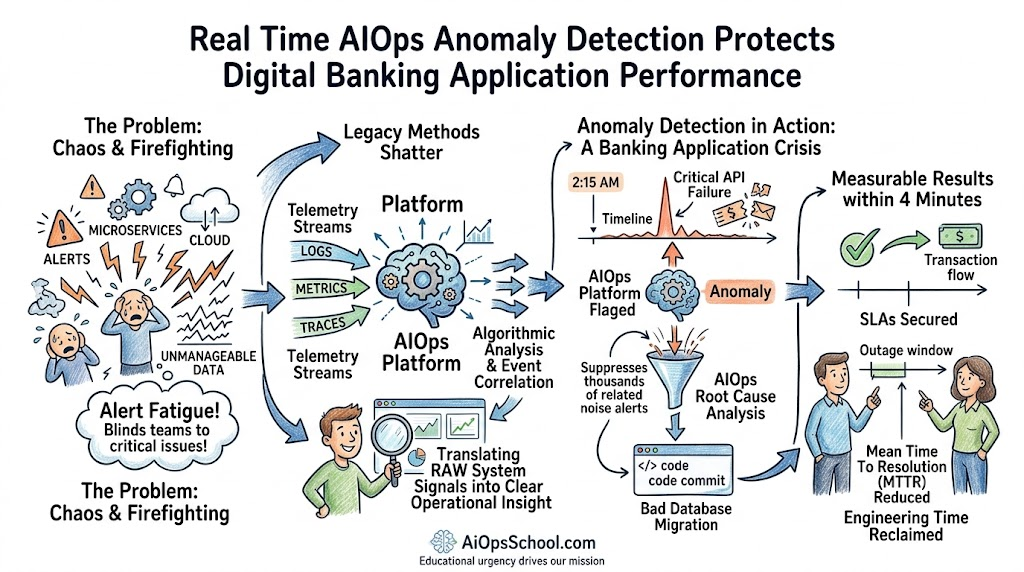
The midnight alert goes off. It is the third time this week, and once again, the on-call engineering team is met with a wall of red dashboards. Thousands of downstream alerts are pouring into the central Slack channel, masking the single database connection failure that started it all. This phenomenon, widely known as alert fatigue, is the breaking point for modern IT teams. As systems move from monolithic architectures to thousands of ephemeral microservices running across multi-cloud environments, traditional monitoring cannot keep pace. The volume, velocity, and variety of operational telemetry are simply too massive for human operators to analyze in real time.
This operational crisis is why teams are shifting from reactive fire-fighting to intelligent, algorithmic automation. To survive and thrive in this new landscape, professionals are seeking comprehensive AIOps Training to understand how artificial intelligence can transform how we manage complex infrastructure. By leveraging machine learning, natural language processing, and advanced analytics, organizations can filter out the operational noise, pinpoint the exact underlying issues, and automate resolutions before users even notice a slowdown. If you want to master these modern methodologies and future-proof your career, AiOpsSchool provides the structured learning path designed for today’s engineering challenges.
Understanding the Shift: What Is AIOps?
To navig ate this paradigm shift, we must first establish a clear definition: What is AIOps? Short for Artificial Intelligence for IT Operations, AIOps is the application of machine learning, data science, and advanced analytics to IT operational data. Instead of relying on rigid, human-authored threshold rules (such as “alert if CPU utilization exceeds 85%”), AIOps platforms ingest vast volumes of historical and real-time operational data to automatically learn how a system behaves under normal and stressed conditions.
In practice, an AIOps platform acts as an intelligent overlay above an enterprise’s entire technology stack. It aggregates data from multiple siloed monitoring systems, cloud providers, and network logs. By analyzing these data streams concurrently, the AI can recognize patterns, identify statistical anomalies, and group related events together. It transforms a chaotic stream of disconnected alerts into a coherent narrative, allowing operations engineers to focus on resolving the actual root cause rather than digging through logs.
Key Operational Concepts You Must Know
Before implementing artificial intelligence in production, a modern operations professional must master several foundational building blocks. Implementing AIOps in IT operations is not about installing a magic piece of software; it requires a deep structural understanding of infrastructure data and operational telemetry.
Observability and Telemetry
Traditional monitoring tells you when a system is failing; observability allows you to understand why it is failing by examining its external outputs. These outputs are composed of three primary telemetry types, often referred to as the pillars of observability:
- Metrics: Numeric values measured over intervals of time (such as CPU utilization, memory consumption, or request rates) that provide a high-level view of system health.
- Logs: Timestamped text records emitted by applications, operating systems, and network devices that provide a granular, historical account of specific events.
- Traces: End-to-end journeys of a single request through a distributed system, mapping exactly which microservices were called and how long each step took.
Event Correlation
In a standard enterprise environment, a single microservice outage can trigger downstream errors across hundreds of dependent applications. Event correlation is the process of using mathematical algorithms and topological mapping to identify which alerts are related. Instead of treating 500 alerts as individual issues, an AIOps platform clusters them into a single incident, significantly reducing the cognitive load on the incident response team.
Baselines vs. Anomalies
Static thresholds are notoriously fragile. A database query volume that is perfectly normal at 2:00 PM on a Cyber Monday could indicate a massive malicious bot attack if seen at 2:00 AM on a Tuesday. AIOps establishes dynamic baselines by continuously analyzing historical trends, seasonal patterns, and business cycles. An anomaly is detected when current system behavior deviates significantly from this mathematically computed historical baseline, allowing for highly accurate, contextual alert generation.
Automation and Remediation
The ultimate goal of modern operations is self-healing infrastructure. Once an AIOps platform detects an anomaly and correlates the events to identify the source of the failure, it can trigger automated remediation scripts. This might involve restarting a dead service container, scaling out a Kubernetes deployment to handle an unpredicted traffic spike, or rolling back a buggy code deployment via a CI/CD pipeline, entirely eliminating human intervention for common operational failures.
Demystifying AIOps for Beginners
If you are new to the field of intelligent infrastructure management, the sheer volume of acronyms and data science terms can feel overwhelming. However, embarking on a journey into AIOps for beginners is one of the most strategic career choices an IT professional can make today. Here are three reasons why now is the perfect time to build your skills in this domain:
- The Inevitability of Data Growth: Corporate infrastructure is scaling exponentially. Human teams cannot scale at the same rate as cloud-native microservices, making algorithmic operations an absolute necessity rather than an optional luxury for modern enterprises.
- The Premium on High Availability: In a global digital economy, even five minutes of downtime can translate to millions of dollars in lost revenue and severe reputational damage. Companies are aggressively hiring engineers who know how to maximize uptime using predictive AI utilities.
- The Shift from Commodity Work to High-Value Strategy: Automating routine tasks like log parsing and ticket routing frees engineers from mundane manual labor. Learning AIOps allows you to transition into an architectural role where you design intelligent systems rather than just fixing broken ones.
Navigating the Paradigm Shift: AIOps vs DevOps vs MLOps
As technology ecosystems evolve, various methodologies emerge to solve different operational inefficiencies. Understanding where AIOps fits relative to DevOps and MLOps is critical for defining operational boundaries and career specializations.
- DevOps focuses primarily on the cultural and technical alignment between software developers and IT operations. It introduces continuous integration, continuous delivery (CI/CD), and infrastructure as code (IaC) to accelerate software release velocity while maintaining system stability.
- AIOps enhances existing operational workflows (including DevOps) by applying machine learning specifically to the massive volumes of data generated by live IT environments, automating monitoring, triage, and root cause analysis.
- MLOps is dedicated to operationalizing machine learning workflows themselves. It ensures that data science teams can build, test, deploy, monitor, and retrain machine learning models in production safely, treating models with the same rigorous engineering lifecycle applied to traditional software.
| Concept | Primary Focus | Core Question It Answers |
| DevOps | Software delivery lifecycle, agility, and cross-team collaboration. | “How can we safely build, test, and deploy software faster?” |
| AIOps | Algorithmic IT operations, automated triage, and observability analytics. | “How can we use artificial intelligence to maintain system health and automate incident response?” |
| MLOps | Machine learning model lifecycle management, monitoring, and scaling. | “How can we deploy, track, and continuously retrain our data science models in production?” |
Platform Implementation vs. Culture — What’s the Real Difference?
A frequent point of failure for organizations pursuing digital transformation is treating AIOps Training as merely an instruction manual for installing a piece of commercial software. True success with AIOps in IT operations requires understanding the deep divide between platform implementation and cultural adoption.
Purchasing and configuring an AIOps platform is a straightforward technical exercise. Engineers can ingest metrics, connect APIs, and set up streaming pipelines into a dashboard. However, if the operational culture does not adapt, the platform becomes an expensive, ignored shelfware product. Cultivating an intelligent operational culture requires a fundamental shift in how teams collaborate, manage change, and establish systemic trust.
| Operational Dimension | Platform Implementation (The Tooling) | Cultural Transformation (The Mindset) |
| Core Objective | Connecting data sources, configuring ingestion pipelines, and deploying software. | Redesigning human workflows, building technical trust, and shifting team habits. |
| Primary Challenge | API integrations, data schema mapping, and scaling database clusters. | Overcoming organizational resistance, breaking down team silos, and embracing automation. |
| Handling Alerts | Filtering duplicate events and grouping alerts based on time topology. | Training engineers to trust algorithmic groupings and stop manual cross-checking. |
| Incident Response | Automatically generating an incident ticket inside an ITSM tool. | Empowering multi-disciplinary engineering teams to collaborate on shared automated fixes. |
| Remediation Strategy | Mapping an alert payload to a specific webhook or script runner. | Transitioning ownership from manual gatekeepers to autonomous, code-driven self-healing systems. |
Building trust is the single greatest cultural hurdle. When an AIOps platform recommends an automated remediation action—such as terminating a virtual machine or altering a routing table—traditional operations teams often hesitate out of fear. Overcoming this requires incremental milestones: starting with read-only recommendations, moving to a “human-in-the-loop” approval model, and finally granting full autonomy to the platform once its mathematical precision has been proven over time.
Core AIOps Use Cases
Modern enterprises deploy intelligent operations engines across multiple vectors to maximize infrastructure resilience. When examining practical AIOps use cases, we see artificial intelligence transforming raw telemetry into deterministic, actionable operational intelligence.
- Intelligent Anomaly Detection: By tracking baseline variations across multi-cloud environments, AIOps can detect subtle drifts in performance—such as a slow memory leak or a creeping increase in API response latency—well before traditional static threshold alerts would trigger.
- Advanced Event Correlation: AIOps analyzes incoming data volumes from thousands of infrastructure elements, automatically deduplicating repetitive alerts and compressing massive storms of events into singular, prioritized operational incidents.
- Automated AIOps Root Cause Analysis: When a complex distributed system experiences an outage, the platform interrogates system topology maps, telemetry traces, and recent code deployments to immediately surface the exact line of configuration or underlying hardware asset responsible for the failure.
- Predictive Capacity Planning: Instead of reacting when a storage volume or compute cluster fills up, AIOps reviews long-term usage trends alongside corporate calendars and historical growth vectors to accurately predict the precise date when resources will be depleted, allowing proactive scaling.
- Automated Remediation and Self-Healing: The platform hooks directly into orchestration systems to trigger automated infrastructure fixes, completely resolving known, repetitive software faults without requiring human engineering intervention during the night.
- Optimizing AIOps in IT operations: By streamlining ticketing workflows, categorizing incoming support requests, and routing complex problems directly to the correct engineering squads, AIOps eliminates organizational friction and speeds up service delivery.
Real-World Use Cases of Modern Operations
To fully appreciate these concepts, let us look at how distinct industries leverage modern operations strategies to solve critical real-world bottlenecks.
In the highly competitive e-commerce sector, a major retail platform implemented modern AIOps use cases to combat localized latency spikes during flash sales. The system automatically correlated a micro-burst in user traffic with a localized database lock, automatically spinning up read-replicas in the affected cloud zone within ninety seconds to keep checkout pages loading instantly.
Within global banking operations, maintaining a pristine ledger environment requires continuous, automated security analytics. A leading financial institution uses AIOps in IT operations to constantly monitor infrastructure logs, catching a sophisticated distributed denial-of-service attempt by detecting highly subtle, anomalous outbound synchronization patterns across thousands of disparate virtual servers before any internal service could be disrupted.
For a enterprise SaaS provider delivering mission-critical communication software, resource exhaustion could lead to massive customer churn. By utilizing predictive capacity forecasting, their system identifies hidden trends in tenant data growth, automatically provisioning additional computing clusters three days in advance of predicted multi-tenant spikes to preserve their strict service level agreements.
Technical Landscape: AIOps Tools You Should Know
To build an impactful career, you must become familiar with the technical ecosystem powering modern intelligent operations. Exploring an AIOps Tools framework reveals an extensive AIOps tools list categorized by its specific architectural function. Engaging with a comprehensive AIOps Tutorial is the natural next step to master the practical usage and integration of these distinct platforms.
Monitoring and Observability Platforms
These platforms serve as the data collection foundations, capturing deep system telemetry across applications and cloud infrastructure:
- Datadog: Features Watchdog, an integrated AI engine that automatically runs anomaly detection, root cause analysis, and log outlier detection across all cloud metrics.
- Dynatrace: Powered by Davis, an object-oriented, deterministic AI engine that provides precise, topology-aware answers rather than mere statistical guesses.
- New Relic: Includes applied intelligence features that automatically isolate anomalies, reduce alert noise by up to 80%, and accelerate incident response.
Event Correlation and ITSM Tools
These systems ingest alerts from various monitoring utilities to group, route, and manage operational incidents:
- BigPanda: A dedicated event correlation engine that uses open integration and machine learning to clean up noisy alerts and map them to historical incidents.
- PagerDuty: Utilizes machine learning-driven event intelligence to group related alerts, provide rich context to on-call teams, and suggest runbook automations.
- ServiceNow ITOM: Combines robust service mapping with predictive analytics to proactively identify service outages and automate tracking workflows.
Open-Source and Cloud-Native Stacks
For organizations building customized, internal intelligent operations capabilities:
- The Elastic Stack (ELK with Machine Learning): Offers native machine learning features for unsupervised anomaly detection and log classification directly within Elasticsearch cluster data.
- Prometheus & Cortex with Custom ML Pipelines: Utilizing open-source cloud metrics databases coupled with Python-based data science libraries to run tailored predictive infrastructure models.
- AWS DevOps Guru / Azure Monitor Center: Built-in cloud provider AI utilities that analyze resource telemetry, highlight operational anomalies, and recommend precise remediation steps.
Common Mistakes in Operations Engineering
Transitioning to automated operations is a journey filled with architectural landmines. Teams frequently stumble when adopting AIOps in IT operations, often amplifying their problems rather than solving them due to poor implementation strategies.
Over-Alerting and Ignoring Noise Reduction
Many engineering teams simply feed their existing, broken alerts directly into a machine learning platform without refining them. This results in the AI engine summarizing and forwarding the same bad data, creating advanced “algorithmic noise” that engineers continue to ignore. The Fix: Clean up your baseline monitoring thresholds and focus your AI engine on grouping high-level business impacts rather than low-level system spikes.
Treating AIOps as “Set and Forget”
Organizations often assume that an AI model will magically understand their customized business logic out of the box without continuous refinement. Without ongoing feedback loops, the platform’s models drift, leading to false positives or missed incidents. The Fix: Schedule regular operational reviews to audit your model outputs and explicitly teach the system which incident groupings were helpful and which were incorrect.
Skipping Data Quality and Normalization
An AI engine is only as good as the underlying telemetry it ingests. Feeding unparsed, non-standardized application logs with inconsistent timestamps into an ML pipeline results in broken correlation maps and inaccurate insights. The Fix: Enforce standardized structured logging formats (such as JSON) and unified tagging policies across every software engineering team.
Automating Remediation Too Early Without Trust
Flushing automated remediation scripts into production without testing the precision of your AIOps root cause analysis can cause catastrophic cascade failures, such as an AI script repeatedly restarting an entire cluster during a database migration. The Fix: Run all new automated actions in a “dry-run” advisory mode for at least 30 days before letting the platform execute code autonomously.
Lack of Cross-Team Buy-In
If your platform engineers build an intelligent operations platform but fail to educate the site reliability engineers and application developers on how to use it, teams will bypass the tool entirely and return to manual troubleshooting. The Fix: Involve multi-disciplinary engineering leads early in the vendor selection and design phase, treating the platform as an internal product built to serve them.
Maximizing Infrastructure Reliability: AIOps for SRE
Site Reliability Engineering (SRE) is a discipline that applies software engineering principles directly to infrastructure and operations challenges. Implementing AIOps for SRE provides these specialized engineering squads with the mathematical scale required to protect complex service agreements.
Traditional SRE teams spend too much manual engineering effort monitoring basic operational indicators. By infusing AI into the operational stack, SREs can automate data crunching and optimize their three most critical performance metrics:
- Mean Time to Detection (MTTD): Instead of waiting for a human operator to notice a drop in application traffic, unsupervised machine learning algorithms detect microscopic anomalies in system behavior instantly, reducing detection times from hours to seconds.
- Mean Time to Resolution (MTTR): By executing deep context correlation, the AI isolates the precise asset fault. Engineers do not waste time reading unrelated logs, allowing them to instantly apply the correct fix and plummeting the overall duration of system downtime.
- Service Level Objectives (SLOs): SREs define strict error budgets based on user-facing metrics. AIOps platforms actively monitor the burn rate of these error budgets, warning teams days in advance if a subtle architectural trend threatens to violate an SLO, protecting the enterprise from compliance penalties.
Seeing AIOps in Action
To truly grasp how these intelligent workflows manifest inside a production environment, let us follow a step-by-step technical incident sequence detailing a major microservices outage.
The Problem
At 2:15 AM, a major retail platform experiences an abrupt failure in its checkout microservice. Under traditional monitoring, this would trigger individual high-severity pages for the networking team, the database administrators, the backend API developers, and the cloud infrastructure team, resulting in fifteen engineers waking up to join a chaotic bridge call with no clear direction.
The Step-by-Step AIOps Resolution
- Ingestion & Deduplication: The centralized operations engine ingests 4,500 individual error alerts generated across 120 distributed container hosts within a 60-second window, instantly filtering and deduplicating the data.
- Topology Mapping & Correlation: The system looks up the real-time application dependency graph. It notices that while the frontend, authentication, and inventory services are all emitting alerts, they all depend on a core user-profile database. The system groups all 4,500 alerts into a single active incident ticket.
- Algorithmic Root Cause Isolation: Utilizing automated AIOps root cause analysis, the platform correlates system logs with recent operational changes. It highlights a bad database schema update deployed by a CI/CD pipeline exactly two minutes prior to the incident, pinpointing this deployment as the definitive cause of the failure.
- Autonomous Incident Remediation: The platform executes a pre-approved digital runbook workflow. It securely logs into the continuous delivery framework, initiates a safe automated code rollback to the previous stable state, and flushes the database query cache.
The Measurable Result
The entire outage is completely resolved by 2:19 AM. The application performance indicators return to baseline, and the error budget is preserved. By utilizing AIOps in IT operations to handle incident management, the Mean Time to Resolution dropped from a historical average of 95 minutes down to just 4 minutes. No human engineers were woken up, saving thousands of dollars in operational overhead and preventing customer disruption.
How to Become an Operations Expert — Career Roadmap
The transition from a traditional systems administrator or a standard monitoring analyst into an advanced intelligent operations engineer requires an intentional, structured approach to skill acquisition. Follow this proven roadmap to rapidly elevate your technical market value:
- Build Your Foundational IT and Monitoring Experience: Master the core elements of Linux administration, basic networking, containerization with Docker, and traditional static infrastructure monitoring utilities like Nagios or basic CloudWatch dashboards.
- Master Core Algorithmic and Observability Concepts: Move beyond basic metrics. Deeply learn the mechanics of high-cardinality log aggregation, distributed tracing methodologies, topology mapping, and how unsupervised machine learning processes streaming data.
- Engage in Hands-On Platform Tool Practice: Build lab environments to practice configuring enterprise-grade observability suites (such as Datadog, Dynatrace, or an advanced ELK stack). Learn how to set up automated alert pipelines and design webhooks for self-healing infrastructure.
- Validate Your Expertise via Structured Certification: Standardize your knowledge base and stand out to technical recruiters by earning an industry-recognized validation. Achieving an official certification ensures you possess a fully vetted grasp of modern automated architectures.
- Pursue Advanced Specialization: Use your modern skillset to step into highly lucrative, strategic engineering positions, including Senior Site Reliability Engineer, Enterprise Platform Architect, Cloud Infrastructure Director, or DevOps Optimization Specialist.
To fast-track this journey and gain access to comprehensive lab environments led by industry veterans, investing in targeted training is key. Utilizing an enterprise-grade AIOps Training program, enrolling in a dedicated AIOps Course, and securing an official AIOps Certification will provide the definitive edge required to lead enterprise-level digital transformations.
Frequently Asked Questions
What technical background do I need before I begin studying AIOps?
You do not need an advanced degree in data science or machine learning to learn AIOps. A foundational understanding of basic IT concepts, cloud infrastructure, container environments, and traditional monitoring systems is sufficient. The primary goal is learning how to apply AI insights to operations, not writing the underlying machine learning algorithms from scratch.
How does an official certification benefit my career trajectory?
Earning an AIOps Certification provides immediate validation of your advanced cloud-native skills to global employers. It proves that you understand how to navigate complex, high-velocity infrastructure data, manage alert noise, and implement intelligent automated architectures, helping you stand out for senior engineering and architectural positions.
What is the specific value of the AIOps Foundation Certification?
The AIOps Foundation Certification provides an essential, standardized baseline of knowledge. It certifies that an engineer thoroughly understands core observability telemetry, event correlation methodologies, dynamic baselining algorithms, and the critical cultural changes necessary to successfully deploy AI systems across enterprise teams.
Can I transition from a traditional DevOps role into this field?
Yes, this is an excellent and natural career progression. DevOps professionals already understand continuous integration and infrastructure as code. Adding algorithmic operations skills allows you to optimize those automated pipelines, introducing deep real-time intelligence and automated remediation capabilities to the delivery lifecycle.
What should I look for in a comprehensive learning program?
When selecting a professional AIOps Course, prioritize programs that offer deep theoretical clarity combined with extensive, hands-on labs. The curriculum must cover multi-cloud telemetry ingestion, real-world incident correlation scenarios, predictive analytics setups, and practical architectural integrations with leading industry tools.
Is learning AIOps relevant for application developers?
Absolutely. Modern software applications are highly distributed and run on complex cloud layers. Developers who understand how intelligent platforms analyze application traces and detect performance anomalies can write cleaner, highly observable code and debug system errors much faster.
How does AIOps help reduce operational burnout?
By utilizing advanced algorithms to filter out hundreds of duplicate notification alerts, it eliminates the exhausting problem of alert fatigue. On-call engineers are only notified when a genuine, correlated business-critical issue occurs, significantly reducing stress, midnight pages, and team burnout.
Why Get an AIOps Certification?
In an increasingly crowded technology landscape, professionals must continuously differentiate themselves. Pursuing a formal AIOps Certification is one of the most effective ways to establish technical authority and accelerate your career progression.
- Unmatched Resume Credibility: As companies scramble to integrate artificial intelligence across their business units, having a certified specialization in intelligent operations instantly signals to recruiters that you possess rare, future-proof infrastructure skills.
- Structured, Comprehensive Learning: Attempting to piece together operational knowledge from random online articles can lead to massive gaps in your architectural understanding. A formal AIOps Foundation Certification pathway forces you to master every dimension of the field in a logical, rigorous sequence.
- Substantial Salary and Role Leverage: Engineers who know how to automate incident triage, protect error budgets, and eliminate costly downtime command a massive premium in the job market, granting you significant negotiation leverage for elite SRE, DevOps management, and enterprise platform engineering roles.
Where to Learn AIOps
Navigating this transition requires access to world-class educational resources built specifically for the needs of modern operational teams. AiOpsSchool provides the definitive training environment designed to take you from a foundational beginner to an advanced automation architect. Their comprehensive educational ecosystems are built around four primary learning modes:
- AIOps Training: Deep-dive, immersive training tracks designed to re-engineer your technical mindset, focusing heavily on how to align enterprise operations culture with advanced machine learning platforms.
- AIOps Course: Highly organized, modular learning paths packed with real-world case studies, architecture breakdowns, and step-by-step implementation strategies covering the entire modern observability landscape.
- AIOps Certification: Rigorous, market-aligned verification programs that test your real-world problem-solving abilities, providing you with a prestigious credential trusted by leading enterprise employers worldwide.
- AIOps Tutorial: Practical, hands-on, step-by-step guides and laboratory exercises designed to give you immediate experience configuring, tuning, and deploying leading intelligent monitoring tools in live cloud environments.
Final Thoughts
The era of manually parsing text logs, hunting through fragmented monitoring dashboards, and reacting blindly to midnight alert storms is drawing to a permanent close. As technical ecosystems scale past human comprehension, the future belongs entirely to engineers who know how to pair operational expertise with the analytical power of machine learning algorithms. By committing to comprehensive AIOps Training and validating your technical mastery with an elite industry AIOps Certification, you position yourself at the absolute forefront of this infrastructure revolution. The tools are ready, the industry demand is unprecedented, and the roadmap is clear. Take the definitive next step in your professional engineering journey today by visiting AiOpsSchool.com to explore their advanced courses and unlock the future of intelligent IT operations.
