Introduction
Most modern vacation circuits push you into frantic queues, commercial theme parks, and polished city centers that look identical anywhere across the globe. Hyderabad breaks away from that sterile routine with weathered granite hills, soulful Qawwalis echoing through centuries-old stone courts, and sacred temple sanctums humming with Vedic chants.
The city’s spiritual landscape represents centuries of coexisting traditions that have shaped the Deccan plateau. Traveling here offers an intimate connection to sacred traditions carved directly into living rock, untouched by commercial tourism.
Why Hyderabad is a must-visit city
Hyderabad anchors the cultural crossroads where Northern Indo-Islamic sensibilities met ancient Southern Dravidian dynasties. Its terrain of prehistoric granite boulders hosts Kakatiya temple corridors, medieval Bahmani domes, and soaring Qutb Shahi minarets standing side by side.
For travelers, the twin cities of Hyderabad and Secunderabad provide seamless rail junctions, direct international air connectivity via Rajiv Gandhi International Airport, and an expanding metro system that links modern tech corridors directly to four-hundred-year-old pilgrimage routes.
The city’s sacred circuit stretches from the bustling core of the walled Old City across serene hilltop shrines out toward quiet freshwater lakes.
| Travel Dimension | Key Detail |
|---|---|
| Primary Spiritual Circuits | Charminar Islamic Heritage, Central Hilltop Temples, Western Lake Shrines |
| Dominant Architecture | Indo-Islamic, Qutb Shahi Granite, Dravidian, and Rajasthani Carved Marble |
| Transit Accessibility | Hyderabad Metro Red/Green/Blue Lines, TSRTC Bus Network, MMTS Local Rail |
| Peak Pilgrimage Season | October to March (cooler ambient temperatures for hill climbs and walking) |
| Cultural Heritage Status | 400+ years of composite Ganga-Jamuni Tehzeeb interfaith traditions |
Best Places or Experiences
Birla Mandir
Rising 280 feet above the central skyline on the rocky knoll of Naubat Pahad, Birla Mandir is sculpted entirely from nearly 2,000 tons of pristine Rajasthani white marble. Inaugurated in 1976 by Swami Ranganathananda of the Ramakrishna Mission, the temple integrates Utkala style sanctum towers with Dravidian gopurams.
The primary sanctum enshrines an 11-foot-tall granite idol of Lord Venkateswara sheltered beneath a carved marble lotus canopy. The complex deliberately omits traditional temple bells, creating a quiet space where breeze from nearby Hussain Sagar lake accompanies meditation.
- Location: Khairatabad / Adarsh Nagar, approximately 4 km from Nampally Railway Station.
- Why it is worth visiting: Unites Orissan and South Indian temple architecture with open, panoramic views of the entire urban valley. Vedavarsity Library
- Best things to do: Study the detailed Mahabharata friezes on the inner marble arches, sit on the rear terrace during dusk, and view the adjacent Buddha shrine.
- Best time to visit: 7:00 AM to 8:30 AM for quiet morning light, or 6:00 PM for the lit marble facade.
- Ideal for whom: Architecture enthusiasts, meditation practitioners, and solo spiritual travelers.
- Travel tip: Mobile phones, cameras, leather bags, and smartwatches are strictly banned inside and must be surrendered at the free cloackroom at the base.
Historic facade of Mecca Masjid.
Mecca Masjid (Makkah Masjid)
Commissioned in 1614 by Sultan Muhammad Quli Qutb Shah and completed by Mughal Emperor Aurangzeb in 1694, Mecca Masjid ranks among the oldest and largest mosques in India. Its central arch bricks were baked from soil brought directly from Mecca, which gave the mosque its name.
The vast courtyard, framed by massive single-block granite columns that required 1,400 oxen to haul from the quarries, can accommodate up to 10,000 worshippers at once. Floral motifs, Belgian chandeliers, and the marble tombs of the Asaf Jahi Nizams give this sanctuary its quiet, monumental grace.
- Location: Old City, adjacent to the Charminar, 5 km south of Hyderabad Deccan Station. Wikipedia
- Why it is worth visiting: A masterwork of Qutb Shahi stone architecture built over an uninterrupted span of 77 years. Holidify
- Best things to do: Rest by the historical stone pond, observe the hand-chiseled Quranic calligraphy on the central arches, and pay respects at the Nizam royal crypt.
- Best time to visit: 8:30 AM to 11:30 AM on weekdays to avoid mid-day sun and heavy prayer assemblies.
- Ideal for whom: Cultural historians, heritage seekers, and interfaith travelers.
- Travel tip: Modest dress covering shoulders and knees is mandatory; women must carry a headscarf, and photography inside the active prayer hall is prohibited.
Entrance to Chilkur Balaji Temple.
Chilkur Balaji Temple
Sitting serenely along the banks of Osman Sagar lake, Chilkur Balaji Temple is affectionately known across South India as the “Visa Balaji Temple.” Legend holds that students and professionals praying for overseas travel receive divine blessings here, returning to complete 108 pradakshinas (circumambulations) in gratitude.
Dating back to the late Telangana Bhakti period, the temple stands apart by rejecting VIP queues, special darshan fees, and monetary donation boxes (hundi). Every devotee, regardless of social status or wealth, stands in the same line, maintaining ancient Vedic egalitarian traditions.
- Location: Chilkur village, approximately 25 km west of Mehdipatnam.
- Why it is worth visiting: An uncommercialized temple where equal treatment for all devotees is strictly enforced.
- Best things to do: Complete the initial 11 prayer pradakshinas around the inner sanctum, walk through the coconut groves, and sample hot tamarind rice prasadam outside.
- Best time to visit: Tuesday to Thursday mornings between 6:00 AM and 8:30 AM to bypass massive weekend crowds.
- Ideal for whom: Traditional pilgrims, students, cultural purists, and families.
- Travel tip: Wear slip-on shoes; barefoot circumambulation over stone flags can be challenging under direct midday heat.
Jagannath Temple, Banjara Hills
Constructed in 2009 by the local Odia community, this temple on Road No. 12, Banjara Hills, replicates the sacred 12th-century Jagannath Temple of Puri. Carved from warm red sandstone imported directly from Rajasthan, the 70-foot-high tower displays intricate mythological relief work.
The inner shrine houses vibrant neem-wood murtis of Lord Jagannath, Balabhadra, and Subhadra. The quiet stone courtyards offer an unexpected oasis from the commercial traffic of surrounding luxury retail hubs.
- Location: Banjara Hills, Central-West Hyderabad, 8 km from Lakdikapool.
- Why it is worth visiting: An authentic example of Kalinga temple architecture tucked right in the heart of modern Hyderabad.
- Best things to do: Admire the detailed erotic and devotional carvings around the exterior plinth, attend the dusk aarti, and visit the sub-shrines of the Navagrahas.
- Best time to visit: 5:30 PM to 7:00 PM when the sandstone glow warms under soft evening spotlights.
- Ideal for whom: Art lovers, spiritual seekers looking for calm, and photographers.
- Travel tip: Visit during the annual Rath Yatra festival in June/July to experience sacred chariot processions outside Odisha.
Moula Ali Dargah on the hillock.
Moula Ali Dargah
Perched on top of an imposing 2,000-foot-tall dome of weathered granite, Moula Ali Dargah is one of the Deccan’s most sacred Sufi shrines. Built during the Asaf Jahi era by Yakut, an eunuch courtier of Sultan Ibrahim Qutb Shah, the shrine houses what devotees revere as the hand imprint of Ali, the son-in-law of Prophet Muhammad.
Reaching the summit requires climbing roughly 480 broad stone steps that curve past boulder fields and medieval bastions. The peak offers sweeping, unobstructed views of the Secunderabad landscape under sweeping Deccan skies.
- Location: Moula Ali suburb, Secunderabad, 12 km northeast of Secunderabad Junction.
- Why it is worth visiting: A hilltop Sufi sanctuary offering an authentic look into the Deccan’s composite religious life.
- Best things to do: Climb the whitewashed stone steps at sunrise, sit in the quiet upper prayer corridor, and view the sacred hand relic casing.
- Best time to visit: Early morning between 5:30 AM and 7:00 AM, or during late Thursday evening for local prayer recitations.
- Ideal for whom: Solitary travelers, Sufi heritage enthusiasts, and sunrise hikers.
- Travel tip: The rock face gets slick during monsoon downpours; wear rubber-soled footwear with reliable grip.
Sri Ujjaini Mahakali Temple, Secunderabad
Located in the center of Secunderabad’s bustling commercial bazaars, this two-century-old shrine anchors the soul of the regional Bonalu festival. Established in 1813 by Suriti Appayya, a native military officer who prayed to Goddess Mahakali during a cholera outbreak, the temple features vibrant Dravidian polychrome gopurams.
Inside, the stone idol of Mahakali is adorned with gold ornaments and fresh neem leaves. The shrine draws daily streams of devotees offering turmeric water, vermilion, and earthen pots wrapped in sacred foliage.
- Location: General Bazaar, Secunderabad, 1.5 km from Secunderabad Railway Station.
- Why it is worth visiting: The cultural center of Telangana’s folk-goddess worship and rural Shakti traditions.
- Best things to do: Observe the evening Harathi ceremony, walk through the old potters’ lanes of General Bazaar, and listen to traditional nadaswaram instrumental performances.
- Best time to visit: Friday morning for deep devotional energy, or during July/August during Ashada Masam for the Bonalu festival.
- Ideal for whom: Folklore researchers, cultural photographers, and devotees of the Divine Mother.
- Travel tip: Narrow bazaar alleyways prevent car access; take an auto-rickshaw or walk from Secunderabad Metro Station.
Offbeat Exploration: Hidden Gems Tourists Miss
Akkanna Madanna Mahankali Caves, Shalibanda
Chiseled into living granite beneath the old royal quarters of the Qutb Shahi ministers Akkanna and Madanna, these 17th-century rock-cut shrines remain largely unseen by mainstream travelers. The cool subterranean sanctums provide a stark acoustic and sensory escape from the city heat.
Dargah Hazrat Yousufain, Nampally
Tucked inside Nampally’s old quarters, this Sufi resting place honors two saintly soldiers from Aurangzeb’s army. On Thursday evenings, qawwals gather under amber lanterns to sing devotional poetry, sharing sweet bread (roti) and cardamom chai with all visitors.
Karmanghat Hanuman Temple
Built in the 11th century during the Kakatiya dynasty, this temple sits quietly in the southeastern suburbs. Legend says when Mughal troops attempted to raze it, an ethereal voice challenged them with the words “Karo Man Ghaat” (“Make your heart strong”), preserving the ancient granite lingam and Hanuman idol intact.
Detailed Practical Guidance for Travelers
| Destination | Standard Entry Fee | General Timings | Best Local Food Options Nearby | Recommended Nearby Attractions |
|---|---|---|---|---|
| Birla Mandir | Free | 7:00 AM – 12:00 PM, 3:00 PM – 9:00 PM | Pulla Reddy Sweets (Pure Ghee treats), Cafe Bahar (Chai) | BM Birla Science Centre, Hussain Sagar Lake |
| Mecca Masjid | Free | 4:00 AM – 9:30 PM (Closed non-worshippers during Namaz) | Nimrah Cafe & Bakery (Irani Chai & Osmania Biscuits), Shadab | Charminar, Chowmahalla Palace, Laad Bazaar |
| Chilkur Balaji | Free (No VIP passes) | 5:00 AM – 8:00 PM | Local roadside dhabas (Millets dosa, Tamarind Rice) | Osman Sagar Lake, Mrugavani National Park |
| Jagannath Temple | Free | 6:00 AM – 12:00 PM, 5:00 PM – 9:00 PM | Chutneys Banjara Hills (Steamed Dosa), Minerva Coffee Shop | KBR National Park, Lotus Pond |
| Moula Ali Dargah | Free | Open 24 Hours (Best visited daytime) | Subhan Bakery (Roht and Osmania biscuits), Nayaab | Moula Ali Hill Viewpoint, Mah Laqa Bai Tomb |
| Ujjaini Mahakali | Free | 6:00 AM – 12:30 PM, 5:00 PM – 9:00 PM | Anand Bhavan (South Indian Thali), Secunderabad Tiffin Centers | Clock Tower Secunderabad, St. Mary’s Basilica |
Logistics & On-Ground Navigation
Local Transport Options
- Hyderabad Metro: Clean and efficient. The Red Line (Miyapur to LB Nagar) and Green Line (JBS to MGBS) cross near central spiritual landmarks including Birla Mandir (Assembly Station) and Nampally.
- Auto-Rickshaws: Plentiful across all neighborhoods. Insist on prepaid taxi/auto booths at stations, or book via Ola and Uber to bypass street price negotiations.
- TSRTC City Buses: Cheap and frequent (routes like 5K and 8M connect Secunderabad and the Old City), but very crowded during rush hours.
- Self-Drive / Car Rentals: Best for outlying destinations like Chilkur Balaji or Moula Ali where finding return cabs can be slow.
Budget Planning
- Budget / Solo Backpacker Tier (₹1,000 – ₹1,800 / day): Clean dormitory or dharamshala stay in Nampally/Kachiguda (₹600), public transport via Metro Day Pass and TSRTC buses (₹200), and meals at historic tiffin centers and Irani cafes (₹400).
- Mid-Range / Comfort Tier (₹3,500 – ₹6,000 / day): Three-star heritage or boutique hotel in Banjara Hills or Begumpet (₹2,500 – ₹4,000), private app-based air-conditioned cabs (₹1,000), and dining at established Andhra mess halls and heritage restaurants (₹1,000).
Safety and Inclusivity Tips
- For Families: Shrines involve extensive stone steps and walking; pack lightweight umbrella strollers and keep hydration bottles handy, especially for elder family members.
- For Couples: Sacred precincts expect conservative behavior; avoid public displays of affection within temple perimeters and mosque courtyards.
- General Safety: Keep belongings zipped in cross-body bags when navigating the packed alleys of Charminar, General Bazaar, and active aarti crowds.
Strategic Travel Planning Guardrails
Travel Planning Tips for Hyderabad
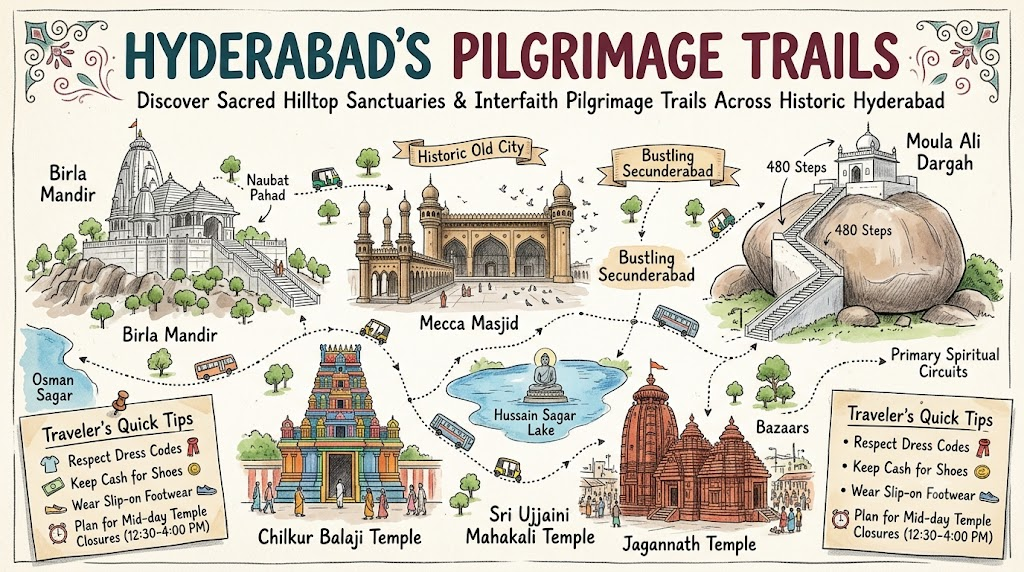
- Plan for Temple Closures: Nearly every major Hindu temple closes its doors between 12:30 PM and 4:00 PM for daily deity resting rituals.
- Keep Cash for Shoes: While UPI digital payments are accepted nearly everywhere, small shoe-storage stands at temple entrances require small ₹10–₹20 cash coins or notes.
- Wear Easy Footwear: Wear slip-on sandals or loafers rather than lace-up boots, as you will be taking them off at every shrine boundary.
- Check Prayer Calendars: Plan Old City visits around Friday afternoon Jumu’ah prayers to manage heavy pedestrian traffic around Mecca Masjid.
- Hydrate for Rock Hikes: Granite hills retain residual daytime heat, so carry electrolytes when climbing Moula Ali or Naubat Pahad.
Common Mistakes to Avoid
- Cramming East and West in One Day: Grouping Chilkur Balaji (far west) with Moula Ali (northeast) on the same afternoon wastes hours in Outer Ring Road traffic.
- Violating Sacred Dress Codes: Showing up in shorts, sleeveless tops, or short skirts will result in denied entry at Mecca Masjid and traditional shrines.
- Ignoring Electronic Bans: Carrying laptops or bulky DSLR cameras to Birla Mandir will force you to wait in long cloakroom lines.
- Rushing Heritage Corridors: Treating these living places of worship simply as photo stops misses the slow morning aartis and evening Sufi gatherings that define them.
- Relying Only on App Cabs for Outskirts: Getting a drop at Chilkur is easy, but finding an app cab back to the city can take hours; arrange a round-trip driver instead.
Suggested Itinerary Blueprints
1. 1-Day Quick Dash (The Central Devotional Spine)
Designed for business travelers or layover visitors looking to see Hyderabad’s core interfaith landmarks in 12 hours.
- Morning (7:30 AM – 10:30 AM): Climb Naubat Pahad early to experience Birla Mandir without crowds, followed by south Indian filter coffee and dosas in Lakdikapool.
- Midday (11:00 AM – 2:00 PM): Head straight to the Old City; explore the vast stone courtyard of Mecca Masjid, followed by Irani chai and bun maska at Nimrah Cafe. Holidify
- Evening (5:30 PM – 7:30 PM): Wind down in Banjara Hills at the red sandstone Jagannath Temple to catch the tranquil evening lamp rituals.
2. 2-Day Deep-Dive (Heritage, Syncretism & Lakes)
- Day 1 (The Old City & Central Knolls): Start at Mecca Masjid and Charminar, wander through the historic lanes of Shalibanda, and spend the afternoon at Birla Mandir for sunset city views. End the night listening to qawwalis at Dargah Hazrat Yousufain.
- Day 2 (Rustic Waters & Ancient Rocks): Take an early morning drive out to Chilkur Balaji Temple by Osman Sagar. Return via Secunderabad to tour Ujjaini Mahakali Temple, wrapping up your day with a sunset climb up the granite stairs of Moula Ali Dargah.
3. Complete Weekend Travel Plan (The Sacred Deccan Loop)
- Friday: Arrive and explore the peaceful sandstone courtyard of the Banjara Hills Jagannath Temple. Follow this with a quiet dinner at an authentic Telugu vegetarian mess.
- Saturday: Dedicate the day to the historic Old City—Mecca Masjid, Akkanna Madanna cave shrine, and an afternoon stop at Birla Mandir. Spend the evening taking in the lights around Hussain Sagar. Wikipedia
- Sunday: Wake before dawn for the 108 pradakshinas at Chilkur Balaji Temple. Spend the afternoon resting, then head to Secunderabad for Ujjaini Mahakali and an evening breeze atop Moula Ali Dargah.
Common Tourist Mistakes to Avoid
- Geographic Blunders: Don’t attempt to cover Chilkur Balaji in the far west and Moula Ali in the northeast on the same day. These sites sit on opposite sides of the metropolitan ring, and cross-city traffic will consume your entire afternoon.
- Commercial Traps: Skip spending your sacred trail hours inside air-conditioned malls in Hitec City. The authentic spiritual heart of Hyderabad lives in the heritage streets around Charminar, Secunderabad General Bazaar, and Khairatabad.
- Neglecting Modern/Alternative Zones: Don’t assume all spiritual character is confined to the walled Old City. The quiet tree-lined avenues of Banjara Hills and the open rocky landscapes around Gandipet show how the city continues to build peaceful sanctuaries.
- Transport Overpayment: Never accept the first quoted price from street auto drivers waiting directly outside major monument gates. Walk 50 meters away to hail a metered ride, or cross-check the rate directly on an app.
- Luxury Dining Bias: Sticking exclusively to five-star hotel buffets deprives you of the real culinary culture of the Deccan. The best flavors here are found at local street counters—freshly baked Osmania biscuits, spicy mirchi bajji, and traditional temple tamarind rice.
Frequently Asked Questions
1. What is the best season to explore Hyderabad’s religious shrines?
The ideal window runs from October through March, when daytime temperatures hover comfortably between 20°C and 28°C. Summer months bring intense Deccan heat that can exceed 40°C, making the exposed granite steps at Moula Ali and the open marble terraces of Birla Mandir hot to walk on barefoot.
2. Are non-Hindus allowed entry inside Birla Mandir?
Yes, Birla Mandir welcomes visitors of all faiths and backgrounds. The foundation stone explicitly dedicates the complex to universal peace. Visitors only need to dress modestly, follow silence guidelines, and leave all footwear and electronic devices at the entrance counters.
PAJASA Service Apartments+ 1
3. What is the dress code for visitors entering Mecca Masjid?
Visitors must wear attire that fully covers their shoulders and legs. Short skirts, sleeveless tops, and shorts are strictly prohibited. Women are required to cover their heads with a dupatta or scarf before entering the courtyard and main sanctuary.
4. Why is Chilkur Balaji known as the “Visa Balaji” Temple?
The reputation started in the 1980s when aspiring software engineers and students credited prayers here for securing difficult US travel visas. Today, thousands visit to complete 11 circumambulations while making a wish, returning to complete 108 rounds once their travel goals are fulfilled.
5. Are cameras and smartphones permitted inside Birla Mandir?
No, smartphones, cameras, tablets, and leather accessories are strictly banned beyond the security gate. The temple management provides free, monitored locker counters at the base of the hill where you can safely deposit your gadgets before walking up the stairs.
6. How many steps must visitors climb at Moula Ali Dargah?
Devotees must climb approximately 480 broad stone steps carved directly into the natural granite hill. The ascent takes about 20 to 30 minutes at an easy pace. Handrails are available along the steepest sections, but there is no elevator or ropeway access.
7. Does Chilkur Balaji offer VIP darshan tickets to bypass queues?
No. Chilkur Balaji is famous for strictly rejecting VIP privileges, special queue lines, and monetary donations. Millionaires, government leaders, and daily pilgrims all stand in the exact same line, honoring the temple’s core principle of complete spiritual equality.
8. Can women visit and pray at Mecca Masjid?
Yes, women can visit the open heritage courtyards of the mosque and access designated private prayer galleries. Modest dress covering the entire body and hair is required, and access to the central male prayer hall is restricted during the five daily congregational namaz services.
9. Which religious festivals are most vibrant in Hyderabad?
The twin cities celebrate three major spiritual events with great enthusiasm: the month-long Bonalu festival in July/August honoring Goddess Mahakali, the grand ten-day Ganesh Visarjan with immersion processions at Hussain Sagar, and the nocturnal food-and-prayer gatherings throughout the holy month of Ramadan.
10. How accessible are these religious sites for wheelchair users?
Accessibility varies significantly. Jagannath Temple features flat courtyard paths that are relatively easy to navigate, but hilltop sites like Birla Mandir and Moula Ali Dargah have steep stone stairs with no ramp or elevator access. Mecca Masjid offers ramp entry into its main outer stone courtyard.
11. Is photography allowed inside Hyderabad’s religious shrines?
Photography policies depend on the specific site. Mobile phones and cameras are banned entirely at Birla Mandir. At Mecca Masjid and Jagannath Temple, exterior courtyard photos are generally permitted, while shooting photos inside the active sanctums or toward worshippers is strictly prohibited.
12. What are the best spiritual souvenirs to buy in Hyderabad?
Traditional souvenirs include handmade glass bangles from the historic Laad Bazaar, fragrant sandalwood oils and natural attar perfumes from Old City shops, miniature Nirmal painted woodwork plaques, and handloom Pochampally prayer shawls from authentic regional weaver outlets.
Conclusion
Traveling through Hyderabad’s sacred sites reveals a city where ancient granite hills, centuries of devotional song, and living traditions continue to thrive. Choosing this pilgrimage over standard, rushed vacation circuits grounds you in the genuine soul of the Deccan. Standing beneath the towering stones of Mecca Masjid at dawn or watching the city lights flicker from the quiet marble terrace of Birla Mandir leaves you with a lasting sense of peace and cultural connection.
