Introduction
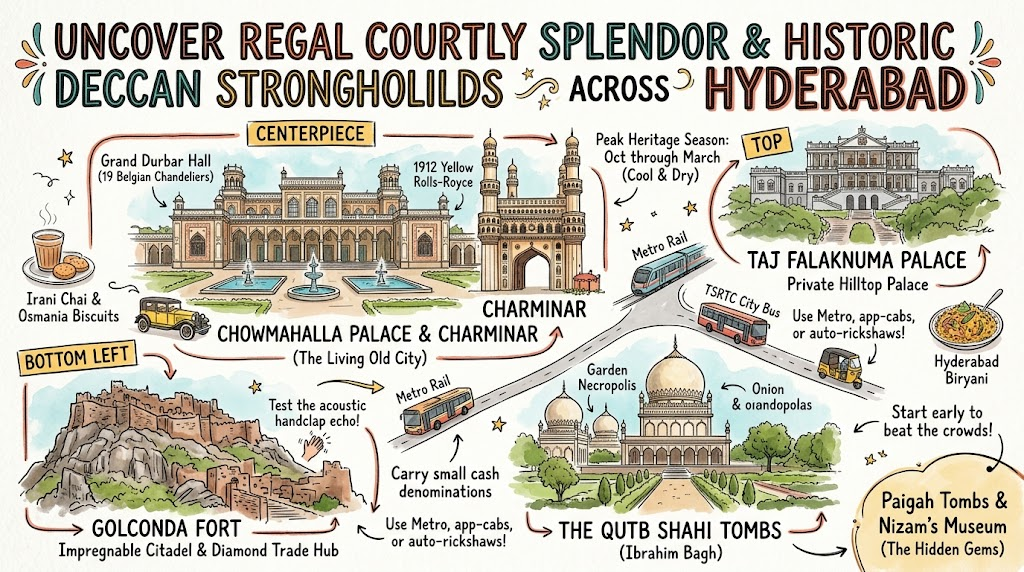
Most popular holiday destinations trap you in generic resort bubbles, sanitized tour circuits, and endless queues that keep real cultural history at arm’s length. Hyderabad offers the exact opposite: an intoxicating, sensory plunge into living aristocracy where 400-year-old royal legacies are woven directly into daily city life.
Here, ancient minarets rise above bustling bazaars scented with roasting cumin, artisanal attar, and slow-steamed biryani. Stepping into the Old City does not feel like touring an artificial museum exhibit; it feels like discovering an unbroken lineage of Deccan royalty that still breathes through every courtyard and archway.
Why Hyderabad is a must-visit city
Hyderabad sits as an extraordinary cultural anchor on the Deccan plateau, acting as a historical bridge between northern Persian elegance and southern Dravidian artistry. Under the reign of the wealthy Asaf Jahi Nizams and the preceding Qutb Shahi dynasty, this metropolis flourished into a global diamond trading hub, a cradle of Urdu poetry, and a crucible of sophisticated Indo-Islamic architecture. Its geographic balance in South India delivers mild winters and exceptional connectivity, whether you arrive via Rajiv Gandhi International Airport or major railway hubs like Secunderabad and Nampally.
The city’s heritage circuit forms an intuitive geographical arc anchored south of the Musi River in the historic Old City, stretching west toward the colossal granite fortresses of Golconda. Moving through these corridors takes you from opulent stucco staterooms to formidable medieval battlements within minutes. Well-paved arterial roads and modern elevated transit corridors make navigating between gritty heritage lanes and polished boutique districts remarkably smooth for solo backpackers, couples, and traveling families alike.
| Destination Metric | Quick Travel Fact |
|---|---|
| Primary Airport | Rajiv Gandhi International Airport (RGIA, Shamshabad) |
| Peak Heritage Season | October through March (Cool, dry weather) |
| Signature Architectural Style | Indo-Islamic, Persian, and Neoclassical synthesis |
| Primary Cultural Language | Dakhani Urdu, Telugu, and English |
| Transit Backbone | Hyderabad Metro, TSRTC City Buses, App-based Cabs |
Best Places to Explore Nizam Heritage
Grand courtyard of Chowmahalla Palace.
The iconic arches of Charminar.
Historic battlements of Golconda Fort.
Royal domed tombs of Ibrahim Bagh.
Chowmahalla Palace
Completed during the reign of Nizam Afzal-ud-Daulah, Chowmahalla Palace served as the official seat of the Asaf Jahi dynasty where foreign dignitaries and viceroys were formally entertained. Built on a scale reminiscent of the Shah’s palace in Tehran, this multi-palace complex showcases a synthesis of Baroque, Persian, and Rajasthani craftsmanship centered around vast courtyards, fountain pools, and manicured green lawns.
The centerpiece is the Khilwat Mubarak, a grand durbar hall crowned by nineteen massive Belgian crystal chandeliers suspended beneath high ceilings. Walking through its corridors reveals the private armory, antique royal carriage galleries, and a famous 1912 yellow Rolls-Royce Silver Ghost that captures the unmatched wealth of the 7th Nizam.
- Location: Motigalli, Khilwat, Old City (approx. 1 km southwest of Charminar; 16 km from Secunderabad Railway Station)
- Why it is worth visiting: The most authentic, meticulously restored royal stateroom complex demonstrating the private and ceremonial lifestyle of the Asaf Jahi rulers.
- Best things to do: Stand beneath the 19 Belgian chandeliers in the Khilwat Mubarak, inspect the royal vintage car collection in the southern courtyard, and examine the intricate Nizami clock tower that has chimed continuously for over a century.
- Best time to visit: Weekdays between 10:00 AM and 12:00 PM to beat tour crowds and enjoy bright ambient morning light for photography.
- Ideal for whom: Architecture enthusiasts, royal history lovers, and photographers.
- Travel tip: Commercial photography fees apply for DSLR cameras; stick to a smartphone to avoid paying the hefty additional camera charge at the gate.
Charminar and the Four Arches (Char Kaman)
Commissioned in 1591 by Muhammad Quli Qutb Shah to commemorate the eradication of a devastating plague, the Charminar stands as the undisputed heart of Hyderabad. Constructing this square granite and lime-mortar monument established the layout of the city, with four colossal grand arches facing the cardinal directions to anchor the thriving trade markets around it.
Surrounding the monument are the historic Char Kaman—four monumental 60-foot gateways that once framed the royal plaza entrance leading to the royal palaces. Gazing up at the four 48.7-meter-high minarets reveals fine stucco ornamentation and delicate upper-balcony balustrades that showcase the pinnacle of Deccan Islamic engineering.
- Location: Charminar Road, Char Kaman, Old City (approx. 4 km from Hyderabad Deccan Railway Station)
- Why it is worth visiting: The monumental ground zero of Hyderabad’s foundation, offering unparalleled cultural immersion in its surrounding historic bazaars.
- Best things to do: Climb the narrow spiral steps to the first-floor balcony for an overhead view of the bazaar, admire the stucco lotus motifs along the upper archways, and walk through Machli Kaman to see how the royal avenues were historically aligned.
- Best time to visit: 7:30 AM to 9:00 AM before bazaar crowds pack the plaza, or after 7:00 PM when the stone facade is beautifully illuminated.
- Ideal for whom: Culture enthusiasts, street photographers, and city explorers.
- Travel tip: The bazaar perimeter gets congested by noon; arrive via Metro (alighting at MGBS or Charminar station) and walk the final stretch rather than driving.
Golconda Fort
Originally an earthen mud fortress under the Kakatiya rulers, Golconda was transformed by the early Qutb Shahi sultans into an impregnable granite citadel. Famous as the trade hub of the legendary Golconda diamonds—which produced the Hope Diamond, Koh-i-Noor, and Daria-i-Noor—the fort combines defensive engineering with royal pavilions and palaces built across a steep granite hill.
The fort’s acoustic design remains an engineering wonder: a single handclap struck beneath the dome of the Fateh Darwaza entrance canopy carries clearly to the Bala Hissar pavilion over a kilometer away at the citadel’s highest point. Clambering up its roughly carved stone stairs reveals military barracks, freshwater storage reservoirs, and Turkish baths cut directly into the hillside rock.
- Location: Ibrahim Bagh, Western Hyderabad (approx. 11 km west of Charminar; 15 km from HITEC City)
- Why it is worth visiting: A masterclass in medieval acoustics, water-engineering systems, and military fortifications with sweeping panoramic views across Hyderabad’s skyline.
- Best things to do: Test the acoustic clap-echo signal at the Fateh Darwaza, climb the 380 stone steps to the breezy Bala Hissar royal summit, and attend the evening sound-and-light show narrated across the fort walls.
- Best time to visit: 8:30 AM to 11:00 AM to complete the steep hill climb before afternoon heat sets in, or from 4:30 PM for sunset vistas.
- Ideal for whom: Trekking buffs, military history followers, and landscape photographers.
- Travel tip: Wear sturdy walking shoes with high grip; the polished granite steps near the top can be slippery, and carry a reusable water bottle as concessions inside are limited.
The Qutb Shahi Tombs (Ibrahim Bagh)
Resting peacefully in the shadow of Golconda Fort, the Qutb Shahi Tombs house the final resting places of seven sultans who ruled the kingdom across nearly two centuries. Set within the landscaped Persian-style gardens of Ibrahim Bagh, this necropolis is one of the only historical sites in the world where an entire royal ruling dynasty is entombed in a single contiguous location.
Each mausoleum features a square base transitioning into onion-domed cupolas, flanked by arched galleries and delicate plaster screens. A multi-year restoration partnership between the Aga Khan Trust for Culture and the State Government has meticulously repaired their glazed tilework, stucco friezes, and complex stepwell systems (baolis), restoring their historic royal tranquility.
- Location: Qutb Shahi Tombs Complex, Ibrahim Bagh (approx. 2 km north of Golconda Fort’s outer gate)
- Why it is worth visiting: The most peaceful, beautifully preserved garden necropolis in the Deccan, combining Persian, Pathan, and Hindu architectural details.
- Best things to do: Marvel at the monumental two-tiered tomb of Muhammad Quli Qutb Shah, examine the intricate calligraphy on the marble sarcophagi, and walk around the restored Badi Baoli stepwell.
- Best time to visit: 3:30 PM to 6:00 PM when the warm golden hour light casts long shadows across the domes and garden lawns.
- Ideal for whom: Solitude seekers, garden walkers, and heritage restoration enthusiasts.
- Travel tip: The complex covers extensive acreage; rent an electric buggy near the ticket booth if visiting with seniors or small children.
Taj Falaknuma Palace
Perched 2,000 feet above the Deccan plain on a private hill, Falaknuma—meaning “Mirror of the Sky”—was designed by Italian architect William Ward Marret for Nawab Viqar-ul-Umra before serving as the private residence of the 6th Nizam, Mir Mahboob Ali Khan. Shaped like a scorpion with twin spreading wings, the palace blends Italian marble, Tudor architecture, and Louis XIV furnishings.
Inside sits a banquet hall with a 101-seat rosewood table illuminated by Belgian chandeliers, a private library housing rare Quranic manuscripts, and jade collections collected by the Asaf Jahi court. Now managed as a luxury heritage hotel by the Taj Group, visiting requires a booking for afternoon tea, fine dining, or a specialized heritage walk.
- Location: Engine Bowli, Falaknuma (approx. 5 km south of Charminar; 18 km from Shamshabad Airport)
- Why it is worth visiting: The pinnacle of 19th-century aristocratic luxury, featuring rare Nizam-era decor, Venetian chandeliers, and sweeping hill vistas.
- Best things to do: Savor royal high tea on the Gol Bungalow terrace overlooking the lit-up city, inspect the carved 101-seat dining table, and admire the ceiling frescoes inside the Durbar Hall.
- Best time to visit: Late afternoon (around 4:30 PM) to catch twilight over the city before having an evening dinner.
- Ideal for whom: Luxury travelers, couples celebrating milestones, and fine-dining lovers.
- Travel tip: Strict entry control is enforced at the base gate; you must hold a confirmed advance dining or hotel reservation to ride the horse-drawn carriage up the hill.
Offbeat Exploration: Hidden Gems Tourists Miss
Paigah Tombs
Tucked inside the residential lanes of Pisal Banda, the Paigah Tombs hold the remains of the aristocratic Paigah family, who were fierce allies and kin by marriage to the Nizams. Built from pristine lime plaster and marble, the tombs feature geometric jaali (lattice) screens, carved teak doorways, and intricate floral motifs that rival Mughal stonework in Agra. Because standard tourist itineraries overlook them, you can often explore these quiet pavilions in complete solitude.
The Nizam’s Museum (Purani Haveli)
Located inside the Purani Haveli palace, this quiet museum displays the silver jubilee gifts presented to Mir Osman Ali Khan, the 7th Nizam, in 1937. Beyond gold models of iconic city landmarks and jewel-encrusted swords, the museum houses the world’s longest single-level walk-in wardrobe: a 176-foot-long, two-tiered corridor carved from Burma teak, designed because the Nizam reportedly never wore the same outfit twice.
Badshahi Ashurkhana
Erected in 1594 shortly after Charminar, this royal mourning house honors the martyrdom of Imam Hussain. The interior walls feature vivid Persian enamel tiles decorated with natural floral patterns and Quranic calligraphy that have retained their blue, turquoise, and yellow luster across four centuries. It provides a quick, serene stop just north of the busy Madina Junction.
Detailed Practical Guidance for Travelers
| Destination | Standard Entry Fee | General Timings | Best Local Food Options Nearby | Recommended Nearby Attractions |
|---|---|---|---|---|
| Chowmahalla Palace | ₹100 (Indians), ₹400 (Foreigners) | 10:00 AM – 5:00 PM (Closed Fridays) | Shadab Hotel (Biryani), Nimrah Cafe (Irani Chai) | Charminar, Mecca Masjid, Laad Bazaar |
| Charminar | ₹25 (Indians), ₹300 (Foreigners) | 9:00 AM – 5:30 PM (Daily) | Nimrah Cafe & Bakery, Subhan Bakery | Chowmahalla Palace, Mecca Masjid |
| Golconda Fort | ₹25 (Indians), ₹300 (Foreigners) | 8:30 AM – 5:30 PM (Daily) | Chicha’s (Khichdi Khatta), Shah Ghouse (Haleem) | Qutb Shahi Tombs, Taramati Baradari |
| Qutb Shahi Tombs | ₹40 (Indians), ₹200 (Foreigners) | 9:30 AM – 5:00 PM (Daily) | Paradise Food Court (Tolichowki branch) | Golconda Fort, Durgam Cheruvu |
| Taj Falaknuma Palace | Reservation Required (Dining/Tea) | Open for pre-booked dining guests | Adaa (In-house Royal Nizami cuisine) | Paigah Tombs, Sudha Cars Museum |
| Paigah Tombs | Free Entry (Small donation customary) | 10:00 AM – 4:30 PM (Closed Fridays) | Pista House (Santosh Nagar branch) | Salar Jung Museum, Purani Haveli |
| Nizam’s Museum | ₹100 (Adults), ₹50 (Children) | 10:00 AM – 5:00 PM (Closed Fridays) | Hotel Nayaab (Paya, Bheja Fry, Roti) | Badshahi Ashurkhana, Salar Jung Museum |
Logistics & On-Ground Navigation
Local Transport Options
- Hyderabad Metro: Clean, rapid, and fully air-conditioned. Take the Green or Red lines to MGBS (Mahatma Gandhi Bus Station) or Sultan Bazaar to get within a quick auto ride of the Old City.
- Auto-Rickshaws: Abundant and ideal for narrow historic alleys. Insist on running the meter, or agree on a fixed rate upfront before stepping inside.
- App-Based Cabs (Uber & Ola): Highly reliable for traveling across town between HITEC City, Banjara Hills, and Golconda.
- TSRTC City Buses: Economical and frequent, though crowded during rush hour. Heritage route buses run between major rail stations and the Charminar zone.
- Self-Drive / Car Rentals: Not recommended within the narrow Old City lanes due to tight spaces and limited parking; booking a car with a local driver is far more practical.
Budget Planning
- Budget / Backpacking Tier (₹1,500 – ₹2,500 / day): Dorm bed or budget guesthouse near Nampally/Abids (₹800–₹1,200), meals at local Irani cafes and street-side biryani joints (₹400–₹600), and public metro/bus transport (₹200–₹300).
- Mid-Range / Comfort Tier (₹5,500 – ₹9,500 / day): 3-star or boutique heritage hotel in Banjara Hills or Begumpet (₹3,500–₹6,000), sit-down dining at iconic restaurants like Shadab and Jewel of Nizam (₹1,200–₹2,000), and dedicated app-cab rentals for hassle-free day transit (₹1,000–₹1,500).
Safety and Inclusivity Tips
- For Families: Keep small children close in high-density shopping lanes around Charminar and Laad Bazaar, and carry a compact stroller or baby carrier that handles uneven cobblestones.
- For Couples: Hyderabad is welcoming and modern, but showing modesty in religious complexes like Mecca Masjid or Dargahs (covering shoulders and knees) ensures a respectful visit.
- General Safety: Street crime is low, but beware of pickpockets in crowded Sunday bazaars; store wallets in front pockets and avoid walking alone in poorly lit alleys late at night.
Strategic Travel Planning Guardrails
Travel Planning Tips for Hyderabad
- Time Your Season Wisely: Visit between late October and early March when pleasant 18°C to 28°C temperatures make extensive walking comfortable.
- Carry Small Cash Denominations: While digital payments (UPI) work almost everywhere, street-side chai stalls and bangle sellers prefer cash notes of ₹50 and ₹100.
- Dress Respectfully for Monuments: Carry a lightweight scarf or shawl; several sites require heads and knees to be covered for entry.
- Start Early in the Old City: Heritage alleys come alive by 7:00 AM with fresh bun maska and chai, well before heavy road traffic builds up.
- Prep for High Step Counts: Sites like Golconda Fort and Qutb Shahi Tombs involve walking over 5–8 kilometers on uneven stone; pack trail shoes with good cushioning.
- Book Weekend Dining Early: Well-known spots like Hotel Shadab, Adaa, and Cafe 555 fill up quickly on Friday and Saturday evenings; reserve in advance.
Common Mistakes to Avoid
- Packing West and South Hyderabad into One Afternoon: Avoid trying to see HITEC City and Charminar in the same afternoon; cross-city traffic will consume your travel time.
- Skipping Irani Chai Culture: Don’t limit dining to your hotel breakfast; missing an early Irani chai with Osmania biscuits misses a core Hyderabadi ritual.
- Relying Exclusively on Cards: Never leave your hotel without paper cash, as small vendors and entry ticket counters frequently experience spotty card machine connectivity.
- Visiting Sites on Fridays Without Checking: Remember that Chowmahalla Palace, Paigah Tombs, and the Nizam’s Museum close on Fridays.
- Underestimating the Golconda Sun: Never attempt climbing Golconda Fort at 1:00 PM without sun protection, sunglasses, and adequate water.
Suggested Itinerary Blueprints
1-Day Quick Dash (The Royal Highlights Loop)
Target Audience: Business travelers and short-layover tourists with limited hours.
- Morning (8:00 AM – 11:30 AM): Beat the crowds at Charminar, savor Irani chai and Osmania biscuits at Nimrah Cafe, and tour Chowmahalla Palace.
- Afternoon (12:30 PM – 2:30 PM): Relish authentic mutton dum biryani and mirchi ka salan at Hotel Shadab near Madina building.
- Late Afternoon (3:30 PM – 6:30 PM): Cab to Golconda Fort for an afternoon exploration of the battlements, finishing with panoramic sunset views over the citadel.
2-Day Deep-Dive (Dynasties and Palaces Circuit)
Target Audience: Weekend heritage enthusiasts and cultural travelers.
- Day 1: The Sultanate Foundations:
- Morning: Head straight to the tranquil Qutb Shahi Tombs to explore the royal mausoleums and stepwells.
- Midday: Lunch at Tolichowki for kebabs and fresh naan.
- Afternoon to Evening: Explore Golconda Fort’s acoustics, staying through sunset for the open-air Sound and Light Show.
- Day 2: The Nizam Court Life:
- Morning: Walk through Charminar, Mecca Masjid, and the courtyards of Chowmahalla Palace.
- Afternoon: Tour the curio galleries and the 176-foot wardrobe inside the Nizam’s Museum (Purani Haveli).
- Evening: Shop for lac bangles and pearls down Laad Bazaar before a traditional dinner along the Musi riverbank.
Complete Weekend Travel Plan (Grand Deccan Heritage Loop)
Target Audience: Slow travelers, photographers, and families wanting a relaxed pace.
- Friday (The Aristocratic Welcome): Check into a heritage hotel; spend the late afternoon visiting the Paigah Tombs, followed by dinner in Banjara Hills.
- Saturday (The Medieval Bastions): Devote the full morning to Golconda Fort; take an afternoon breather at a local cafe; spend the golden hour at the Qutb Shahi Tombs; unwind with dinner in Jubilee Hills.
- Sunday (The Living Old City): Start early with chai at Charminar; stroll the grand halls of Chowmahalla Palace; explore the collections inside Salar Jung Museum; end the journey with sunset high tea at Taj Falaknuma Palace.
Common Tourist Mistakes to Avoid
Geographic Blunders
Hyderabad’s urban sprawl often surprises first-time visitors. Attempting to combine western tech hubs like Gachibowli with the historic Old City in the same half-day leads to hours stuck in traffic along the Mehdipatnam corridor. Keep your days geographically clustered: dedicate one day entirely to the southern Old City and another to the western Golconda and Tolichowki area.
Commercial Traps
Many tourists spend precious evening hours in modern shopping malls buying generic mass-produced souvenirs. Instead, walk through the centuries-old alleys of Laad Bazaar for hand-crafted lac bangles, or visit the government-certified pearl dealers near Pathergatti. You will get authentic craftsmanship and directly support generational artisans.
Neglecting Modern and Alternative Zones
Focusing solely on crumbling stone walls can cause travelers to miss Hyderabad’s modern cultural scene. Neighborhoods like Jubilee Hills, Film Nagar, and Begumpet feature vibrant art spaces, restored stepwells (like the Bansilalpet Stepwell), and quiet garden cafes that highlight how the city blends history with contemporary design.
Transport Overpayment
Hailing unmetered auto-rickshaws directly outside major monuments like Charminar or Golconda Fort frequently results in inflated fares. Open ride-hailing apps like Uber, Ola, or Rapido to check the standard market rate before negotiating, or simply book your ride through the app to secure fair pricing.
Luxury Dining Bias
Dining exclusively inside five-star hotels deprives you of the real culinary soul of the Deccan. Hyderabad’s food culture lives on the street: the aromatic paya stews at Hotel Nayaab, the late-night dosa carts at Ram Ki Bandi, and the hot khameeri rotis in local markets showcase the real flavors of the city.
Local Insider Secret: Order your Irani chai paani kam—which means brewed with extra-thick, reduced milk—paired with a warm, salty Osmania biscuit dipped straight into the cup.
Frequently Asked Questions
1. What is the best month to explore Nizam heritage sites in Hyderabad?
The best window to visit is between October and March. During these months, the Deccan plateau experiences cool, dry weather with daytime temperatures ranging between 18°C and 28°C, making walking tours and hill climbs at Golconda Fort comfortable compared to the scorching summer heat.
2. Can I visit Taj Falaknuma Palace without staying overnight as a hotel guest?
Yes, non-resident guests can access the palace grounds by booking an advance table reservation for afternoon high tea or dinner at its fine-dining restaurants like Adaa. Alternatively, you can book a weekend Telangana Tourism heritage tour that includes guided access through the staterooms.
3. How much time is needed to see Chowmahalla Palace properly?
You should plan for roughly two to two-and-a-half hours to explore Chowmahalla Palace comfortably. This gives you enough time to walk through the Khilwat Mubarak durbar hall, inspect the vintage vehicle collection in the south court, and view the royal attire and armory exhibits.
4. Are there dress code restrictions for entering Mecca Masjid near Charminar?
Yes, visitors should dress modestly when entering the Mecca Masjid complex. Both men and women must ensure their shoulders and knees are covered. Women are expected to drape a scarf over their heads, and all footwear must be deposited at the entrance counter before walking in.
5. Is photography permitted inside all Nizam heritage properties?
Smartphone photography is permitted across almost all monuments, though modest entry fees apply. However, professional DSLR cameras and tripods require expensive permits at Chowmahalla Palace and Golconda Fort, and interior camera use is restricted inside the private galleries of the Nizam’s Museum.
6. How far is Golconda Fort from the Charminar area?
Golconda Fort sits approximately 11 kilometers west of Charminar. Depending on peak traffic through the busy Mehdipatnam and Asif Nagar junctions, transit by auto-rickshaw or taxi takes roughly 40 to 60 minutes, so it is best to visit them in distinct half-day blocks.
7. What are the key architectural traits of the Asaf Jahi Nizam style?
The Asaf Jahi architectural style blends Persian domes and scalloped arches with European Neoclassical columns, Italian marble flooring, and ornate Rajasthani stone balconies. This synthesis creates an open palace layout featuring wide courtyards, detailed stucco facades, and grand banquet halls lit by crystal chandeliers.
8. Which spot serves the most authentic Hyderabadi Biryani near the heritage circuit?
For authentic taste in the heritage district, Hotel Shadab near Madina Circle and the historic Cafe Bahar in Basheerbagh offer flavorful, traditionally prepared kacchi dum biryani. Alternatively, Chicha’s in Lakdikapul serves excellent regional home-style curries and fragrant rice dishes.
9. Are guided tours necessary when touring Golconda Fort?
Hiring an authorized guide at the main gate is well worth it for Golconda Fort. The complex lacks extensive explanatory signs, and a knowledgeable guide will demonstrate the famous acoustic engineering, decipher royal water systems, and share dramatic historical accounts of the Mughal siege.
10. Is the Hyderabad Old City safe for solo female travelers?
The Old City is generally safe, welcoming, and lively late into the evening. However, navigating the bustling, narrow lanes around Charminar can feel overwhelming, so dressing conservatively, keeping personal belongings secure in crowds, and avoiding unlit alleys after dark ensures a smooth, trouble-free visit.
11. What is the single biggest logistical mistake tourists make in Hyderabad?
The biggest logistical error is underestimating city traffic between the western IT corridor (HITEC City/Gachibowli) and the southern heritage district. Commuting across town during peak hours can easily take over 90 minutes each way, so it is wise to book lodging closer to the center.
12. What authentic Nizam-era souvenirs should travelers purchase?
Top authentic keepsakes include hand-crafted lac and glass bangles from Laad Bazaar, GI-tagged Bidriware metalwork featuring silver inlays on darkened zinc alloy, certified Basra pearls from Pathergatti dealers, and traditional boxes of Luqman-e-Hakeem attar or Osmania biscuits from Subhan Bakery.
Conclusion
Choosing to explore the royal Nizami heritage of Hyderabad rewards you with something far more enriching than a standard sightseeing trip. Walking through these grand courtyards and climbing historic granite fortresses connects you to centuries of art, empire, and Deccan hospitality that continue to shape the city’s modern character. It is a journey that replaces tourist crowds with authentic local life, leaving you with lasting memories of amber-lit minarets, the scent of crushed spices, and the timeless dignity of an extraordinary royal capital.
