Introduction
Most travelers treat Hyderabad as an exhaustive checklist of Nizami monuments, bustling bazaar streets, and crowded IT corridor eateries. Yet, beyond the packed tourist lines of Charminar and Golconda Fort lies an unexpected, deeply moving layer of Deccani history and spiritual serenity.
Stepping across the marble thresholds of the city’s historic Gurudwaras transports you into an atmosphere of quiet reverence, rhythmic Gurbani chants, and unmatched community warmth. Here, authenticity is not staged for tourists—it lives in the tireless clatter of the langar kitchens and centuries-old ties between Sikh valor and the Deccan plateau.
Why Hyderabad is a must-visit city
Hyderabad carries an extraordinary composite heritage rooted in pluralism, trade, and historic alliances. In 1832, Maharaja Ranjit Singh of Punjab sent a detachment of 14,000 disciplined Sikh soldiers to support Nizam Nasir-ud-Daulah, giving birth to the legendary Dakhni Sikh diaspora. This deep cultural intertwining created a distinct spiritual geography across the twin cities of Hyderabad and Secunderabad that few mainstream guidebooks capture.
Practical connectivity makes navigating this circuit effortless. Rajiv Gandhi International Airport links major global hubs, while three core railway junctions—Secunderabad, Hyderabad Deccan (Nampally), and Kacheguda—connect travelers across India. An extensive modern metro grid and well-paved arterial ring roads weave the old fortified settlements cleanly into the modern metropolis.
| Key Dimension | Details |
| Circuit Focus | Historical, Architectural, and Community Gurudwaras |
| Geographic Span | Kishan Bagh (South), Gowliguda (Central), Ameerpet (West), Secunderabad (North) |
| Best Travel Season | October to March (Comfortable, crisp weather) |
| Key Festivals | Prakash Purab of Guru Nanak Dev Ji, Baisakhi, Khalsa Panth Foundation Day |
| Transit Accessibility | Hyderabad Metro (Red & Green Lines), TSRTC city buses, App-based Cabs |
| Hospitality Range | Serene Gurudwara Sarai stays, heritage boutique hotels, modern business hubs |
Best Places or Experiences
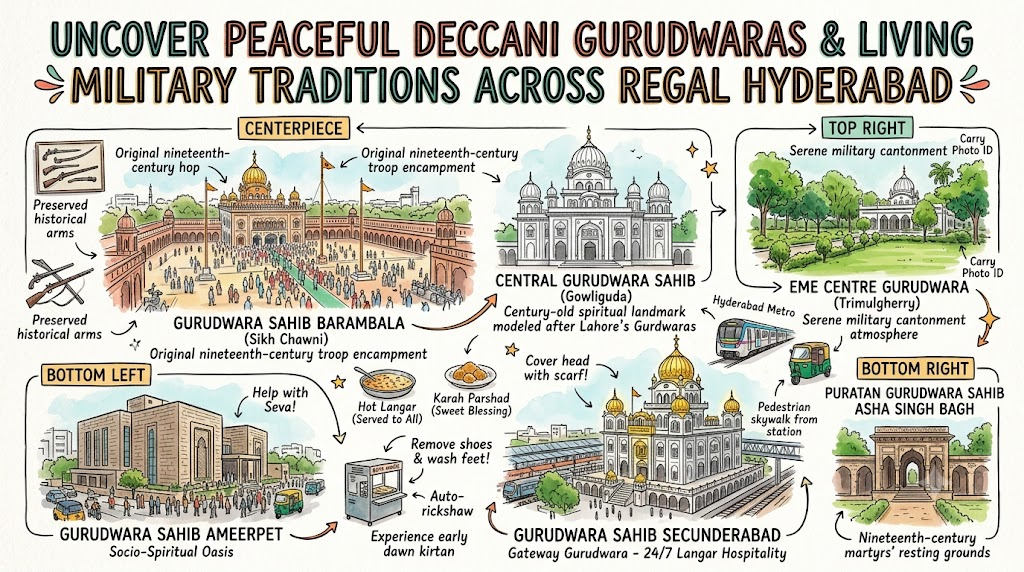
Gurudwara Sahib Barambala (Sikh Chawni, Kishan Bagh)
Gurudwara Sahib Barambala stands as the undisputed cradle of Sikh heritage in South India. Set within the historic military cantonment known as Sikh Chawni, this sanctuary marks the original settlement where Maharaja Ranjit Singh’s troops were stationed in the early nineteenth century under treaty with the Asaf Jahi rulers.
Walking through its expansive compound reveals classic Indo-Sikh architectural elements merged seamlessly with open Deccani courtyards. The sanctum preserves precious historical weaponry and artifacts brought from Lahore, enveloped in an aura of solemn bravery and unwavering spiritual dedication.
- Location: Kishan Bagh, Old City zone; approximately 14 km south-west of Secunderabad Junction and 8 km from Nampally.
- Why it is worth visiting: The fountainhead of Dakhni Sikh culture, housing nineteenth-century weaponry and historic military heritage.
- Best things to do: Observe the preserved historical arms display, experience the dawn Asa Di Var recitation, and partake in community langar cooked over wood fires.
- Best time to visit: Early morning between 5:30 AM and 8:00 AM, particularly during Guru Gobind Singh Ji’s Prakash Purab celebrations.
- Ideal for whom: Cultural preservationists, military history enthusiasts, and solo spiritual seekers.
- Travel tip: The approach roads through Kishan Bagh get congested after mid-morning; arrive at dawn to park comfortably inside the designated grounds.
Central Gurudwara Sahib (Gowliguda)
Inaugurated in 1926 near the historic Gowliguda Chaman, this institution represents a century of continuous prayer, social service, and community refuge. Its sanctum was intentionally designed to reflect the interior aesthetics of Gurudwara Dera Sahib in Lahore, cementing an emotional connection between the Punjab frontier and the Deccan.
The Gurudwara features a stunning white facade topped with elegant domes, welcoming thousands of devotees daily across religious lines. During historic regional upheavals and modern celebrations alike, Central Gurudwara Sahib has remained a rock-solid bastion of community welfare and humanitarian relief.
- Location: Gowliguda Chaman, central Hyderabad; 2 km from Hyderabad Deccan (Nampally) Railway Station.
- Why it is worth visiting: A century-old spiritual landmark modeled after Lahore’s classic gurdwaras, celebrating continuous charitable seva.
- Best things to do: Participate in voluntary vegetable chopping during afternoon langar seva, admire the gilded sanctum arches, and listen to traditional string instruments (tanti saaj) during festival diwans.
- Best time to visit: Sundays between 10:00 AM and 1:30 PM for the vibrant community congregation (sangat).
- Ideal for whom: Heritage architecture lovers, families, and first-time travelers to old Hyderabad.
- Travel tip: Use the MGBS Metro Interchange station to bypass severe surface traffic bottlenecks around Afzal Gunj and Gowliguda.
Gurudwara Sahib Ameerpet
Situated along the busy thoroughfares of modern commercial Hyderabad, Gurudwara Sahib Ameerpet is renowned as the primary socio-spiritual nucleus of the western suburbs. Established in the mid-twentieth century, this Gurudwara blends contemporary stone masonry with exquisite inner hall acoustics.
The spacious Darbar Sahib showcases intricate glasswork, velvet canopies, and polished marble floors that remain pristine despite thousands of daily visitors. It serves as an oasis of absolute calm amidst the honking horns and tech-coaching hubs of Ameerpet.
- Location: Gurudwara Lane, Ameerpet; roughly 7 km west of Secunderabad and 9 km from Hitec City.
- Why it is worth visiting: Renowned for exceptional kirtan acoustics and its central role in orchestrating Telangana’s largest Vaisakhi nagar kirtans.
- Best things to do: Listen to evening Rehras Sahib paath, visit the extensive spiritual book stall, and volunteer in the automated roti-making unit.
- Best time to visit: Evening from 6:30 PM to 8:30 PM when the sanctum is softly lit and the evening ragas commence.
- Ideal for whom: Working professionals seeking quiet reflection, students, and traveling families.
- Travel tip: Footwear deposit counters are well-organized, but carry a handkerchief or scarf to cover your head prior to entering the premises.
Gurudwara Sahib Secunderabad (Station Road)
Positioned right on Station Road opposite Secunderabad Junction, this monumental shrine serves as the welcoming beacon for rail travelers entering the twin cities. Its towering multi-tiered facade and luminous gold-leaf gumbads command attention across the colonial-era cantonment sector.
Inside, the atmosphere balances vibrant military cantonment discipline with profound devotion. The langar hall operates with clockwork efficiency, feeding weary long-distance train travelers, local porters, and office commuters round the clock.
- Location: Sarojini Devi Road / Station Road, Secunderabad; right across from Secunderabad Railway Station.
- Why it is worth visiting: Strategic gateway gurudwara offering unbroken 24/7 hospitality and pristine colonial-era cantonment heritage.
- Best things to do: Relish hot Karah Parshad at the entry corridor, join the early morning palki sahib ceremony, and observe the disciplined langar distribution.
- Best time to visit: 4:30 AM to 6:30 AM for Amritvela prayers, or mid-day around 12:30 PM for lunch langar.
- Ideal for whom: Transit passengers, solo backpackers, and community volunteers.
- Travel tip: Avoid auto drivers waiting outside the railway gates who refuse meters; cross into the gurudwara precinct using the pedestrian skywalk.
EME Centre Gurudwara (Trimulgherry)
Tucked away in the sprawling green woodlands of the Military College of Electronics and Mechanical Engineering (MCEME), this cantonment shrine is celebrated for its serene environmental setting. Unlike the dense urban footprint of city shrines, EME Centre Gurudwara sits amid manicured lawns, tall eucalyptus groves, and calm paved walkways.
Maintained with military precision, the complex represents the proud martial traditions of Sikh regiments stationed across the Deccan. The silence here is interrupted only by rustling leaves, birdsong, and the resonant cadence of Gurbani.
- Location: Lal Bazaar / Trimulgherry, Secunderabad Cantonment; approximately 6 km north of Secunderabad Junction.
- Why it is worth visiting: A park-like military cantonment atmosphere unmatched anywhere else in the metropolitan region.
- Best things to do: Walk through the tranquil memorial gardens, spend silent meditation moments on the marble veranda, and admire the regiment’s ceremonial insignia.
- Best time to visit: Early morning or late afternoon between 4:00 PM and 6:30 PM.
- Ideal for whom: Nature lovers, senior travelers, and photographers drawn to clean cantonment architecture.
- Travel tip: As this is adjacent to military residential zones, carry a valid government photo ID and strictly adhere to photography prohibition signboards outside the prayer hall.
Puratan Gurudwara Sahib Asha Singh Bagh
A place of deep solemnity and historical valor, this shrine commemorates the resting grounds of early Sikh martyrs stationed in the Deccan during the nineteenth century. Known locally as an enduring memorial to Lahori soldiers who gave their lives in service, it retains an authentic, unvarnished spiritual sanctity.
The architecture leans towards regional stone construction, featuring historic arched entryways and memorial plaques that recount forgotten chapters of Deccani history. Devotees visit specifically to seek blessings for fortitude and inner resilience.
- Location: Asha Singh Bagh, Kishan Bagh, near Nehru Zoological Park; 13 km south of central Secunderabad.
- Why it is worth visiting: An authentic historic memorial preserving the memories of nineteenth-century soldiers and martyrs.
- Best things to do: Read the stone memorial inscriptions detailing historical troop deployments, meditate in the ancient inner chamber, and converse with resident elders regarding local oral histories.
- Best time to visit: Morning between 7:00 AM and 10:00 AM.
- Ideal for whom: Dedicated historians, genealogists, and pilgrims exploring deep ancestral footprints.
- Travel tip: Combine this visit with Gurudwara Barambala since both sit in the Kishan Bagh neighborhood.
Offbeat Exploration: Hidden Gems Tourists Miss
Charmahal Gurudwara (Hussaini Alam, Old City)
Hidden deep within the winding alleys of the historic walled city near Petla Burz and Charminar lies Charmahal Gurudwara. Constructed in the mid-twentieth century on royal land endowments, it operates as an intimate neighborhood sanctuary where local Dakhni Sikhs converse in fluent Hyderabadi Urdu while keeping their Sikh religious traditions intact.
Albail Singh Samadhi & Asthan (Kishan Bagh)
A short distance from Barambala lies the sacred Asthan of Shaheed Baba Albail Singh Ji. Shrouded under canopy trees, this quiet shrine commemorates early Sikh leaders who settled disputes and defended local communities in the Asaf Jahi era. It remains untouched by commercial foot traffic.
Shaheed Gunj Gurudwara (Srinivasa Nagar)
Tucked in a residential alcove off Ameerpet, Shaheed Gunj is a serene local gem rarely featured on tourist maps. It is known for its intimate morning Sukhmani Sahib recitations and its deeply peaceful courtyard where neighborhood volunteers manage daily community services without urban rush.
Detailed Practical Guidance for Travelers
| Destination | Standard Entry Fee | General Timings | Best Local Food Options Nearby | Recommended Nearby Attractions |
| Gurudwara Barambala | Free / Seva | 04:30 AM – 09:30 PM | Hot Langar; authentic Irani Chai at Kishan Bagh Chowk | Nehru Zoological Park, Mir Alam Tank |
| Central Gurudwara Gowliguda | Free / Seva | 04:00 AM – 10:00 PM | Free Langar; Govind Dosa (Urdu Gali), Subhan Bakery | Salar Jung Museum, Badshahi Ashurkhana |
| Gurudwara Ameerpet | Free / Seva | 04:30 AM – 10:00 PM | Langar Hall; Kakatiya Mess (Authentic Andhra meals) | Jalavihar Water Park, Hussain Sagar Lake |
| Gurudwara Secunderabad | Free / Seva | Open 24 Hours | 24/7 Langar; Alpha Hotel (Biryani & Chai) | Clock Tower Secunderabad, St. Mary’s Basilica |
| EME Centre Gurudwara | Free / Seva | 05:00 AM – 08:00 PM | Langar; local eateries along Lal Bazaar main road | Trimulgherry Fort, Military Cantonment Church |
| Asha Singh Bagh Gurudwara | Free / Seva | 05:00 AM – 08:30 PM | Sacred Langar; Nayab Hotel (Paya & Naan, Old City) | Chowmahalla Palace, Charminar |
Logistics & On-Ground Navigation
Local Transport Options
- Hyderabad Metro: The quickest, air-conditioned way to bypass Hyderabad’s dense surface traffic. The Red Line directly connects Ameerpet and MGBS (close to Gowliguda), while the Blue Line links to Secunderabad West.
- Auto-Rickshaws: Abundant across every street corner. Insist firmly on the digital fare meter or agree on a fixed negotiated price before boarding.
- App-Based Rides (Uber & Ola): Highly reliable for traveling between distant zones like Ameerpet and Kishan Bagh. Choose hatchback or sedan cabs during hot afternoons.
- TSRTC City Buses: Extremely economical, with frequent trunk routes linking Secunderabad Station to Charminar, Koti, and Afzal Gunj.
Budget Planning
- Backpacker / Budget Tier (₹800 – ₹1,500 per day): Stay in basic guesthouses or Gurudwara Sarai quarters (where available upon prior request), utilize the Metro and city buses, partake in sacred langar meals, and budget for modest street-side snacks and teas.
- Mid-Range / Comfort Tier (₹3,000 – ₹6,500 per day): Stay in comfortable 3-star or 4-star boutique hotels around Begumpet or Banjara Hills, use app-based cabs exclusively, and balance gurudwara visits with iconic local dining at legacy cafes and heritage dining rooms.
Safety and Inclusivity Tips
- Families: All Gurudwaras in Hyderabad have wheelchair ramps, secure shoe stands, and spacious dining floors suitable for multi-generational families.
- Couples: Sacred sites demand conservative comportment. Refrain from public displays of affection; dress modestly with shoulders and knees fully covered.
- General Safety: Keep valuables secured when navigating crowded market streets adjacent to Gowliguda and Kishan Bagh. Always drink packaged or RO water provided on site.
Strategic Travel Planning Guardrails
Travel Planning Tips for Hyderabad
- Cover Your Head: Always bring a cotton bandana, scarf, or rumāl. Caps and sunhats are not permitted inside the sanctum.
- Remove Footwear: Deposit shoes and socks at the free, managed Jora Ghar (shoe counter) and wash feet in the shallow water channel (Charan Ganga) before entry.
- Cash for Ardas: Carry small physical currency notes (₹10, ₹50, ₹100) if you wish to offer matha tekna donations at the sanctum or Golak.
- Morning Timing: Schedule visits around 05:00 AM to 08:00 AM to experience pristine sunrise atmospheres and avoid midday Deccan heat.
- Langar Etiquette: Sit cross-legged on the floor (pangat) with knees covered; take only what you can finish, as leaving food in the plate is discouraged.
Common Mistakes to Avoid
- Rushing Langar Service: Treating the communal meal as a fast-food counter rather than a sacred egalitarian tradition.
- Inappropriate Attire: Wearing shorts, sleeveless shirts, or short dresses into the Gurudwara campus.
- Photography in Sanctum: Taking selfie photos or filming videos inside the prayer hall where the Sri Guru Granth Sahib is enthroned.
- Assuming City Closeness: Underestimating transit times across the Musi River during peak morning and evening office commutes.
- Skipping Prasad: Refusing Karah Parshad at the exit; accept it respectfully with both cupped hands.
Suggested Itinerary Blueprints
1. Day Quick Dash (The Central Devotional Loop)
- Target Audience: Short-stay travelers, transit passengers, and business travelers on limited layovers.
- Morning (06:00 AM – 09:00 AM): Start at Gurudwara Sahib Secunderabad for morning prayer and breakfast prasad.
- Mid-Day (10:30 AM – 01:30 PM): Take the Metro Red Line down to Central Gurudwara Sahib Gowliguda for diwan prayers and community langar.
- Late Afternoon (04:30 PM – 07:00 PM): Head to Gurudwara Sahib Ameerpet to experience evening Gurbani kirtan, concluding with dinner langar.
2. Day Deep-Dive (Heritage & Hidden Deccan Footprints)
- Target Audience: Cultural researchers, families, and curious spiritual travelers.
- Day 1 (The Historical Frontier): Dedicate the morning to Gurudwara Barambala and the Albail Singh Asthan in Kishan Bagh. Transition to Asha Singh Bagh Gurudwara by noon. Spend the evening exploring the nearby monuments of Old Hyderabad.
- Day 2 (The Modern and Cantonment Centers): Begin with sunrise serenity at EME Centre Gurudwara Trimulgherry. Move to Gurudwara Sahib Ameerpet for afternoon contemplation, ending your tour with an authentic meal in Begumpet.
3. Complete Weekend Travel Plan (The Grand Deccan Sikh Pilgrimage)
- Friday: Arrive in Secunderabad. Unpack, visit Gurudwara Sahib Secunderabad, and enjoy heritage Irani chai and Osmania biscuits on Station Road.
- Saturday: Journey south into Old City territory. Explore Gurudwara Barambala, Asha Singh Bagh, and the hidden Charmahal Gurudwara. Partake in extended community seva at Central Gurudwara Gowliguda.
- Sunday: Enjoy a crisp morning drive through the cantonment pine and banyan canopy at EME Centre Gurudwara Trimulgherry. Wrap up the spiritual circuit at Gurudwara Sahib Ameerpet before catching evening flights or trains.
Common Tourist Mistakes to Avoid
- Geographic Blunders: Attempting to pair Kishan Bagh (far south) with Trimulgherry (far north) during midday. Hyderabad’s central corridor experiences heavy traffic bottlenecks across the Musi bridges.
- Commercial Traps: Wasting afternoon hours in high-end shopping malls along Banjara Hills when the authentic soul of the city thrives in century-old community alleys and historic langar kitchens.
- Neglecting Modern/Alternative Zones: Focusing entirely on old stone structures and omitting peaceful green cantonment gems like Trimulgherry and quiet residential spots in Ameerpet.
- Transport Overpayment: Paying unmetered flat rates demanded by street auto drivers outside railway hubs. Always compare rates across rideshare apps first.
- Luxury Dining Bias: Eating exclusively in high-end hotel restaurants and missing out on authentic communal langar, neighborhood wood-fired bakeries, and heritage Irani cafes that define everyday Hyderabadi life.
Frequently Asked Questions
1. Are non-Sikh visitors allowed to enter Gurudwaras in Hyderabad?
Yes, every Gurudwara in Hyderabad welcomes people of all faiths, backgrounds, and nationalities without discrimination. The founding principle of Sikhism emphasizes universal brotherhood and equality. Visitors simply need to follow basic reverential codes: cover their head, remove shoes, wash their hands and feet, dress modestly, and refrain from carrying tobacco or alcohol.
2. Is there an entry fee or ticket required to visit these Gurudwaras?
No, there is absolutely no entry fee, registration charge, or mandatory ticketing at any Gurudwara in Hyderabad. Entry is entirely free for everyone. Devotees may choose to place voluntary financial contributions (dana) in the central donation box (Golak) in front of the holy scripture, but it is never compulsory.
3. What is the dress code for visiting Gurudwaras in Hyderabad?
Dress conservatively and respectfully. Both men and women should wear clothing that covers their shoulders and knees completely; trousers, long kurtas, or modest traditional Indian wear are ideal. Shorts, miniskirts, and sleeveless tops are strictly prohibited. You must also keep your head covered at all times using a scarf, dupatta, or bandana.
4. Can tourists eat the free community meal (Langar) at the Gurudwaras?
Yes, tourists and travelers are warmly encouraged to partake in the free community meal known as langar. Langar is freshly prepared, strictly vegetarian food served equally to everyone sitting side by side on carpet runners on the floor. It represents an essential spiritual experience reflecting selfless service, humility, and human equality.
5. Which is the oldest Gurudwara in Hyderabad?
Gurudwara Sahib Barambala in Kishan Bagh (Sikh Chawni) holds the deepest historical roots in the region, dating back to 1832 when Maharaja Ranjit Singh dispatched Sikh regiments to Hyderabad. Central Gurudwara Sahib in Gowliguda, established in 1926, is also one of the earliest urban gurudwaras in the heart of the city.
6. Can I volunteer or perform Seva during my visit to Hyderabad’s Gurudwaras?
Yes, travelers are always welcome to participate in voluntary service (seva). You can assist in peeling and cutting vegetables in the community kitchen, rolling rotis, serving water and meals to diners in the langar hall, cleaning dining mats, or helping manage the shoe keeping counter (Jora Ghar).
7. Is photography allowed inside the prayer halls of Hyderabad Gurudwaras?
Photography of the exterior courtyards and architecture is generally permitted, but photography and videography inside the main sanctum (Darbar Sahib) are strictly prohibited. This rule preserves the sanctity and focus of ongoing prayers. Always check for signboards or ask temple volunteers for permission before taking photographs.
8. Do any Gurudwaras in Hyderabad offer overnight accommodation for travelers?
Certain major institutions, such as Gurudwara Sahib Ameerpet and Central Gurudwara Gowliguda, maintain modest pilgrimage guesthouse facilities (sarai) for travelers. These rooms are basic, clean, and alcohol-free. Availability depends on ongoing festivals, and allocation is subject to management verification upon presenting valid government photo identification.
9. How do I get to Gurudwara Sahib Barambala in Kishan Bagh?
The most convenient way to reach Gurudwara Barambala is by booking an app-based cab or auto-rickshaw through Uber or Ola, as direct metro connectivity to Kishan Bagh is not available. If using public transit, take a bus to the Bahadurpura or Charminar bus stops, then take a short local auto-rickshaw ride.
10. What festivals are celebrated with high enthusiasm at these Gurudwaras?
The largest celebrations take place during Guru Nanak Dev Ji’s Prakash Purab (November), Guru Gobind Singh Ji’s Prakash Purab (December/January), and Vaisakhi / Khalsa Panth Foundation Day (April). During these occasions, the shrines host massive public processions (Nagar Kirtan), martial arts displays (Gatka), and round-the-clock kirtan and langar.
11. Is it safe for solo female travelers to visit Gurudwaras in Hyderabad?
Yes, Gurudwaras are among the safest spiritual sanctuaries for solo female travelers in Hyderabad. The premises are well-lit, active from early morning until late night, and managed by respectful community volunteers and families. Standard precautions apply when navigating transit through crowded outer bazaar corridors.
12. What language is used for prayers and interactions inside the Gurudwaras?
The scripture recitations and kirtan are sung in Gurbani (Gurumukhi script). However, community announcements, discourses, and daily interactions among local devotees and committee members are conducted seamlessly across Punjabi, Hindi, Hyderabadi Urdu, and Telugu, making communication easy for travelers from across India and abroad.
Conclusion
Visiting Hyderabad’s historic Gurudwaras offers far more than a typical urban excursion; it is a grounding journey into the living spirit of selfless service, resilience, and peaceful co-existence. Here, amid gleaming marble corridors, gentle hymns, and steaming cauldrons of dal and kheer, the city reveals its true heart—one where all who enter are welcomed as family. For travelers seeking authentic human connection and quiet spiritual peace, following this sacred trail across the Deccan will stay in your memory long after your travels conclude.
