Introduction
When most people map out a photography expedition across India, their minds naturally drift to the desert backdrops of Rajasthan or the crowded ghats of Varanasi. But those mainstream tourist circuits often leave visual storytellers fighting for elbow room, dodging identical selfie sticks, and capturing a version of India that feels overly rehearsed. If you are looking for a destination where deep historical roots, raw authenticity, and a living cultural connection naturally fill your frames, you need to point your lens toward Hyderabad.
Hyderabad is a city that refuses to be compressed into a single aesthetic. It is a striking visual paradox where 400-year-old Islamic arches stand proudly against the sleek, hyper-modern neon glass structures of India’s Silicon Valley. Here, the air is thick with the aroma of slow-cooked biryani and roasting coffee beans, and the light shifts dramatically from the golden dust of the old city to the crisp twilight reflections of urban lakes. For anyone who carries a camera—be it a high-end DSLR or a smartphone—this city offers an endless playground of textures, patterns, and candid human stories.
Why Hyderabad is a must visit city
To truly appreciate Hyderabad through a viewfinder, you have to understand the macro-level weight of its geography and history. Founded in 1591 by Muhammad Quli Qutb Shah, the city was built as a centerpiece of art, wealth, and architecture. It later became the seat of the legendary Nizams, who accumulated incomprehensible fortunes and infused the local culture with a distinct blend of Persian elegance and South Indian warmth. This unique socio-cultural tapestry created a visual aesthetic found nowhere else on the subcontinent.
Navigating this sprawling destination is remarkably straightforward for every type of traveler. The city is seamlessly connected to global hubs via the Rajiv Gandhi International Airport and tied to the rest of India through an expansive railway network. On the ground, a modern metro line cuts right through the chaos, bridging the geographical gap between the heritage-rich Old City and the tech-centric Western corridor. Whether you are a solo backpacker looking for raw street photography or a lifestyle content creator seeking clean, curated backdrops, the travel circuit here accommodates every pacing preference.
| Key Travel Metric | Regional Detail |
|---|---|
| Primary Airport | Rajiv Gandhi International Airport (HYD), Shamshabad |
| Major Rail Termini | Secunderabad (SC), Hyderabad Deccan (HYB / Nampally), Kacheguda (KCG) |
| Peak Photography Season | October to March (Mild winters, crisp morning air) |
| Signature Local Aesthetics | Indo-Islamic Architecture, Deccani Rock Formations, Cyberpunk Urbanism |
| Core Transit Modes | Hyderabad Metro, Auto-rickshaws, App-based Cabs (Uber, Ola, Rapido) |
Best Places or Experiences
Charminar
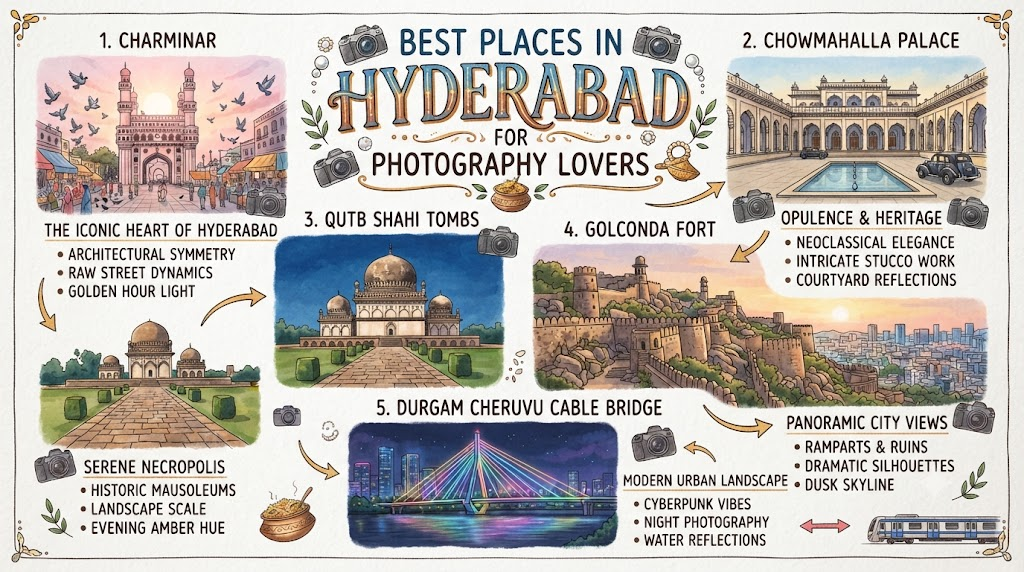
The Charminar is the absolute geographic and emotional heart of Hyderabad. Built to commemorate the end of a devastating plague, this monumental mosque features four grand arches framing four distinct, bustling bazaars. The real magic happens just as the city wakes up, when the soft, pink morning light cuts through the morning haze, illuminating thousands of pigeons taking flight across the granite structure.
Capturing the perfect shot here requires patience and a keen eye for street dynamics. As the hours tick by, the area transforms into a chaotic sea of shoppers, pearl vendors, and colorful glass bangle displays in the adjacent Laad Bazaar. The interplay of ancient stone architecture with the vibrant, fast-paced energy of modern local life provides an endless canvas for editorial and documentary-style frames.
The iconic Charminar at sunrise.
- Location: Old City, Ghansi Bazaar, roughly 4 kilometers from Nampally Railway Station.
- Why it is worth visiting: It is the definitive architectural symbol of Hyderabad, boasting unmatched opportunities for architectural symmetry and raw street photography.
- Best things to do: Shoot the classic framing angle through the windows of Nimrah Cafe, capture the swirling motion of the surrounding traffic using a slow shutter speed, and photograph the colorful bangle displays inside Laad Bazaar.
- Best time to visit: 5:30 AM to 7:00 AM for soft golden hour lighting and minimal crowds before the markets open.
- Ideal for whom: Street photographers, architectural purists, and cultural documentarians.
- Travel tip: Grab a window seat on the first floor of the nearby tea shops to get an elevated, unobstructed perspective of the monument without being jostled by crowds.
Chowmahalla Palace
If you want to capture the opulence of the Nizams without the chaotic rush of the street, Chowmahalla Palace is your sanctuary. This grand estate, meticulously modeled after the Shah of Iran’s palace in Tehran, is a masterclass in neoclassical architecture. The palace grounds are split into manicured courtyards, expansive green lawns, and massive ceremonial halls adorned with massive Belgian crystal chandeliers.
The interior spaces offer an incredible play of light and shadow. Sunlight pours through soaring yellow arched corridors, bouncing off polished marble floors to create clean reflections that are perfect for portraiture. Every corner reveals an ornate detail, from vintage yellow tilework to intricately carved wooden ceilings that tell stories of a lavish bygone era.
The neoclassical elegance of Chowmahalla Palace.
- Location: Khilwat, Old City, about 1 kilometer south of the Charminar.
- Why it is worth visiting: It offers an impeccably preserved look into royal Deccani heritage with flawless architectural symmetry and stunning indoor lighting.
- Best things to do: Capture the repeating geometric reflection of arches in the central courtyard pool, photograph the breathtaking ceiling configuration of the Khilwat Mubarak hall, and document the royal vintage car collection.
- Best time to visit: 10:00 AM right as the gates open to catch the morning light slanting through the western corridors.
- Ideal for whom: Fine-art photographers, architectural history buffs, and fashion portrait creators.
- Travel tip: Standard tripod use is generally restricted inside the main exhibition galleries, so increase your ISO settings and rely on lens stabilization for crisp interior shots.
Qutb Shahi Tombs
Tucked away from the urban hum, the Qutb Shahi Tombs represent one of the most cinematic and expansive historical necropolises in the world. This final resting place of the seven Qutb Shahi rulers has undergone an extensive, world-class restoration process. The result is a stunning parkland dotted with massive domed structures that combine Persian, Hindu, and Pathan architectural elements.
The grey granite domes contrasted against the manicured lawns and deep blue skies provide an incredible sense of scale. Photographers can easily spend half a day here exploring the intricate stucco work, hidden stepwells, and recessed stone staircases. It is a space where time slows down, allowing you to compose complex, minimal landscape frames that look entirely disconnected from a bustling modern city.
The grand necropolis of the Qutb Shahi Tombs.
- Location: Ibrahim Bagh, Secunderabad corridor, roughly 2 kilometers from the Golconda Fort entrance.
- Why it is worth visiting: The park offers a rare combination of monumental tomb architecture, ancient stepwells, and peaceful landscapes all in a single, uncrowded zone.
- Best things to do: Compose wide-angle landscape shots showcasing multiple domes in a single frame, find the hidden stepwell for dramatic leading lines, and capture close-up details of the intricate floral stucco patterns.
- Best time to visit: 3:30 PM to 5:30 PM when the setting sun turns the grey granite into a warm, glowing amber hue.
- Ideal for whom: Landscape photographers, minimalism lovers, and historical researchers.
- Travel tip: Carry a circular polarizer filter to maximize the contrast between the pale stone domes and the deep blue sky during mid-afternoon shoots.
Golconda Fort
Golconda Fort is an absolute colossus of stone and history, rising dramatically above the rocky Deccan landscape. Once famous for its legendary diamond mines that produced the Koh-i-Noor, this medieval citadel is a playground for wide-angle landscape photography. The fort walls stretch for kilometers over steep granite hills, offering jagged lines, massive iron-spiked gates, and cavernous acoustic halls.
Climbing to the Bala Hissar pavilion at the very top is a steep, sweaty endeavor, but the photographic reward is unmatched. From the summit, you get a breathtaking panoramic view of the entire Hyderabad skyline. The stark contrast between the ancient, crumbling stone ruins in the foreground and the glittering, modern high-rises of Hitech City on the horizon perfectly encapsulates the dual soul of Hyderabad.
- Location: Khairatabad district, Western Hyderabad, around 11 kilometers from the central city hub.
- Why it is worth visiting: It provides the ultimate panoramic vantage point of the city alongside sprawling, dramatic fortress architecture.
- Best things to do: Capture silhouettes of the ancient watchtowers against a blazing sunset, photograph the intricate shadow patterns created by the step-like ruins, and shoot the expansive view of the city skyline from the summit.
- Best time to visit: 4:00 PM onwards to catch the evening golden hour and stay for the dramatic light and sound show.
- Ideal for whom: Adventure travel photographers, panoramic landscape enthusiasts, and history buffs.
- Travel tip: Wear sturdy, high-grip shoes for the climb up, as the ancient stone steps have been worn smooth and slick by centuries of foot traffic.
Durgam Cheruvu & Cable Bridge
For a complete shift in visual aesthetics, head over to Durgam Cheruvu, affectionately known as the Secret Lake. This natural lake is framed on one side by ancient, jagged granite rock formations and on the other by the striking Durgam Cheruvu Cable Bridge. This modern suspension bridge, with its clean, parallel steel cables, looks like something straight out of a futuristic travel film.
When darkness falls, this location transforms into a cyberpunk dreamscape. The entire bridge lights up in shifting neon hues, casting long, colorful reflections across the dark lake water. The nearby high-rise corporate towers add layers of illuminated geometric patterns to the background, making it the premier location in the city for long-exposure night photography and modern urban landscapes.
- Location: Madhapur / Jubilee Hills corridor, nestled deep within the modern tech zone.
- Why it is worth visiting: It is the best spot in the city to capture Hyderabad’s slick, modern, high-tech urban identity and long-exposure night trails.
- Best things to do: Set up a tripod along the lakefront promenade for water reflections, use a telephoto lens to compress the bridge cables against the city skyscrapers, and capture light trails from passing vehicles on the deck.
- Best time to visit: 6:30 PM to 8:00 PM to capture the vibrant blue hour sky mixing with the artificial neon lights of the bridge.
- Ideal for whom: Urban landscape photographers, long-exposure specialists, and night sky enthusiasts.
- Travel tip: Use a dedicated lens hood when shooting on the bridge walkways to eliminate glare from the strong, direct overhead streetlights.
Offbeat Exploration: Hidden Gems Tourists Miss
Moula Ali Hill
This is an offbeat paradise for landscape photographers who want a view completely untouched by commercial tourism. To reach the top of this massive dome-shaped hill, you have to climb a winding staircase of roughly 500 steps worn smooth by centuries of pilgrims. At the summit sits a historic shrine, but the real draw for photographers is the raw, uninterrupted view of Secunderabad and the surrounding boulder-strewn Deccani landscape. The sunset from here is a dramatic, moody experience, casting a heavy golden flare over an endless horizon of rooftops and rocky outcrops.
State Central Library
Built in 1891 during the reign of Nizam Mir Mahbub Ali Khan, this magnificent heritage building is a dream for anyone who loves moody, cinematic interiors. The structure features grand high ceilings, massive arched windows that let in dusty beams of light, and rows upon rows of weathered, leather-bound books. The dark wooden stairways and vintage iron railings provide incredible framing opportunities for portraits that feel lost in time. It is a quiet, atmospheric space where the silence carries an immense visual weight.
Maqtha Art District
Located near MS Maqtha, this residential neighborhood has been transformed into an open-air public art gallery by local and international muralists. As you navigate the tight, labyrinthine alleys, the walls explode with bold geometric shapes, pastel portraits, and trippy abstract art. The laundry hanging between houses, children playing on the doorsteps, and everyday local life mixed against these massive, colorful backdrops create a surreal, high-contrast playground for street and fashion editorial photography.
Detailed Practical Guidance for Travelers
The following logistical matrix provides a quick-reference guide to planning your shoots at the primary photography locations discussed above.
| Destination | Standard Entry Fee | General Timings | Best Local Food Options Nearby | Recommended Nearby Attractions |
|---|---|---|---|---|
| Charminar | INR 40 (Indians), INR 300 (Foreigners) | 9:30 AM – 5:30 PM (Surroundings open 24/7) | Nimrah Cafe (Irani Chai & Bun Malai), Shadab Restaurant | Mecca Masjid, Laad Bazaar |
| Chowmahalla Palace | INR 100 (Indians), INR 400 (Foreigners) | 10:00 AM – 5:00 PM (Closed on Fridays) | Hotel Rumaan (Biryani & Kebabs) | Nizam Museum, Badshahi Ashurkhana |
| Qutb Shahi Tombs | INR 50 (Camera fee extra INR 100) | 9:30 AM – 4:30 PM (Open daily) | Shah Ghouse Hotel (Mandi & Biryani) | Deccan Park, Golconda Fort |
| Golconda Fort | INR 35 (Indians), INR 300 (Foreigners) | 9:00 AM – 5:30 PM (Open daily) | Local street food stalls outside the gate | Taramati Baradari, 7 Tombs |
| Durgam Cheruvu | Free entry to bridge walkway | Open 24/7 (Bridge lights active 6:30 PM – 11 PM) | The Hoppery (Craft cafe), Inorbit Mall dining | Inorbit Mall, Jubilee Hills cafes |
Logistics & On-Ground Navigation
Local Transport Options
Navigating across the distinct halves of Hyderabad requires a strategic mix of transport modes. For long-distance journeys between the modern Western tech corridor and the historic Old City, the Hyderabad Metro Rail is your fastest, air-conditioned savior, completely bypassing traffic bottlenecks. For short hops within the dense alleys of the Old City around Charminar, local Auto-Rickshaws are highly efficient, though you must negotiate fares firmly before stepping in.
For maximum flexibility when carrying heavy camera gear, app-based car rentals and ride-sharing services like Uber, Ola, and Rapido are highly recommended. They provide transparent, fixed pricing and a comfortable bubble against the intense midday heat.
Budget Planning
- Budget/Backpacking Tier: Expect to spend roughly INR 1,200 to INR 1,800 per day. This covers commuting primarily via the Metro and shared autos, eating at legendary street-side establishments like Nimrah or Shah Ghouse, and staying in highly rated hostels or budget guesthouses in the Secunderabad or Nampally zones.
- Mid-Range/Comfort Tier: Expect to spend roughly INR 4,000 to INR 6,500 per day. This path allows for dedicated app-based cab rentals for seamless gear transit, dining at comfortable heritage restaurants or trendy tech-corridor cafes, and lodging in boutique hotels or business-class accommodations in Madhapur or Gachibowli.
Safety and Inclusivity Tips
- Families: The primary heritage sites like Chowmahalla Palace and Qutb Shahi Tombs are incredibly spacious, safe, and welcoming for family groups. However, avoid taking large strollers into the dense, high-traffic market zones of Laad Bazaar.
- Couples: If you are conducting a couple’s portrait session or a pre-wedding shoot, opt for paid heritage venues or modern lakefront parks. Avoid overly secluded spots around the city outskirts after dark to ensure a comfortable experience.
- General Safety: Hyderabad is widely considered one of India’s safest metropolitan cities. That said, when shooting in dense market environments, practice basic situational awareness with your camera gear. Keep your equipment zipped up in a sturdy cross-body bag when navigating through heavy crowds.
Strategic Travel Planning Guardrails
Travel Planning Tips for Hyderabad
- Embrace Digital Payments: Almost every vendor, from upscale cafes to tiny street-side tea stalls, prefers instant digital payments via UPI (GPay, PhonePe). Keep a small amount of cash handy solely for monument entry ticket counters or local auto rides.
- Check Monument Holidays: Always double-check operational days before setting out; for instance, Chowmahalla Palace remains strictly closed to the public on Fridays.
- Dress Culturally Appropriately: When shooting near active places of worship like Mecca Masjid or the Moula Ali Shrine, ensure your shoulders and knees are fully covered. Carrying a light scarf to cover your head is highly recommended.
- Prepare for the Deccan Heat: The afternoon sun bouncing off grey granite monuments can be incredibly intense. Pack polarized sunglasses, apply high-SPF sunscreen, and carry plenty of water to stay hydrated during long outdoor shoots.
- Invest in a Good Camera Strap: A secure, slash-resistant cross-body sling strap is essential for keeping your camera stable and safe while navigating uneven heritage steps or crowded market lanes.
Common Mistakes to Avoid
- Over-packing Your Itinerary: Do not try to shoot the Charminar and the modern Cable Bridge on the exact same afternoon. The cross-city traffic will swallow up your prime golden hour shooting window.
- Assuming All Venues Allow Tripods: Most major historical sites in India classify tripods as commercial equipment and will stop you at the gate unless you have an expensive pre-approved permit. Learn to shoot handheld or utilize small, flexible stabilization options.
- Skipping the Local Street Food: Relying solely on room service or familiar western fast-food chains means missing out on the culinary soul of the city. The local Irani chai and street snacks are cultural experiences that belong in your travel journal.
- Ignoring the Monsoons: Do not automatically write off the rainy season. The months of July and August wash the dusty granite rock formations clean and turn the dry lake beds into lush, dramatic landscapes.
- Overpaying for Unmetered Autos: Never hop into a local auto waiting right outside a major tourist gate without agreeing on a price beforehand. Cross-reference the route distance on a map app to estimate a fair rate.
Suggested Itinerary Blueprints
1. One-Day Quick Dash (The Heritage Circuit)
This rapid-fire route is tailor-made for travelers on a tight schedule who want to capture the core historical essence of the city. Start at 5:30 AM at the Charminar to catch the sunrise light and the early morning street vibe. Walk over to Mecca Masjid at 7:30 AM for architectural scale, followed by a hearty breakfast of Irani chai and bun malai at Nimrah Cafe.
By 10:00 AM, head straight to Chowmahalla Palace to document the grand courtyards before the midday heat peaks. Take a lunch break, then spend your afternoon from 3:00 PM onwards exploring the Qutb Shahi Tombs, wrapping up your day with wide landscape frames as the sun dips below the horizon.
2. Two-Day Deep-Dive (Old Soul, New Horizons)
- Day 1: The Foundations of Empire. Spend your entire morning exploring the massive ramparts of Golconda Fort, starting at 9:00 AM. After a heavy local lunch, spend your late afternoon wandering through the peaceful paths of the Qutb Shahi Tombs for golden hour light.
- Day 2: Markets and Modernity. Begin at 6:00 AM in the chaotic, colorful lanes of the Gudimalkapur Flower Market to capture fast-paced street portraits. Transition to Chowmahalla Palace by mid-morning. In the evening, head over to the Durgam Cheruvu Cable Bridge to capture long exposures of the neon-soaked urban skyline.
3. Complete Weekend Travel Plan (The Ultimate Portfolio Loop)
- Friday Evening: Arrive and set up at the Hussain Sagar Lake promenade. Capture the giant Buddha statue illuminated against the twilight sky.
- Saturday: Dedicate the morning to the classic Old City loop (Charminar, Laad Bazaar, and Chowmahalla Palace). In the late afternoon, take the 500-step climb up Moula Ali Hill to capture a panoramic sunset view over the entire city landscape.
- Sunday: Start with a quiet, moody interior shoot at the State Central Library at opening time. Spend your afternoon exploring the vibrant public murals of the Maqtha Art District, and end your weekend with a long-exposure night session at the Durgam Cheruvu Cable Bridge.
Common Tourist Mistakes to Avoid
- Geographic Blunders: Trying to shoot a sunrise in the old city and a morning landscape in Hitech City on the same day is a recipe for frustration. Group your destinations strictly by zones to avoid spending your best lighting windows trapped in traffic.
- Commercial Traps: Spending your limited travel hours inside the massive, air-conditioned shopping malls of Jubilee Hills or Gachibowli will yield generic results. Seek out the historic lanes, local bazaars, and traditional neighborhoods where the real textures of Hyderabad live.
- Neglecting Modern/Alternative Zones: Do not fall into the trap of thinking Hyderabad is only about old ruins. The sharp lines of the cyber corridors, the street art districts, and the quiet lakeside parks offer a brilliant modern contrast that adds depth to any travel portfolio.
- Transport Overpayment: Always cross-reference your travel distances on ride-sharing apps before hailing a roadside vehicle. If a local driver refuses to offer a reasonable rate, simply book an app-based cab or walk to the nearest metro station to avoid getting price-gouged.
- Luxury Dining Bias: While the fine-dining restaurants inside restored palaces offer incredible luxury, the true culinary heart of Hyderabad is found at the street level. The tiny tea stalls, bustling biryani joints, and local breakfast spots offer an authentic sensory experience that you cannot replicate in a curated dining room.
Frequently Asked Questions
1. Is a special permit required for photography at major heritage sites in Hyderabad?
Standard smartphone photography and casual DSLR shooting for personal use do not require any special advance permits at public monuments like Charminar or Golconda Fort. However, you will have to pay a nominal camera entry fee at the ticket counter. If you plan to use professional gear for commercial work, fashion editorials, or pre-wedding shoots involving multiple outfit changes, you must secure formal written permission and pay a higher commercial venue fee from the respective heritage department.
2. Can I use a tripod or drone at the Qutb Shahi Tombs or Golconda Fort?
Drones are strictly banned across all public monuments and urban areas in Hyderabad due to strict archaeological protection laws and military airspace restrictions. Tripods are generally prohibited inside enclosed galleries, museum rooms, and high-traffic areas of Golconda Fort and Chowmahalla Palace to prevent safety hazards for other visitors. If you need steady shots, rely on a monopod, a compact flexible stabilizer, or lean against stable stone surfaces.
3. What is the single best location in Hyderabad to capture a classic sunset skyline?
The absolute best vantage point for an uninterrupted, dramatic sunset view is the summit of Moula Ali Hill or the highest pavilion of Golconda Fort. Both locations elevate you well above the urban haze, providing a panoramic view where you can watch the sun sink below the horizon while the city lights begin to blink on across the sprawling landscape.
4. Where can I find genuine street photography opportunities without overwhelming crowds?
If you want the texture of the Old City without the intense mid-day crush of the Charminar markets, explore the quiet residential lanes behind the Chowmahalla Palace or head over to the Maqtha Art District. These neighborhoods offer beautiful vintage doorways, colorful walls, and authentic local life moving at a relaxed, approachable pace.
5. What lenses should I pack for a comprehensive photography tour of Hyderabad?
A versatile travel kit should include a wide-angle zoom lens (like a 16-35mm) to capture the massive scale of the fort walls, grand palace courtyards, and expansive domes. Additionally, pack a fast prime lens (such as a 35mm or 50mm f/1.8) for low-light indoor spaces, moody portraits inside the library, and quick candid street photography around the busy bazaars.
6. Is it safe for a solo photographer to explore the Old City areas late at night?
Yes, the Old City area is generally very safe and remains highly active well into the midnight hours, especially around popular culinary hubs. However, from a photography perspective, the narrow, unlit alleys away from the main streets can become difficult to navigate safely in the dark. Stick to the well-illuminated main market roads for night street photography.
7. How do I handle the local crowds when trying to take candid street portraits?
Hyderabadi residents are remarkably warm, polite, and hospitable. If you want to take a portrait of a local vendor or artisan, a simple smile, a polite nod, and asking for permission goes a long way. Most people will happily pose for a frame. Always show them the captured image on your camera screen afterward as a gesture of appreciation.
8. Are there any specific clothing restrictions I need to be aware of when visiting these sites?
While secular tourist spots like Golconda Fort do not have strict dress codes, locations that share space with active religious shrines—like the Mecca Masjid next to Charminar or the mosque inside the Qutb Shahi Tombs grounds—require conservative attire. Ensure your shoulders and knees are fully covered, and keep a light scarf handy in your camera bag to cover your head if requested.
9. Where can I capture water reflection shots of the city lights at night?
The lakeside promenade along Durgam Cheruvu, right near the base of the Cable Bridge, is the premier spot for night reflections. The calm water acts as a perfect dark mirror, catching the shifting neon illumination of the suspension cables and the distant glittering high-rises of the tech corridor.
10. What is the best season to plan a dedicated photography trip to Hyderabad?
The winter months from October to March offer the most comfortable shooting conditions. During this period, the daytime temperatures are mild, the skies are crisp and blue, and the early mornings often bring a soft, atmospheric mist that adds a beautiful, dreamlike layer to your landscape and heritage frames.
11. Is it easy to find charging points or camera accessory shops near the heritage zones?
The historic Old City zones have limited modern electronics infrastructure, so you will not find high-end camera shops easily near the monuments. Always set out with fully charged batteries and empty memory cards. If you need emergency camera gear, rentals, or repairs, you will need to head to the central commercial districts like Secunderabad or Madhapur.
12. How can I get an elevated view of the Charminar without using a drone?
To get a safe, legal, and elevated perspective of the Charminar and the swirling crowds below, walk over to the first-floor seating area of Nimrah Cafe or any of the multi-story tea and spice shops framing the central monument square. Ordering a hot cup of tea easily buys you the time and space to compose beautiful, elevated frames through their open windows.
Conclusion
Choosing to explore Hyderabad with a camera is far more than a simple sightseeing trip; it is an intellectual and creative awakening. This city rewards the patient observer who looks past the surface chaos to find the quiet symmetry of a royal courtyard, the long shadow stretching across an ancient tomb, or the warm smile of a street vendor pouring a cup of tea. By stepping off the overly manicured tourist trail and embracing the raw, contrasting textures of this historic capital, your portfolio gains something incredibly rare: a genuine soul. You will leave this place not just with a collection of beautiful frames, but with a deep, lasting connection to a destination where history is a living, breathing story.
