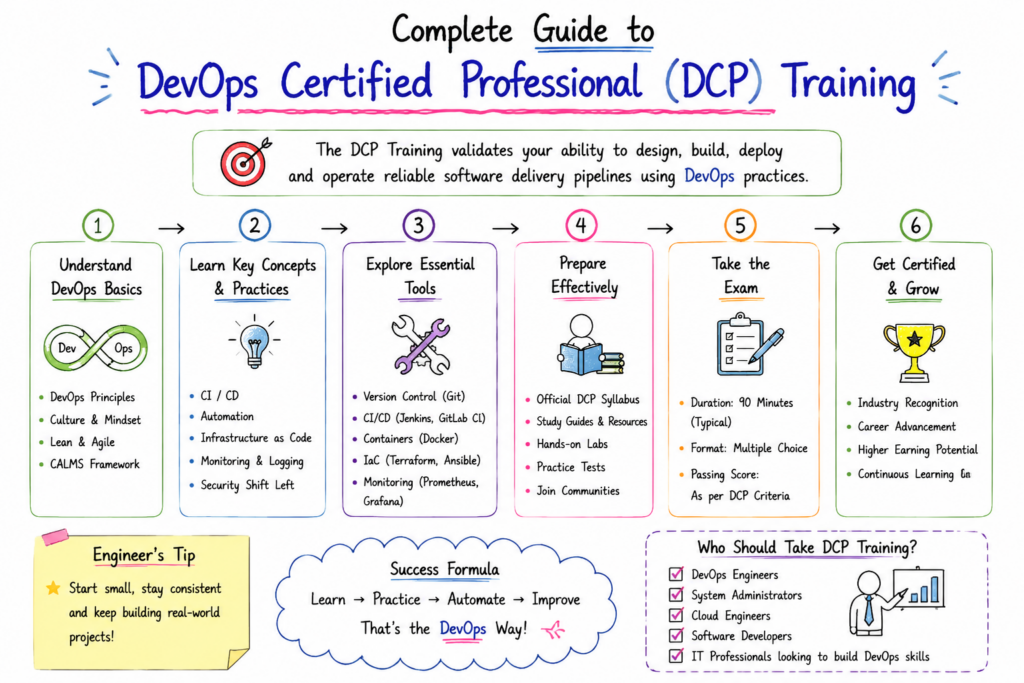
Introduction
The DevOps Certified Professional (DCP) is a comprehensive roadmap designed for engineers who want to bridge the gap between software development and IT operations. This guide is for professionals who feel stuck in traditional silos and want to move into modern platform engineering and cloud-native roles. In today’s fast-paced market, understanding the full lifecycle of a product—from code to production—is no longer optional.
This guide helps you navigate the complexities of modern engineering careers by breaking down the DevOps Certified Professional (DCP) into manageable milestones. We focus on providing a clear path so that working professionals can make informed decisions about their learning journey. By the end of this article, you will understand how this certification aligns with your specific career goals and daily technical challenges.
What is the DevOps Certified Professional (DCP)?
The DevOps Certified Professional (DCP) represents a standard of excellence in the engineering community that prioritizes hands-on skill over theoretical knowledge. It exists to validate that an engineer can handle the pressure of production environments while maintaining the speed of delivery. Unlike basic courses, this certification focuses on the practical application of tools within enterprise-scale workflows.
It aligns perfectly with modern engineering practices by teaching you how to build resilient systems using automation and continuous feedback loops. Whether you are working in a startup or a large corporation, the principles covered here are universal. The goal is to move beyond just knowing “how to use a tool” and toward understanding “how to design a system.”
Who Should Pursue DevOps Certified Professional (DCP)?
Software engineers and system administrators who want to transition into SRE or Platform roles will find the most value in this program. It is also highly beneficial for security professionals looking to integrate into the development cycle and data engineers who need to automate their pipelines. The curriculum is broad enough to support beginners while offering depth for experienced seniors.
In the global market, and specifically within the Indian IT landscape, there is a massive demand for engineers who can manage complex cloud infrastructures. Managers and technical leaders should also consider this path to better understand the technical hurdles their teams face daily. It provides a common language for everyone involved in the software delivery process.
Why DevOps Certified Professional (DCP)
The demand for skilled DevOps engineers continues to grow as more companies move their core business operations to the cloud. Longevity in this field depends on your ability to adapt to changing toolsets while maintaining a firm grasp of underlying architectural principles. This certification ensures you stay relevant by focusing on core competencies that do not expire when a new tool becomes popular.
Investing time in the DevOps Certified Professional (DCP) offers a high return on effort because it addresses the most common bottlenecks in software delivery. Enterprises are moving away from generalists and toward certified specialists who can prove their expertise in automation and reliability. This certification acts as a signal to employers that you are ready to take on high-stakes production responsibilities.
DevOps Certified Professional (DCP) Certification Overview
The program is delivered via the official and is hosted on the devopsschool platform. The certification is structured into practical modules that cover everything from version control to cloud orchestration. Each level of the program is designed to build upon the last, ensuring a steady learning curve for all participants.
Ownership of your learning is emphasized through a project-based assessment approach rather than simple multiple-choice questions. This ensures that when you earn your certificate, you have actually demonstrated the ability to solve real-world problems. The structure is transparent and focuses on the skills that technical hiring managers are actually looking for in candidates.
DevOps Certified Professional (DCP) Certification Tracks & Levels
The certification is divided into Foundation, Professional, and Advanced levels to cater to different stages of a career. The Foundation level introduces the core concepts of automation and culture, while the Professional level dives deep into tool integration and CI/CD. The Advanced level is for those who want to master complex topics like microservices architecture and large-scale orchestration.
Specialization tracks allow you to focus on specific domains such as SRE, FinOps, or DevSecOps once you have mastered the basics. This allows for a flexible career progression where you can start as a generalist and eventually become a subject matter expert. Each level is carefully mapped to specific job responsibilities and seniority levels within an engineering organization.
Complete DevOps Certified Professional (DCP) Certification Table
| Track | Level | Who it’s for | Prerequisites | Skills Covered | Recommended Order |
| Core DevOps | Foundation | Aspiring Engineers | Basic Linux | Git, Docker, CI/CD | 1st |
| Core DevOps | Professional | Active SREs/Devs | 1-2 years exp | Kubernetes, Jenkins | 2nd |
| Engineering | Advanced | Senior Architects | Pro Level Cert | IAC, Monitoring | 3rd |
| Security | Specialist | Security Analysts | Foundation | Vault, SonarQube | Optional |
| SRE | Specialist | Platform Engineers | Foundation | ELK, Prometheus | Optional |
Detailed Guide for Each DevOps Certified Professional (DCP) Certification
DevOps Certified Professional (DCP) – Foundation Level
What it is
This certification validates your understanding of the basic pillars of DevOps, including culture, automation, and basic tooling. It confirms you can contribute to a modern team effectively.
Who should take it
It is suitable for fresh graduates, traditional system administrators, or developers who are new to the world of automation and cloud-native practices.
Skills you’ll gain
- Mastery of Git and version control workflows.
- Basic understanding of containerization with Docker.
- Introduction to continuous integration principles.
- Knowledge of Agile and DevOps cultural practices.
Real-world projects you should be able to do
- Setting up a basic automated build pipeline for a simple web app.
- Containerizing a legacy application for consistent deployment.
- Managing code versions across a small team using branching strategies.
Preparation plan
- 7-14 Days: Focus on Linux command line basics and understanding the DevOps lifecycle through documentation.
- 30 Days: Practice Dockerizing different types of applications and setting up local Jenkins instances.
- 60 Days: Build a complete end-to-end pipeline that includes automated testing and basic deployment.
Common mistakes
- Skipping the cultural aspects to focus only on tools.
- Not spending enough time learning the Linux terminal.
Best next certification after this
- Same-track option: DCP Professional Level.
- Cross-track option: SRE Foundation.
- Leadership option: Team Lead Certification.
DevOps Certified Professional (DCP) – Professional Level
What it is
This certification validates your ability to manage complex toolchains and integrate multiple platforms into a cohesive automated system. It proves you are ready for middle-management technical roles.
Who should take it
Active engineers with at least a year of hands-on experience in automation who want to specialize in high-availability systems and cloud orchestration.
Skills you’ll gain
- Advanced Kubernetes orchestration and cluster management.
- Complex CI/CD pipeline design with multiple environments.
- Infrastructure as Code (IaC) using tools like Terraform.
- Monitoring and logging integration for production health.
Real-world projects you should be able to do
- Deploying a multi-node Kubernetes cluster on a public cloud provider.
- Automating infrastructure provisioning for a microservices architecture.
- Implementing a zero-downtime deployment strategy like Blue-Green or Canary.
Preparation plan
- 7-14 Days: Deep dive into Kubernetes manifests and networking concepts.
- 30 Days: Work on Terraform modules to automate repeatable infrastructure tasks.
- 60 Days: Integrate security scanning and performance testing into your main deployment pipelines.
Common mistakes
- Ignoring the cost implications of cloud-native infrastructure.
- Over-complicating pipelines with too many unnecessary tools.
Best next certification after this
- Same-track option: DCP Advanced/Expert Level.
- Cross-track option: DevSecOps Professional.
- Leadership option: Engineering Manager Track.
Choose Your Learning Path
DevOps Path
This path focuses on the core principles of continuous delivery and rapid feedback. You will learn how to break down the walls between development and operations to ensure software is released faster and with fewer bugs. It is the most common starting point for engineers transitioning from traditional roles.
DevSecOps Path
The security path is designed for those who believe security should be part of the pipeline from day one. You will learn how to automate vulnerability scanning and secret management without slowing down the development team. This is a high-demand path as security threats become more sophisticated.
SRE Path
Site Reliability Engineering is about applying software engineering principles to operations problems. You will focus on service level objectives (SLOs), error budgets, and building self-healing systems. This path is ideal for engineers who love deep technical troubleshooting and system design.
AIOps / MLOps Path
This modern path focuses on automating the lifecycle of machine learning models and using AI to improve IT operations. You will learn how to manage data drift and model retraining pipelines. It is perfect for those working at the intersection of data science and systems engineering.
DataOps Path
DataOps is for professionals who manage large-scale data platforms and want to apply DevOps principles to data engineering. You will learn about data versioning, automated testing for datasets, and scalable data infrastructure. It ensures data is reliable and accessible across the enterprise.
FinOps Path
FinOps focuses on the financial management of cloud resources to ensure teams get the most value out of their spending. You will learn how to monitor cloud costs, optimize resource usage, and foster accountability among engineering teams. This is essential for companies scaling their cloud footprint.
Role → Recommended (Topic name) Certifications
| Role | Recommended Certifications |
| DevOps Engineer | DCP Foundation + DCP Professional |
| SRE | DCP Professional + SRE Specialist |
| Platform Engineer | DCP Advanced + IaC Specialist |
| Cloud Engineer | DCP Professional + Cloud Native Track |
| Security Engineer | DCP Foundation + DevSecOps Specialist |
| Data Engineer | DCP Foundation + DataOps Specialist |
| FinOps Practitioner | DCP Foundation + FinOps Specialist |
| Engineering Manager | DCP Foundation + Leadership Module |
Next Certifications to Take After DevOps Certified Professional (DCP)
Same Track Progression
Once you complete the core levels, the best move is to seek specialized “Expert” designations within the same ecosystem. This allows you to master specific tools like advanced Kubernetes or specialized CI/CD platforms. Deepening your knowledge in your current track ensures you remain the go-to person for complex technical challenges.
Cross-Track Expansion
If you want to become a versatile lead engineer, broadening your skills is the way to go. For example, a DevOps pro should look into security or cost management to understand the bigger picture of enterprise engineering. This makes you more valuable during high-level architectural discussions and planning sessions.
Leadership & Management Track
For those looking to move away from daily coding and toward people or project management, the leadership track is ideal. It focuses on the ROI of technical decisions, team culture, and strategic alignment. Understanding the technical debt and the “why” behind the tools helps you become a much more effective manager.
Training & Certification Support Providers for DevOps Certified Professional (DCP)
DevOpsSchool
DevOpsSchool stands out as a primary resource for engineers looking for interactive and mentor-led training. They provide a vast library of tutorials and live sessions that focus on the practical application of the DCP curriculum. Their community is active, providing a space where professionals can discuss real-world scenarios and get feedback from peers who are currently working in the field. This platform is excellent for those who prefer a structured learning environment with direct access to experts who can clarify complex topics.
Cotocus
Cotocus specializes in providing high-end technical training and consulting services that align with enterprise needs. They focus on bridging the gap between academic learning and industrial requirements, making them a great choice for professionals in corporate environments. Their approach to the DCP certification often involves case studies from their consulting branch, giving students a unique look at how these tools are used in large-scale production. It is a solid choice for those who want to see the business impact of their technical skills.
Scmgalaxy
Scmgalaxy is one of the oldest and most trusted community-driven platforms in the SCM and DevOps space. It offers a wealth of free and premium resources, including white papers, tool-specific guides, and interview preparation materials. For someone pursuing the DCP, Scmgalaxy provides the technical depth needed to understand the history and evolution of these tools. Their focus on the “Software Configuration Management” aspect of the lifecycle is particularly useful for engineers dealing with legacy systems or complex build processes.
BestDevOps
BestDevOps focuses on curating the most effective learning paths and best practices for modern engineering teams. They offer a streamlined perspective on the DCP certification, highlighting the most critical skills that lead to immediate job performance improvements. Their content is often updated to reflect the latest trends in the industry, ensuring that students aren’t learning outdated techniques. If you are looking for a focused, efficient way to master the core competencies of a DevOps professional, this provider is highly recommended.
devsecopsschool
As the name suggests, devsecopsschool is the authority on integrating security into the DevOps lifecycle. They provide specialized training that complements the DCP by adding layers of security automation and compliance as code. Their instructors are experts at teaching how to “shift left” without causing friction in the development process. For an engineer who wants to specialize in protecting modern infrastructure while maintaining speed, this is the most relevant support provider to partner with during their certification journey.
sreschool
SRESchool is dedicated to the art and science of reliability, focusing on how to keep systems running at scale. Their training programs are a perfect follow-up or parallel to the DCP, as they dive deep into observability, incident management, and performance tuning. They teach the mathematical and engineering side of operations, helping you understand how to manage risk through data. For those aiming for high-level SRE roles in major tech firms, the resources here are invaluable for mastering production stability.
aiopsschool
AIOpsSchool is at the forefront of the next wave of IT operations, teaching how to use machine learning to manage complex systems. They provide the necessary context for DCP candidates to understand how automation is evolving into autonomous systems. Their training covers everything from anomaly detection to automated root cause analysis. This is a forward-thinking provider for engineers who want to stay ahead of the curve and understand how artificial intelligence will change the way we manage cloud-native environments in the coming years.
dataopsschool
DataOpsSchool bridges the gap between data science and operational excellence. They offer training that applies the principles of the DCP to the world of data engineering and analytics. Their curriculum focuses on the automated delivery of data pipelines and the infrastructure required to support them. As data becomes the core of every business, understanding how to apply DevOps to data is a critical skill. This provider is essential for anyone working in data-heavy industries who needs to ensure their pipelines are as robust as their code.
finopsschool
FinOpsSchool addresses the critical need for financial accountability in the cloud. They provide specialized training on how to manage and optimize cloud spending without sacrificing performance or innovation. For DCP candidates, this provides the “business side” of engineering, teaching you how to justify costs to stakeholders and eliminate waste. Their programs are highly practical, offering tools and frameworks that can be applied immediately to reduce a company’s cloud bill while maintaining operational efficiency.
Frequently Asked Questions (General)
- How difficult is the DCP certification for a beginner? It is designed to be challenging but accessible if you follow the recommended learning paths and spend time on labs.
- What are the basic prerequisites for starting this journey? You should have a basic understanding of the Linux command line and at least one programming or scripting language.
- How long does it typically take to complete the Professional level? Most working professionals take between three to five months to feel fully prepared for the assessment.
- Is the certification recognized by global technology companies? Yes, the skills validated are standard across the industry worldwide, especially in the US and India.
- Do I need to be a developer to become a DevOps Certified Professional? No, but you must be comfortable reading code and writing scripts to automate infrastructure tasks.
- How much of the exam is theoretical versus practical? The program heavily favors practical, hands-on tasks over memorizing definitions or theoretical models.
- What is the return on investment (ROI) for this program? Most certified engineers report a significant increase in salary and job opportunities within six months of completion.
- Can I take the levels out of order? While possible, it is highly recommended to follow the foundation-to-advanced sequence to avoid knowledge gaps.
- Are there any recurring fees to maintain the certification? Typically, you may need to update your certification every few years to stay current with modern toolsets.
- Does the course cover multiple cloud providers like AWS and Azure? Yes, the principles are cloud-agnostic, though specific examples may use popular providers for clarity.
- What kind of support is available if I get stuck during my labs? Most providers offer community forums, mentor sessions, and technical support to help you through hurdles.
- Will this help me move into a management role? Absolutely, it provides the technical grounding necessary to lead engineering teams and make strategic decisions.
FAQs on DevOps Certified Professional (DCP)
- What makes the DCP unique compared to other vendor-specific certifications? It focuses on the end-to-end lifecycle rather than just one specific cloud tool, making your skills more portable across different companies and tech stacks.
- How does DCP address the growing need for automation in the enterprise? It teaches you to build sustainable automation frameworks that can scale with the business, rather than just writing isolated scripts for small tasks.
- Is there a focus on legacy system migration within the DCP curriculum? Yes, a significant portion of the training involves how to containerize and modernize older applications to fit into modern CI/CD pipelines.
- Does the program include training on security best practices? Security is integrated into every module, ensuring you learn to build safe systems from the ground up rather than as an afterthought.
- Can I complete the DCP labs on my local machine? While some basics can be done locally, you will eventually need access to cloud environments to practice at scale.
- How does DCP help with incident response and system reliability? It covers observability and monitoring extensively, giving you the tools to detect and fix issues before they impact the end user.
- Are there group discounts for corporate engineering teams? Many providers offer custom packages for companies looking to upskill their entire department at once.
- What is the best way to prepare for the DCP final assessment? Hands-on practice is the only way; you should aim to build several complete projects from scratch before attempting the final exam.
Final Thoughts: Is DevOps Certified Professional (DCP) Worth It?
If you are looking for a way to future-proof your career in IT, the answer is a clear yes. The DevOps Certified Professional (DCP) is not just a piece of paper; it is a validation of your ability to handle the complexity of modern software systems. We are moving toward a world where the boundary between code and infrastructure is invisible, and this certification puts you right at the center of that shift.
My advice as a mentor is to focus on the “why” behind every tool you learn. Don’t just learn Jenkins because it’s popular; learn why we need continuous integration in the first place. This mindset, combined with the practical skills from the DCP, will make you an invaluable asset to any engineering team. It’s a marathon, not a sprint, so take your time to master the fundamentals before moving to the flashy tools.
