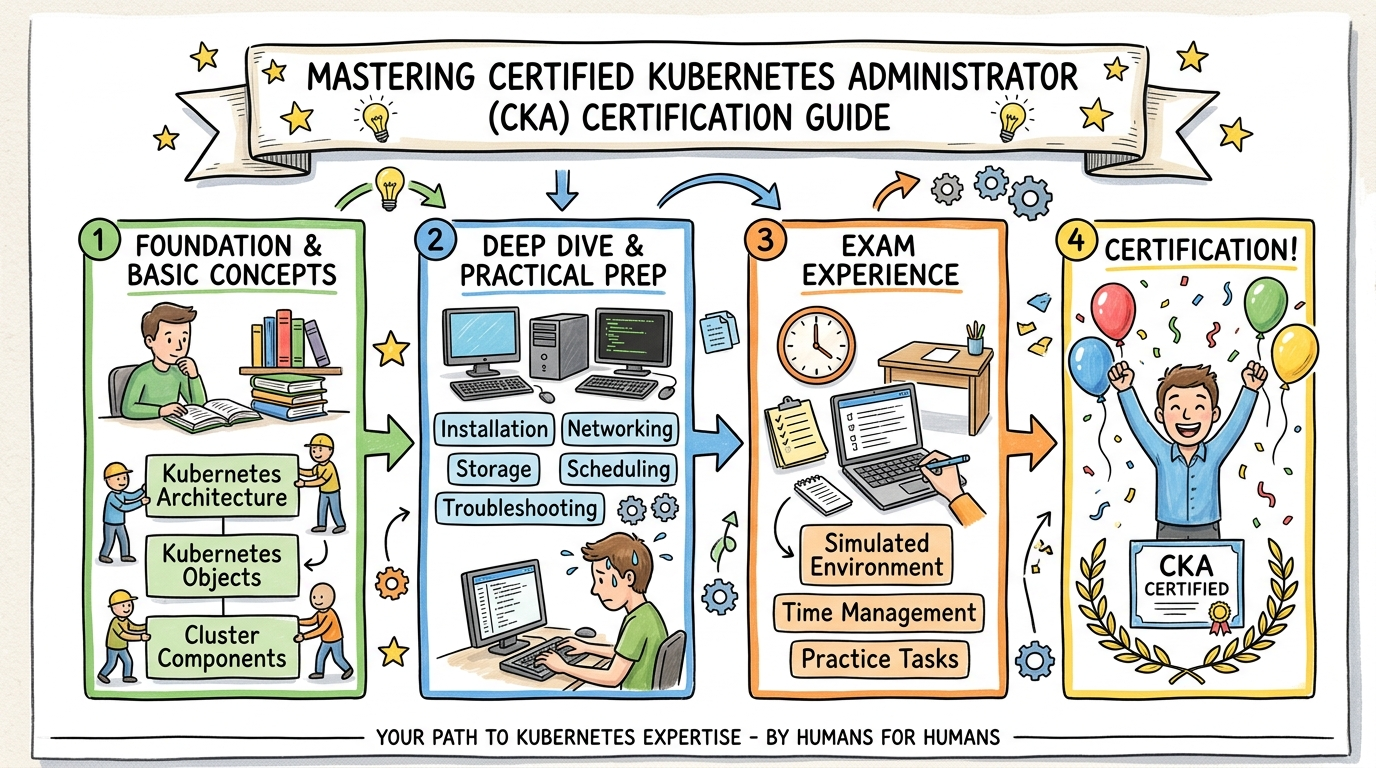
Introduction
Navigating the modern cloud-native landscape requires a deep understanding of container orchestration, and the Certified Kubernetes Administrator (CKA) designation stands as the definitive benchmark for engineering professionals. This comprehensive guide is designed for systems administrators, development operations engineers, and platform leaders who want to validate their ability to manage production-grade clusters. By exploring the core components of the examination, this resource provides clear, actionable insights to help professionals make informed decisions about their career path. Investing time into this technical milestone enables infrastructure teams to establish reliable cloud practices and helps individual contributors secure top-tier roles across global enterprise markets, including the highly competitive tech sectors in India. For those looking to expand their expertise across automated infrastructure operations, exploring foundational courses on platforms like aiopsschool can provide a strong complementary skill set alongside container management.
What is the Certified Kubernetes Administrator (CKA)?
The Certified Kubernetes Administrator (CKA) certification is a practical, performance-based assessment that verifies an engineer’s capability to install, configure, and manage production-ready Kubernetes clusters. Unlike traditional multiple-choice exams that focus purely on theoretical definitions, this program requires candidates to solve real-world problems directly inside a live command-line interface. It exists to solve a critical industry challenge: ensuring that platform engineers can handle real-time infrastructure failures, resource constraints, and networking issues. Enterprise workflows rely heavily on distributed applications, making the ability to troubleshoot core cluster components a mandatory requirement rather than an optional skill. By aligning closely with daily operational responsibilities, this certification serves as a reliable filter for companies looking to hire true technical specialists.
Who Should Pursue Certified Kubernetes Administrator (CKA)?
This certification is highly beneficial for system administrators, site reliability engineers (SREs), cloud architects, and platform developers who deal with containerized workloads on a daily basis. Beginners in cloud infrastructure can use this structured learning path to bridge the gap between basic container runtime knowledge and enterprise-level orchestration. Experienced professionals use it to formalize their practical background, while engineering managers find the curriculum valuable for understanding the operational risks and resource demands of modern cloud environments. On a global scale, and specifically within India’s rapidly growing IT outsourcing and product development sectors, having this credential signals that an engineer can immediately contribute to complex infrastructure migration projects without requiring extensive foundational training.
Why Certified Kubernetes Administrator (CKA)
The enterprise adoption of container technologies continues to grow at an unprecedented rate, making cluster management tools a permanent fixture in modern data centers. Obtaining this certification ensures long-term career longevity because it emphasizes vendor-neutral principles that apply to all major cloud service providers and on-premises deployments. Tools and specific cloud interfaces may shift over time, but the underlying architecture of container orchestration remains consistent across the industry. The return on investment for this credential is exceptionally high, as it translates directly into minimized system downtime, better infrastructure cost optimization, and more efficient application deployment pipelines. For any engineer looking to remain relevant in a changing market, mastering these fundamental cluster operations is a highly secure career investment.
Certified Kubernetes Administrator (CKA) Certification Overview
The structured educational program for this curriculum is delivered via devopsschool and is officially hosted on the devopsschool platform. The assessment approach focuses heavily on administrative competence, evaluating how well an engineer can handle cluster architecture, installation, troubleshooting, and security configurations. Rather than testing memorization, the program evaluates active problem-solving skills under realistic time constraints, ensuring that successful candidates possess genuine technical autonomy. The entire structure is maintained and updated frequently to reflect the latest upstream releases of the orchestration platform. This ongoing alignment with current software releases ensures that the skills validated during the assessment are immediately applicable to modern enterprise production environments.
Certified Kubernetes Administrator (CKA) Certification Tracks & Levels
The container orchestration learning path is divided into foundational, professional, and advanced tiers to support progressive career development. The foundational tier introduces basic container concepts and application definition patterns, allowing newcomers to familiarize themselves with basic declarative syntax. The professional tier, represented by the core administration exam, focuses on deep infrastructure control, networking, cluster maintenance, and diagnostic tasks. Advanced tiers move into specialized tracks such as cloud-native security implementations and complex application developer configurations. This multi-level alignment allows technical professionals to systematically build their capabilities, transforming from junior team members into principal engineers capable of designing resilient corporate architectures.
Complete Certified Kubernetes Administrator (CKA) Certification Table
| Track | Level | Who it’s for | Prerequisites | Skills Covered | Recommended Order |
|---|---|---|---|---|---|
| Core Administration | Professional | Systems Administrators & SREs | Basic Linux CLI knowledge | Cluster setup, logging, storage, networking | Second Step |
| Application Development | Professional | Cloud Developers & DevOps Engineers | Container basics | Pod design, deployments, configmaps | First Step |
| Security Engineering | Advanced | SecOps & Infrastructure Architects | Core Administration certificate | Cluster hardening, system auditing | Third Step |
Export to Sheets
Detailed Guide for Each Certified Kubernetes Administrator (CKA) Certification
Certified Kubernetes Administrator (CKA) – Core Administration
What it is
This performance-based certification validates the practical skills required to configure, maintain, and troubleshoot production-grade Kubernetes clusters from the command line.
Who should take it
Systems administrators, platform engineers, and site reliability specialists who have at least one year of hands-on experience managing infrastructure environments.
Skills you’ll gain
- Installing and configuring production-ready cluster components using deployment utilities.
- Troubleshooting complex network connection issues and pod initialization errors.
- Implementing persistent storage volumes and configuring access policies for workloads.
- Performing manual cluster upgrades and scheduling backups for the control plane state store.
Real-world projects you should be able to do
- Provision a multi-node cluster from scratch on bare-metal or cloud instances.
- Diagnose and repair a broken control plane component caused by certificate expiration.
Preparation plan
- 7–14 days: Review core architecture definitions, master command-line shortcuts, and focus heavily on understanding declarative configuration files.
- 30 days: Build multiple experimental clusters locally, practice manual component modification, and regularly run imperative commands to build speed.
- 60 days: Execute comprehensive practice exams under timed constraints, focus deeply on complex networking scenarios, and study official documentation structures.
Common mistakes
- Failing to manage time effectively during the practical exam, leading to unfinished high-weight troubleshooting scenarios.
- Relying too heavily on copy-pasting code blocks from documentation rather than typing clean, accurate imperative commands.
- Neglecting to double-check the current cluster context before running destructive administration commands.
Best next certification after this
- Same-track option: Certified Kubernetes Security Specialist (CKS)
- Cross-track option: Certified Kubernetes Application Developer (CKAD)
- Leadership option: Cloud-Native Enterprise Architect Certification
Choose Your Learning Path
DevOps Path
Engineers following this path focus heavily on continuous integration, automated infrastructure deployment, and configuration management. Learning to orchestrate container environments allows these professionals to bridge the gap between application code delivery and stable underlying platform operations. This path emphasizes declarative setup styles and automated testing routines.
DevSecOps Path
This specialty prioritizes infrastructure hardening, secure container supply chains, and automated compliance auditing. Professionals on this track integrate security scanning directly into deployment workflows and set up strict resource isolation rules across cluster nodes. It ensures that safety policies do not slow down deployment cycles.
SRE Path
Site Reliability Engineering centers on platform uptime, system performance, metric monitoring, and automated incident response. Mastering cluster internals allows SREs to build self-healing infrastructures, define accurate service level objectives, and troubleshoot deep network routing failures. The focus remains on systemic scaling and error reduction.
AIOps Path
This path applies machine learning algorithms and advanced data analysis to automate IT operations and predict platform failures. Engineers utilize smart patterns to observe cluster performance trends, automate capacity planning, and remediate system errors without human intervention. It merges predictive analytics with infrastructure administration.
MLOps Path
Professionals on this track focus specifically on deploying, scaling, and managing machine learning models inside containerized environments. They configure distributed training workflows, manage GPU resource allocations, and ensure smooth transitions from data science sandboxes to production pipelines. It bridges data science with platform reliability.
DataOps Path
This discipline brings agile principles to data pipeline management, data warehousing, and distributed storage systems. Engineers learn to run high-throughput data processing engines and stateful database workloads reliably across scalable node pools. The primary objective is ensuring continuous data delivery and processing integrity.
FinOps Path
This path combines financial accountability with cloud engineering to maximize business value and control operational spend. Professionals analyze container resource utilization, configure accurate namespace quotas, and track cluster spending trends against business output. It ensures engineering teams scale their infrastructure cost-effectively.
Role → Recommended Certified Kubernetes Administrator (CKA) Certifications
| Role | Recommended Certifications |
|---|---|
| DevOps Engineer | Certified Kubernetes Administrator (CKA), Certified Kubernetes Application Developer (CKAD) |
| SRE | Certified Kubernetes Administrator (CKA), Cloud-Native Observability Specialist |
| Platform Engineer | Certified Kubernetes Administrator (CKA), Certified Kubernetes Security Specialist (CKS) |
| Cloud Engineer | Certified Kubernetes Administrator (CKA), Multi-Cloud Infrastructure Professional |
| Security Engineer | Certified Kubernetes Security Specialist (CKS), DevSecOps Certified Professional |
| Data Engineer | Certified Kubernetes Administrator (CKA), Distributed Big Data Systems Architect |
| FinOps Practitioner | Cloud Financial Management Certification, Container Optimization Specialist |
| Engineering Manager | Certified Kubernetes Administrator (CKA) Foundations, Agile Technical Leadership Guide |
Export to Sheets
Next Certifications to Take After Certified Kubernetes Administrator (CKA)
Same Track Progression
Following the completion of core administration, the logical evolution is to advance into dedicated security hardening. The Certified Kubernetes Security Specialist (CKS) path focuses exclusively on protecting platform boundaries, securing build pipelines, and verifying container runtime compliance. This narrow focus transforms an administrator into a specialized platform defender.
Cross-Track Expansion
To broaden operational capabilities, professionals can cross into multi-cloud networking, infrastructure-as-code automation, or specialized data management platforms. Gaining expertise in declarative provisioning tools like Terraform or configuration managers like Ansible builds a comprehensive hybrid-cloud skill set. This cross-training prevents dependency on a single tool.
Leadership & Management Track
For senior engineers aiming for managerial positions, transitioning toward enterprise architecture frameworks and cloud governance models is ideal. This educational track emphasizes budget control, team scaling strategies, risk mitigation, and the alignment of engineering outputs with commercial corporate goals. It turns hands-on technical experts into strategic business leaders.
Training & Certification Support Providers for Certified Kubernetes Administrator (CKA)
DevOpsSchool provides deep technical mentoring with an absolute focus on practical lab exercises and production-grade environment setups. Their training plans are designed by veteran industry practitioners to help engineers clear complex, performance-based validation assessments confidently.
Cotocus specializes in immersive corporate training programs and hands-on boot camps that emphasize real-world infrastructure delivery. Their learning pathways help development teams pick up advanced container orchestration techniques within compressed timelines.
Scmgalaxy offers an extensive repository of community-driven resources, technical blogs, and self-paced study guides covering modern infrastructure management. It serves as an excellent technical support platform for independent learners looking to solve specific operational issues.
BestDevOps delivers targeted training blueprints centered on continuous integration and delivery tools. Their structured educational modules ensure that engineers master both foundational platform concepts and advanced automation scripting patterns.
devsecopsschool focuses heavily on integrating automated security gates directly into modern cloud infrastructure setups. Their courses guide administrators through the process of protecting runtime environments and mitigating container vulnerabilities effectively.
sreschool provides specialized training dedicated to platform reliability, distributed system monitoring, and automated incident response frameworks. Their curriculum teaches engineers how to maintain high availability across volatile multi-node setups.
aiopsschool offers advanced programs combining artificial intelligence analytics with day-to-day infrastructure management operations. Their technical paths prepare professionals to handle automated system diagnostics and predictive maintenance routines.
dataopsschool addresses the growing need for continuous data integration and scalable processing framework management across container environments. Their instructional tracks help database and data pipeline engineers maintain processing reliability.
finopsschool delivers highly specialized training focused on cloud cost optimization, financial governance, and engineering resource accountability. Their guides show teams how to eliminate infrastructure waste while maintaining high software performance.
Frequently Asked Questions (General)
- How long does it typically take to prepare for a professional-level technical certification? For an engineer working with infrastructure daily, consistent preparation across 30 to 60 days is usually sufficient to cover the exam requirements. Those completely new to the underlying concepts should plan for a structured 90-day learning path to build necessary hands-on familiarity.
- Are performance-based practical exams harder than traditional multiple-choice tests? Yes, performance-based assessments require actual problem-solving and command syntax accuracy rather than simple conceptual recognition. They evaluate true working competence under time limits, which makes thorough practical lab practice essential for passing.
- What happens if my certification credentials expire after a few years? Most modern technology platforms require renewal every two to three years to ensure your skills match current software versions. Renewal typically involves passing the updated version of the exam or completing an advanced tier within the same track.
- Do I need a strong programming background to succeed in infrastructure administration? A deep programming background is not mandatory, but you must be comfortable writing and reading basic script formats like Bash or Python. Understanding structural syntax types like YAML or JSON is absolutely required for daily infrastructure configuration tasks.
- Can passing an infrastructure exam guarantee an immediate salary increase or promotion? While credentials validate your technical knowledge to recruiters, long-term career growth depends on how you apply those skills to real company problems. Certifications serve as a powerful tool to secure interviews and validate your technical background.
- How critical is a knowledge of Linux operating system fundamentals for cloud-native roles? Linux fundamentals are the absolute foundation of modern container and cloud platform management. Without a clear understanding of process isolation, file permissions, and system networking, troubleshooting complex orchestration issues becomes exceptionally difficult.
- Is it better to focus on vendor-specific certifications or vendor-neutral pathways? Vendor-neutral paths offer greater career flexibility because the core principles apply universally across all service providers. Vendor-specific tracks are valuable when your employer uses a dedicated cloud provider, but a hybrid approach offers the best market value.
- What is the recommended approach for setting up an affordable practice environment at home? Utilizing local open-source virtualization tools or single-node cluster configurations allows you to practice command structures without incurring cloud costs. For complex networking scenarios, minor cloud spending on a few small virtual instances provides a realistic lab environment.
- How should I manage my time effectively during a live command-line exam? Skip highly complex, low-weight questions initially and focus on securing points from straightforward configuration tasks first. Always use imperative commands where possible to generate configuration templates rapidly rather than writing files from scratch.
- Do employers value certifications if an engineer has several years of practical experience? Yes, because certifications serve as a standardized validation method that proves an experienced engineer has kept up with current official best practices. It removes ambiguity regarding the depth and scope of an applicant’s background.
- What is the primary difference between application developer tracks and platform administrator tracks? Developer tracks focus on packaging, deploying, and configuring resources for specific software workloads within an existing environment. Administrator tracks focus on building, upgrading, securing, and maintaining the underlying platform infrastructure itself.
- Should I learn infrastructure-as-code tools before or after mastering container orchestration? It is highly recommended to learn container orchestration first so you understand the manual steps required to build and manage resources. Once you understand the architecture, learning to automate those tasks with code becomes much easier.
FAQs on Certified Kubernetes Administrator (CKA)
- What specific technical prerequisites are required before starting CKA preparation? Candidates should possess a strong operational command of the Linux command-line interface, basic shell scripting, and standard networking concepts like DNS and firewalls. Familiarity with container virtualization platforms and basic YAML syntax formatting is also necessary to navigate the exam environment efficiently.
- What is the passing score and format for the CKA examination? The exam consists of multiple practical, performance-based tasks delivered in a live command-line environment, which must be completed within two hours. Candidates must achieve a score of 66 percent or higher to earn the official administration credential.
- Can I access any reference materials or documentation during the live CKA test? Yes, candidates are permitted to open one additional browser tab to access the official upstream documentation pages for research during the test. However, relying too heavily on searching during the exam can lead to severe time management issues.
- How does the CKA exam differ significantly from the CKAD test track? The CKA focus area centers on cluster architecture, installation, node maintenance, core networking, and overall troubleshooting of the control plane components. The CKAD track concentrates strictly on application design, pod deployment patterns, and workload resource allocations.
- Why do enterprises prioritize hiring CKA holders over uncertified infrastructure applicants? The practical testing methodology ensures that a CKA holder can immediately manage live production systems without risking catastrophic operational configuration mistakes. It provides verified proof of an engineer’s troubleshooting speed and technical independence.
- How frequently is the CKA exam curriculum updated by the upstream community? The assessment curriculum is updated periodically throughout the year to remain aligned with the latest minor releases of the orchestration software. This ensures that certified professionals are always tested on modern features and stable API versions.
- What strategy should I use to handle broken cluster nodes during the exam? Check the status of the core system services on the affected host, inspect the system logs for runtime errors, and verify certificate validity. Always check network connectivity between the worker nodes and the primary control plane interface first.
- Is the CKA credential globally recognized across enterprise IT markets outside of India? Yes, it is recognized globally as the definitive standard for container platform administration, backed directly by the Cloud Native Computing Foundation. It carries equal weight across North American, European, and Asian enterprise tech markets.
Final Thoughts: Is Certified Kubernetes Administrator (CKA) Worth It?
Investing the time and effort to secure the Certified Kubernetes Administrator credential is an exceptionally sound decision for any infrastructure professional. The exam is demanding and requires genuine practical capability, which is precisely why the market holds it in such high regard. It separates theoretical talkers from hands-on engineers who can reliably maintain system uptime under pressure. If your daily work involves cloud-native infrastructure, or if you are planning a transition into platform engineering, skipping the marketing hype and focusing on this practical certification will provide immense clarity and long-term career value.
