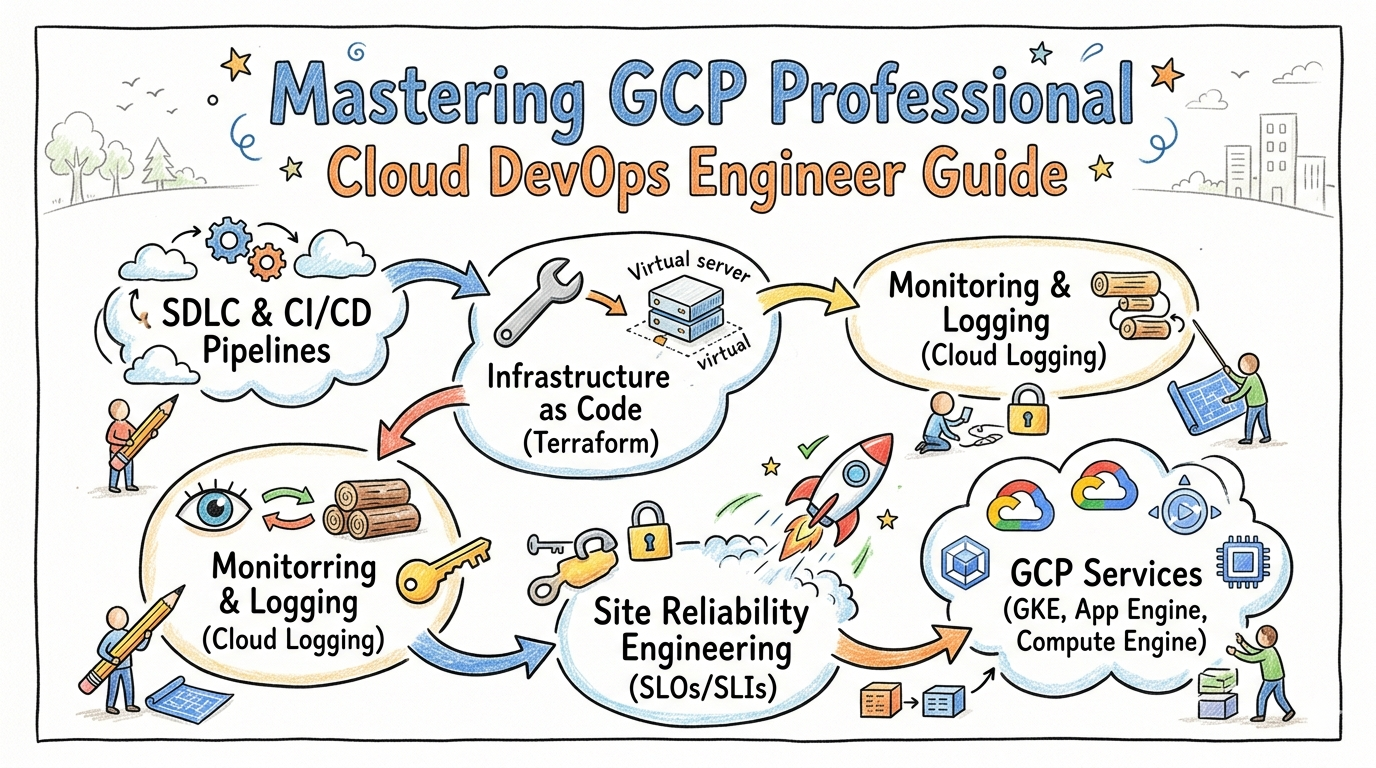
Introduction
The GCP Professional Cloud DevOps Engineer certification is a premier validation for engineering professionals looking to build, scale, and secure enterprise infrastructure on Google Cloud Platform. This guide is crafted for working software engineers, site reliability engineers, and technical leaders who need to navigate the complexities of cloud-native architectures. By focusing on site reliability engineering principles, continuous delivery pipelines, and automated infrastructure management, this comprehensive guide helps professionals make informed, strategic decisions about their career progression. To accelerate your cloud journey, choosing the right training ecosystem is critical, and specialized institutions like DevOpsSchool, scmgalaxy, or aiopsschool offer targeted resources to build these advanced competencies effectively.
What is the GCP Professional Cloud DevOps Engineer?
The GCP Professional Cloud DevOps Engineer designation represents a professional’s ability to balance service reliability and delivery speed in a production environment. This certification exists because modern enterprise cloud operations require a shift from traditional operations to automated, code-driven infrastructure management. It emphasizes practical, production-focused learning over abstract cloud theory, validating that an engineer can manage real-world infrastructure lifecycles. For organizations utilizing Google Cloud Platform, this certification ensures that engineering practices align with Google’s proven site reliability engineering frameworks.
Who Should Pursue GCP Professional Cloud DevOps Engineer?
This certification pathway heavily benefits system engineers, cloud architects, and platform engineering professionals who manage distributed applications. Experienced software developers looking to transition into infrastructure roles, as well as systems administrators moving away from manual provisioning, will find immense value here. Security engineering personnel and data platform operations teams also benefit by learning how to embed compliance and automation into cloud pipelines. In both the rapidly growing technology hubs of India and global enterprise markets, this certification serves as a benchmark for high-performing infrastructure talent.
Why GCP Professional Cloud DevOps Engineer
The demand for engineers who understand how to design resilient systems continues to grow as organizations scale their cloud footprints. This certification provides long-term career longevity because it teaches fundamental site reliability engineering methodologies rather than just temporary tool configurations. Even as specific deployment tools evolve, the underlying principles of monitoring, continuous integration, and incident management remain constant across enterprises. Investing time into mastering this ecosystem ensures a high return on effort by positioning professionals for senior technical and architectural roles.
GCP Professional Cloud DevOps Engineer Certification Overview
The formal preparation program for this role is delivered via the official training path available on the devopsschool platform. The certification assessment approach relies heavily on scenario-based performance evaluation, requiring candidates to solve complex infrastructure problems. It is designed to test practical engineering decisions, such as optimization under constraints, rather than simple rote memorization. The ownership of the certification structure lies with Google Cloud, ensuring that the content remains aligned with current production standards and architectural best practices.
GCP Professional Cloud DevOps Engineer Certification Tracks & Levels
The journey toward mastering Google Cloud infrastructure spans multiple levels, from foundational principles to advanced engineering capabilities. Foundational tracks focus on core cloud literacy and basic managed services, ensuring professionals understand general cloud concepts. The professional level introduces deep domain specializations, such as advanced continuous delivery, observability, and service mesh management. These tracks align with career progression by transforming generalist engineers into specialized domain experts capable of leading large-scale enterprise migrations.
Complete GCP Professional Cloud DevOps Engineer Certification Table
| Track | Level | Who it’s for | Prerequisites | Skills Covered | Recommended Order |
|---|---|---|---|---|---|
| Cloud Core | Foundational | Associate Cloud Engineers, IT Associates | Basic networking knowledge | Core GCP services, IAM, CLI tools, basic compute management | First |
| DevOps & SRE | Professional | DevOps Engineers, SREs, Systems Architects | 3+ years infrastructure experience | CI/CD automation, SRE metrics, monitoring, infrastructure as code | Second |
| Advanced Security | Specialty | Cloud Security Engineers, Compliance Officers | Professional DevOps level skills | DevSecOps, identity federation, binary authorization, encryption | Third |
Export to Sheets
Detailed Guide for Each GCP Professional Cloud DevOps Engineer Certification
GCP Professional Cloud DevOps Engineer – Professional Level
What it is
This certification validates an engineer’s ability to design, implement, and manage continuous delivery pipelines while ensuring system reliability and performance on Google Cloud.
Who should take it
Senior software engineers, site reliability engineers, and platform professionals with multiple years of hands-on experience deploying distributed systems to production cloud environments.
Skills you’ll gain
- Building automated deployment pipelines using Cloud Build and Artifact Registry
- Configuring comprehensive monitoring, logging, and alerting systems via Cloud Monitoring
- Managing infrastructure safely and predictably using declarative tools like Terraform
- Implementing site reliability principles such as Service Level Objectives and Error Budgets
Real-world projects you should be able to do
- Design a multi-environment, automated CI/CD pipeline that enforces security scanning before deployment
- Build a self-healing application architecture on Google Kubernetes Engine with multi-region failover
- Configure an enterprise-wide logging aggregation system with automated anomaly alerting
Preparation plan
- 7–14 days strategy: Review the official exam guide, take the baseline practice assessment, and focus heavily on filling immediate conceptual gaps regarding Google-specific SRE definitions.
- 30 days strategy: Dedicate structured hours to deep-dive documentation reading on Google Kubernetes Engine, Cloud Build, and Cloud Operations suite while setting up sandbox projects.
- 60 days strategy: Conduct extensive troubleshooting scenarios in a live lab environment, review case studies on incident management, and take multiple full-length timed mock exams.
Common mistakes
- Focusing too much on generic open-source tools while neglecting the specific implementation details of native Google Cloud services.
- Underestimating the theoretical scenarios related to Service Level Indicators and how to calculate error budgets correctly.
- Memorizing configuration commands instead of understanding the architectural patterns required to solve complex, multi-tiered infrastructure failures.
Best next certification after this
- Same-track option: GCP Professional Cloud Architect
- Cross-track option: GCP Professional Cloud Security Engineer
- Leadership option: Cloud Digital Leader or Enterprise Architecture certifications
Choose Your Learning Path
DevOps Path
The traditional engineering path focuses on the convergence of software development and infrastructure operations through absolute automation. Professionals master version control strategies, automated testing validation, and progressive delivery methodologies like canary and blue-green deployments. The core objective is to decrease the time between writing a line of code and running it safely in production. This path is ideal for engineers who want to specialize in velocity, artifact management, and continuous optimization.
DevSecOps Path
The security-focused infrastructure path integrates compliance, vulnerability scanning, and identity management directly into the automated delivery lifecycle. Engineers learn to shift security left by embedding container image scanning, static code analysis, and policy enforcement into the initial stages of building software. This track focuses on mitigating supply chain risks, enforcing least-privilege access, and ensuring continuous audit compliance. It fits professionals who bridge the gap between enterprise security standards and engineering velocity.
SRE Path
The site reliability engineering path treats operational problems as if they were software engineering challenges, focusing strictly on system scalability and uptime. Practitioners design resilient architectures, define service level objectives, and manage the balance between infrastructure stability and feature release velocity. Attention is given to blameless post-mortems, incident mitigation automation, and reducing manual operational tasks through systemic software fixes. This track benefits those dedicated to maintaining highly available, large-scale distributed systems.
AIOps Path
The artificial intelligence operations path applies machine learning models to infrastructure data to automate problem identification and remediation. Engineers focus on processing massive streams of telemetry data, log events, and metric indicators to predict system anomalies before they impact end-users. The goal is to move from reactive alerting configurations to proactive, intelligent system self-healing mechanisms. This path serves forward-looking infrastructure engineers aiming to manage highly complex, dynamic microservices clusters.
MLOps Path
The machine learning operations path bridges the gap between data science experimentation and production infrastructure engineering. Professionals focus on building automated data pipelines, continuous training frameworks, and reliable model serving infrastructure on cloud platforms. This involves managing the specific challenges of model drift, dataset versioning, and compute resource optimization for heavy workloads. It is designed for engineers who ensure that complex machine learning models run reliably at scale.
DataOps Path
The data operations path applies agile manufacturing and DevOps principles to continuous data collection, processing, and analytics lifecycles. Engineers build automated, highly observable data pipelines that guarantee data quality, governance, and low-latency availability across the enterprise. It minimizes the cycle time of data analytics while maintaining strict data privacy and architectural compliance standards. This track is aimed at infrastructure professionals supporting large-scale data engineering and analytics teams.
FinOps Path
The financial operations path combines finance, engineering, and business metrics to drive fiscal accountability across cloud consumption models. Professionals design cost-allocation frameworks, automate the detection of wasted cloud resources, and optimize reservation strategies for compute infrastructure. This track ensures that engineering scalability decisions are tightly coupled with business profitability and transparent budgeting. It is suited for analytical engineers and technical managers responsible for maximizing the efficiency of cloud spend.
Role → Recommended GCP Professional Cloud DevOps Engineer Certifications
| Role | Recommended Certifications |
|---|---|
| DevOps Engineer | GCP Professional Cloud DevOps Engineer, Professional Cloud Architect |
| SRE | GCP Professional Cloud DevOps Engineer, Professional Cloud Network Engineer |
| Platform Engineer | GCP Professional Cloud DevOps Engineer, Associate Cloud Engineer |
| Cloud Engineer | Associate Cloud Engineer, Professional Cloud DevOps Engineer |
| Security Engineer | Professional Cloud Security Engineer, Professional Cloud DevOps Engineer |
| Data Engineer | Professional Cloud Data Engineer, Professional Cloud DevOps Engineer |
| FinOps Practitioner | Cloud Digital Leader, Professional Cloud DevOps Engineer |
| Engineering Manager | Cloud Digital Leader, Professional Cloud DevOps Engineer |
Export to Sheets
Next Certifications to Take After GCP Professional Cloud DevOps Engineer
Same Track Progression
After mastering the DevOps practitioner level, deep specialization involves moving into advanced infrastructure design patterns. The logical step forward is to secure certifications that validate overarching system design, such as cloud architecture paths. This ensures the engineer can design the broader foundational systems that continuous delivery pipelines deploy into.
Cross-Track Expansion
Broadening operational expertise requires diving into adjacent infrastructure domains like advanced networking and zero-trust security frameworks. Pursuing specialty tracks in security or data processing allows a DevOps specialist to handle specialized workloads. This cross-training creates a well-rounded engineering professional capable of resolving multi-disciplinary system bottlenecks.
Leadership & Management Track
Transitioning from hands-on implementation to strategic technical leadership involves focusing on business value, governance, and organizational alignment. Professionals should target certifications that emphasize cloud strategy, digital transformation frameworks, and financial operations. This shift enables senior engineers to effectively lead large engineering departments and manage vendor relationships.
Training & Certification Support Providers for GCP Professional Cloud DevOps Engineer
DevOpsSchool provides comprehensive, instructor-led training programs focused on practical labs, real-world deployment scenarios, and deep architectural deep dives. Their curriculum emphasizes hands-on mastery of continuous delivery concepts, making it highly valuable for professionals preparing for advanced cloud certification exams.
Cotocus specializes in immersive, production-focused training bootcamps tailored for enterprise engineering teams looking to modernize their infrastructure workflows. Their practical approach ensures that engineers gain actual deployment skills that translate directly into clear exam success.
Scmgalaxy offers an extensive repository of technical tutorials, community forums, and expert-led study blueprints centered around configuration management and continuous integration. It serves as a highly reliable knowledge base for self-paced engineers aiming for technical certifications.
BestDevOps focuses on delivering highly curated learning tracks that align traditional operations teams with modern, cloud-native software delivery practices. Their targeted courses break down complex site reliability engineering philosophies into structured, digestible technical modules.
devsecopsschool delivers specialized training focused exclusively on embedding automated security tools, compliance policies, and vulnerability checking directly into deployment pipelines. This preparation is essential for engineers moving toward advanced, security-conscious cloud roles.
sreschool provides deeply technical courses dedicated purely to site reliability engineering principles, focusing on monitoring, system resilience, and incident lifecycle management. Their curriculum prepares engineers to handle high-availability challenges in complex production environments.
aiopsschool trains professionals on how to utilize machine learning frameworks to analyze telemetry data and automate enterprise infrastructure operations. The coursework prepares modern engineers to manage complex, automated self-healing cloud deployments effectively.
dataopsschool addresses the specific infrastructure needs of data lifecycles, teaching engineers how to build automated, highly reliable data delivery systems. Their training maps directly to the operational demands of enterprise data environments.
finopsschool focuses on the structural intersections of cloud architecture, resource optimization, and corporate financial management. Their courses equip technical professionals with the exact strategies needed to manage and optimize large-scale cloud budgets.
Frequently Asked Questions (General)
- What is the typical difficulty level of professional cloud engineering exams? Professional-level exams are generally considered highly challenging as they avoid simple definition questions. They require candidates to evaluate complex architectural scenarios and select the most efficient, secure, and cost-effective operational solution.
- How much hands-on experience is recommended before attempting an engineering certification? It is highly recommended to have a minimum of three years of industry experience, with at least one full year actively managing production workloads on the specific cloud platform.
- Can passing an exam guarantee a career transition or immediate promotion? While a certification validates technical knowledge and dedication, career advancement depends heavily on practical experience, problem-solving capabilities, and overall communication skills.
- How long does it take to prepare for a professional-level cloud certification? For an experienced professional, dedicated preparation usually spans between thirty to sixty days of structured study, lab work, and practice examination review.
- Are foundational certifications mandatory prerequisites for professional exams? No, most cloud providers do not require you to clear foundational certifications before attempting professional levels, allowing experienced engineers to take advanced exams directly.
- How long do professional cloud certifications remain valid before expiration? Most professional certifications are valid for two years, after which professionals must pass a recertification exam to maintain their active credential status.
- What is the core difference between DevOps and Site Reliability Engineering? DevOps focuses primarily on breaking down organizational silos and increasing software delivery velocity through automation, whereas SRE applies software engineering principles specifically to maximize system reliability and lifecycle scalability.
- Why are scenario-based questions preferred over simple multiple-choice questions? Scenario-based questions ensure that the candidate can analyze realistic business problems, manage technical trade-offs, and apply theoretical cloud patterns to actual production issues.
- How do cloud certifications impact hiring decisions in enterprise IT environments? Certifications act as an initial filtering mechanism for technical recruiters, ensuring that the candidate possesses a verified baseline of domain knowledge before technical interviews.
- Is it better to specialize in a single cloud platform or learn multiple environments? Deeply mastering one major platform initially is highly recommended, as cloud-native principles easily transfer to other environments once the core patterns are understood.
- What role do sandbox lab environments play in certification preparation? Sandbox labs are absolutely essential because they allow engineers to make mistakes, observe failure modes, and configure services without risking live production infrastructure.
- How do specialized training providers improve overall examination pass rates? Specialized providers offer structured guidance, clarify complex architectural documentation, and offer realistic mock exams that simulate actual testing constraints.
FAQs on GCP Professional Cloud DevOps Engineer
- What specific Google Cloud services are emphasized most during the examination process? The exam focuses heavily on Google Kubernetes Engine, the Cloud Operations suite for monitoring and logging, Cloud Build for continuous integration, and Artifact Registry. Candidates must understand how these services interact seamlessly to form a highly automated, secure, and observable deployment infrastructure.
- How deeply does this exam test automated infrastructure as code practices? While the exam evaluates the strategic patterns of infrastructure automation, it specifically tests your ability to manage state, handle safe resource updates, and implement declarative configuration principles within Google Cloud environments.
- What is the significance of Site Reliability Engineering principles in this particular track? Google authored the core SRE framework, so this certification places immense weight on monitoring service health, defining practical metrics, and managing release velocities through structured error budgets.
- Are software development and coding skills required to pass this operational exam? Candidates do not need to write complex application code, but they must be highly comfortable reading configuration files, writing deployment scripts, and understanding general application architectures.
- How does this certification address security within the continuous delivery lifecycle? The exam thoroughly evaluates DevSecOps principles, including the configuration of private clusters, managing secure container images, setting up identity access policies, and automating compliance scanning across pipelines.
- What is the best way to practice for the complex monitoring and logging questions? Engineers should gain practical experience setting up metric dashboards, configuring distributed tracing across microservices, and writing advanced log filters within the native Cloud Operations suite workspace.
- How does the market value this certification compared to general cloud architect pathways? The DevOps track specifically appeals to teams focused on day-to-day deployment execution, automation velocity, and live system reliability, making it highly valuable for targeted engineering roles.
- What strategy should be used to handle the time constraints of the official exam? Candidates should practice pacing themselves using full-length mock assessments, ensuring they do not spend excessive time on single, highly complex architectural scenarios during the test.
Final Thoughts: Is GCP Professional Cloud DevOps Engineer Worth It?
Investing your time and energy into securing the GCP Professional Cloud DevOps Engineer certification is an exceptionally valuable decision for any modern infrastructure professional. It moves far beyond surface-level tooling, forcing you to think like a site reliability engineer who balances deployment velocity with absolute system stability. The industry-wide shift toward highly automated, observable platform architectures means that professionals who hold these verified skills will remain central to enterprise technical strategies. If you are committed to advancing past routine configuration tasks and want to lead high-performance cloud operations, this credential provides the clear technical foundation required to succeed.
Mastering Azure Data
