Introduction
Receiving a complex medical diagnosis often brings an overwhelming wave of uncertainty, emotional strain, and difficult clinical choices for families.
During these critical moments, finding clarity requires structured medical facts, verified specialist backgrounds, and transparent healthcare options.
Navigating modern oncology requires a systematic approach because clinical pathways vary significantly across different healthcare systems.
Patients and caregivers must balance local availability against specialized treatment protocols offered by major international centers.
By leveraging dedicated informational platforms like CancersHospitals, families can evaluate comprehensive clinical data, hospital capabilities, and accredited facilities worldwide.
This collaborative approach helps patients organize records, evaluate therapy pathways, and choose care centers aligned with specific clinical diagnoses.
What Should You Look for in Cancer Hospitals?
Selecting the right care center requires looking far beyond basic facility reputations and physical amenities.
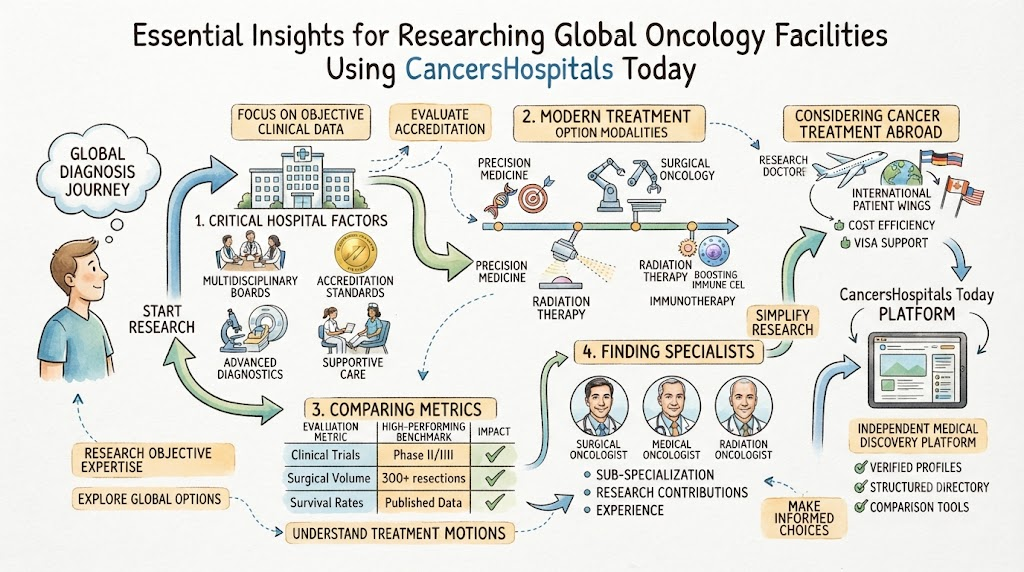
The top cancer hospitals distinguish themselves through strict quality accreditations, such as Joint Commission International recognition, and dedicated multidisciplinary tumor boards.
These boards unite medical oncologists, surgical oncologists, radiation specialists, pathologists, and radiologists to review individual patient files collaboratively.
Clinical research shows that multidisciplinary review alters initial treatment plans in roughly 15% to 20% of complex cases, directly improving therapeutic accuracy.
Look for centers running active clinical trials and offering integrated patient-support services, including oncology nutrition, pain management, and dedicated counseling.
Understanding Cancer Treatment Options
Modern therapeutic approaches have moved far beyond standard single-modality interventions into highly personalized regimens.
A premier oncology hospitals network will provide access to advanced surgical oncology, precision radiation therapy, and specialized systemic treatments.
Patients frequently evaluate a combination of therapies tailored to the genetic markers of their specific tumor biology:
- Surgical Oncology: Precision tumor resections using robotic-assisted systems to spare healthy margins.
- Chemotherapy: Targeted cytotoxic drugs administered to disrupt cancer cell division cycles.
- Precision Radiation: Stereotactic body radiation therapy (SBRT) and proton therapy delivering high doses with minimal collateral tissue damage.
- Immunotherapy: Checkpoint inhibitors and CAR-T cell therapies that empower the body’s natural immune system to target malignancies.
- Targeted Therapy: Small-molecule inhibitors and monoclonal antibodies that block specific molecular mutations driving cell growth.
How to Compare the Best Cancer Treatment Hospitals
Evaluating high-tier facilities demands an objective, data-driven framework rather than reliance on subjective testimonials alone.
Compare institutional patient volumes, specialized oncology nurse-to-patient ratios, and published clinical outcome registries.
High-volume surgical centers consistently demonstrate lower complication rates and superior long-term survival statistics across complex operations.
| Evaluation Metric | General Regional Hospital | Specialized Global Oncology Center |
| Multidisciplinary Tumor Board | As-needed or periodic review | Mandatory, weekly subspecialty panels |
| Technology Integration | Standard 3D conformal radiation | Proton beam, MR-Linac, robotic suites |
| Clinical Trial Access | Limited external trial networks | Phase I–III proprietary & global trials |
| Subspecialty Focus | General internal oncology | Organ-specific oncology departments |
When determining the best hospital for cancer treatment, prioritize facilities that provide transparent safety metrics, comprehensive nurse navigation, and clear second-opinion workflows.
Researching the Best Cancer Doctors
The expertise of your primary specialist plays a direct role in determining treatment efficacy and quality of life during therapy.
When seeking the best cancer doctors, verify board certifications, subspecialty fellowships, and disease-specific publication histories.
An oncologist who focuses exclusively on thoracic, gastrointestinal, or hematologic malignancies will possess deeper diagnostic insight than a generalist.
Always evaluate a physician’s willingness to collaborate openly, discuss emerging clinical trial protocols, and coordinate seamlessly with your local medical team.
When Should You Consider Cancer Treatment Abroad?
Seeking care across international borders is a strategic decision often driven by the need for advanced therapeutic interventions unavailable locally.
Patients explore cancer treatment abroad to access novel medications awaiting regional regulatory approval, specialized proton beam installations, or world-renowned surgical teams.
Additionally, substantial cost variations make cross-border care an effective option for families seeking high-grade treatment within sustainable financial boundaries.
International patient departments in leading destinations streamline this process by managing medical visa documentation, language interpretation, and cross-border medical record synchronization.
Exploring Cancer Hospitals Around the World
A thorough global evaluation reveals distinguished regional excellence across multiple medical travel hubs.
The best cancer hospitals in the world span continents, combining cutting-edge infrastructure with specialized research institutes.
North American and Western European hubs remain global leaders in early-phase clinical trials, translational genetics, and complex surgical reconstructions.
Meanwhile, premier cancer treatment hospitals across Asia and the Middle East provide accredited, cost-efficient oncology care supported by high-volume clinical expertise.
Exploring these diverse regions allows patients to identify facilities that balance logistical convenience, specialized technology, and financial considerations.
How CancersHospitals Can Help With Your Research
Independent research can quickly become exhausting for families attempting to decipher medical jargon and foreign hospital directories alone.
The resource directory at CancersHospitals serves as an organized portal for researching international healthcare infrastructure.
The platform centralizes vital facility details, provider credentials, and therapeutic modalities into a single, navigable research environment.
By presenting clear comparative information on institutional capabilities and international patient departments, the platform simplifies medical discovery.
This structured access allows patients to review verified information objectively before entering direct consultations with clinical teams.
Questions to Ask Before Choosing a Hospital
Entering initial consultations with a clear list of targeted questions ensures you gather actionable, definitive information from prospective providers:
- Multidisciplinary Oversight: How often will a specialized tumor board review my ongoing treatment plan?
- Clinical Trial Access: Are there any active clinical trials or molecular-targeted therapies suitable for my diagnosis?
- Volume and Experience: How many surgical or therapeutic procedures of my specific type does this team perform annually?
- Emergency Protocols: What emergency response systems and intensive care facilities are available if acute complications occur?
- Logistical Continuity: How does the international patient department coordinate post-discharge follow-up care with my home physician?
Frequently Asked Questions About CancersHospitals
How do I identify the best cancer treatment hospitals for my specific diagnosis?
Focus on facilities with high-volume subspecialty departments, dedicated tumor boards, Joint Commission International accreditation, and active clinical trial programs.
What advantages do dedicated oncology hospitals offer over general medical centers?
Dedicated oncology facilities house specialized diagnostic labs, organ-specific specialists, advanced radiation systems, and clinical teams focused exclusively on cancer therapies.
Why do patients pursue international cancer treatment programs?
Patients travel internationally to access novel therapies, specialized surgical techniques, advanced proton therapies, or accredited care at accessible price points.
How can I verify the credentials of the best cancer doctors?
Review board certifications, specialized fellowship training, institutional affiliations, published clinical research, and verified clinical trial participation records.
What is the role of a multidisciplinary tumor board?
A tumor board brings together surgical, medical, and radiation oncologists, alongside radiologists and pathologists, to design and review tailored treatment strategies collaboratively.
What factors influence the cost of cancer treatment abroad?
Costs depend heavily on geographic destination, specific surgical requirements, inpatient duration, drug protocols, diagnostic staging needs, and post-operative monitoring.
How does CancersHospitals assist international patients?
The platform compiles verified data regarding global oncology centers, treatment specialties, doctor profiles, and hospital resources to streamline patient research.
What documents are required to seek a second opinion from cancer hospitals?
You will need complete histopathology slides or reports, digital imaging files (CT, MRI, PET scans), molecular profiling reports, and comprehensive treatment summaries.
Can targeted therapy and immunotherapy replace traditional chemotherapy?
In specific biomarker-positive cases, targeted agents or immunotherapies serve as primary treatments, though they are frequently integrated alongside conventional chemotherapy protocols.
What follow-up care is necessary after completing cancer treatment abroad?
Patients require structured discharge summaries, scheduled digital imaging intervals, coordinated blood panels, and direct communication channels between overseas and local physicians.
Final Thoughts
Selecting an advanced cancer care pathway requires thorough evaluation, objective data, and clear communication between families and healthcare professionals.
Whether you choose treatment locally or travel internationally, prioritizing accredited facilities, multidisciplinary teams, and verified specialists remains paramount.
Structured research empowers families to make informed, confident choices tailored to their specific medical, financial, and personal circumstances.
