Introduction
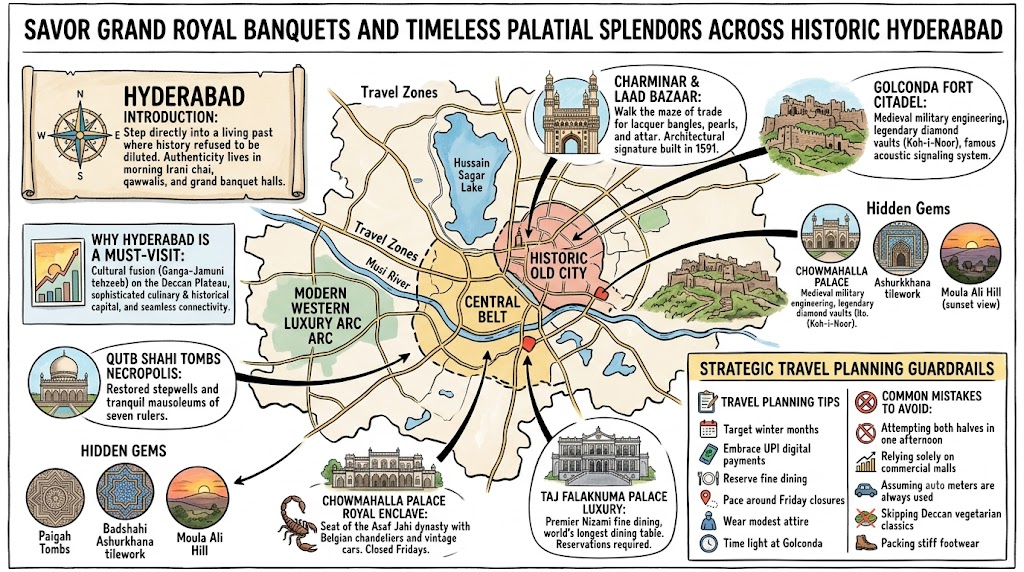
Most mainstream vacation hubs greet travelers with commercialized chaos, fabricated attractions, and uniform storefronts that feel detached from history. Hyderabad immediately dismantles that standard tourist template. The ancient capital of the Deccan operates with a measured cadence where 400-year-old minarets share horizons with glass-clad tech campuses.
Here, authenticity is not staged for visitors. It lives within the aromatic steam of morning Irani chai counters, resonant qawwalis drifting through medieval alleyways, and grand banquet halls where recipes developed for royalty are still prepared with centuries-old precision. Stepping into this city connects you directly with a living past that refuses to be diluted.
Why Hyderabad Is A Must-Visit City
Hyderabad stands as a monumental bridge between North and South India. Culturally forged under the medieval Qutb Shahi dynasty and refined by the opulent Asaf Jahi Nizams, the city developed a distinct, syncretic identity known as Ganga-Jamuni tehzeeb. Geographically situated atop the granite-rich Deccan Plateau, it transformed from a fortified diamond-trading citadel into one of Asia’s most sophisticated culinary and historical capitals.
Modern connectivity makes navigating this heritage remarkably seamless. Rajiv Gandhi International Airport connects directly with major international capitals and domestic hubs. Within the metropolis, the elevated Hyderabad Metro Rail, expansive Outer Ring Road, and three principal railway terminals link every traveler archetype—from solo backpackers to luxury connoisseurs—to every major historical pocket.
The core travel circuit revolves around three primary geographical zones: the historic Old City south of the Musi River, the central Hussain Sagar and Secunderabad cantonment belt, and the modern western luxury arc of Banjara Hills and HITEC City.
| Key Metric | Detail / Practical Fact |
|---|---|
| State & Region | Telangana, Southern Deccan Plateau |
| Primary Languages | Telugu, Dakhni Urdu, Hindi, English |
| Ideal Trip Duration | 3 to 4 Full Days |
| Peak Season | October to February (Pleasant, 15°C to 28°C) |
| Nearest Transit Hub | Rajiv Gandhi International Airport (RGIA, Shamshabad) |
| Signature Fare | Hyderabadi Dum Biryani, Haleem, Mirchi Ka Salan, Double Ka Meetha |
Best Places or Experiences
Charminar stands at Hyderabad’s heart.
Charminar & Laad Bazaar Heritage Walk
Built in 1591 by Sultan Muhammad Quli Qutb Shah, Charminar serves as the architectural signature and physical heart of Hyderabad’s Old City. Crafted from granite, lime, mortar, and pulverized marble, the square structure features four grand arches opening toward the cardinal directions, surmounted by minarets rising over 54 feet above the roofline. Its upper gallery once housed a mosque and a madrasa, designed to commemorate the eradication of a devastating plague while anchoring a newly planned metropolis.
Surrounding this monument is Laad Bazaar, an exhilarating maze of trade that has thrived since the Qutb Shahi era. The corridor glitters with hundreds of workshops crafting traditional lacquered bangles embedded with stones, hand-woven zardozi embroidery, natural attar (perfumes), and real Basra pearls. Walking this precinct immerses you in the raw sensory energy that defines everyday Hyderabadi life.
- Location: Old City, Charminar Zone; approximately 20 km north of Rajiv Gandhi International Airport.
- Why it is worth visiting: It is the foundational core of Deccan Islamic architecture and the cultural epicenter of historic Hyderabad.
- Best things to do: Climb to the first level for a panoramic view of the Char Kaman arches, watch lacquer artisans spin and stud bangles in Laad Bazaar, and sip Irani chai at Nimrah Cafe right across the monument.
- Best time to visit: 7:30 AM to 9:00 AM for soft morning light and fewer crowds, or after 7:00 PM when the stone is illuminated.
- Ideal for whom: History enthusiasts, street photographers, cultural shoppers, and architecture buffs.
- Travel tip: Wear slip-on footwear if you plan to visit nearby Mecca Masjid, and keep small currency notes ready for street vendors.
Acoustic stone arches of Golconda Fort.
Golconda Fort Acoustic Citadel
Golconda Fort is an engineering masterpiece of medieval military architecture rising atop a 120-meter-high granite hill. Originally a mud-brick outpost under the Kakatiyas in the 11th century, it was expanded by the Qutb Shahi kings into an impregnable stronghold spanning an 11-kilometer outer perimeter. The fort controlled the world’s most lucrative diamond mines, which yielded world-famous gems including the Koh-i-Noor, Hope, and Daria-i-Noor diamonds.
The citadel’s defining wonder is its sophisticated acoustic signaling system. A single handclap beneath the grand dome of the Fateh Darwaza entrance canopy travels clearly to the highest pavilion, the Bala Hissar, located nearly a kilometer away uphill. The complex also integrates clay pipe water-cooling channels, deep granaries, and secret subterranean escape passages designed to withstand multi-month sieges.
- Location: Ibrahim Bagh, Western Zone; roughly 11 km west of Charminar and 14 km from the central railway hub.
- Why it is worth visiting: It combines remarkable acoustic engineering with panoramic Deccan views and the storied legacy of legendary diamond vaults.
- Best things to do: Test the sound transmission between Fateh Darwaza and the hilltop, climb the 360-plus stone steps to Bala Hissar for sunset, and attend the evening sound-and-light narration.
- Best time to visit: Late afternoon (3:30 PM to 6:30 PM) to explore the upper pavilions comfortably before sunset.
- Ideal for whom: Trekkers, military history fans, audio-science enthusiasts, and older families who can manage stone stairs.
- Travel tip: Hire an official government-badged guide at the entry gate; their live acoustic demonstrations reveal hidden architectural details you will otherwise overlook.
Courtyards of Chowmahalla Palace.
Chowmahalla Palace Royal Enclave
Chowmahalla Palace, meaning “Four Palaces,” served as the official seat of the Asaf Jahi dynasty where the Nizams entertained visiting viceroys and royal dignitaries. Commenced in 1750 by Salabat Jung and completed by Nizam Afzal-ud-Daulah in the mid-19th century, the estate reflects a synthesis of Persian, Indo-Saracenic, and European Neo-Classical styles. Its manicured lawns, serene central cistern, and yellow stucco facade immediately isolate visitors from the bustling city outside.
The highlight of the estate is the Khilwat Mubarak, the grand durbar hall supported by towering marble pillars and crowned with 19 magnificent Belgian crystal chandeliers. Here stands the sacred Takht-e-Nishan, the royal marble throne where state assemblies were held. The adjacent palace corridors house impeccably curated collections of vintage royal carriages, antique weaponry, hand-painted porcelain services, and rare 1912 Rolls-Royce Silver Ghosts.
- Location: Motigalli, Khilwat, Old City; roughly 1 km southwest of Charminar.
- Why it is worth visiting: It offers an authentic, intact window into the peerless wealth and refined ceremonial lifestyle of the Asaf Jahi monarchs.
- Best things to do: Admire the Belgian chandeliers within the Grand Durbar Hall, inspect the Nizam’s vintage automobile collection, and photograph the historic Khilwat Clock Tower that has ticked continuously for over a century.
- Best time to visit: Weekday mornings between 10:30 AM and 1:00 PM for calm courtyard viewing and ideal interior lighting.
- Ideal for whom: Heritage travelers, luxury design lovers, textile collectors, and families.
- Travel tip: The palace complex strictly closes on Fridays; plan your Old City itinerary around this weekly closure.
Royal veranda at Taj Falaknuma Palace.
Taj Falaknuma Palace Luxury Heritage Experience
Perched 2,000 feet above Hyderabad atop a dramatic hillock, Falaknuma—literally “Mirror of the Sky”—is widely recognized as one of the world’s most lavish palace hotels. Commissioned in 1893 by Paigah nobleman Nawab Sir Viqar-ul-Umra and later acquired by the sixth Nizam, Mir Mahboob Ali Khan, the palace was constructed entirely of Italian Carrara marble in the shape of a scorpion.
Today, preserved and managed by the Taj Group, the property offers one of India’s premier luxury dining and heritage encounters. Guests arriving for the palace tour or private dining at Adaa restaurant are transferred by royal horse-drawn carriage, showered with rose petals along the grand marble staircase, and seated beneath frescoed ceilings. The 101-seat dining table—the longest of its kind in the world—and the palace library modeled after Windsor Castle showcase unmatched aristocratic splendor.
- Location: Engine Bowli, Falaknuma; approximately 5 km south of Charminar.
- Why it is worth visiting: It provides an immersive, multi-course Nizami fine-dining experience paired with a curated walk through one of the richest private art and manuscript collections in South Asia.
- Best things to do: Reserve an evening table at Adaa for slow-cooked Dum Pukht specialties, attend the sunset champagne walk guided by the palace historian, and enjoy live sufiyana qawwalis on the Gol Bungalow terrace.
- Best time to visit: Evenings from 5:30 PM onward to witness the sunset across Hyderabad followed by night illuminations.
- Ideal for whom: Luxury connoisseurs, honeymooning couples, gastronomy seekers, and celebratory private gatherings.
- Travel tip: Non-residential access requires a confirmed advance dining reservation or an official weekend heritage tour ticket; walk-in admissions are strictly prohibited at the main gate.
Qutb Shahi Tombs Necropolis & Heritage Park
Nestled close to Golconda Fort lies Ibrahim Bagh, the burial ground containing the mausoleums of the seven Qutb Shahi rulers who governed the region for nearly two centuries. What makes this necropolis globally exceptional is that an entire reigning dynasty lies buried in one unified, tranquil landscaped complex. Each tomb rises on a high square terrace, incorporating bulbous domes, intricate plasterwork crenellations, and pointed arches that reveal early Deccan architectural experimentation.
Recent restoration led by the Aga Khan Trust for Culture has returned this sprawling park to its historic glory, reinstating original orchards, stepwells (baolis), and stone waterways. Walking among these silent stone giants away from highway traffic offers quiet contemplation found nowhere else in the city. The towering mausoleum of Muhammad Quli Qutb Shah, rising over 42 meters, remains the crowning visual anchor of the park.
- Location: Fort Road, Toli Chowki; approximately 2 km north of Golconda Fort gate.
- Why it is worth visiting: It is an expansive UNESCO-tentative heritage landscape showcasing uninterrupted funerary architecture spanning over 170 years.
- Best things to do: Explore the subterranean chambers of the restored Badi Baoli stepwell, photograph the geometric dome symmetry from the outer pathways, and visit the on-site interpretation center.
- Best time to visit: 8:00 AM to 10:30 AM or late afternoon (4:00 PM to 5:30 PM) when low-angle sunlight accents the stucco detailing.
- Ideal for whom: Photographers, landscape architects, cultural researchers, and travelers seeking quiet walks.
- Travel tip: Wear comfortable walking shoes; the heritage park spans over 100 acres, and electric golf carts are limited during peak hours.
Offbeat Exploration: Hidden Gems Tourists Miss
Paigah Tombs
Tucked away in the quiet residential lanes of Pisalbanda, the Paigah Tombs represent an architectural idiom found nowhere else in India. The Paigah noble family, fiercely loyal aristocrats linked to the Nizams by marriage, constructed these mausoleums between the late 18th and early 20th centuries.
The tombs feature translucent marble lattice screens (jaalis) carved in geometric patterns, mother-of-pearl inlays, and hybrid arches influenced by Greek, Mughal, Persian, and Rajasthani aesthetics. The absence of tour buses ensures you can observe these delicate geometric carvings in complete serenity.
Badshahi Ashurkhana
Located a short walk from the High Court, the Badshahi Ashurkhana is an early Qutb Shahi royal house of mourning constructed in 1594. While its exterior appears understated, its inner sanctum contains vivid, enameled Persian ceramic tilework that has retained its sapphire, turquoise, emerald, and amber hues for more than four centuries.
The floral panels, calligraphic verses, and symbolic alam motifs make it one of the Deccan’s finest surviving examples of Persian mosaic artistry.
Moula Ali Hill Sunset Viewpoint
For travelers willing to trade tourist circuits for natural elevation, Moula Ali Dargah in northeastern Secunderabad offers the most panoramic vantage point in the twin cities.
A climb of 484 broad stone steps brings you to a hilltop shrine built atop a massive black granite dome boulder. At dusk, the summit delivers a 360-degree view of the urban landscape transitioning into illuminated city grids beneath vast evening skies.
Detailed Practical Guidance for Travelers
| Destination | Standard Entry Fee | General Timings | Best Local Food Options Nearby | Recommended Nearby Attractions |
|---|---|---|---|---|
| Charminar | ₹25 (Indians), ₹300 (Foreigners) | 9:00 AM – 5:30 PM (Daily) | Nimrah Cafe (Chai & Osmania Biscuits), Shadab (Biryani) | Mecca Masjid, Laad Bazaar, Gulzar Houz |
| Golconda Fort | ₹25 (Indians), ₹300 (Foreigners) | 9:00 AM – 5:30 PM (Daily) | Chicha’s Lakdikapul, Toli Chowki Shawarma Hubs | Qutb Shahi Tombs, Taramati Baradari |
| Chowmahalla Palace | ₹100 (Indians), ₹400 (Foreigners) | 10:00 AM – 5:00 PM (Closed Fridays) | Grand Hotel, Nayab Hotel (Nalli Nihari & Bheja Fry) | Salar Jung Museum, High Court Heritage Riverfront |
| Taj Falaknuma Palace | Dining reservation / Heritage tour package | 4:00 PM – 10:30 PM (Prior Booking Only) | Adaa Restaurant (In-house fine dining), Celeste | Sudha Cars Museum, Nehru Zoological Park |
| Qutb Shahi Tombs | ₹25 (Indians), ₹300 (Foreigners) | 9:30 AM – 4:30 PM (Daily) | Rumaan Restaurant, Mandi King Toli Chowki | Golconda Fort, Durgam Cheruvu Lake |
| Paigah Tombs | Free entry (Donations welcome) | 10:00 AM – 4:30 PM (Closed Fridays) | Subhan Bakery (Osmania Biscuits), Pista House Charminar | Raymond’s Tomb, Saroornagar Lake |
Logistics & On-Ground Navigation
Local Transport Options
Navigating Hyderabad efficiently requires pairing the right mode of transport with each specific geographical pocket:
- Hyderabad Metro Rail: The most reliable option for traveling between Secunderabad, Central Hyderabad, Ameerpet, and the western IT corridor (HITEC City/Raidurg). It avoids surface traffic congestion entirely.
- App-Based Rides (Uber & Ola): Readily available across the city for air-conditioned transfers between distinct zones, airport runs, and late-night returns from dining venues.
- Auto-Rickshaws: Excellent for short hops within neighborhoods like the Old City, Abids, and Banjara Hills. Always insist on using the digital fare meter or confirm a negotiated price prior to boarding.
- TSRTC City Buses: Highly economical and extensive network connecting suburbs, though often crowded during standard morning and evening peak office commute hours.
- Self-Drive & Chauffeur Rentals: Recommended if planning a comprehensive heritage day covering Golconda Fort, Gandipet, and the Qutb Shahi necropolis in a single coordinated loop.
Budget Planning
Hyderabad remains one of India’s most value-driven metropolitan travel destinations across all price tiers:
- Budget / Solo Backpacker Tier (₹1,500 – ₹2,500 per day):
- Accommodation: Heritage homestays, hostels, or economy guesthouses around Abids, Lakdikapul, or Secunderabad (₹800 – ₹1,400 per night).
- Food: Irani chai breakfast, authentic street biryani lunch at local favorites, and tiffin dinners (₹400 – ₹600 per day).
- Transit: Hyderabad Metro card combined with short shared-auto trips (₹200 – ₹300 per day).
- Mid-Range / Comfort Tier (₹5,500 – ₹10,000 per day):
- Accommodation: 4-star boutique hotels or modern apartments in Banjara Hills, Jubilee Hills, or Gachibowli (₹3,500 – ₹6,500 per night).
- Food: Lunch at established heritage establishments like Jewel of Nizam or Paradise, and specialty dinners (₹1,500 – ₹2,500 per day).
- Transit: App-booked cabs for seamless inter-district hops (₹800 – ₹1,200 per day).
Safety and Inclusivity Tips
Hyderabad holds a well-earned reputation as one of India’s safest major metros, supported by visible She Teams police patrols across public spaces:
- For Families: Historical parks, Chowmahalla Palace, and lakefront promenades are exceptionally family-friendly. Opt for cabs rather than walking along congested Old City roads with young children.
- For Couples: Cultural landmarks, heritage dining spaces, and lakeside verandas in Jubilee Hills welcome couples openly. Public displays of overt affection are best avoided in conservative historic quarters.
- General Health & Safety: Always drink bottled or certified filtered water, particularly when exploring street-side culinary trails. Carry a lightweight scarf or stole to cover your head and shoulders when visiting operational shrines and religious monuments.
Strategic Travel Planning Guardrails
Travel Planning Tips for Hyderabad
- Target Winter Months: Schedule your trip between late October and mid-February when Deccan temperatures hover comfortably between 15°C and 28°C.
- Embrace UPI Digital Payments: Almost every vendor—from luxury boutiques in Jubilee Hills down to tea stalls in Old City—seamlessly accepts digital payments via QR codes.
- Reserve Fine Dining Weeks in Advance: Venues like Adaa at Falaknuma or specialty chef’s tables in luxury hotels book up weeks early, especially around long weekends.
- Pace Around Friday Closures: Keep in mind that Chowmahalla Palace, Paigah Tombs, and several state museums remain closed to visitors on Fridays.
- Wear Comfortable, Modest Attire: Breathable cottons paired with easily removable slip-on shoes make exploring stone ramparts and active religious complexes pleasant.
- Time the Light at Golconda: Plan your Golconda Fort trek to descend just before twilight, allowing you to catch the illuminated skyline without descending rough stairs in pitch darkness.
Common Mistakes to Avoid
- Attempting Both Halves in One Afternoon: Do not try to pair an Old City walking exploration with an evening excursion to western HITEC City; peak cross-city traffic will consume your afternoon.
- Relying Solely on Commercial Malls: Avoid spending prime evenings in generic shopping malls when historic heritage bazaars and atmospheric lakefront walks offer far richer culture.
- Assuming Auto Meters Are Always Used: Never hop into an unmetered auto-rickshaw outside busy railway stations without verifying the rate or opening a ride-hailing app first.
- Skipping Deccan Vegetarian Classics: Do not focus exclusively on meat biryanis; traditional Telangana and Rayalaseema vegetarian thalis, spiced gunpowders, and local dosas are sensational culinary triumphs.
- Packing Stiff Footwear: Avoid stiff leather shoes or high heels; navigating granite monuments like Golconda Fort requires sturdy walking shoes with reliable rubber grip.
Suggested Itinerary Blueprints
1. 1-Day Quick Dash (The Classic Nizami Express)
- Target Audience: Business travelers, transit visitors, and fast-paced explorers.
- Morning (8:30 AM – 1:00 PM): Arrive at Charminar early to beat traffic, enjoy chai and bun maska at Nimrah, tour Chowmahalla Palace, and wander through Laad Bazaar.
- Afternoon (1:30 PM – 4:00 PM): Head to Hotel Shadab or Grand Hotel for authentic Dum Biryani, followed by a quick walk through the Salar Jung Museum.
- Evening (4:30 PM – 7:30 PM): Cab to Golconda Fort for the late-afternoon acoustic walk and sunset over the city ramparts.
2. 2-Day Deep-Dive (Heritage & Gastronomy Circuit)
- Day 1 (The Historic Old City Core):
- Morning: Charminar, Mecca Masjid, and Chowmahalla Palace.
- Afternoon: Authentic Hyderabadi lunch at Nayab Hotel followed by Badshahi Ashurkhana and Salar Jung Museum.
- Evening: Sunset boat ride across Hussain Sagar Lake followed by local dinner at Ohri’s Gufha.
- Day 2 (Fortresses, Necropolises & Royal Splendor):
- Morning: Extensive tour of the Qutb Shahi Tombs and restored stepwells.
- Afternoon: Exploration of Golconda Fort’s upper citadel and royal palaces.
- Evening: High tea or curated royal dinner at Taj Falaknuma Palace (reservation required).
3. Complete Weekend Travel Plan (The Deccan Connoisseur Loop)
- Friday (Arrival & Contemporary Vibe):
- Check into your hotel in Banjara Hills or Jubilee Hills.
- Afternoon walk through KBR National Park or Durgam Cheruvu cable-stayed bridge promenade.
- Dinner at an upscale regional restaurant sampling spicy Andhra, Telangana, and Deccan curries.
- Saturday (The Medieval Sultanate Trail):
- Full morning dedicated to Golconda Fort and the Qutb Shahi Heritage Park.
- Afternoon lunch sampling regional Biryani and Dum Ka Murgh in Lakdikapul.
- Late afternoon discovery of the secluded Paigah Tombs.
- Evening cultural performance or sunset view from Moula Ali Hill.
- Sunday (Nizami Magnificence & Bazaars):
- Morning walking tour starting at Charminar, weaving through Laad Bazaar, ending at Chowmahalla Palace.
- Afternoon pearl shopping at trusted heritage jewelers near Pathergatti.
- Evening fine-dining finale at Taj Falaknuma Palace, overlooking the twinkling city lights below.
Common Tourist Mistakes to Avoid
Geographic Blunders
The most frequent logistical error travelers make is attempting to combine western IT zones (Hitec City, Gachibowli) with southern historic districts (Charminar, Falaknuma) within a single afternoon window.
Traffic along the Mehdipatnam-Old City corridor can add 90 minutes to your transit time during rush hours. Group your itinerary strictly by zone: dedicate full days to the Old City south of the river, and separate days to the central lake and western suburban circuits.
Commercial Traps
Many visitors spend valuable vacation hours inside modern multi-level shopping centers buying mass-produced goods labeled as local crafts.
Instead, venture directly into the state-run Lepakshi handicraft emporiums, Shilparamam arts village, or the established lanes of Laad Bazaar and Pathergatti. You will acquire authentic Bidriware metalwork, kalamkari textiles, and certified pearls directly from master artisans at fair prices.
Neglecting Modern & Alternative Zones
Focusing solely on medieval stone gates leads visitors to miss Hyderabad’s vibrant modern pulse.
Neighborhoods like Jubilee Hills and Film Nagar house dynamic contemporary art galleries, third-wave artisanal roasteries, tranquil urban parks, and some of India’s most innovative microbreweries and open-air garden cafes. Experiencing both historical roots and contemporary energy provides a balanced perspective of the city.
Transport Overpayment
Hailing auto-rickshaws directly in front of major railway stations or monuments often leads to inflated fares quoted to unsuspecting visitors.
Always check standard rates on ride-sharing applications like Uber, Ola, or Rapido before negotiating with an independent street driver. If taking a street auto, insist calmly on the meter fare (meter se chaliye) to ensure an honest transaction.
Luxury Dining Bias
While dining in royal palace hotels offers unforgettable elegance, relying entirely on five-star dining rooms deprives you of Hyderabad’s most authentic flavors.
The true culinary heritage of this city lives at the corner Irani cafes where steaming chai is poured into saucer plates, at roadside tiffin stalls turning out paper-thin dosas drenched in spicy chutneys, and in century-old kitchens slow-cooking aromatic nihari in copper cauldrons before dawn. Make space on your plate for both worlds.
Frequently Asked Questions
1. What is the single best time of year to plan a trip to Hyderabad?
The most favorable window for visiting Hyderabad is between late October and late February. During these winter months, daytime temperatures remain pleasant and clear around 20°C to 28°C, and evenings cool down significantly, making outdoor monuments and walking bazaars comfortable. Summer months from March to May bring intense dry heat exceeding 40°C.
2. How many days are recommended to experience Hyderabad properly?
A 3 to 4-day itinerary is ideal for first-time visitors. This allows two full days to explore the historic Old City, Golconda Fort, and Qutb Shahi Tombs, one day for museums, palaces, and heritage shopping, and an extra day to enjoy modern culinary hotspots, lakefront parks, and offbeat architectural sites.
3. Is the food in Hyderabad excessively spicy for international visitors?
Traditional Andhra and Rayalaseema curries feature high chili levels, but authentic Nizami and Hyderabadi dishes (like Dum Biryani, Haleem, and Dum Ka Murgh) prioritize rich aromatic spices—such as cardamom, cloves, cinnamon, and saffron—over fiery chili heat. You can always request mild spice preparations at established restaurants.
4. Can tourists visit Taj Falaknuma Palace without staying as hotel guests?
Yes, non-resident guests can enter the palace grounds by making a confirmed advance dining reservation at its signature restaurants, Adaa or Celeste. Alternatively, you can book an official Telangana Tourism weekend heritage tour ticket, which includes curated transport, palace grounds access, high tea, and an architectural tour.
5. Where should travelers go to purchase certified, authentic Hyderabadi pearls?
Avoid informal street vendors for pearl purchases. Visit established, historic pearl merchants around Pathergatti, near the High Court, or reputable jewelers in Basheerbagh and Banjara Hills like Mangatrai and Jagdamba. Always request an official certificate of authenticity specifying the pearl variety, luster grade, and surface quality.
6. What is the dress code when visiting monuments and religious sites in Hyderabad?
While modern casual clothing is acceptable in cafes and malls, modest attire is recommended when visiting heritage monuments, mosques, and temples. Keep shoulders and knees covered. When entering places of worship like Mecca Masjid or Dargahs, women should carry a scarf to cover their head, and slip-on footwear makes the frequent shoe-removal process simple.
7. How accessible is Rajiv Gandhi International Airport from central Hyderabad?
The airport in Shamshabad is situated roughly 30 to 40 km from central hotel hubs. Travelers can use the dedicated Pushpak Airport Liner AC buses running round-the-clock along major city routes, or hire an app-based cab. The elevated expressway ensures a smooth travel time of 35 to 55 minutes outside extreme peak hours.
8. What exactly makes Hyderabadi Biryani distinct from other Indian biryanis?
Authentic Hyderabadi Biryani uses the Kacchi Akhni Dum Pukht method. Raw, marinated meat is layered directly with half-cooked, aromatic long-grain basmati rice, sealed inside an earthenware or heavy copper pot (degh) with dough, and cooked slowly over gentle charcoal embers. This allows the meat juices and spices to infuse the rice grains directly without pre-boiling the meat separately.
9. Is Hyderabad safe for solo female travelers?
Hyderabad is considered one of the safest metropolitan cities in India, supported by dedicated Telangana Police “She Teams” monitoring public areas. Solo female travelers should take standard precautions: use trusted app-based transport after dark, avoid poorly lit alleys late at night in older districts, and stay in well-connected neighborhoods like Banjara Hills, Jubilee Hills, or Gachibowli.
10. What unique souvenirs should visitors bring home from Hyderabad?
Signature items to purchase include handcrafted lacquer bangles from Laad Bazaar, Bidriware metal artifacts (zinc and copper alloys inlaid with pure silver), hand-embroidered zardozi fabrics, traditional Osmania biscuits and fruit cookies from Karachi Bakery or Subhan Bakery, and locally distilled natural attar perfumes.
11. Is Golconda Fort manageable for senior citizens or travelers with mobility limits?
The lower courtyards, outer ramparts, and sound-and-light seating areas are relatively accessible with gradual inclines. However, climbing to the uppermost citadel (Bala Hissar) requires ascending over 360 uneven granite steps without elevator access. Senior citizens can explore the lower pavilions comfortably or enjoy the acoustic demonstrations at the main gates.
12. Do local street markets and auto drivers accept digital payments?
Yes, digital payment adoption through India’s UPI network is universal across Hyderabad. Almost every street food stall, auto-rickshaw, and market vendor displays a QR code for payments. However, keeping ₹500 to ₹1,000 in small physical currency notes is wise for minor parking fees, public restrooms, and small shoe-keeping counters.
Conclusion
Choosing Hyderabad over an ordinary vacation destination means choosing depth over surface-level sightseeing. It is a city that lingers in your memory long after your bags are unpacked—recalled in the lingering taste of saffron and cardamom, the quiet resonance of a whispered prayer beneath centuries-old domes, and the unmistakable warmth of Deccan hospitality. Traveling through its ancient gates and modern avenues reminds us that true luxury lies not merely in modern excess, but in the timeless privilege of experiencing a magnificent culture that continues to thrive on its own terms.
