Introduction
Modern enterprise software delivery requires a systematic approach to automation, governance, and infrastructure management. Organizations across the globe are moving away from legacy infrastructure silos and adopting unified cloud-native platform workflows. This comprehensive career roadmap breaks down the steps required to achieve one of the most respected credentials in the cloud domain. Professionals looking to validate their automation and continuous delivery skills can utilize specialized training programs offered through devopsschool to prepare for this rigorous evaluation. Understanding how this qualification fits into broader industry frameworks like site reliability engineering and aiopsschool setups helps engineers make informed decisions regarding their long-term professional development. This guide provides an objective, experience-driven analysis of the exam requirements, practical preparation strategies, and real-world career impacts.
What is the Azure DevOps Engineer Expert (AZ-400)?
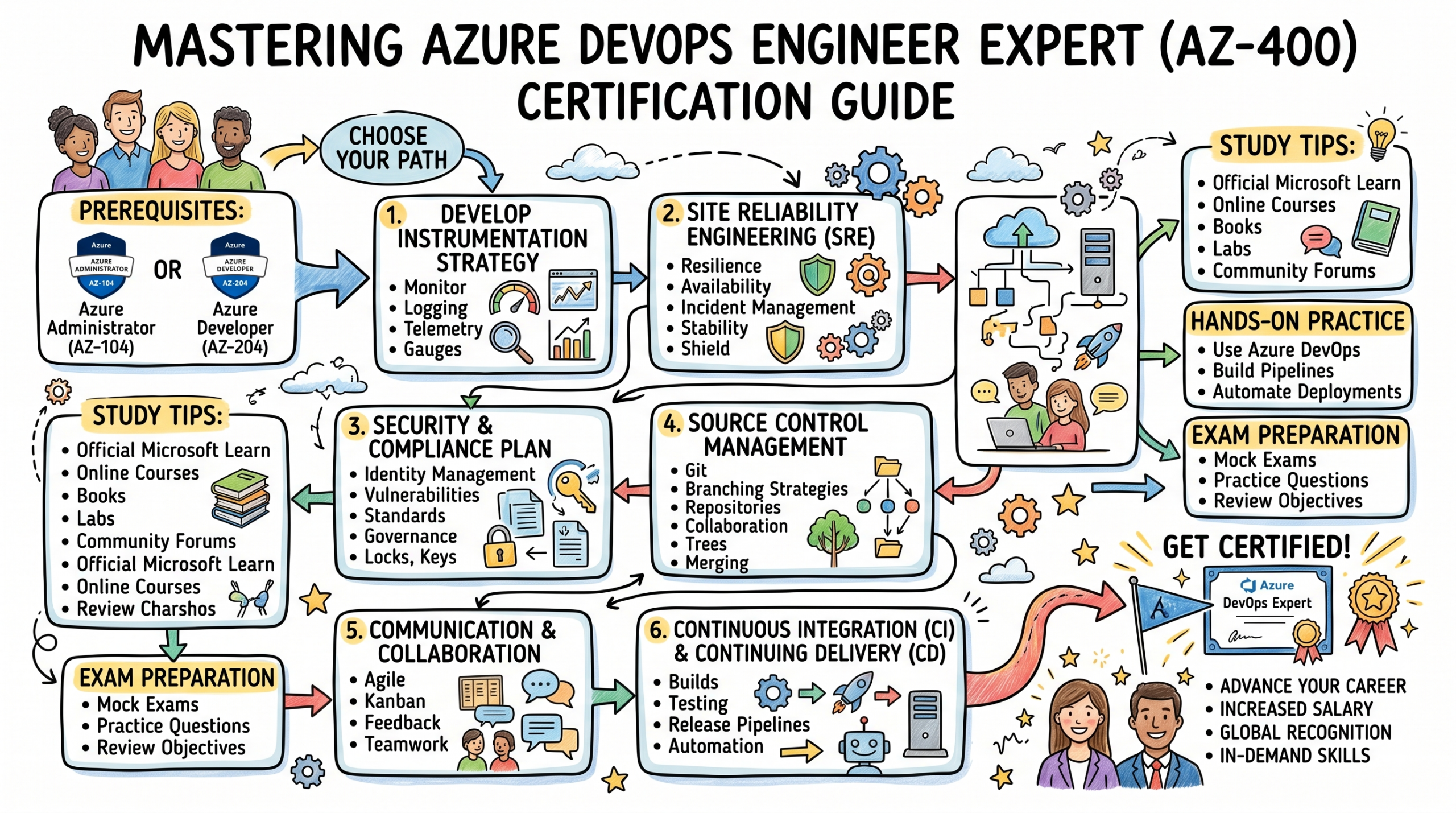
The Azure DevOps Engineer Expert (AZ-400) designation represents a high-level validation of an engineer’s ability to design and implement DevOps processes within the Microsoft cloud ecosystem. This certification does not focus purely on academic theories or basic cloud architecture; instead, it tests practical skills required to run production workloads reliably. Candidates must demonstrate deep technical knowledge in designing version control strategies, configuring secure build pipelines, and implementing automated release workflows. It bridges the gap between software development and IT operations by standardizing how code is built, tested, and deployed at enterprise scale. By verifying competencies in compliance, instrumentation, and infrastructure as code, the credential ensures that engineers can confidently lead complex digital transformation initiatives within modern corporate environments.
Who Should Pursue Azure DevOps Engineer Expert (AZ-400)?
This expert-level certification is designed primarily for mid-to-senior level professionals who manage infrastructure, deployment pipelines, and application lifecycles. Traditional system administrators, software developers, build engineers, and cloud architects will find immense value in aligning their skills with this structured curriculum. It serves as an excellent progression path for individuals who already hold associate-level cloud certifications and wish to move into specialized platform engineering or site reliability engineering roles. In tech hubs across India and the global market, engineering managers and technical leaders also pursue this credential to better oversee automated workflows and build compliant development teams. Beginners should note that this is not an entry-level program, as it requires a foundational understanding of cloud environments and basic scripting practices before attempting the coursework.
Why Azure DevOps Engineer Expert (AZ-400)
Enterprise reliance on public and hybrid cloud infrastructure continues to expand, creating a permanent demand for engineers who can optimize operational efficiency. Tools and frameworks may change over time, but the underlying core principles of automation, configuration management, and continuous feedback remain completely constant. Earning this certification demonstrates to employers that an engineer possesses the adaptability to handle sophisticated pipeline architectures and large-scale deployment issues. The investment of time and effort yields substantial returns, as companies consistently prioritize hiring certified professionals to minimize downtime and secure software supply chains. By mastering these cloud-native automation methodologies, engineers safeguard their careers against technical obsolescence and position themselves for high-paying roles in senior infrastructure management.
Azure DevOps Engineer Expert (AZ-400) Certification Overview
The certification process evaluates a candidate’s comprehensive grasp of continuous integration, automated delivery, and cloud governance frameworks. The entire educational program and training matrix are delivered via devopsschool, providing structured learning paths that map directly to the official certification criteria. To achieve the expert designation, candidates must pass the rigorous AZ-400 examination, which features a combination of multi-step case studies, technical scenarios, and direct multiple-choice questions. Microsoft maintains strict ownership of the certification standard, ensuring that the curriculum is regularly updated to mirror actual enterprise engineering requirements. Candidates must also satisfy specific associate-level prerequisites to formally receive the final expert certificate, making it a highly structured and respected professional milestone.
Azure DevOps Engineer Expert (AZ-400) Certification Tracks & Levels
The qualification pathway is divided into distinct, manageable tiers to ensure that candidates possess balanced skills in both general administration and advanced automation. The journey begins at the associate level, where engineers must master either cloud administration or cloud application development as a foundational step. Once the prerequisite associate credential is secured, candidates transition into the expert tier, which focuses heavily on advanced continuous delivery, compliance, and systems optimization. This tiered structure ensures that an expert engineer does not just know how to write a deployment script, but fully understands the underlying compute, network, and security architectures. This systematic approach allows professionals to steadily build their expertise while maintaining a clear trajectory toward senior engineering positions.
Complete Azure DevOps Engineer Expert (AZ-400) Certification Table
| Track | Level | Who it’s for | Prerequisites | Skills Covered | Recommended Order |
|---|---|---|---|---|---|
| Cloud Infrastructure Track | Associate | Systems Administrators, Network Engineers | Basic Cloud Knowledge | Azure governance, storage configuration, compute resources, virtual networking | Step 1 (Option A) |
| Cloud Development Track | Associate | Application Developers, Software Engineers | Basic Programming | Cloud SDKs, serverless architecture, secure API integrations, storage solutions | Step 1 (Option B) |
| Advanced Automation Track | Expert | Senior DevOps Engineers, SREs, Architects | Associate Level (AZ-104 or AZ-204) | CI/CD pipeline design, dependency tracking, compliance, configuration management | Step 2 |
Export to Sheets
Detailed Guide for Each Azure DevOps Engineer Expert (AZ-400) Certification
Azure DevOps Engineer Expert (AZ-400) – Prerequisite Associate Level
What it is
This initial phase validates core competency in managing cloud infrastructure or developing cloud-native applications, establishing the mandatory technical baseline required for advanced engineering.
Who should take it
Systems administrators, cloud infrastructure engineers, and developers who need to validate their everyday operational capabilities on public cloud platforms before moving to automation engineering.
Skills you’ll gain
- Configuring and managing virtual networks and secure cloud storage solutions
- Implementing identity management and role-based access control policies
- Deploying compute resources, container instances, and virtual machine scale sets
- Monitoring cloud resources and managing backup environments effectively
Real-world projects you should be able to do
- Deploy a multi-tier virtual network with secure subnets and load balancers
- Configure automated backup routines and governance policies for enterprise subscription accounts
Preparation plan
- 7–14 Days: Review official documentation, focus on basic cloud services, and set up a personal lab sandbox environment.
- 30 Days: Complete hands-on lab exercises for compute, network, and storage configurations while resolving basic configuration errors.
- 60 Days: Take multiple full-length practice evaluations, identify knowledge gaps in security policies, and review case study architectures thoroughly.
Common mistakes
- Ignoring foundational networking principles like subnetting, routing tables, and public-to-private communication rules.
- Relying entirely on theoretical study guides without gaining direct, manual experience inside an active cloud management portal.
Best next certification after this
- Same-track option: Azure DevOps Engineer Expert (AZ-400)
- Cross-track option: Azure Security Engineer Associate
- Leadership option: Azure Solutions Architect Expert
Azure DevOps Engineer Expert (AZ-400) – Expert Level Certification
What it is
This advanced credential validates high-level expertise in designing and executing modern deployment strategies, continuous integration pipelines, and total operational governance models.
Who should take it
Experienced cloud professionals, platform engineers, and build specialists who design automation systems and manage enterprise software delivery pipelines.
Skills you’ll gain
- Designing modern source control strategies and Git branching structures
- Building automated continuous integration and continuous delivery pipelines
- Managing secrets, application configurations, and secure service connections
- Implementing infrastructure as code using declarative configuration tools
Real-world projects you should be able to do
- Construct an end-to-end multi-stage pipeline that automates testing, security scanning, and deployment to staging and production.
- Provision an entire enterprise infrastructure stack using repeatable code templates with automated state-file management.
Preparation plan
- 7–14 Days: Analyze the exam objective blueprint, focus on pipeline schema structures, and understand container orchestration rules.
- 30 Days: Build complex multi-stage deployment definitions, integrate automated test suites, and configure secure package feeds.
- 60 Days: Focus heavily on enterprise compliance frameworks, secrets management policies, and advanced system instrumentation scenarios.
Common mistakes
- Memorizing specific command-line syntax while failing to understand the broader conceptual design of deployment strategies like blue-green or canary releases.
- Underestimating questions related to open-source package dependency management, security compliance tracking, and feed configuration.
Best next certification after this
- Same-track option: Certified Cloud Security Professional
- Cross-track option: Azure Certified Solutions Architect
- Leadership option: Certified Information Systems Security Manager
Choose Your Learning Path
DevOps Path
This path focuses heavily on building high-velocity delivery pipelines, optimizing continuous integration setups, and standardizing version control methodologies across development teams. Engineers learn to eliminate operational friction by automating regular deployment tasks and creating reproducible testing setups. The primary objective is to maintain a stable, predictable, and fully transparent software supply chain from local developer code check-ins to production hosting.
DevSecOps Path
Security must be woven directly into every phase of the automated deployment pipeline rather than treated as a final, manual evaluation step. This specialized path trains professionals to integrate static code analysis, vulnerability scanning, and license compliance audits directly into automated build definitions. Engineers learn to manage credentials securely using centralized vault mechanisms and enforce compliance policies automatically across all cloud infrastructure assets.
SRE Path
Site reliability engineering bridges the gap between software development and production operations by applying software engineering principles to infrastructure problems. This path emphasizes deep infrastructure monitoring, automated alerting configurations, and high-availability architecture designs to guarantee maximum system uptime. Professionals focus on defining service level objectives, analyzing system bottlenecks, and implementing self-healing mechanisms to handle unexpected load spikes seamlessly.
AIOps Path
Modern operational environments generate vast amounts of log data, metrics, and alerts that require intelligent analysis to maintain platform health. This track guides engineers on how to integrate automated analytical tools and machine learning components into monitoring frameworks to predict failures before they happen. Professionals learn to automate root-cause analysis, reduce alert noise, and utilize telemetry data to guide systemic infrastructure optimization choices.
MLOps Path
Deploying machine learning models into production requires specialized continuous delivery pipelines that handle data versioning, model training, and model serving. This learning path teaches engineers how to manage the lifecycle of complex data algorithms alongside traditional application code deployments. Focus areas include automating model retraining schedules, monitoring prediction accuracy drift, and managing specialized compute resources needed for data science workloads.
DataOps Path
Data delivery pipelines require the same level of automation, quality control, and governance as standard enterprise application codebases. This path centers on automating database schema migrations, validating data quality within continuous pipelines, and managing distributed data lake architectures. Engineers learn to coordinate continuous integration practices among data science teams, database administrators, and cloud platform specialists.
FinOps Path
Managing cloud infrastructure efficiently requires strict financial accountability and real-time visibility into operational spending across all engineering units. This path trains technical professionals to implement resource tagging policies, track cloud consumption metrics, and identify underutilized compute instances automatically. Engineers learn to collaborate with finance teams to optimize cloud budgets and build automated cost-alert systems inside enterprise deployment workflows.
Role → Recommended Azure DevOps Engineer Expert (AZ-400) Certifications
| Role | Recommended Certifications |
|---|---|
| DevOps Engineer | Azure DevOps Engineer Expert (AZ-400), HashiCorp Certified Terraform Associate |
| SRE | Azure DevOps Engineer Expert (AZ-400), Certified Kubernetes Administrator |
| Platform Engineer | Azure DevOps Engineer Expert (AZ-400), Azure Solutions Architect Expert |
| Cloud Engineer | Azure Administrator Associate, Azure DevOps Engineer Expert (AZ-400) |
| Security Engineer | Azure Security Engineer Associate, Azure DevOps Engineer Expert (AZ-400) |
| Data Engineer | Azure Data Engineer Associate, Azure DevOps Engineer Expert (AZ-400) |
| FinOps Practitioner | FinOps Certified Practitioner, Azure DevOps Engineer Expert (AZ-400) |
| Engineering Manager | Azure DevOps Engineer Expert (AZ-400), Lean Six Sigma Green Belt |
Export to Sheets
Next Certifications to Take After Azure DevOps Engineer Expert (AZ-400)
Same Track Progression
After securing the expert status, engineers should focus on deep specialization within the cloud ecosystem by mastering advanced container orchestration systems. Pursuing credentials like the Certified Kubernetes Administrator ensures that you can manage large-scale microservice deployments that sit on top of automated infrastructure. This deepens your technical value, making you the primary authority for architectural engineering challenges within your organization.
Cross-Track Expansion
Broadening your technical capabilities requires expanding into surrounding domains like comprehensive cloud security architectures or advanced data systems management. Earning an enterprise security credential allows a DevOps expert to validate their ability to protect complex software supply chains from external vulnerabilities. This combination of skills makes an engineer highly versatile and capable of bridging the gap between infrastructure teams and corporate security officers.
Leadership & Management Track
Transitioning into executive technical leadership involves moving your focus from daily execution to long-term engineering strategy and resource governance. Pursuing enterprise architecture certifications or specialized management frameworks helps senior engineers master budget planning, risk management, and organizational design. This transition allows you to guide entire engineering divisions, define corporate cloud strategies, and lead high-performing technical teams effectively.
Training & Certification Support Providers for Azure DevOps Engineer Expert (AZ-400)
DevOpsSchool offers deep technical training specifically built for platform engineers and system administrators looking to validate their skills. The curriculum covers everything from infrastructure as code to complex release management strategies using Azure DevOps tools. Students get access to production-like environments where they can build, test, and deploy software configurations safely. The instructors focus on practical troubleshooting methods rather than just helping students memorize exam dumps. This structured approach helps professionals handle real enterprise workloads and clear their technical interviews with confidence. It remains a reliable option for teams requiring comprehensive cloud engineering skills.
Cotocus delivers highly customized enterprise bootcamp programs that emphasize hands-on implementation and rapid skills acquisition for working engineering groups. Their training modules match modern corporate environments by incorporating real deployment scenarios, high-availability architecture configurations, and pipeline security practices. The technical instructors guide candidates through complex labs that isolate common architectural errors, teaching effective resolution patterns. This makes the learning experience highly efficient for busy engineers who must balance certification preparation with daily production deliverables. The platform is well-regarded for its direct, no-nonsense approach to technical training.
Scmgalaxy serves as an extensive repository of community knowledge, practice evaluations, and step-by-step documentation for configuration management specialists. The platform focuses heavily on the mechanics of source control systems, automated build pipelines, and artifact repository configuration strategies. Professionals utilize these resources to clarify niche technical concepts, understand pipeline schema variations, and master complex versioning rules. By providing practical examples alongside theoretical definitions, it ensures candidates understand the operational realities behind the examination questions. It remains an excellent supplemental study asset for independent learners.
BestDevOps focuses its educational content entirely on modern continuous integration tools, continuous delivery strategies, and infrastructure automation workflows. Their structured learning materials break down advanced architectural design concepts into easily digestible modules that match exam blueprints. The platform provides extensive lab guides that help engineers set up automated environments from scratch, ensuring thorough practical familiarity. Candidates benefit from clear explanations of complex subjects like deployment strategies, testing integration, and compliance enforcement. It is an ideal training destination for targeted exam preparation.
devsecopsschool answers the growing enterprise need for secure software delivery by focusing its entire curriculum on pipeline safety and compliance automation. The training programs ensure that engineers know exactly how to embed vulnerability scanning, secret management, and compliance checks into automated pipelines. Students learn to handle modern threat models and build auditable delivery workflows that meet strict corporate governance guidelines. This specialized training bridges the gap between raw deployment velocity and rigid institutional security requirements. It is highly suited for security-conscious professionals.
sreschool provides targeted educational pathways focused on platform reliability, comprehensive systems instrumentation, and automated incident mitigation strategies. The curriculum teaches engineers how to analyze performance metrics, configure proactive alerting systems, and maintain high enterprise availability standards. Training exercises simulate complex production failures, forcing candidates to use telemetry data to diagnose and resolve infrastructure issues. This prepares professionals to maintain stable environments while managing frequent automated software deployments. It is ideal for operational specialists.
aiopsschool introduces engineers to the integration of automated analysis and machine learning workflows within traditional infrastructure systems. The educational material covers how to utilize modern monitoring tools to identify anomalies and predict potential production bottlenecks. Students discover how to manage large-scale log analysis systems and configure automated responses to common platform alerts. This training ensures that engineers can manage high-volume cloud systems without succumbing to alert fatigue. It is perfect for future-focused platform specialists.
dataopsschool addresses the distinct challenges of automating data delivery networks, database schema migrations, and large enterprise data structures. The training programs apply classic DevOps automation principles to data engineering tasks, ensuring reliability and quality control across data pipelines. Professionals discover how to build automated validation tests for data assets and manage continuous integration for analytics platforms. This specialized knowledge helps align data teams with modern rapid software development lifecycles.
finopsschool delivers specialized education centered on cloud financial management, resource optimization, and automated cost accountability practices. The curriculum teaches technical professionals how to monitor infrastructure spending, configure budget alerts, and eliminate wasted cloud capacity systematically. Students discover how to align engineering choices with business financial goals without sacrificing performance or deployment speed. This training prepares senior engineers to make fiscally responsible architecture choices in large enterprise environments.
Frequently Asked Questions (General)
- What is the typical time required to prepare for a professional cloud engineering certification? Most working professionals dedicate between six to twelve weeks of consistent study, scheduling around eight to ten hours of weekly preparation time. This duration varies based on your existing familiarity with public cloud environments, manual scripting languages, and general enterprise infrastructure management.
- Can I attempt an expert-level certification exam without holding any associate-level credentials? You can physically sit for the advanced examination at any point, but the official certifying body will not award the formal expert credential until all prerequisite associate certificates are completed. It is highly recommended to follow the designated sequence to avoid administrative complications or gaps in your professional certification record.
- How long do professional cloud engineering certificates remain valid before expiration?
Most major cloud service providers require certifications to be renewed every one or two years to ensure that your technical knowledge matches current platform updates. Renewal processes are frequently free and typically consist of a shorter, unproctored online assessment focused on newly released features and updated tools. - What happens if a candidate fails the examination on their first attempt?
Certifying bodies maintain specific retake policies that generally require a twenty-four-hour waiting period before a second attempt is permitted. If subsequent attempts are necessary, the waiting period typically extends to fourteen days, allowing candidates sufficient time to review weak performance areas thoroughly. - Are these certifications recognized globally or are they limited to specific geographic tech regions?
These technical qualifications are standardized globally and hold equal professional value across North America, Europe, Asia, and the Indian enterprise market. Large multinational corporations utilize these certifications as a universal baseline when evaluating engineering candidates for remote or international infrastructure roles. - Do these exams include live lab environments where I must configure actual cloud resources? Exam formats change frequently, but many high-level evaluations include interactive performance sections where candidates must resolve actual technical issues within a simulated cloud console. Preparing with genuine hands-on lab exercises is critical to ensuring you do not run out of time during these practical sections.
- Is a background in computer science mandatory to clear these advanced cloud examinations?
A formal computer science degree is not required, as these evaluations prioritize practical operational knowledge, scripting familiarity, and system troubleshooting capabilities. Many successful platform engineers transition from traditional backgrounds in system administration, tech support, or hardware management by building hands-on experience. - How do enterprise employers verify the authenticity of my digital engineering credentials?
Employers use secure, centralized digital credential platforms to verify your certification status via a unique identification number or public verification URL. You can share these verifiable badges directly on professional networking platforms or embed them within your technical resume for background check purposes. - What is the primary difference between a cloud architect certification and a DevOps engineering certification?
Architect certifications focus on high-level system design, cost optimization, global availability, and general infrastructure structural planning. DevOps certifications emphasize continuous deployment automation, software delivery velocity, pipeline security integration, and configuration management practices. - Should I focus on learning multiple cloud platforms simultaneously or master one specific ecosystem first?
It is strategically wiser to master one specific cloud platform ecosystem completely before attempting to learn secondary alternative providers. The core conceptual frameworks of cloud automation translate easily across platforms, making subsequent learning paths significantly faster once the first ecosystem is fully mastered. - Do these examinations require a deep understanding of programming languages like Java or C++?
Deep application development skills are not mandatory, but you must be fully comfortable reading and editing configuration languages like YAML, JSON, and basic administrative scripting languages. The exam evaluates your ability to automate infrastructure configurations and manage deployment parameters rather than write complex business logic. - Are practice exam dumps sufficient to clear high-level cloud infrastructure evaluations?
Relying on exam dumps is an unreliable strategy that frequently leads to failure because official test questions are regularly rotated and updated. Enterprise environments require actual troubleshooting capabilities, making genuine hands-on lab practice and concept mastery the only dependable path to success.
FAQs on Azure DevOps Engineer Expert (AZ-400)
- What are the official prerequisite paths required to fully activate the Azure DevOps Engineer Expert designation?
To achieve this credential, you must successfully pass the AZ-400 examination and hold either the Azure Administrator Associate (AZ-104) or the Azure Developer Associate (AZ-204) certificate. Passing the AZ-400 exam alone will not grant you the expert status until Microsoft verifies that one of these foundational associate milestones has been met. Most infrastructure professionals choose the administrator path, whereas application engineers prefer the developer track. Following this order ensures you have the foundational knowledge required to understand advanced deployment scenarios. - How difficult is the AZ-400 examination compared to standard associate-level cloud assessments?
The AZ-400 assessment is considered highly challenging because it requires a comprehensive understanding of both software development lifecycles and advanced systems operations. Unlike associate exams that focus on separate cloud components, this exam requires you to connect multiple tools into unified pipelines. You will face complex case studies that require careful analysis of business constraints, security policies, and technical requirements simultaneously. Success requires hands-on experience with source control strategies, continuous integration configurations, and automated release gates. - Which specific infrastructure as code technologies are emphasized within the official curriculum? The examination heavily tests your ability to design and maintain declarative infrastructure configurations using Azure Resource Manager templates, Bicep, and Terraform frameworks. You must understand how to manage state files securely, configure automated infrastructure deployments within pipelines, and handle parameter variables across multiple environments. Questions frequently focus on modular design patterns, configuration drift resolution, and policy enforcement within automated provisioning workflows. Mastering these tools is essential for modern enterprise infrastructure management.
- How does the AZ-400 blueprint handle open-source container tools and orchestration platforms?
The curriculum requires a solid understanding of containerization strategies using Docker and orchestration platforms like Azure Kubernetes Service. You must know how to build secure container images, manage private container registries, and configure automated deployment steps to Kubernetes clusters. Testing also includes scenarios on container security scanning, image versioning practices, and managing secrets within microservice architectures. This ensures that certified engineers can confidently manage modern cloud-native deployment patterns. - What types of monitoring and telemetry practices are evaluated during the certification process?
Candidates must prove their ability to design and implement comprehensive logging and monitoring strategies using Azure Monitor and Application Insights. The exam checks your knowledge of configuring log analytics workspaces, establishing custom alerts, tracking application performance metrics, and analyzing crash dumps. You must also know how to integrate third-party telemetry tools and set up continuous feedback loops that alert engineering teams to production failures automatically. This focuses on maintaining operational health after deployment. - Are third-party open-source tools included in the exam, or is it limited to native Microsoft services?
While native services like Azure Pipelines and Repos are central, the exam also evaluates your ability to integrate popular third-party tools. You will encounter questions regarding GitHub integration, Jenkins build setups, SonarQube quality gates, and dependency scanning utilities like WhiteSource or Mend. The certification validates your ability to operate in diverse enterprise environments that combine open-source tools with native cloud solutions. This realistic approach makes the credential highly valuable to modern businesses. - What is the career value and return on investment of earning this expert-level certification?
Securing this credential positions you for senior roles such as platform engineer, site reliability engineer, or lead DevOps architect. Enterprises prioritize certified experts to lead cloud migrations, standardize automation, and secure corporate software delivery channels. In competitive hiring markets, this qualification differentiates your resume, confirming your ability to handle complex infrastructure without requiring extensive initial oversight. The investment yields clear professional growth and opens avenues to leadership positions. - How frequently does Microsoft update the technical syllabus and objectives for the AZ-400 exam?
Microsoft reviews and updates the exam objectives every few months to mirror the continuous feature releases and architectural changes within the cloud platform. Candidates should always check the official exam blueprint documentation before beginning their studies to ensure their training materials match current requirements. This continuous updates policy maintains the certification’s prestige, ensuring that your skills remain aligned with actual enterprise engineering needs.
Final Thoughts: Is Azure DevOps Engineer Expert (AZ-400) Worth It?
Earning the Azure DevOps Engineer Expert (AZ-400) certification requires a significant investment of study time, hands-on practice, and exam preparation. From a senior engineering perspective, this qualification is highly valuable for professionals committed to working within public and hybrid cloud environments. It goes beyond simple vendor certification by enforcing a disciplined approach to automation, security engineering, and operational quality.
The certification avoids academic theory in favor of verifying real-world capabilities, which aligns directly with what corporate engineering divisions look for during technical evaluations. If your goal is to master modern platform engineering, standardize corporate deployment pipelines, and validate your expertise with an industry-standard credential, this path is highly recommended. Focus on building genuine hands-on experience within lab environments, master the foundational prerequisites, and approach your preparation with a focus on practical engineering principles.
