Introduction
In the current landscape of cloud-native infrastructure, securing your environment is not just an option but a core requirement for any serious engineer. This Certified Kubernetes Security Specialist (CKS) guide is designed for professionals who manage complex cluster environments and need to demonstrate their ability to handle real-world security challenges. Whether you are a DevOps engineer or a platform lead, understanding the intricacies of container security is vital to maintaining robust systems. By exploring the resources at devopsschool, you can align your technical skills with industry standards. This guide will help you understand how this certification serves as a benchmark for excellence in aiopsschool environments and beyond, enabling you to make informed decisions about your professional development.
What is the Certified Kubernetes Security Specialist (CKS)?
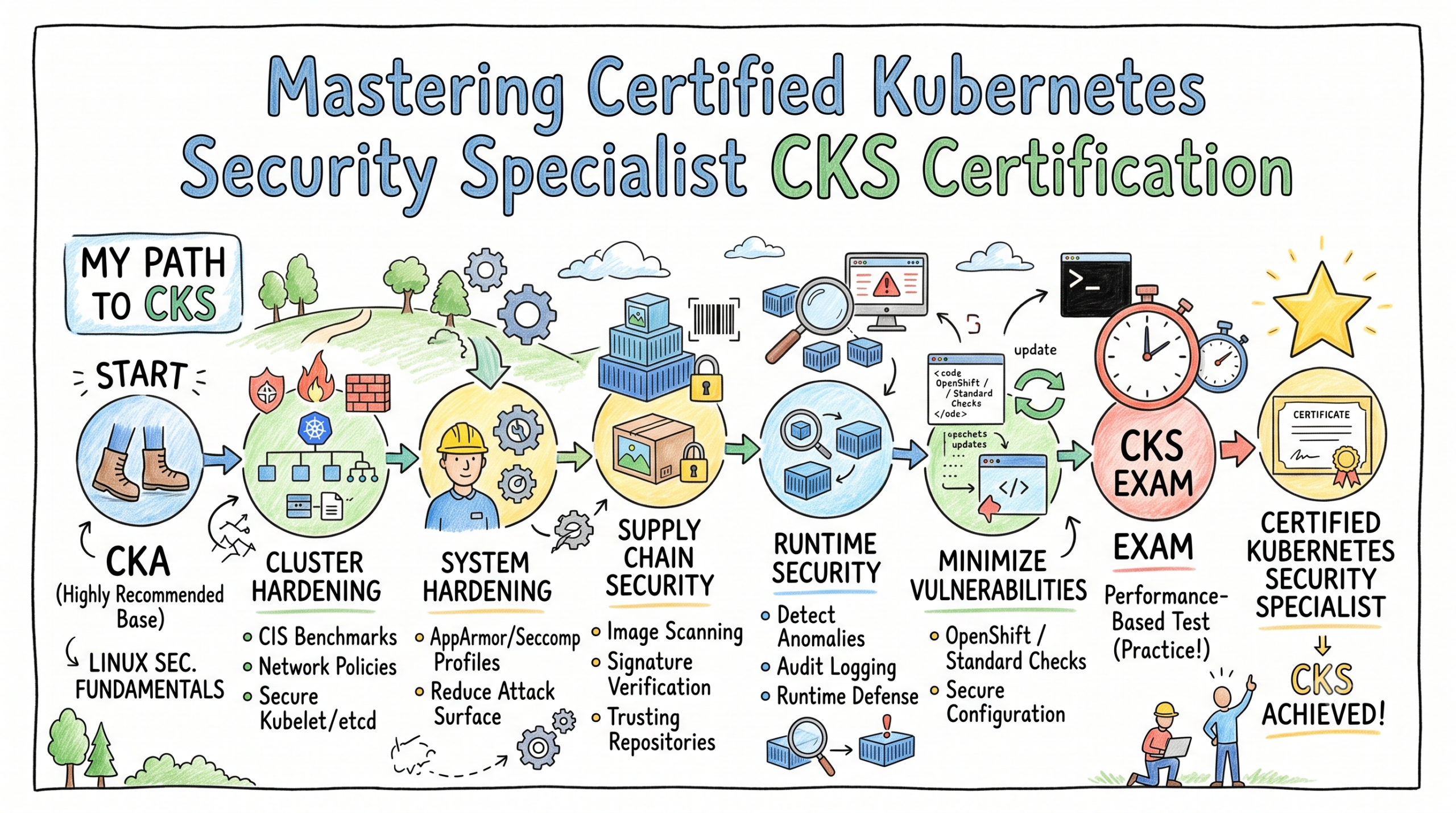
The Certified Kubernetes Security Specialist (CKS) is a performance-based certification that validates a candidate’s ability to secure container-based applications and Kubernetes platforms during build, deployment, and runtime. Unlike multiple-choice exams that test theoretical knowledge, this program requires you to solve security problems in a live command-line environment. It focuses on the practical application of security principles, such as cluster hardening, system hardening, and minimizing microservice vulnerabilities. By achieving this certification, professionals prove they can handle production-grade security threats and implement defense-in-depth strategies within enterprise clusters.
Who Should Pursue Certified Kubernetes Security Specialist (CKS)?
This certification is essential for security-conscious engineers, including DevOps practitioners, Site Reliability Engineers, and Cloud Security specialists. It is particularly relevant for those working in environments where data protection and compliance are critical, such as finance or healthcare sectors. Engineering managers who oversee infrastructure teams will also find this certification useful as a way to standardize security proficiency across their departments. Whether you are based in India or working for a global organization, the ability to demonstrate hands-on Kubernetes security skills is a significant career differentiator.
Why Certified Kubernetes Security Specialist (CKS)
The demand for professionals who can bridge the gap between development and security continues to grow as organizations move more workloads to the cloud. This certification provides a structured path to master the complexities of Kubernetes security, ensuring you remain relevant even as tools evolve. By investing your time in this program, you gain a deep understanding of core concepts that transcend specific software versions. The return on this investment is seen in your ability to design resilient architectures, reduce downtime, and protect sensitive infrastructure from evolving cyber threats.
Certified Kubernetes Security Specialist (CKS) Certification Overview
This program is delivered through devopsschool to ensure comprehensive coverage of security best practices. The certification focuses on a performance-based assessment where you must demonstrate your skills under timed conditions. You are expected to configure, monitor, and secure clusters according to industry-standard benchmarks. By completing this program, you gain the confidence to handle production environments where security incidents can have significant business implications. The training structure is designed to be rigorous, focusing on real-world scenarios that you will encounter in professional settings.
Certified Kubernetes Security Specialist (CKS) Certification Tracks & Levels
The certification path is structured to take you from foundational understanding to advanced security management. Initially, you focus on the basics of cluster architecture and security configuration. As you progress, the levels introduce more complex topics, such as supply chain security, runtime security, and network policies. These levels align with typical career progression, starting from a junior administrator who secures basic clusters to a senior security engineer capable of managing entire platform ecosystems. Each step in this track is designed to build upon the last, ensuring a solid foundation of knowledge.
Complete Certified Kubernetes Security Specialist (CKS) Certification Table
| Track | Level | Who it’s for | Prerequisites | Skills Covered | Recommended Order |
| Security | Advanced | DevOps / Security Engineers | CKAD / CKA | Cluster Hardening, Supply Chain | 3 |
| Operations | Professional | SRE / Platform Engineers | CKA | Runtime Security, Policy | 2 |
| Infrastructure | Foundation | Cloud / System Administrators | Basic Linux, K8s | Security Fundamentals | 1 |
Detailed Guide for Each Certified Kubernetes Security Specialist (CKS) Certification
Certified Kubernetes Security Specialist (CKS) – Specialist Level
What it is
This certification validates deep expertise in securing containerized workloads and platforms. It confirms that you can implement security controls across the entire application lifecycle.
Who should take it
It is intended for experienced engineers who already have a strong grasp of Kubernetes administration and are looking to specialize in security.
Skills you’ll gain
- Implementing CIS benchmarks for cluster hardening.
- Managing pod security standards and admission controllers.
- Securing the software supply chain through image signing and scanning.
- Configuring network policies for microservices.
Real-world projects you should be able to do
- Conducting a full security audit of an existing production cluster.
- Automating the detection of misconfigured resources using policy engines.
- Establishing secure inter-service communication using mTLS.
- Deploying and managing runtime security tools to detect anomalies.
Preparation plan
- 7–14 days: Review official documentation and core Kubernetes security concepts.
- 30 days: Practice hands-on labs in a sandboxed environment focusing on terminal commands.
- 60 days: Perform mock exams under timed conditions to improve speed and accuracy.
Common mistakes
Candidates often overlook the importance of understanding Linux security fundamentals or fail to manage time effectively during the hands-on exam.
Best next certification after this
- Same-track: Certified Cloud Security Professional.
- Cross-track: Certified Data Engineer.
- Leadership: Certified Information Systems Security Professional.
Choose Your Learning Path
DevOps Path
The DevOps path focuses on integrating security into the CI/CD pipeline to ensure seamless deployments. You will learn to automate security testing and ensure that code remains secure from commit to production. This path is ideal for those who want to be central to both development velocity and system stability.
DevSecOps Path
This path emphasizes the “shift-left” philosophy, where security is integrated early in the development process. You will focus on vulnerability scanning, threat modeling, and automated policy enforcement within your infrastructure. It is the perfect path for those who want to champion security culture within their teams.
SRE Path
The SRE path prioritizes system reliability through secure operational practices. You will learn how to balance security requirements with system uptime and performance metrics. This path is crucial for engineers who are responsible for maintaining the health and security of large-scale, distributed systems.
AIOps Path
The AIOps path integrates artificial intelligence into the management and security of complex clusters. You will learn how to use automated tools to predict security incidents and respond to threats in real-time. This is a forward-thinking path for those interested in the future of autonomous infrastructure.
MLOps Path
The MLOps path focuses on the unique security challenges of machine learning pipelines. You will learn to protect data integrity, secure model training environments, and manage sensitive model parameters. This path is essential for engineers working at the intersection of data science and production infrastructure.
DataOps Path
The DataOps path focuses on securing data pipelines and ensuring compliance in data-driven environments. You will learn how to protect data in transit and at rest while maintaining high-performance data processing workflows. This path is ideal for those who handle massive datasets and complex analytics platforms.
FinOps Path
The FinOps path centers on the cost-efficiency and security of cloud infrastructure. You will learn how to implement security measures without driving up operational costs unnecessarily. This path is designed for professionals who want to balance the triple constraint of security, performance, and budget.
Role → Recommended Certified Kubernetes Security Specialist (CKS) Certifications
| Role | Recommended Certifications |
| DevOps Engineer | CKS, CKA |
| SRE | CKS, CKA |
| Platform Engineer | CKS, CKA |
| Cloud Engineer | CKS, CKA |
| Security Engineer | CKS, CISSP |
| Data Engineer | CKS, DataOps Pro |
| FinOps Practitioner | CKS, FinOps Certified |
| Engineering Manager | CKS, Project Management |
Next Certifications to Take After Certified Kubernetes Security Specialist (CKS)
Same Track Progression
After mastering CKS, you should look into advanced cloud security certifications that cover multi-cloud environments. This allows you to scale your expertise beyond a single container orchestration platform and manage complex, global infrastructure.
Cross-Track Expansion
Expanding your skills into data engineering or artificial intelligence operations can provide a broader perspective on infrastructure. Learning how these specific workloads function will make you a more versatile engineer who can secure diverse system components.
Leadership & Management Track
Transitioning to leadership involves moving from hands-on execution to strategic oversight. Certifications in project management or organizational security leadership are excellent next steps for those looking to manage teams and set infrastructure policies.
Training & Certification Support Providers for Certified Kubernetes Security Specialist (CKS)
DevOpsSchool provides comprehensive training programs that are deeply integrated with current industry trends. They offer hands-on labs and mentor-led sessions that ensure you are fully prepared for the certification exam and real-world application.
Cotocus focuses on practical, project-based learning to help engineers build strong foundations. Their training modules are designed to bridge the gap between theoretical knowledge and professional operational demands.
Scmgalaxy specializes in deep-dive technical training, focusing on complex topics like cluster architecture and advanced security measures. They provide a structured approach that is highly valued by experienced engineering teams.
BestDevOps offers flexible learning paths that cater to both beginners and seasoned professionals. Their resources are designed for high engagement, ensuring that you can master complex security concepts at your own pace.
devsecopsschool concentrates on the intersection of security and operations, providing targeted curriculum for engineers. Their focus on practical vulnerability management makes them a top choice for certification preparation.
sreschool provides specialized training for reliability engineers who need to understand security as a core component of system uptime. Their approach integrates security into the broader context of site reliability engineering.
aiopsschool offers advanced modules that explore the use of intelligent systems in infrastructure management. They are an essential resource for those looking to stay ahead in the rapidly evolving field of AI-driven operations.
dataopsschool focuses on the security of data pipelines and large-scale analytical environments. Their training is highly recommended for engineers who need to ensure data compliance and protection.
finopsschool specializes in the intersection of cloud finance and infrastructure security. They teach you how to manage resources efficiently while maintaining a secure and compliant cluster environment.
Frequently Asked Questions (General)
- What is the difficulty level of the certification?
The certification is considered challenging due to its performance-based nature, requiring actual command-line work. - How much time should I dedicate to preparation?
Most professionals benefit from a structured 60-day plan, though this depends on your existing Kubernetes experience. - Are there any formal prerequisites?
While not strictly required, having CKA certification is highly recommended to ensure you have the necessary base knowledge. - What is the ROI for this certification?
The ROI is high as it positions you as a specialized security expert in a highly competitive job market. - Is this certification valid globally?
Yes, the certification is recognized by global employers and reflects international standards in container security. - Can I use my own resources during the exam?
The exam environment is restricted to a specific browser and official documentation, ensuring a fair assessment. - How often should I recertify?
The certification typically requires renewal every few years to ensure your skills remain updated with the latest versions. - What if I fail the exam on my first attempt?
Most providers offer a retake option, allowing you to review your weaknesses and try again after a brief waiting period. - Does this certification help with career growth?
It significantly aids career growth by validating your ability to handle high-stakes security tasks in production. - How does this differ from theoretical exams?
This exam tests your ability to solve actual problems, making it more practical than standard multiple-choice tests. - Can I manage my own cluster after this?
Yes, you will have the technical competency to securely design, manage, and harden your own Kubernetes clusters. - Is it suitable for engineering managers?
Yes, it provides managers with the knowledge to lead security initiatives and make informed architectural decisions.
FAQs on Certified Kubernetes Security Specialist (CKS)
- How do I start my preparation?
Begin by reviewing the official curriculum and setting up a local Kubernetes cluster to practice your commands. - Is this course enough for production roles?
The course provides the foundation, but applying these skills in real-world scenarios is key to success. - What is the most difficult part of the exam?
Many candidates find the time-management aspect during the hands-on cluster configuration tasks to be the most demanding. - Does this cover network security policies?
Yes, network policies are a core component of the curriculum to ensure secure communication between pods. - Is there a focus on supply chain security?
Absolutely, you will learn how to secure images and verify the integrity of the software components in your cluster. - Are there practice labs provided?
Yes, most authorized training partners offer hands-on labs that simulate the exam environment. - How does this affect my salary prospects?
Specialized security skills in Kubernetes often lead to higher compensation packages in enterprise roles. - Is this certification relevant for hybrid clouds?
The security principles taught are universal and highly applicable across hybrid and multi-cloud environments.
Final Thoughts: Is Certified Kubernetes Security Specialist (CKS) Worth It?
If you are serious about a career in infrastructure security, this certification is a significant milestone. It moves you away from theory and forces you to prove your skills in a real-world, high-pressure environment. While the preparation is demanding, the skills you gain are immediately applicable to securing production workloads. Avoid the urge to look for shortcuts; instead, focus on truly understanding the mechanics of how clusters are hardened. For any engineer looking to elevate their professional standing and provide tangible value to their organization, this path is highly recommended. Stay focused, practice consistently, and build your confidence through hands-on experience.
