Introduction
Most popular holiday destinations trap visitors in a loop of plastic souvenir stands, scripted bus tours, and frantic crowds jostling for the same identical selfie. Hyderabad rejects that shallow commercial veneer entirely. It is a metropolis where four centuries of royal patronage remain etched into everyday life, from the hypnotic scent of simmering cardamom broth to the rhythmic clang of silversmiths hammering foil in forgotten alleyways.
Stepping into this Deccan citadel means engaging with a living, multi-layered civilization. The city does not perform its heritage for tourists; it simply lives it through ancient sandstone bastions, fragrant Irani chai houses, and sprawling suburban lakes.
The historic Charminar in Hyderabad.
Why Hyderabad is a must-visit city
Hyderabad occupies an unmatched cultural crossroads where North Indian courtly etiquette merges with the fiery regional flavors and artistic traditions of South India. Geographically rooted in the rocky granite Deccan plateau, this city was the beating heart of the Golconda Sultanate and the Asaf Jahi dynasty, amassing legendary wealth from the Golconda diamond mines. Today, that imperial grandeur sits comfortably alongside a futuristic, glass-fronted tech corridor, creating a dynamic urban dialogue you will not find anywhere else on the subcontinent.
Reaching Hyderabad is effortless across all budgets. Rajiv Gandhi International Airport (RGIA) connects directly to key global hubs and major domestic cities, while three primary railway terminals—Secunderabad, Hyderabad Deccan (Nampally), and Kacheguda—handle daily long-distance rail routes. An extensive, gleaming elevated metro rail, combined with wide arterial flyovers and app-based cabs, ensures smooth intra-city transit. Whether you are a solo backpacker, an architectural researcher, or a family traveling in comfort, the city’s legendary mehmaan-nawazi (royal hospitality) caters seamlessly to every style.
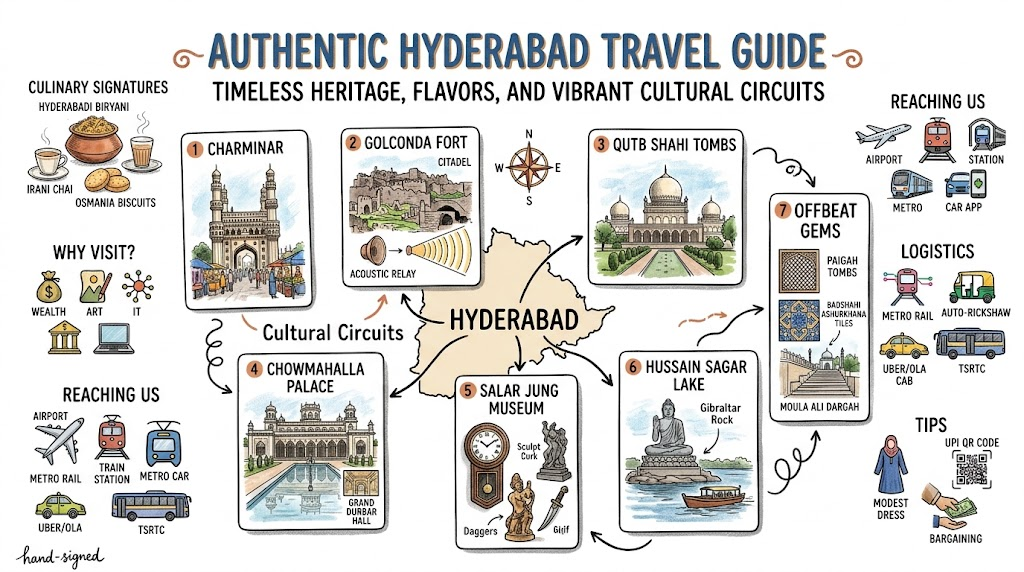
The classic Hyderabad travel circuit moves fluidly from the historic Old City south of the Musi River to the verdant cantonment parks of Secunderabad, before sweeping west toward the granite ruins of Golconda and the contemporary dining scenes of Banjara Hills and HITEC City.
| Dimension | Key Details |
|---|---|
| Primary Region & State | Telangana, Southern Deccan Plateau |
| Best Travel Window | October to March (Crisp mornings, pleasant evenings) |
| Ideal Trip Duration | 3 to 4 Full Days |
| Primary Transit Hubs | RGIA Airport (HYD), Secunderabad Junction (SC), Nampally (HYB) |
| Culinary Signatures | Hyderabadi Dum Biryani, Mirchi ka Salan, Osmania Biscuits, Irani Chai |
| Local Languages | Dakhni Urdu, Telugu, Hindi, English |
Top Places or Experiences
Charminar
Built in 1591 by Sultan Muhammad Quli Qutb Shah to commemorate the eradication of a devastating plague, the Charminar stands as the timeless structural soul of Hyderabad. Constructed from locally quarried granite, lime mortar, and pulverized marble, its four soaring minarets rise 48.7 meters above a bustling bazaar intersection. The monument features intricate stucco work, delicate arches, and an ancient open-air mosque on its top floor that captures cool breezes above the chaotic streets below.
Surrounding this four-legged colossus is the pulsating energy of Laad Bazaar and Madina Chowk. The air here carries the sweet aroma of baking butter cookies, rich incense, and brewing tea. Wandering underneath its monumental grand arches at dawn or dusk connects you directly to the vibrant dawn of medieval Deccan urban planning.
- Location: Old City, Hyderabad; roughly 18 km north of RGIA Airport and 8 km south of Nampally Station.
- Why it is worth visiting: It is the supreme emblem of Indo-Islamic architectural harmony and the beating pulse of historic Hyderabad.
- Best things to do: Climb the spiral staircase for an elevated panoramic view of the Old City markets; admire the delicate stucco floral motifs along the upper gallery; stroll through the base arches during the blue twilight hour.
- Best time to visit: 8:30 AM for quiet, unobstructed photography before the bazaars open, or 7:00 PM to view the grand facade brilliantly illuminated.
- Ideal for whom: Architectural purists, cultural photographers, and first-time travelers to the Deccan.
- Travel tip: The stairs are steep and narrow; leave large daypacks at your hotel and secure your wallet against heavy bazaar crowds.
Golconda Fort
The majestic ramparts of Golconda Fort.
Rising majestically atop a 120-meter-high granite hill, Golconda Fort was the formidable seat of the Qutb Shahi dynasty. Originally an earthen mud fort under the Kakatiya rulers, it expanded into a massive stone citadel enclosed by three concentric outer walls, spanning over 11 kilometers in circumference with 87 massive bastions. The fort is globally famous for yielding some of the world’s most storied gems, including the Koh-i-Noor and the Hope Diamond.
What truly sets Golconda apart is its ingenious acoustic and hydraulic engineering. A sharp handclap at the main outer gateway (Fateh Darwaza) resonates clearly across the granite crags all the way to the royal palace (Bala Hissar) located nearly a kilometer uphill. Walking through its cavernous armories, freshwater reservoirs, and vaulted halls reveals an ancient defense system built to withstand decades of imperial siege.
- Location: Ibrahim Bagh, Western Hyderabad; approximately 11 km west of the city center.
- Why it is worth visiting: World-class medieval defense architecture, acoustic marvels, and unmatched panoramic views of the modern skyline.
- Best things to do: Test the acoustic relay from Fateh Darwaza to the summit; hike the stone steps up to the Bala Hissar citadel; attend the evening sound-and-light show recounting the fortress’s fall.
- Best time to visit: 9:00 AM to beat the mid-afternoon Deccan heat, or late afternoon from 3:30 PM to catch sunset from the summit.
- Ideal for whom: Trekking enthusiasts, history buffs, and military engineering aficionados.
- Travel tip: Wear sturdy walking shoes with aggressive tread; climbing the smooth, centuries-worn granite steps can be slick in flat footwear.
Qutb Shahi Tombs
Domes of the Qutb Shahi Tombs.
Set within the tranquil landscaped expanse of the Ibrahim Bagh gardens, the Qutb Shahi Tombs house the final resting places of seven successive rulers of the Qutb Shahi dynasty. Each mausoleum is an architectural masterwork, blending Persian miniature aesthetics, Pathan monumental scale, and indigenous Hindu stone carving traditions. The monuments sit atop elevated square terraces, framed by gracefully bulbous onion domes and intricate floral merlons.
Unlike the crowded corridors of the Old City, this heritage park offers profound quiet. Extensive conservation efforts have restored the lost turquoise-and-lapis glazed tiles, historic stepwells (baolis), and stone water channels that once cooled these royal grounds. Walking beneath the massive stone plinths as late afternoon sunlight glints across the plasterwork feels like wandering through an untouched imperial garden.
- Location: Fort Road, Tolichowki; approximately 2 km north of Golconda Fort’s outer gate.
- Why it is worth visiting: It is one of the only historical sites in the world where an entire royal lineage is entombed within a single unified garden complex.
- Best things to do: Explore the massive, multi-tiered tomb of Muhammad Quli Qutb Shah; photograph the reflections in the restored stepwells; visit the on-site interpretation center detailing the heritage restoration.
- Best time to visit: November through February, specifically between 3:00 PM and 5:30 PM for warm, cinematic golden-hour light.
- Ideal for whom: Solitary travelers, landscape photographers, and families seeking quiet, unhurried open spaces.
- Travel tip: Purchase a combined photography permit at the main ticket office if bringing professional DSLR equipment to avoid entry checks.
Chowmahalla Palace
Courtyard of Chowmahalla Palace.
Chowmahalla Palace—translating literally to “Four Palaces”—served as the official seat of the Asaf Jahi dynasty, where the Nizams entertained visiting viceroys and royal dignitaries. Commenced in 1750 by Salabat Jung and completed in neoclassical splendor by Nizam Afzal-ud-Daulah, the complex captures royal European court style mixed with classical Persian architecture. The central courtyard features a vast water cistern reflecting stately yellow-and-white stone facades lined with royal palms.
The centerpiece of the entire estate is the breathtaking Khilwat Mubarak (Grand Durbar Hall). Beneath high ceilings adorned with nineteen authentic Belgian crystal chandeliers, the elevated pure marble throne (Takht-e-Nishan) stands surrounded by rich stucco pilasters. The adjoining corridors showcase an extraordinary collection of vintage carriages, Mughal-era armaments, intricate textiles, and the legendary 1912 yellow Rolls-Royce Silver Ghost.
- Location: Motigalli, Khilwat; 1 km southwest of Charminar in the Old City.
- Why it is worth visiting: Pristinely preserved royal interiors that transport you straight into the zenith of 19th-century royal Deccan luxury.
- Best things to do: Gaze up at the nineteen Belgian crystal chandeliers inside the Khilwat Mubarak; view the pristine vintage royal automobile collection; admire the ceremonial china and porcelain dinner services.
- Best time to visit: 10:30 AM right as doors open to experience the grand durbar hall without tour groups.
- Ideal for whom: Design lovers, decorative arts historians, and heritage lovers.
- Travel tip: Flash photography and tripods are strictly prohibited inside the exhibition halls; keep camera settings adjusted for low, atmospheric ambient light.
Salar Jung Museum
Situated along the southern bank of the Musi River, the Salar Jung Museum is home to one of the largest single-man art collections on the planet. Amassed largely by Nawab Mir Yousuf Ali Khan (Salar Jung III), Prime Minister to the seventh Nizam, the institution contains over 40,000 precious artifacts, 50,000 rare books, and ancient manuscripts gathered from across Europe, the Middle East, and Asia. It serves as an astonishing monument to individual passion and cultural preservation.
The museum’s galleries demand hours of unhurried curiosity. World-famous treasures include the Veiled Rebecca, an 1876 marble sculpture by Giovanni Maria Benzoni showcasing translucent stone drapery, and the 19th-century double-sided wood sculpture of Mephistopheles and Margaretta. Its central courtyard also draws crowds every hour to witness the antique musical clock, where a mechanical timekeeper emerges to strike a miniature bronze bell.
- Location: Salar Jung Marg, Darulshifa; 2 km northeast of Charminar.
- Why it is worth visiting: An encyclopedic, world-spanning treasury of jade dagger handles, Japanese lacquerware, Mughal miniatures, and European marble.
- Best things to do: Study the exquisite chisel work of the Veiled Rebecca; gather in the courtyard five minutes before the hour to watch the historic mechanical clock strike; explore the jade room containing daggers belonging to Nur Jahan and Emperor Jahangir.
- Best time to visit: Weekday mornings (Tuesday through Thursday) between 10:00 AM and 1:00 PM for minimal school tour crowds.
- Ideal for whom: Art lovers, history researchers, and collectors.
- Travel tip: The museum is closed on Fridays; plan your weekly itinerary carefully to avoid showing up to locked iron gates.
Hussain Sagar Lake & Necklace Road
Excavated in 1563 by Ibrahim Quli Qutb Shah across an eastern tributary of the Musi River, Hussain Sagar Lake is a monumental civil engineering project that historically supplied water to the city. Today, this expansive urban water body physically bridges the twin cities of Hyderabad and Secunderabad. Floating dramatically in the center on the Gibraltar Rock is an enormous, 18-meter-tall monolithic granite statue of Gautama Buddha, weighing roughly 450 metric tons and carved by master artisans from single rock faces.
The perimeter of the lake, affectionately called Necklace Road (P.V. Narasimha Rao Marg), transforms each evening into a lively social promenade. Gentle lake breezes carry the sounds of laughter, buzzing motor launches, and roadside food vendors serving spiced sweet corn. Taking a ferry across the dark water toward the illuminated Buddha offers an exhilarating change of pace from the dense traffic of the Old City.
- Location: Central Hyderabad, bounded by Tank Bund and P.V. Narasimha Rao Marg.
- Why it is worth visiting: The ultimate civic gathering ground offering panoramic boat rides, waterfront parks, and sweeping evening skyline views.
- Best things to do: Board a regular ferry or speedboat from Lumbini Park out to the Buddha monolith; take an evening sunset walk along Tank Bund to view the bronze statues of legendary Telugu poets; rent an e-bicycle along Necklace Road at sunrise.
- Best time to visit: 5:00 PM to 8:00 PM when the lakefront catches evening breezes and the monuments illuminate.
- Ideal for whom: Couples, budget travelers, runners, and families traveling with children.
- Travel tip: Avoid taking boat rides during mid-day heat; the uncovered fiberglass decks reflect extreme glare off the water surface.
Offbeat Exploration: Hidden Gems Tourists Miss
Paigah Tombs
Tucked deep within a quiet residential enclave in Pisalbanda, the Paigah Tombs belong to the aristocratic Paigah nobility, fierce loyalists who intermarried with the Nizams. What makes these mausoleums mesmerizing is their singular architectural style, often termed Indo-Saracenic with heavy Andalusian and Asaf Jahi overtones.
Walk through the tranquil marble pavilions to observe delicate geometric lime plaster screens (jaalis). Unlike anywhere else in central India, these filigree marble lattices resemble the fine lace stonework of the Alhambra in Granada, casting shifting geometric shadow maps across the smooth mosaic floors as the sun traces its path.
Badshahi Ashurkhana
Located just a short walk north of the high-arched Madina Chowk, the Badshahi Ashurkhana is an ancient royal mourning hall established in 1594 by Muhammad Quli Qutb Shah. Commissioned for Shia mourning ceremonies during the month of Muharram, this monument houses some of the most vibrant glazed Persian enamel tiles in South Asia.
The interior walls are covered with dazzling Persian ceramic mosaics, retaining their intense cobalt blue, turquoise, sulfur yellow, and emerald green hues after more than 400 years. Because commercial group tours rarely stop here, you can sit undisturbed, appreciating a masterpiece of Safavid artistic exchange that shaped early Deccan architecture.
Moula Ali Dargah
Perched on the crown of a colossal, smooth granite boulder on the northeastern fringe of Secunderabad, the Moula Ali Dargah requires an invigorating climb up roughly 480 broad stone steps. Built in the late 16th century following a courtier’s spiritual vision, this hilltop shrine holds deep reverence across all faiths and communities.
Ascending the stone stairs at dawn rewards you with refreshing hill breezes and a sweeping 360-degree vista of the Secunderabad cantonment lakes and granite outcroppings. The peaceful courtyard at the summit, smelling of fresh roses and crushed sandalwood, feels worlds away from the urban hum below.
Detailed Practical Guidance for Travelers
| Destination | Standard Entry Fee | General Timings | Best Local Food Options Nearby | Recommended Nearby Attractions |
|---|---|---|---|---|
| Charminar | ₹25 (Indians), ₹300 (Foreigners) | 9:00 AM – 5:30 PM (Daily) | Nimrah Cafe (Chai & Irani bakery), Shadab (Biryani) | Mecca Masjid, Laad Bazaar, Gulzar Houz |
| Golconda Fort | ₹25 (Indians), ₹300 (Foreigners) | 9:00 AM – 5:30 PM (Daily) | Hotel Rumaan (Marag & Tandoori), Shah Ghouse | Qutb Shahi Tombs, Taramati Baradari |
| Qutb Shahi Tombs | ₹40 (Indians), ₹200 (Foreigners) | 9:30 AM – 4:30 PM (Sat–Thu, Closed Fri) | Al Saba Restaurant, Pista House Tolichowki | Golconda Fort, Durgam Cheruvu |
| Chowmahalla Palace | ₹100 (Indians), ₹400 (Foreigners) | 10:00 AM – 5:00 PM (Sat–Thu, Closed Fri) | Subhan Bakery, Hotel Nayab (Nihari & Dosa) | Charminar, Nizam Museum, Salar Jung |
| Salar Jung Museum | ₹50 (Indians), ₹500 (Foreigners) | 10:00 AM – 5:00 PM (Sat–Thu, Closed Fri) | Madina Hotel, Govind Ki Bandi (Street dosas) | High Court of Telangana, Purani Haveli |
| Hussain Sagar Lake | Free (Boating: ₹100 to ₹400 extra) | Open 24/7 (Boating: 9:00 AM – 8:30 PM) | Eat Street, Paradise Secunderabad, Waterfront | Lumbini Park, NTR Gardens, Birla Mandir |
| Paigah Tombs | Free (Donations welcomed) | 10:00 AM – 4:30 PM (Sat–Thu, Closed Fri) | Pista House Charminar branch, local bakeries | Raymond’s Tomb, Charminar |
| Moula Ali Dargah | Free | 5:30 AM – 9:00 PM (Daily) | Local tea stalls, Secunderabad Alpha Hotel | Safilguda Lake, Trimulgherry Cantonment |
Logistics & On-Ground Navigation
Local Transport Options
Navigating Hyderabad’s sprawling neighborhoods requires a practical mix of modern transit lines and traditional street-level rides:
- The Hyderabad Metro Rail: Highly efficient, air-conditioned, and elevated. The Red, Blue, and Green lines cut through cross-city gridlock, linking Miyapur, Ameerpet, Secunderabad, and the HITEC City IT corridors.
- Auto-Rickshaws: Abundant and ideal for short hops through tightly wound alleys. Drivers rarely engage meters for tourists; always negotiate firmly or check app estimates before stepping in.
- App-Based Cabs (Uber & Ola): The most reliable choice for long trips, evening returns, and cross-river hops between the Old City and modern districts.
- TSRTC City Buses: Ultra-affordable but frequently packed during morning and evening rush hours; best left to adventurous solo travelers.
- Self-Drive & Two-Wheeler Rentals: Available via app-based vehicle rentals across Gachibowli and Madhapur, though weaving through historic city intersections demands defensive driving.
Budget Planning
Hyderabad remains remarkably budget-friendly compared to other Indian metropolitan centers.
- Budget / Backpacking Tier (₹1,500 – ₹2,500 per day): Includes a comfortable dormitory bed or simple heritage lodge (₹800–₹1,200), three authentic local meals at traditional Irani cafes and street stalls (₹400–₹600), and public transport via metro and buses (₹200–₹300).
- Mid-Range / Comfort Tier (₹4,500 – ₹8,500 per day): Includes a private room in a characterful boutique hotel or three-star property (₹3,000–₹5,500), comfortable sit-down meals at established dining rooms (₹1,200–₹2,000), private app-cab transfers, and guided museum entries (₹800–₹1,500).
Safety and Inclusivity Tips
Hyderabad is broadly recognized as one of India’s safest and most welcoming metropolitan destinations.
- Families: Paved walkways at Chowmahalla Palace and the waterfront parks around Hussain Sagar are stroller-accessible. Keep children close in bustling market crowds around Charminar.
- Couples: The city is culturally cosmopolitan, particularly around Jubilee Hills and Gachibowli. Exercise standard modesty when exploring traditional neighborhoods in the Old City.
- General Street Safety: Watch for uneven flagstones and rapid two-wheeler traffic when strolling narrow historic alleys. Carry bottled water during afternoon sightseeing to stay hydrated under the Deccan sun.
Strategic Travel Planning Guardrails
Travel Planning Tips for Hyderabad
- Time Your Visits Around Friday Closures: Remember that Salar Jung Museum, Chowmahalla Palace, and the Qutb Shahi Tombs remain strictly closed on Fridays.
- Rely on UPI Digital Payments: Almost every vendor, from street tea stalls to luxury boutiques, accepts instant digital payments via QR codes (PhonePe, Google Pay, Paytm), though keeping ₹1,000 in paper cash helps in remote bazaar pockets.
- Respect Sacred Spaces: Modest dress covering shoulders and knees is mandatory when entering Mecca Masjid, Moula Ali Dargah, and Birla Mandir. Remove footwear at designated token counters.
- Embrace Afternoon Downtime: Schedule indoor museum tours or leisurely culinary lunches between 1:00 PM and 3:30 PM to avoid peak heat.
- Reserve Morning Walks for the Bazaars: The historic alleys around Laad Bazaar are tranquil before 10:00 AM, making that the ideal window for architecture lovers to admire antique timber balconies without street congestion.
Common Mistakes to Avoid
- Underestimating Travel Distances: Attempting to visit HITEC City cafes, Golconda Fort, and Charminar all on the same morning will leave you stuck in highway traffic.
- Skipping Traditional Breakfast Counters: Missing a 7:00 AM breakfast of soft tawa idlis and crispy dosas at Govind Ki Bandi or Pragati Tiffin Centre robs you of legendary street flavors.
- Drinking Unfiltered Water: Always choose packaged or reliably filtered RO water to avoid digestive issues that can interrupt your trip.
- Paying the First Stated Price in Bazaars: When buying Lac bangles, bidriware metal crafts, or embroidered stoles in Old City markets, polite bargaining is expected.
- Assuming All Biryani Tastes Identical: Don’t visit only commercial chain outlets; seek out long-standing family establishments like Shadab, Meridian, or Cafe Bahar for distinct spice blends.
Suggested Itinerary Blueprints
1-Day Quick Dash (The Royal Deccan Express)
Designed for transit travelers, business visitors, or short layovers.
- Morning (8:00 AM – 12:00 PM): Arrive early at the Charminar before the surrounding bazaars open. Enjoy a breakfast of steaming Irani chai and buttery Osmania biscuits at Nimrah Cafe. Walk through the monumental arches of Mecca Masjid, then take a quick five-minute auto-rickshaw ride to tour Chowmahalla Palace.
- Afternoon (12:30 PM – 3:30 PM): Head to Hotel Shadab near Madina Chowk for an authentic mutton dum biryani lunch. Cool off inside the climate-controlled galleries of Salar Jung Museum to admire the Veiled Rebecca.
- Evening (4:00 PM – 7:30 PM): Take an app-cab west to Golconda Fort. Explore the lower court acoustics and stay through twilight to watch the sound-and-light presentation illuminate the granite ramparts.
2-Day Deep-Dive (Heritage & Modern Contrast)
Designed for weekend travelers looking to balance royal history with contemporary cultural dining.
- Day 1: Imperial Nizam Heritage & Old City Markets
- Morning: Start at Chowmahalla Palace, lingering in the Khilwat Mubarak durbar hall. Wander through Laad Bazaar to watch traditional bangle artisans at work.
- Lunch: Dine on Zabaan or spicy chicken biryani at Hotel Nayab.
- Afternoon: Spend three focused hours exploring the masterworks of Salar Jung Museum.
- Evening: Walk through the monumental arches of Charminar as night falls. Finish with street kebabs and Falooda along the bustling Ghansi Bazaar lanes.
- Day 2: Fortresses, Necropolises & Lakeside Promenades
- Morning: Beat the sun with an early morning hike up Golconda Fort, tracing the defensive ramparts to the summit.
- Lunch: Savor slow-cooked mutton Marag with warm naan at Hotel Rumaan.
- Afternoon: Stroll quietly through the leafy grounds of the Qutb Shahi Tombs, admiring the domed mausoleums.
- Evening: Head to Hussain Sagar Lake, boarding an evening boat to the central Buddha statue before enjoying artisanal dining in Jubilee Hills.
Complete Weekend Travel Plan (The Grand 3-Day Deccan Odyssey)
The complete Friday-to-Sunday loop covering historic bastions, forgotten architecture, and modern cafe culture.
- Friday: Undiscovered Jewels & Lakeside Twilight
- Morning: Visit the hidden, lace-like stucco screens of the Paigah Tombs in Pisalbanda.
- Lunch: Sample authentic Andhra vegetarian thalis at Kakatiya Mess in Ameerpet.
- Afternoon: Take a panoramic driving tour along Tank Bund, visiting the tranquil white marble sanctuary of Birla Mandir.
- Evening: Enjoy a scenic sunset walk along Necklace Road, sampling local street food at the open-air food courts.
- Saturday: The Heart of the Old Sultanate
- Morning: Begin at Golconda Fort right as the gates open at 9:00 AM to explore the secret passages and acoustic arches.
- Lunch: Dine on rich dum pukht specialties at Shah Ghouse in Tolichowki.
- Afternoon: Tour the restored gardens, historic pavilions, and stepwells of the Qutb Shahi Tombs.
- Evening: Head to Durgam Cheruvu in modern HITEC City to cross the illuminated cable-stayed suspension bridge and relax in lakeside bistros.
- Sunday: Imperial Splendor & Bazaar Exploration
- Morning: Climb the interior stone staircase of Charminar, followed by an unhurried morning tour of Chowmahalla Palace.
- Lunch: Feast on chicken 65 and fragrant mutton biryani at Cafe Bahar in Basheerbagh.
- Afternoon: Tour the decorative art and royal weapon collections at Salar Jung Museum.
- Evening: Ascend the smooth granite staircase of Moula Ali Dargah to take in panoramic views of the illuminated city below.
Common Tourist Mistakes to Avoid
Geographic Blunders
Hyderabad covers massive surface area, and traffic pinches heavily along the bridges crossing the Musi River. Trying to bounce between Golconda Fort in the west, Salar Jung in the center, and Ramoji Film City on the eastern outskirts on the same day wastes hours stuck on congested highways. Always cluster your sightseeing geographically: keep Old City monuments together on one day, and reserve western fortresses and modern districts for another.
Commercial Traps
Many first-time visitors spend entire afternoons inside upscale malls in Banjara Hills, purchasing mass-manufactured pearl jewelry from glitzy retail outlets. In doing so, they miss the authentic, historic pearl-sorting markets of Patthar Gatti near Charminar. Here, multi-generational dealers still sort, drill, and hand-string genuine cultured and Basra pearls on simple velvet pads at fairer prices.
Neglecting Modern and Alternative Zones
Focusing solely on medieval battlements leaves out the city’s dynamic creative pulse. Neighborhoods like Jubilee Hills, Film Nagar, and Madhapur offer thriving independent art spaces, boutique roasteries, tranquil microbreweries, and scenic walking trails around Durgam Cheruvu Lake. Skipping these leaves you with an incomplete impression of today’s Deccan lifestyle.
Transport Overpayment
Hailing an unmetered auto-rickshaw directly outside major railway gates or outside the Charminar arches routinely results in inflated tourist quotes.
Insider Tip: Always check estimated fares on Uber or Ola before negotiating with street drivers. If an auto driver refuses to run the meter or negotiate reasonably, simply step two streets away from the main monument gate to secure a standard ride.
Luxury Dining Bias
Limiting your meals to international five-star hotel buffets deprives you of the culinary heart of Hyderabad. The city’s greatest delicacies—from early-morning butter dosas at street carts to slow-simmered Haleem during Ramzan and afternoon bun maska at Irani cafes—are found along everyday street counters that charge only pocket change.
Frequently Asked Questions
1. What is the single best month to visit Hyderabad for comfortable sightseeing?
November is widely considered the ideal month to visit Hyderabad. The intense summer heat and heavy monsoon cloudbursts have dissipated completely, leaving crisp, sunny mornings and delightfully cool evening breezes. Day temperatures hover around a comfortable 28°C, which makes long walking tours through Golconda Fort and the Old City bazaars thoroughly enjoyable.
2. How many days are realistically needed to experience Hyderabad properly?
A well-planned itinerary of three full days allows you to explore the city’s essential highlights without feeling rushed. This gives you enough time to tour the grand monuments of the Old City, spend leisurely hours at Golconda and the royal tombs, and still enjoy the contemporary cafes, lakes, and culinary institutions across modern neighborhoods.
3. Is the street food in Hyderabad safe for international visitors?
Street food is generally safe if you patronize bustling, highly rated stalls that prepare dishes fresh to order in full view. Stick to piping-hot items like freshly tossed dosas, tandoori kebabs, and boiled chai while avoiding raw chutneys made with untreated water. Always drink certified bottled mineral water rather than open tap water.
4. What is the authentic difference between Hyderabadi Biryani and other regional biryanis?
Hyderabadi Biryani is world-famous for its traditional Kacchi Dum method, where raw marinated meat is layered directly with half-cooked basmati rice in a sealed heavy copper vessel. Cooking slowly over glowing charcoal embers allows rich meat juices, saffron, and aromatic spices to infuse every grain, creating a spicier, more fragrant dish than northern Pakki biryani styles.
5. How accessible is Hyderabad for solo female travelers?
Hyderabad is considered one of the safer metropolitan cities in India for solo female travelers. The people are courteous, and public transport like the elevated Metro Rail offers dedicated women’s coaches. As with any major city, exercise standard precautions: dress modestly when exploring traditional heritage quarters and use app-based cabs for late-night travel.
6. Which monument in Hyderabad requires the most physical exertion?
Golconda Fort demands the greatest physical effort of any local landmark, requiring visitors to ascend more than 360 steep, uneven stone stairs to reach the hilltop Bala Hissar citadel. The climb takes roughly 45 minutes under direct sunlight; visitors should wear supportive walking shoes, carry plenty of drinking water, and tackle the climb early in the day.
7. Can non-Muslim travelers enter Mecca Masjid next to Charminar?
Yes, Mecca Masjid warmly welcomes visitors of all cultural and religious backgrounds outside of active congregational prayer hours. All visitors must remove their footwear at the entrance gate and dress conservatively with shoulders and legs fully covered. Women are also required to loosely drape a scarf over their heads before stepping inside the courtyard.
8. Is credit card acceptance widespread across shopping areas in Hyderabad?
Credit and debit cards are widely accepted at established restaurants, hotels, modern supermarkets, and luxury boutiques across the city. However, small handicraft stores in Laad Bazaar, local Irani cafes, and street-side food stalls operate predominantly on Indian UPI digital payments or paper cash. It is always wise to keep around ₹1,000 to ₹2,000 in cash handy.
9. What authentic souvenirs are best to purchase in Hyderabad?
The most distinctive keepsakes include authentic lac bangles hand-set with sparkling stones from Laad Bazaar, fine pearl jewelry from traditional dealers along Patthar Gatti, and Bidriware handicrafts—an exquisite metal inlay craft featuring pure silver motifs set into blackened zinc-copper alloy. Boxes of fresh Osmania biscuits and Karachi Bakery fruit biscuits are also classic culinary gifts.
10. What is the most practical way to reach the city center from Rajiv Gandhi International Airport?
The most convenient option is booking an authorized prepaid airport taxi or an app-based cab (Uber/Ola) from the arrivals terminal, which takes roughly 45 to 60 minutes via the elevated PVNR Expressway. Budget travelers can also use the convenient Pushpak Airport Liner luxury bus service, which runs comfortable, air-conditioned routes directly to key points across the city.
11. Why do so many attractions close on Fridays in Hyderabad?
Because Hyderabad retains deep cultural ties to its Islamic heritage, several historic royal institutions—including the Salar Jung Museum, Chowmahalla Palace, and the Qutb Shahi Tombs—traditionally observe Friday as their designated weekly public closure. To avoid missing out, plan to visit Golconda Fort, Birla Mandir, or Hussain Sagar Lake on Fridays instead.
12. What is the origin and etiquette of drinking Irani Chai in Hyderabad?
Introduced by Zoroastrian Persian immigrants in the early 20th century, Hyderabadi Irani Chai is prepared by gently simmering sweet, condensed milk and strong black tea decoction in separate copper vessels before pouring them together. It is traditionally sipped piping hot from small white ceramic cups, accompanied by crisp, salted Osmania biscuits that are lightly dipped into the rich tea before each bite.
Conclusion
Traveling to Hyderabad rewards you with an experience that typical, manufactured tourist destinations simply cannot match. From standing atop the wind-swept granite ramparts of Golconda Fort to watching evening mist roll across the domes of the Qutb Shahi Tombs, the city offers an intimate glimpse into centuries of refined art, grand architecture, and generous hospitality. When you choose to step away from predictable itineraries and immerse yourself in Hyderabad’s bustling bazaars, fragrant backstreets, and quiet courtyards, you discover not just an ancient capital, but a living Deccan culture that stays with you long after the journey ends.
