Introduction
Modern enterprise engineering environments operate at unprecedented scale, requiring teams to deliver software rapidly across distributed architectures, hybrid cloud platforms, and data-intensive pipelines without sacrificing platform resilience. As infrastructure patterns shift toward microservices, managed container orchestration, and continuous deployment, functional silos between developers, platform teams, data specialists, and operational personnel create delivery bottlenecks. Resolving these operational frictions demands unified operational frameworks capable of bridging these distinct technical specializations. Navigating this operational evolution introduces XOps as an umbrella approach that connects disparate disciplines under a single lifecycle paradigm, enabling practitioners to align software delivery, artificial intelligence, and platform governance. For engineers seeking structured technical upskilling across these interconnected disciplines, XOpsSchool provides clear conceptual roadmaps and community resources designed to unpack operational complexity.
What Is XOps?
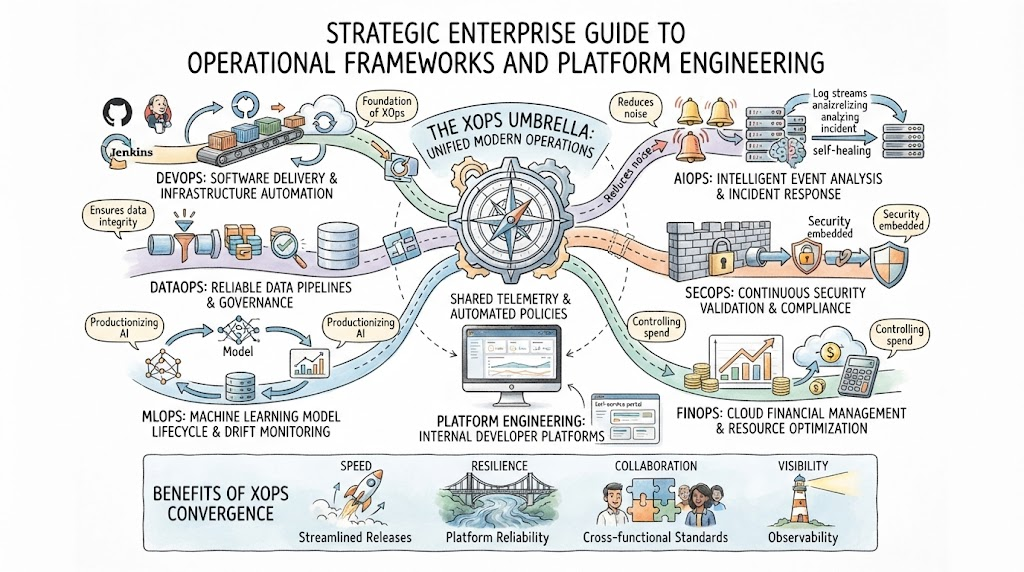
XOps represents an umbrella operational framework where the variable “X” stands for any specialized technology function—such as development, machine learning, data engineering, security, financial governance, or platform infrastructure—integrated with disciplined operational management. Rather than operating in isolated silos with bespoke tooling, XOps aligns diverse workflows under shared principles of continuous integration, automated deployment, end-to-end observability, and feedback-driven governance across the complete application lifecycle. Consider a modern retail platform: developers push microservices through continuous integration pipelines (DevOps), data teams orchestrate recommendation feeds (DataOps), data scientists deploy inference models (MLOps), platform monitors correlate operational anomalies (AIOps), security tools scan artifacts (SecOps), financial analysts review compute usage (FinOps), and site reliability engineers maintain uptime budgets (SRE). XOps integrates these overlapping responsibilities into a cohesive delivery engine that ensures end-to-end operational visibility, predictable release cadence, and sustainable reliability.
What Does XOps Include?
The modern XOps ecosystem encompasses diverse operational specializations that collaborate to sustain enterprise application ecosystems throughout their lifecycle. DevOps establishes fundamental automation for code progression and continuous delivery, while DataOps enforces schema consistency, pipeline orchestration, and continuous data validation for analytical platforms. MLOps governs machine learning models through automated tracking, packaging, and monitoring against production data drift, and AIOps injects machine intelligence into operational telemetry for dynamic event correlation. Concurrently, SecOps embeds security controls directly into deployment workflows, FinOps tracks cloud expenditures, SRE defends availability budgets, InfraOps codifies bare-metal and virtual resources, and Platform Engineering builds self-service internal developer portals. By standardizing practices across these operational domains, engineering teams eliminate organizational friction, safeguard platform stability, and accelerate time-to-market.
| XOps Discipline | Primary Focus | Typical Responsibilities |
| DevOps | Software delivery and infrastructure automation | Managing CI/CD pipelines, containerizing services, and standardizing deployment artifacts. |
| DataOps | Data pipeline reliability and orchestration | Automating ETL workflows, validating schema changes, and monitoring data quality. |
| MLOps | Machine learning lifecycle and deployment | Versioning training sets, automating model deployments, and detecting inference drift. |
| AIOps | Algorithmic telemetry and event management | Correlating cross-system alerts, identifying anomalies, and automating incident triage. |
| SecOps | Continuous security and compliance integration | Automating container scanning, secret rotation, and policy enforcement across environments. |
| FinOps | Cloud financial management and optimization | Tracking cloud resource expenditures, optimizing instances, and assigning cost ownership. |
| SRE | Production reliability and availability management | Defining service level objectives, managing error budgets, and conducting blameless post-mortems. |
| InfraOps | Base infrastructure provisioning and upkeep | Managing core networking, bare-metal provisioning, and hypervisor maintenance. |
| Platform Engineering | Internal developer platform self-service | Standardizing infrastructure golden paths and building developer self-service tooling. |
What Is XOpsSchool?
XOpsSchool functions as a specialized knowledge repository and technical education portal dedicated to unravelling modern IT operations, automation paradigms, and cloud-native practices for engineering practitioners. The platform deconstructs complex operational concepts into structured, practical modules covering continuous software delivery, scalable infrastructure automation, machine learning operations, and intelligent telemetry analysis. By providing targeted technical overviews, configuration patterns, and workflow breakdowns, it assists professionals in transitioning from single-domain execution to multi-disciplinary operational leadership across hybrid environments. Learners leverage its practical content to discover architectural standards, explore automation strategies, and understand how containerized workloads interact with automated pipelines in real-world deployments. Ultimately, the platform acts as an educational companion for engineers seeking to grasp the technical intersections defining modern platform reliability.
Why Is XOps Important?
Modern digital platforms run on distributed cloud-native architectures where microservices, serverless workloads, event-driven streaming engines, and analytical pipelines interact across multiple environments, creating massive operational complexity. Traditional, segmented operational practices collapse under these environments because an issue in a data streaming job or a drifting machine learning model directly impacts frontend service latency and operational budgets. Security compliance mandates, relentless release cycles, and spiraling cloud compute costs require teams to maintain end-to-end accountability rather than passing problems across functional divides. XOps addresses these operational challenges by harmonizing infrastructure codification, telemetry analysis, and deployment governance across traditionally disconnected technical teams. Consequently, engineering organizations achieve resilient platform availability, eliminate operational bottlenecks, enforce continuous compliance, and deliver consistent end-user value.
Why Choose XOps Training?
Pursuing structured technical development across multi-domain operational practices equips engineers with the systems-level perspective required to manage modern enterprise platforms. Rather than remaining confined to isolated configuration scripts or platform-specific maintenance tasks, engineers gain cross-functional proficiency across container orchestration, automated release pipelines, security automation, and infrastructure provisioning. This comprehensive operational insight enhances technical problem solving, enabling platform specialists, software developers, and system administrators to collaborate seamlessly during critical production releases and complex infrastructure outages. Furthermore, mastering these interconnected practices prepares technical professionals to design scalable platforms, optimize complex cloud environments, and implement comprehensive observability standards across diverse distributed systems.
How Does XOps Training Work in Practice?
Effective technical progression across multi-discipline operations requires an incremental, laboratory-centric framework that moves from fundamental platform administration to advanced cross-domain automation. Engineers establish their foundation through Linux kernel administration, low-level networking, and shell automation before progressing to distributed version control workflows and containerization architectures. Next, the progression tackles container orchestration, declarative infrastructure provisioning, and multi-environment pipeline deployment, followed by end-to-end observability, security scanning integration, and production reliability engineering. Advanced phases introduce data pipeline scheduling, model lifecycle automation, and algorithmic incident correlation systems across real-world operational environments. Immersing engineers in hands-on production failure labs ensures they master diagnosing network latencies, resolving deployment rollbacks, and remediating configuration drift under real-world constraints.
XOps Certification: What Should You Look For?
Evaluating professional credentials in modern operations requires looking beyond multiple-choice exams to find programs that validate real-world operational execution and problem-solving skills. A meaningful curriculum tests candidate capabilities across container orchestration, declarative infrastructure management, continuous deployment workflows, security automation, and multi-tier telemetry instrumentation. Rigorous credentials prioritize performance-based, timed lab examinations where candidates must deploy functional architectures, diagnose broken microservices, configure secure secret vaults, and rectify failing pipelines in live environments. While a credential confirms that an engineer understands industry-standard patterns, architectural frameworks, and continuous delivery methodologies, it serves as a supplement to, rather than a substitute for, extensive production troubleshooting experience.
XOps Tools: Understanding the Technology Stack
Modern cross-functional operations rely on an expansive ecosystem of open-source projects, managed services, and specialized automation frameworks tailored to distinct delivery phases. No single platform covers the entire operational continuum; instead, organizations assemble cohesive toolchains based on open standards, declarative configurations, and programmable application interfaces. Version control systems and continuous integration platforms coordinate code progression, while declarative infrastructure tools and container orchestrators manage execution environments across distributed clouds. Concurrently, GitOps controllers automate cluster state synchronization, distributed tracing engines collect granular runtime telemetry, and secret managers enforce security policies across all deployment stages.
| Operational Area | Example Tools | Practical Purpose |
| Version Control & CI/CD | Git, GitHub, GitLab, Jenkins | Managing source code repositories and automating integration testing pipelines. |
| Containers & Orchestration | Docker, Podman, Kubernetes | Packaging runtime environments and managing automated container scaling. |
| Infrastructure as Code | Terraform, OpenTofu, Ansible | Codifying cloud infrastructure provisioning and standardizing machine states. |
| GitOps & Delivery | Argo CD, Flux | Automating continuous deployment states based on version-controlled declarations. |
| Observability & Logging | Prometheus, Grafana, OpenTelemetry | Collecting system metrics, visualizing operational telemetry, and tracing calls. |
| Secrets & Security Management | HashiCorp Vault, Trivy, Kyverno | Managing sensitive credentials and scanning container images for vulnerabilities. |
DevOps Training as the Foundation of XOps
DevOps serves as the fundamental baseline for all extended operational disciplines by establishing the automation principles, culture, and delivery pipelines upon which other frameworks depend. Mastering source control branching strategies, automated testing execution, immutable container builds, and declarative configuration models provides the technical bedrock required to tackle data or machine learning pipelines. Without predictable CI/CD pipelines, consistent infrastructure provisioning practices, and baseline telemetry instrumentation, advanced frameworks like MLOps or DataOps quickly devolve into manual, fragile configurations. Therefore, developing deep technical competence in core DevOps methodologies allows engineers to construct reliable delivery pipelines before taking on the data dependencies and architectural challenges of broader operational disciplines.
AIOps Training: Adding Intelligence to Operations
AIOps integrates algorithmic intelligence and machine learning models into operational monitoring architectures to automate event parsing, alert grouping, anomaly identification, and root-cause analysis across massive telemetry streams. In distributed enterprise infrastructures generating gigabytes of runtime logs, distributed traces, and platform metrics per second, traditional static monitoring thresholds fail, overwhelming on-call engineering teams with alert storms. Algorithmic telemetry platforms ingest this high-cardinality telemetry data, filter background operational noise, discover non-obvious failure correlations across microservice boundaries, and trigger automated remediation playbooks. However, deploying AIOps requires a reliable telemetry baseline; feeding low-quality, unstructured, or unstandardized logs into automated operational models will produce misleading correlations and erratic automated interventions.
MLOps Training: Taking Machine Learning Into Production
MLOps bridges the technical gap between experimental data science workflows and scalable, highly reliable production software engineering systems. Traditional software deployments center on static code artifacts, whereas production machine learning systems depend on a complex triad of evolving algorithm code, dynamic training data, and fluctuating runtime feature inputs. MLOps frameworks introduce automated model training pipelines, strict metadata tracking, artifact registries, canary rollout patterns, and continuous performance monitoring to detect concept and data drift. Connecting these machine learning workflows with established continuous integration pipelines ensures that model deployments occur seamlessly, predictably, and with comprehensive audit trails across enterprise environments.
DataOps Training: Making Data Operations Reliable
DataOps adapts modern agile software delivery and automation practices to the design, execution, and ongoing governance of complex data pipelines. In enterprise analytics environments, breaking schema modifications, upstream data corruptions, and pipeline delays compromise downstream business operations and production machine learning models. Implementing DataOps introduces continuous data testing, automated schema migrations, end-to-end data lineage mapping, and runtime pipeline observability into continuous delivery workflows. For instance, if an upstream operational database alters a column type, a validated DataOps pipeline immediately intercepts the pull request, runs automated integration tests against synthetic datasets, and prevents breaking changes from destabilizing production data warehouses.
Real-Life Scenarios / Experiences
Production environments consistently demonstrate the critical necessity of unified operational frameworks when navigating scale, security, and system reliability:
- An international e-commerce platform endured chronic checkout latency spikes during high-volume sales events, which on-call engineers struggled to resolve due to disjointed monitoring tools. By implementing an integrated operations model, the team correlated database connection saturation with a newly deployed microservice, identifying that an unindexed database query had overwhelmed backend clusters.
- A financial analytics organization experienced frequent data warehouse pipeline corruptions caused by unannounced schema updates pushed by upstream microservice development teams. Adopting a structured operational framework enabled the team to integrate automated schema linting into pull-request validation pipelines, catching breaking database modifications prior to artifact merges.
- A healthcare platform hosting predictive clinical diagnostic models suffered severe inference accuracy drops that went unnoticed for multiple weeks following an unannounced third-party API data shift. Implementing an automated operations stack introduced continuous statistical feature distribution tracking, triggering immediate model retraining workflows whenever live data inputs drifted beyond baseline confidence boundaries.
Common Mistakes to Avoid When Choosing Learning Resources
Navigating modern technical education requires avoiding several common educational pitfalls that hinder practical engineering capability:
- Committing exclusively to theoretical lecture libraries that lack integrated, hands-on production laboratory environments.
- Selecting specialized courses that teach proprietary user interfaces instead of industry-standard declarative configuration tooling.
- Overlooking baseline system engineering foundations, such as Linux operating system internals, core networking protocols, and system diagnostics.
- Relying on courses that feature simplistic “hello-world” demonstrations rather than realistic, multi-tier microservice architectures.
- Disregarding the critical operational disciplines of distributed system observability, structured logging, and application telemetry collection.
- Ignoring cloud cost management and governance practices, leaving engineers unprepared for enterprise financial efficiency requirements.
- Assuming that passing a multiple-choice examination demonstrates real-world production system troubleshooting proficiency.
- Focusing exclusively on application build pipelines while neglecting post-deployment incident triage, rollback strategies, and system resilience.
How XOpsSchool Can Support the Learning Journey
Engineers seeking to expand their architectural capabilities can utilize XOpsSchool as a structured learning platform dedicated to navigating modern operations, cloud engineering, and infrastructure automation. The portal features specialized guides, conceptual teardowns, and architecture overviews that connect fundamental delivery patterns with advanced operational disciplines, including infrastructure codification, container orchestration, and telemetry analysis. By exploring its practical resources, practitioners can benchmark their understanding of distributed system reliability, assess architectural trade-offs between various open-source tools, and learn how cross-functional operational workflows integrate within enterprise platforms. The platform’s educational resources help engineers bridge knowledge gaps, transition between specialized operational disciplines, and establish practical competencies that align with modern platform engineering standards.
How to Get the Most From an XOps Course
Maximizing practical retention from technical operational coursework requires abandoning passive content consumption in favor of an active, experimentation-based learning loop: learn the core concept, implement the target architecture, intentionally break the system, troubleshoot the resulting failure, document the findings, automate the fix, and measure the operational outcome. Rather than simply following scripted configuration guides to deploy a sample Kubernetes cluster, engineers should deliberately terminate backend pods, simulate high network latencies, corrupt deployment manifests, and misconfigure service meshes. Diagnosing these simulated production incidents using low-level system utilities, analyzing container runtime logs, and tracing failing remote procedure calls builds the diagnostic muscle memory required to manage enterprise systems. Concurrently, automating infrastructure fixes through declarative scripts and measuring recovery metrics solidifies technical mastery, transforming theoretical concepts into dependable, production-ready engineering skills.
Frequently Asked Questions
1. What does the term XOps actually mean in modern enterprise engineering?
XOps represents an umbrella framework where “X” denotes distinct technical functions—such as development, machine learning, data engineering, or security—integrated with disciplined operational management. It harmonizes diverse operational disciplines using shared automation, continuous delivery, and observability practices across the software lifecycle.
2. How does an XOps framework differ from traditional DevOps implementations?
While traditional DevOps focuses primarily on unifying software development with IT infrastructure delivery, XOps expands these automation and continuous delivery principles across all technical domains, including data pipelines, machine learning models, financial tracking, and security governance.
3. Which foundational technical skills should I master before exploring XOps?
Engineers should establish solid foundations in Linux system administration, core networking protocols, shell scripting, Git version control, and containerization fundamentals before attempting to manage complex multi-domain operational architectures across enterprise cloud platforms.
4. Why is distributed observability critical within an XOps operational model?
Distributed observability provides continuous visibility across interconnected services, data pipelines, and infrastructure layers. By aggregating metrics, traces, and structured logs, teams can correlate cross-system dependencies, rapidly identify operational bottlenecks, and triage production failures.
5. What role does Site Reliability Engineering play within an XOps ecosystem?
Site Reliability Engineering applies software engineering principles to infrastructure and platform operations, using service level objectives, error budgets, and automated failure remediation to maintain system resilience without slowing down release velocity.
6. Can an engineer transition directly into MLOps without DevOps knowledge?
Transitioning directly into MLOps without core DevOps knowledge is challenging because machine learning platforms depend directly on continuous integration, container orchestration, declarative infrastructure, and automated testing patterns established by standard DevOps practices.
7. How does DataOps prevent data corruption in analytics pipelines?
DataOps incorporates automated schema validation, continuous data integration testing, pipeline orchestration, and end-to-end data lineage tracking directly into data pipelines, preventing malformed data from reaching downstream data warehouses and reporting applications.
8. What is the operational purpose of AIOps platforms in enterprise environments?
AIOps platforms ingest high-cardinality telemetry data, applying machine learning algorithms to eliminate monitoring noise, correlate cross-system alerts, detect subtle anomalies, and suggest or execute automated remediation actions during operational incidents.
9. Does Platform Engineering replace the need for an XOps framework?
Platform Engineering complements XOps by building internal developer platforms that package complex XOps toolchains and operational golden paths into self-service portals, enabling product developers to deploy and operate applications autonomously.
10. How do organizations integrate security controls into an XOps culture?
Security integration, or SecOps, introduces automated vulnerability scanning, container image signing, secret management, and compliance-as-code validations directly into continuous delivery pipelines, identifying vulnerabilities before software artifacts reach production environments.
11. What value does FinOps add to technical operational teams?
FinOps establishes visibility over cloud compute expenditures, mapping infrastructure costs to specific engineering services and empowering cross-functional teams to make data-driven trade-offs between system performance, availability, and cloud expenditure.
12. Are professional certifications sufficient to secure senior platform engineering roles?
While certifications validate baseline theoretical understanding and familiarity with standardized architectural patterns, senior roles require extensive, hands-on production troubleshooting experience, system design competence, and practical incident management capabilities that certifications alone cannot convey.
Conclusion
Embracing unified operational methodologies has become an essential architectural strategy for managing the scale, velocity, and technical diversity of modern cloud-native environments. By breaking down legacy functional silos and harmonizing software delivery, data engineering, machine learning pipelines, platform security, and financial governance under shared automation and observability frameworks, organizations build resilient, adaptable systems. Cultivating cross-functional engineering proficiency through hands-on laboratory experimentation, deep diagnostic troubleshooting, and deliberate platform design enables technical professionals to bridge complex operational divides. Ultimately, adopting these collaborative operational principles empowers engineering teams to navigate architectural complexity efficiently, safeguard application availability, and deliver sustained technical value across evolving enterprise platforms.
