Introduction
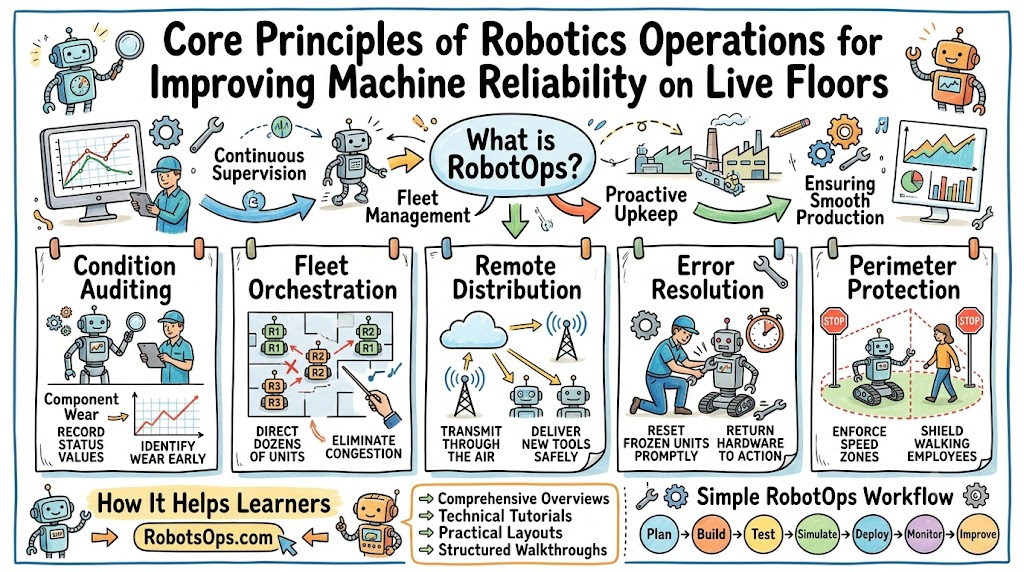
Autonomous hardware reshapes daily productivity the moment carts roll onto warehouse concrete. Industry specialists call this ongoing field supervision RobotOps. Mobile platforms interact with human workers and physical cargo, unlike standard code modules running inside sealed servers. Machinery therefore demands continuous attention throughout daily operating shifts. Engineers first validate movement routines inside virtual test environments. Next, monitoring software checks sensor streams to stop silent hardware failures. Programmers beam wireless software improvements directly to mobile units. Support crews swap broken components quickly when mechanical strain causes wear. Central control systems coordinate multi-unit movements to prevent floor gridlock. Students explore these operational systems through guides on RobotsOps.com. The technical portal clarifies operational concepts for emerging engineers.
What Is RobotOps?
The operational lifecycle guides physical hardware from component assembly to active commercial service. Developers assemble mechanical frames and draft control algorithms. Field deployment sends machines into high-demand work settings like distribution hubs or clinic corridors. Live telemetry tracking monitors motor temperatures, camera clarity, and battery health without interruptions. Software teams broadcast over-the-air code patches to refine navigation routines. Periodic servicing lubricates drive joints and tightens loose wiring harnesses. Fleet coordination programs allow a lone supervisor to direct dozens of units simultaneously. Incident management protocols clear navigation blockages or dropped loads. Machine operations differ sharply from basic web server management because hardware strikes physical obstacles, drains internal energy cells, and experiences structural wear.
Why RobotOps Matters
Guiding a single automated platform rarely challenges an engineering team. Directing eighty independent units across a single facility introduces difficult logistical obstacles. Rolling chassis strip rubber tread or damage payload lifters. Incomplete firmware upgrades immobilize hardware across production zones. Thick steel storage shelves block wireless radio links. Battery cells run out of charge and strand heavy haulers along crowded aisles. Lens smudges deceive navigation algorithms into detecting non-existent barriers. Fast machines moving alongside people demand continuous safety verification. Unified monitoring screens reveal mechanical stops the moment trouble begins. Well-planned operational routines transport customer boxes through distribution centers without unexpected stoppages.
RobotOps Areas
| RobotOps Area | Simple Meaning | Main Goal |
| System Health | Watching machine diagnostics | Avoid unplanned downtime |
| Teleoperation | Remote manual navigation | Free trapped machinery |
| Code Releases | Over-the-air file distribution | Install upgrades safely |
| Zone Protection | Perimeter and worker detection | Eliminate collision risks |
Robot Fleet Management Made Simple
Fleet management systems gather unit oversight onto a single computer interface. Coordinators view real-time performance indicators across large machine deployments. The dashboard plots real-time machine coordinates over facility maps. Status gauges display battery percentages for every active transport unit. Intelligent dispatch logic measures travel distance and delegates handling chores. Audible alarms alert staff whenever a machine stops unexpectedly. Technicians guide stranded vehicles clear using cloud-connected steering sticks. System logs verify software package versions across the entire fleet. Centralized data keeps all hardware productive throughout long shifts.
| Management Task | Old Manual Way | Modern Fleet Way |
| Energy Checks | Inspect voltage dials on foot | Read power levels online |
| Route Dispatch | Shout instructions across halls | Transmit path waypoints digitally |
| Fault Alarms | Wait until floor crews notice | Flash notifications on screen |
Industrial Robotics and Robotics Automation
High-volume manufacturing facilities depend on powerful industrial automation tools. Articulated robot arms lift heavy stamped steel sheets with millimeter precision. Optical cameras check manufactured assemblies for structural defects. Microcontrollers send timed drive signals to high-torque electric motors. Modern plants employ automated systems for component joining, metal welding, and cargo packing. These electro-mechanical helpers boost output speeds. However, single-point failures along automated conveyors halt entire assembly plants. Operational oversight spots component friction before joints seize up. Careful change management rolls out new trajectory profiles without stopping manufacturing lines.
Real-World Robot Examples
| Robot Type | Common Work | RobotOps Need |
| Transport Platform | Hauling goods across warehouses | Wireless map distribution |
| Articulated Arm | Joining car frame components | Joint heat tracking |
| Hospital Carrier | Transporting sterile medical supplies | Reliable elevator door handshakes |
| Survey Drone | Inspecting field crops from above | Battery level surveillance |
Robotics Software and ROS 2
Firmware code dictates how motors spin and sensors take readings. Developers build advanced applications on the ROS 2 software backbone. ROS 2 acts as a universal communication bridge between peripheral devices. Modular software units called nodes handle discrete operations. A camera node processes incoming image frames while a drive node powers motors. Nodes exchange sensor data through communication pathways called topics. Teams assign complex tasks with feedback loops through actions. Predictable data exchange ensures safe navigation and manipulation. Operational pipelines distribute and monitor these ROS 2 packages across deployed machines.
Robot Simulation Before Real Deployment
Virtual simulation allows developers to validate code inside simulated 3D environments. Running unverified code on metal hardware risks expensive collisions. Developers model machines, payload weights, and walls inside a computer. They examine suspension travel over uneven floor models. Virtual sensors bounce simulated beams off shiny glass surfaces and metal racks. Engineers evaluate collision-avoidance algorithms against simulated pedestrian traffic. Automated scripts trigger motor faults to test emergency stop behaviors. Computers complete thousands of stress tests within minutes. While simulation saves development capital, physical field tests remain vital because dust and liquid spills confuse ideal algorithms.
Autonomous Mobile Robots
Autonomous mobile robots, known as AMRs, navigate industrial spaces without floor guides. They move bulk cargo across vast logistics centers. Built-in laser scanners and depth cameras generate internal facility maps. The software plots clear travel corridors around moving staff and parked forklifts. Automatic power routines route carts back to charging pads when energy levels dip. Fleet managers assign incoming transport tasks to nearby idle units. Operations platforms safeguard AMRs through dynamic traffic coordination, battery usage analysis, and floor map version control.
Robotics Operations Center
A centralized operations center functions as the nerve hub for connected machinery. It resembles an aerospace flight control room with large video walls. System operators track real-time telemetry metrics across global sites. Screens display motion velocity, internal core heat, and network ping times. When an unexpected obstacle stops a transport cart, alerts ping the operator. The operator steers the cart around the barrier using remote controls. Field reports record recurring hardware glitches to guide component upgrades. Centralized visibility lets growing enterprises expand machine fleets without adding site-level support staff.
Real-Life Scenarios / Experiences
- Direct afternoon sunlight blinds an optical sensor on a warehouse runner. Control systems alert the remote operator, who steers the cart clear via side-sonar guidance.
- A six-axis welding robot shows rising thermal readings along an elbow gear. Technicians detect this trend on diagnostic dashboards, pause the line, and apply grease before components fail.
- Software developers broadcast navigation patches to forty mobile clinic carriers. Three units lose connectivity inside a basement corridor, prompting the management software to restore earlier firmware builds.
- An automatic scrubber encounters dead radio zones beside thick metal cold-storage gates. Internal safety routines stop drive wheels immediately until maintenance crews re-establish wireless links.
Common Mistakes to Avoid When Choosing Operations Events
- Ignoring wireless signal dead zones across busy loading docks.
- Skipping digital simulation trials before sending updates to live machines.
- Running rechargeable cells down to zero before sending carts to charge docks.
- Neglecting optical lens cleanings, which blinds safety sensors on active floors.
- Forgetting to teach floor staff how mobile machinery signals intended turns.
- Pushing system updates to every machine at the exact same moment.
- Working without manual recovery procedures for major network outages.
- Overlooking subtle vibration telemetry that signals failing bearings in wheel hubs.
How RobotsOps.com Helps Learners
Studying connected industrial automation opens up exciting professional pathways. RobotsOps.com delivers structured technical articles for budding developers and engineering managers. Readers explore detailed lessons on robotics operations and modern fleet supervision. The resource explains robotics software architectures, simulation methods, and autonomous mobile carts. Learners study industrial robotics automation, operations center designs, and ROS 2 middleware structures. The site shares clear guides that explain advanced robotic systems in plain language.
A Simple RobotOps Workflow
Engineering teams follow a straightforward cycle to support connected hardware.
- Plan: Leaders specify job duties and map out facility boundaries.
- Build: Assemblers wire physical motors and program navigation routines.
- Test: Engineers verify mechanical switches and sensor connections inside testing bays.
- Simulate: Computers test vehicle code inside virtual test environments.
- Deploy: Technicians place equipment on real production floors to begin daily operations.
- Monitor: Central dashboards log power drain, motor strain, and travel speeds.
- Fix: Specialists patch broken lines of code or replace worn gears.
- Improve: Teams study operational data to boost efficiency on upcoming runs.
Frequently Asked Questions
1. What core purpose defines RobotOps?
Dedicated technicians oversee, upgrade, and service automated field hardware throughout daily work schedules. Server software operates within secure data centers, but dynamic machines navigate beside warehouse staff and material bins. Operators track live diagnostics, distribute firmware patches, and clear mechanical faults. These routines protect machines within fulfillment yards, medical wards, and assembly lines.
2. Why do field robots need different care than cloud software?
Standard computer programs encounter zero mechanical friction or environmental damage. Mobile machines travel across active floors where moving parts gradually degrade. Carts bump into crates, gather dirt on lenses, and exhaust batteries. Signals drop out when units drive behind dense metal storage racking. Fleet supervisors combine code updates with mechanical servicing to keep units operational.
3. Which core duties belong to fleet management software?
Central dashboards track dozens of autonomous units through a single web browser. The interface plots current vehicle positions across digital blueprints. Dispatch systems monitor cell charges and route transport jobs to available carts. When a unit stalls, alerts notify floor supervisors. Centralized controls help facilities supervise machine networks without extra floor staff.
4. Which features make ROS 2 practical for robot code?
Engineers use ROS 2 as a modular communication framework for machine peripherals. Independent programs called nodes control sensors, motor drives, and steering actuators. These functional blocks share information across standardized message lanes known as topics. Complex operational routines run through structured action calls. This design lets developers swap sensors without rebuilding entire codebases.
5. Why do engineers test robot software in virtual simulations?
Validating unverified movement routines on physical hardware risks severe impact damage. Simulation tools model machine dynamics inside virtual environments on a computer. Developers run thousands of corner-case tests to find navigation flaws before physical trials. While digital runs cut development expenses, physical floor trials remain necessary because digital simulations miss fine dust and floor grease.
6. Which functions separate an Autonomous Mobile Robot from older carts?
Autonomous mobile carts steer through spaces without magnetic tape lines or ceiling reflectors. Built-in laser scanners and cameras survey surrounding spaces in real time. The unit generates a live spatial layout to skirt around workers, pallets, and clutter. Operations platforms dispatch transport tasks to nearby AMRs and monitor their state of charge.
7. Which duties occur inside a Robotics Operations Center?
The control room acts as a central hub for running distributed machine fleets. Technicians watch wall monitors showing live system health metrics. When a cart loses its route, an operator takes remote joystick control to steer the vehicle clear. The operations team monitors diagnostic alerts and distributes software patches to sustain overall fleet productivity.
8. Which operational routines maintain worker safety around heavy machinery?
Heavy industrial equipment works directly alongside human teams on active floors. Operational systems safeguard personnel by tracking sensor health and response times. If a scanner accumulates dirt, software triggers an inspection alert. Careful rollout rules prevent accidental shutdowns of obstacle detection features, keeping active workspaces safe.
9. What information travels inside machine telemetry streams?
Telemetry covers the live operational data that equipment sends back to base stations. Packets contain battery percentages, motor temperatures, driving speed, and Wi-Fi signal strength. Analyzing telemetry data helps maintenance crews address emerging hardware strain early. High joint heat warns technicians to apply grease before a motor burns out completely.
10. Do smaller businesses gain value from modern machine management?
Compact commercial setups gain immediate value from structured operational habits. Facilities running just two delivery carts prevent expensive delays by scheduling timely charges and software checks. Regular diagnostic monitoring stops unexpected machine breakdowns during peak work hours. As operational needs expand, structured habits keep fleet expansion orderly.
11. How do remote intervention tools resolve machine stoppages?
Remote control tools allow offsite operators to pilot stalled machines over networks. Confusing floor conditions like spilled detergent or shiny metal plates can stall autonomous navigation. Rather than waiting for a floor technician to arrive, a remote operator takes manual control through a digital interface. The operator maneuvers the cart clear so autonomous routines resume.
12. Which resources guide newcomers through robotic management basics?
Curious readers can start with plain-English educational platforms online. RobotsOps.com hosts technical guides and conceptual overviews for students and practicing engineers. Articles explain fleet management, ROS 2 architecture, mobile platforms, simulation tools, and factory automation. Simple lessons help software developers, platform engineers, and students learn practical operational skills.
CONCLUSION
Sustained industrial output demands disciplined operational supervision across enterprise facilities. Designing mechanical hardware fulfills only the initial requirement of modern automation. Long-term commercial success requires structured fleet management, resilient robotics software, and live telemetry tracking. Simulation models catch design bugs before field deployment, while ROS 2 unifies motors and perception sensors. Supervising heavy industrial robotics or nimble autonomous mobile robots requires vigilant monitoring habits. Organized practices eliminate sudden bottlenecks and safeguard industrial employees. Automation professionals seeking practical guidance find comprehensive tutorials on RobotsOps.com.
