Introduction
Becoming an Azure Solutions Architect Expert is a significant milestone for any professional working in cloud-native environments and platform engineering. This guide is designed for senior engineers and technical leaders who want to validate their ability to design high-performance, secure, and scalable cloud solutions. As organizations move toward advanced automation and intelligence through platforms like aiopsschool, the role of the architect becomes even more critical in bridging the gap between infrastructure and business value. By following this roadmap, professionals can make informed decisions about their learning journey and career growth in the competitive global market.
What is the Azure Solutions Architect Expert?
The Azure Solutions Architect Expert designation represents the pinnacle of architectural mastery within the Microsoft cloud ecosystem. It is not just about understanding individual services but involves the art of designing comprehensive production-grade systems that meet enterprise requirements. This certification validates that an individual can balance technical constraints with business goals to deliver reliable and cost-effective infrastructure. It aligns perfectly with modern engineering workflows where architects must oversee security, scalability, and disaster recovery.
Who Should Pursue Azure Solutions Architect Expert?
This path is ideally suited for cloud engineers, systems administrators, and SREs who have a strong foundation in managing cloud resources. It is also highly beneficial for security architects and data professionals who need to understand how their specialized systems integrate into a broader cloud architecture. Engineering managers and technical leaders in India and around the world find this certification valuable for gaining the high-level perspective needed to lead digital transformation projects. Even experienced developers looking to transition into architectural roles will find the structured learning path essential.
Why Azure Solutions Architect Expert
The demand for expert-level architects remains high as enterprises continue to adopt multi-cloud and hybrid-cloud strategies. Achieving this status demonstrates a long-term commitment to professional excellence and ensures that your skills remain relevant despite the rapid pace of tool changes. It provides a significant return on time and investment by opening doors to senior-level positions and consulting opportunities. Large-scale organizations prioritize hiring certified experts because it reduces the risk of costly architectural mistakes in production environments.
Azure Solutions Architect Expert Certification Overview
The program is delivered via the Azure Solutions Architect Expert course at and is hosted on the devopsschool platform. This certification level requires candidates to demonstrate expertise in compute, network, storage, and security. Unlike associate-level exams that focus on day-to-day management, this expert-level track assesses the ability to design and advise on complex infrastructure solutions. The structure is built around a series of rigorous assessments that challenge your problem-solving skills in real-world scenarios.
Azure Solutions Architect Expert Certification Tracks & Levels
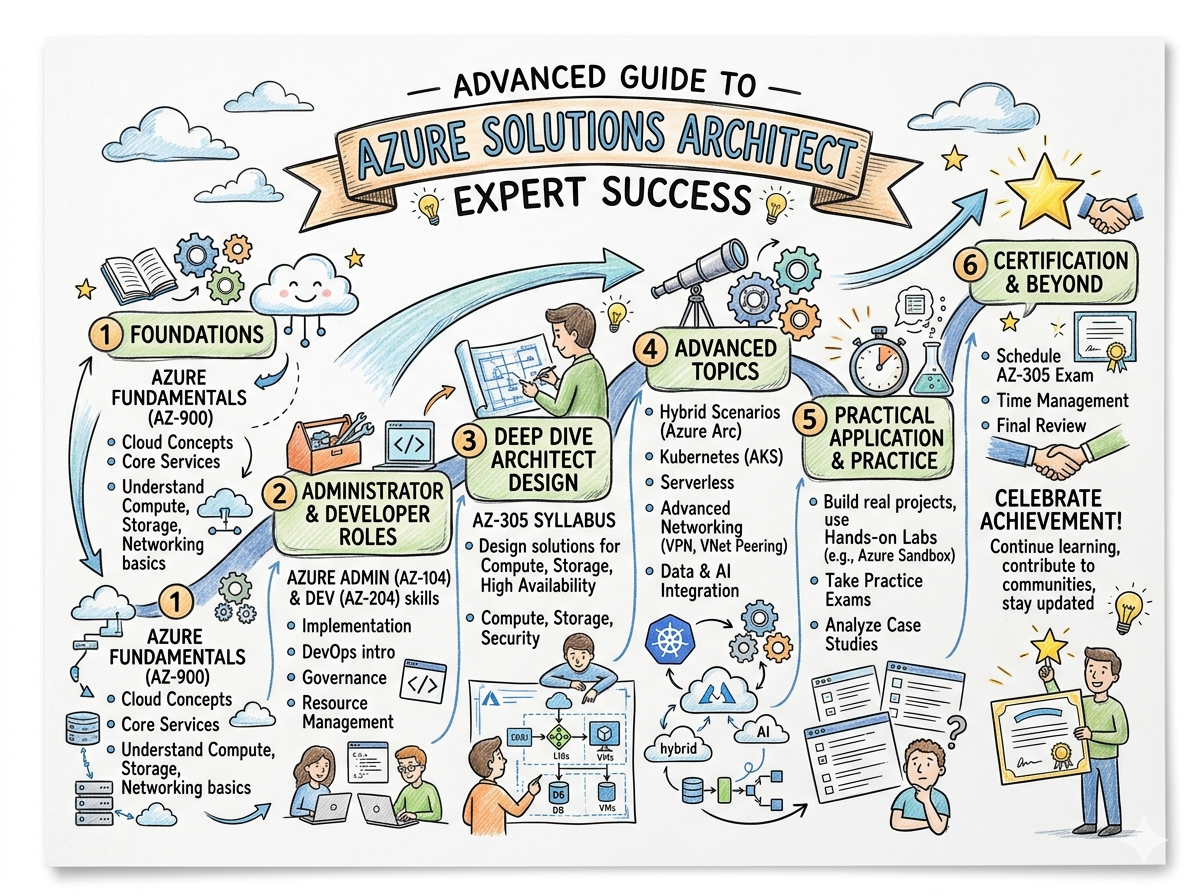
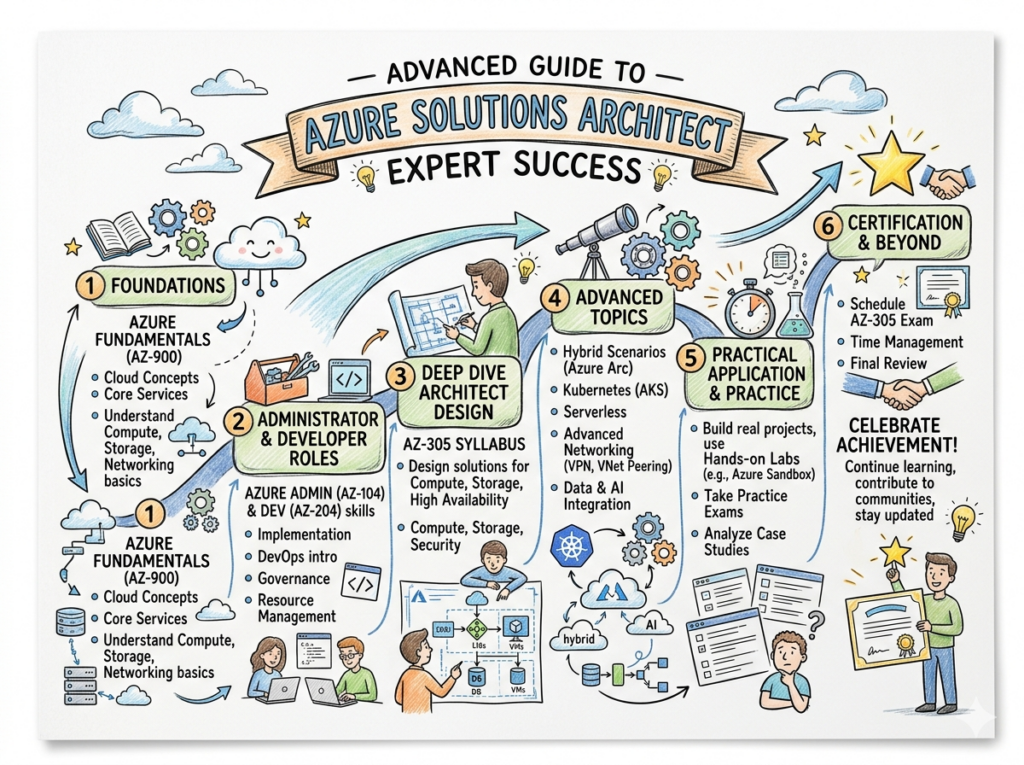
The Azure journey typically begins with the foundation level, where engineers learn the basics of cloud concepts and core services. Moving to the professional or associate level allows individuals to specialize in administration or development before reaching the advanced expert tier. There are various specialization tracks available, such as DevOps, SRE, and FinOps, which can be integrated into your architectural learning. These levels are designed to align with career progression, ensuring that each certification builds upon the knowledge gained in the previous stage.
Complete Azure Solutions Architect Expert Certification Table
| Track | Level | Who it’s for | Prerequisites | Skills Covered | Recommended Order |
|---|---|---|---|---|---|
| Cloud Infrastructure | Associate | Systems Administrators | Basic Cloud Knowledge | Administration and Management | 1 |
| Solutions Design | Expert | Senior Cloud Engineers | AZ-104 Certification | Advanced Design and Strategy | 2 |
| Security Architecture | Specialty | Security Professionals | Associate Level Skills | Cybersecurity and Compliance | 3 |
| Data Solutions | Specialty | Data Engineers | Fundamental Data Skills | Big Data and Analytics | 4 |
Export to Sheets
Detailed Guide for Each Azure Solutions Architect Expert Certification
Azure Solutions Architect Expert – AZ-104 Microsoft Azure Administrator
What it is This certification validates the foundational skills required to implement, manage, and monitor an organization’s Microsoft Azure environment. It serves as the primary prerequisite for reaching the expert level in the architectural track.
Who should take it It is suitable for IT professionals who have at least six months of hands-on experience in administering Azure workloads. This is the ideal starting point for engineers aiming for architectural roles.
Skills you’ll gain
- Managing Azure identities and governance protocols.
- Implementing and managing storage solutions across the cloud.
- Deploying and managing Azure compute resources effectively.
- Configuring and managing virtual networking for enterprise systems.
Real-world projects you should be able to do
- Designing and deploying a multi-tier virtual network with secure subnets.
- Configuring Azure Backup and Site Recovery for business continuity.
- Automating resource deployment using ARM templates or Bicep.
Preparation plan
- 7-14 Days: Focus on the official documentation and review the core exam objectives to identify your knowledge gaps.
- 30 Days: Set up a sandbox environment and practice deploying virtual machines, storage accounts, and networking components.
- 60 Days: Take multiple practice exams and deep dive into troubleshooting scenarios and complex governance policies.
Common mistakes
- Underestimating the complexity of networking and identity management.
- Relying solely on the portal instead of learning PowerShell and CLI commands.
Best next certification after this
- Same-track option: AZ-305 Designing Microsoft Azure Infrastructure Solutions.
- Cross-track option: AZ-500 Microsoft Azure Security Technologies.
- Leadership option: AZ-305 to complete the Expert status and lead teams.
Azure Solutions Architect Expert – AZ-305 Designing Microsoft Azure Infrastructure Solutions
What it is This exam focuses on high-level design and the ability to choose the right services to meet specific business and technical requirements. It is the final step in earning the Expert badge.
Who should take it Senior engineers and architects who are responsible for designing infrastructure and advising stakeholders on the best cloud strategies should take this exam.
Skills you’ll gain
- Designing identity, governance, and monitoring solutions for the enterprise.
- Creating data storage solutions that are scalable and secure.
- Designing business continuity and disaster recovery strategies.
- Designing infrastructure solutions for high availability and performance.
Real-world projects you should be able to do
- Architecting a global application with traffic manager and front door integration.
- Designing a migration strategy from on-premises data centers to the cloud.
- Creating a cost-optimization plan for a large-scale enterprise environment.
Preparation plan
- 7-14 Days: Review the case studies provided in the official Microsoft Learn paths to understand architectural decision-making.
- 30 Days: Practice mapping business requirements to specific Azure services and compare different SKU options for cost-efficiency.
- 60 Days: Focus on complex scenarios involving hybrid cloud connectivity and advanced security frameworks.
Common mistakes
- Focusing too much on administration rather than architectural design choices.
- Ignoring the cost implications of various service configurations during the exam.
Best next certification after this
- Same-track option: AZ-400 Designing and Implementing Microsoft DevOps Solutions.
- Cross-track option: AZ-700 Designing and Implementing Microsoft Azure Networking Solutions.
- Leadership option: Professional Cloud Architect certifications from other providers.
Choose Your Learning Path
DevOps Path
The DevOps path focuses on the automation of infrastructure and the streamlining of software delivery pipelines. Architects in this path learn how to integrate Azure DevOps and GitHub with cloud resources to enable continuous integration and deployment. It is essential for teams looking to achieve faster release cycles and higher reliability in their cloud-native applications. Mastering this path allows you to design systems that are both resilient and highly automated.
DevSecOps Path
The DevSecOps path emphasizes the integration of security at every stage of the architectural design and deployment process. It involves using tools like Azure Policy, Defender for Cloud, and Key Vault to protect sensitive data and ensure compliance. Architects in this space are responsible for building “security by design” into all cloud environments. This is a critical requirement for organizations in highly regulated industries such as finance and healthcare.
SRE Path
The Site Reliability Engineering path focuses on maintaining the availability and performance of large-scale distributed systems. It involves deep knowledge of Azure Monitor, Log Analytics, and Application Insights to track system health. SRE architects design for high availability and implement disaster recovery plans to minimize downtime. This path is vital for managing production environments that require consistent uptime and rapid incident response.
AIOps Path
The AIOps path is designed for architects who want to leverage artificial intelligence to improve IT operations and monitoring. It involves using machine learning models to analyze logs and predict system failures before they occur. Architects in this field work on automating complex operational tasks through intelligent insights. This approach helps in reducing manual overhead and improving the overall efficiency of the cloud infrastructure.
MLOps Path
The MLOps path focuses on the architectural requirements for deploying and managing machine learning models at scale. It involves integrating Azure Machine Learning with DevOps practices to ensure smooth model transitions from development to production. Architects must design infrastructure that can handle heavy compute workloads and manage data versioning. This is an essential path for organizations that rely on data-driven decision-making and AI services.
DataOps Path
The DataOps path focuses on the architecture of data pipelines and the management of large-scale data warehouses. It involves using services like Azure Synapse Analytics, Data Factory, and Data Lake Storage. Architects in this domain ensure that data flows seamlessly and securely across the organization. This path is crucial for building the infrastructure needed for business intelligence and advanced analytics.
FinOps Path
The FinOps path is dedicated to cloud financial management and cost optimization within the architectural framework. Architects learn how to design systems that maximize business value while minimizing unnecessary spending. This involves using Azure Cost Management, Reserved Instances, and Savings Plans to track and control cloud budgets. As cloud costs grow, the ability to architect for financial efficiency becomes a top priority for leadership.
Role → Recommended Azure Solutions Architect Expert Certifications
| Role | Recommended Certifications |
|---|---|
| DevOps Engineer | AZ-104, AZ-400, AZ-305 |
| SRE | AZ-104, AZ-700, AZ-305 |
| Platform Engineer | AZ-104, AZ-305, AZ-400 |
| Cloud Engineer | AZ-104, AZ-305 |
| Security Engineer | AZ-104, AZ-500, AZ-305 |
| Data Engineer | DP-203, AZ-104, AZ-305 |
| FinOps Practitioner | AZ-104, AZ-305, AZ-900 |
| Engineering Manager | AZ-900, AZ-104, AZ-305 |
Export to Sheets
Next Certifications to Take After Azure Solutions Architect Expert
Same Track Progression
After becoming an expert, you might consider deep specialization in networking or security to further your technical depth. Exploring the Specialty certifications like AZ-700 for networking or AZ-120 for SAP workloads on Azure can make you an indispensable asset. These certifications allow you to tackle the most complex technical challenges within the Microsoft ecosystem. Staying within the same track ensures you remain the go-to authority for all things Azure.
Cross-Track Expansion
Broadening your skills by looking at other cloud providers like AWS or GCP can provide a more holistic view of the industry. Understanding how different platforms handle architecture allows you to design more effective multi-cloud solutions. You could also look into Kubernetes certifications like CKA or CKAD to enhance your container orchestration skills. Cross-track expansion makes you more versatile and adaptable in a rapidly changing tech landscape.
Leadership & Management Track
If you are moving toward leadership, certifications focused on IT service management or project management can be highly beneficial. Understanding the business side of technology, including budget management and team leadership, is key to becoming a successful IT director or CTO. Transitioning to leadership requires a shift from purely technical tasks to strategic planning and stakeholder management. This track prepares you to lead large engineering organizations through complex digital transformations.
Training & Certification Support Providers for Azure Solutions Architect Expert
DevOpsSchool This provider offers extensive training programs that focus on practical, hands-on learning for cloud architects. Their curriculum is designed by industry experts who understand the challenges of modern production environments. They provide a supportive environment with access to labs and real-world projects that help students master complex concepts. Their commitment to student success is evident in the quality of their study materials and the depth of their technical sessions. Students gain the confidence needed to pass expert-level exams while learning skills that are immediately applicable in their jobs.
Cotocus This organization is known for its high-quality technical workshops and corporate training solutions. They specialize in helping professionals transition into advanced cloud and DevOps roles through structured learning paths. Their instructors are seasoned veterans who bring years of field experience into the classroom, providing insights that go beyond standard textbooks. They focus on delivering measurable results and ensuring that candidates are fully prepared for the rigors of certification exams. Many engineers choose them for their personalized approach and dedication to technical excellence.
Scmgalaxy This platform serves as a massive knowledge hub for community-driven learning and technical resources. They offer a wide range of tutorials, blogs, and guides that cover everything from basic administration to advanced architectural design. Their focus is on building a strong community of learners who can share knowledge and support each other through various certification journeys. It is an excellent resource for staying updated on the latest trends and tool updates in the cloud-native ecosystem. Many professionals use this site to supplement their formal training with practical, real-world advice.
BestDevOps As a specialized training provider, they focus on the core principles of DevOps and how they apply to cloud architecture. Their courses are designed to bridge the gap between development and operations, making them ideal for aspiring solutions architects. They emphasize the importance of automation and continuous improvement in every architectural design. Their hands-on labs and interactive sessions ensure that students get plenty of practice with the tools they will use in the field. This provider is highly recommended for those who want a deep dive into the operational side of the cloud.
devsecopsschool This provider is at the forefront of the security-first approach to cloud computing and infrastructure management. Their programs are specifically designed to help architects integrate security into the very foundation of their designs. They cover advanced topics such as automated compliance, vulnerability scanning, and secure secret management. By training with them, professionals learn how to build systems that are not only functional but also highly resistant to modern cyber threats. Their expertise is invaluable for anyone working in security-sensitive environments.
sreschool Focused entirely on reliability and system performance, this provider helps engineers master the art of maintaining high-availability systems. Their training covers essential SRE practices such as error budgets, service level objectives, and automated incident response. Architects benefit from learning how to design systems that are easy to monitor and quick to recover from failures. Their curriculum is practical and grounded in the realities of managing large-scale distributed applications. This is the go-to place for anyone looking to excel in site reliability engineering.
aiopsschool This institution focuses on the future of IT operations by teaching the integration of artificial intelligence and machine learning. Their courses help architects understand how to use data-driven insights to optimize infrastructure and predict potential issues. They provide a forward-looking perspective on how automation is evolving through intelligent algorithms. Students learn how to build self-healing systems and improve operational efficiency using the latest AI tools. This training is essential for staying ahead of the curve in an increasingly automated world.
dataopsschool Dedicated to the specialized field of data operations, this provider offers deep dives into data architecture and management. They help professionals learn how to build robust pipelines that ensure data quality and availability across the enterprise. Their training covers everything from big data processing to advanced analytics infrastructure. Architects in this path learn how to handle the unique challenges of managing massive datasets in the cloud. This is an ideal choice for those focused on the data-centric aspects of modern cloud solutions.
finopsschool This provider specializes in teaching the financial side of cloud computing, focusing on cost transparency and optimization. They help architects understand the impact of their design choices on the company’s bottom line. Their training provides practical strategies for managing cloud spend without sacrificing performance or scalability. Students learn how to implement governance frameworks that encourage accountability and efficiency across the organization. This is a critical skill set for any architect who wants to provide strategic value to their leadership team.
Frequently Asked Questions (General)
- How difficult is it to achieve an expert-level certification in cloud architecture? The difficulty is high because it requires a combination of broad technical knowledge and deep practical experience. You must be able to think critically about architectural trade-offs and business requirements.
- How much time should I dedicate to preparing for these exams? Most professionals need about two to three months of consistent study, depending on their existing experience level. This includes time for reading documentation, practicing in labs, and taking mock exams.
- Are there any prerequisites before I can take the expert exam? Yes, most expert-level tracks require you to pass an associate-level exam first to demonstrate your foundational knowledge. This ensures that you have the basic skills needed to understand more complex architectural concepts.
- What is the return on investment for getting certified as an expert? The ROI is significant, often leading to salary increases, better job prospects, and a higher level of professional credibility. It also provides the personal satisfaction of mastering a complex and demanding field.
- In what order should I take the certifications for the best results? It is generally recommended to start with the foundations, then move to the associate level, and finally tackle the expert exam. This step-by-step approach allows you to build a solid knowledge base.
- Will these certifications help me in the global job market? Absolutely, these are globally recognized credentials that demonstrate a standardized level of expertise. Companies all over the world look for these certifications when hiring for senior technical roles.
- Do I need to have a lot of coding experience to be a cloud architect? While you don’t need to be a full-time developer, having a basic understanding of scripting and infrastructure as code is highly beneficial. You should be comfortable with automation tools and basic programming concepts.
- How often do I need to renew my expert-level certifications? Most cloud certifications require renewal every year or two to ensure that your skills remain current with the latest platform updates. Microsoft offers free online renewal assessments to help you maintain your status.
- Can I pass the exam by just using study guides and practice tests? While they are helpful, hands-on experience in a real cloud environment is crucial for passing expert-level exams. The questions are often based on complex scenarios that require practical problem-solving skills.
- What are the most important skills for a solutions architect to have? Beyond technical knowledge, soft skills like communication, leadership, and business strategy are essential. You must be able to explain technical concepts to non-technical stakeholders and lead teams through change.
- Is it better to specialize in one cloud or learn multiple platforms? Specializing in one cloud first allows you to reach an expert level faster and become a true authority in that ecosystem. Once you are an expert, learning other platforms becomes much easier and increases your value.
- What kind of jobs can I get after becoming a certified expert? You can qualify for roles such as Senior Solutions Architect, Cloud Consultant, Infrastructure Lead, or CTO. These positions often involve high-level strategy and making critical decisions for the organization.
FAQs on Azure Solutions Architect Expert
- What is the main difference between AZ-104 and AZ-305? AZ-104 focuses on the practical administration and management of resources, while AZ-305 focuses on the high-level design and architectural strategy for enterprise solutions.
- Can I take the AZ-305 exam before passing the AZ-104? You can take the exam, but you will not receive the official Expert certification until you have successfully passed both the AZ-104 and the AZ-305.
- How does this certification align with DevOps practices? The certification covers infrastructure as code, automation, and monitoring, which are core pillars of DevOps. It ensures you can architect environments that support continuous delivery.
- Is Azure Solutions Architect Expert relevant for hybrid cloud scenarios? Yes, a significant part of the exam covers connecting on-premises data centers with Azure using tools like VPN, ExpressRoute, and Azure Arc.
- Does the exam cover cost optimization strategies? Cost management is a key component of the architectural design process covered in the exam, focusing on choosing the most cost-effective services.
- What is the best way to practice for the design-based questions? Working through real-world case studies and using the Azure Well-Architected Framework is the best way to prepare for the design challenges in the exam.
- Are container services like AKS covered in the expert track? Yes, designing solutions that involve container orchestration and microservices is a critical part of the modern architectural requirements for the expert level.
- How does identity management factor into the architectural design? The exam places a heavy emphasis on designing secure identity solutions using Microsoft Entra ID to manage access across complex cloud environments.
Final Thoughts: Is Azure Solutions Architect Expert Worth It?
Investing your time in achieving the Azure Solutions Architect Expert designation is a move that will pay dividends throughout your career. It proves that you have moved beyond simply managing tools and have entered the realm of designing strategic solutions. In an industry where technology is always shifting, having a deep understanding of architectural principles provides a stable foundation for growth. As long as you remain curious and continue to apply your skills to real-world problems, this certification will serve as a powerful catalyst for your professional journey. Take the leap, stay focused on the practical application of your knowledge, and enjoy the process of becoming a true expert in your field.
