Introduction
Most modern vacation circuits pull travelers into sterile, overcrowded commercial resorts or manicured amusement complexes where genuine local culture is scrubbed away. Hyderabad completely defies this cookie-cutter travel pattern. Here, the aroma of burning oud, crushed cardamom, and sizzling kebabs drifts through narrow stone lanes older than modern empires.
The city’s historic mosques are not lifeless open-air museums preserved behind velvet ropes. They are vibrant, living sanctuaries where four centuries of Indo-Islamic, Persian, and Moorish craftsmanship converge with daily community prayers. Standing before these towering granite facades offers an authentic, grounding journey into the spiritual and architectural soul of the Deccan.
Why Hyderabad is a must-visit city
Hyderabad stands as a monumental cultural crossroad in South India, fusing Qutb Shahi ingenuity with the regal elegance of the Asaf Jahi Nizams. The city’s geography bridges the northern Indo-Aryan architectural vernacular with the southern Dravidian landscape, producing dramatic stone monuments found nowhere else on earth. For travelers of every archetype—solo backpackers seeking lost tales, heritage photographers chasing morning light, or families exploring living traditions—the city offers effortless connectivity via Rajiv Gandhi International Airport (HYD), extensive passenger rail lines across three central junctions, and an efficient metro transit network.
The central travel circuit connects the historic walled precincts south of the Musi River with the aristocratic cantonment enclaves of Begumpet and Secunderabad. Moving between these zones reveals a multi-layered skyline where 16th-century granite domes stand proudly alongside tree-lined avenues and bustling culinary bazaars.
| Travel Dimension | Highlight & Metric | Practical Tip |
|---|---|---|
| Primary Heritage Zone | Old City (Charminar & Karwan precincts) | Best explored on foot before noon to avoid traffic. |
| Architectural Epochs | Qutb Shahi (1518–1687) & Asaf Jahi (1724–1948) | Look for Deccan lotus motifs intertwined with Persian stucco. |
| Transit Hubs | Secunderabad Junction, Nampally Station, HYD Airport | Use the Hyderabad Metro Red Line for rapid cross-city transit. |
| Culinary Anchors | Irani chai, osmania biscuits, authentic dum biryani | Fuel up at heritage tea stalls dotting every mosque gate. |
| Cultural Etiquette | Conservative attire, footwear removal at entry | Carry a lightweight scarf or stole for head covering. |
Best Places or Experiences
Grand granite facade of Mecca Masjid.
Mecca Masjid
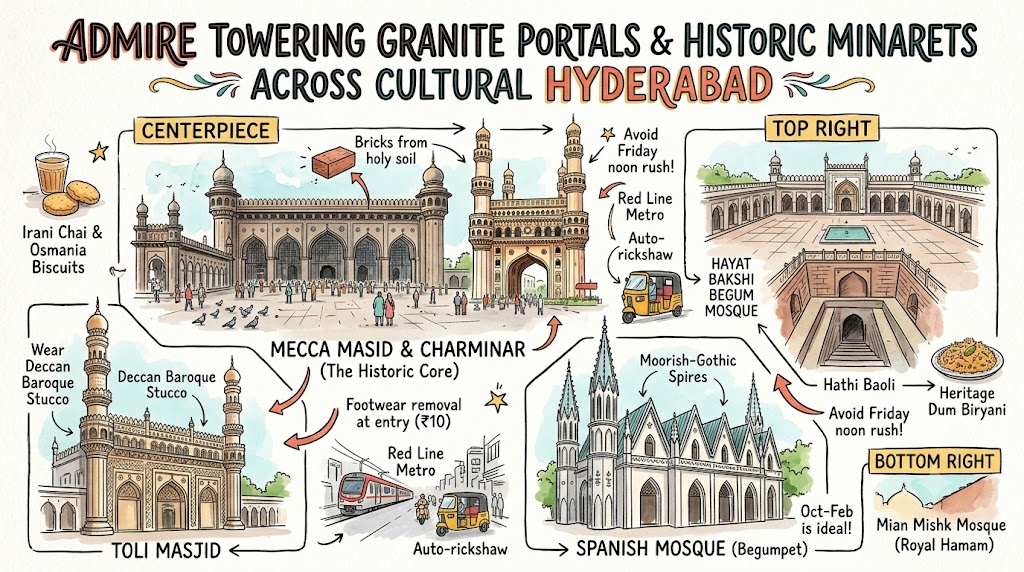
Commissioned in 1614 by Sultan Muhammad Quli Qutb Shah and completed nearly eight decades later under Mughal Emperor Aurangzeb in 1694, Mecca Masjid is the monumental centerpiece of Hyderabad’s historic core. The mosque derives its name from the bricks embedded above its central mihrab, which were molded from soil brought directly from the holy city of Mecca. Its massive prayer hall, carved out of a single monolithic slab of black granite, accommodates over 10,000 worshippers under cavernous, rhythmic pointed arches.
The vast paved courtyard contains the marble tombs of several Asaf Jahi rulers, creating a serene, breeze-swept sanctuary just steps from the frantic commerce of the Charminar markets. Walking along the raised stone portico reveals intricate floral stucco, historic sundials, and centuries of pigeon-flocked granite balustrades that tell the story of Hyderabad’s royal resilience.
- Location: Charminar Road, Charminar precinct, approximately 4 km south of Nampally Railway Station.
- Why it is worth visiting: It is one of the largest and oldest mosques in the Indian subcontinent, representing the crowning architectural achievement of the Qutb Shahi dynasty.
- Best things to do: Inspect the bricks baked from holy soil above the central arch, sit on the black stone benches by the ablution pool, and admire the marble tombs of the Nizams.
- Best time to visit: Early morning between 8:00 AM and 10:00 AM for soft sunlight and tranquil photography before mid-day prayers.
- Ideal for whom: History buffs, architecture enthusiasts, and cultural documentarians.
- Travel tip: Wear clothes covering your shoulders and knees; women must carry a headscarf, and photography inside the active indoor prayer chamber is strictly restricted during prayer times.
Intricate stucco parapets of Toli Masjid.
Toli Masjid
Built in 1671 AD by Mir Musa Khan Mahaldar, the royal architect of Sultan Abdullah Qutb Shah, Toli Masjid is a sublime showcase of Deccan baroque stucco work. Legend notes that the architect received one ‘damri’ (a small coin) for every rupee spent during the construction of Mecca Masjid, using his pooled earnings to finance this suburban gem. Though more compact than its royal sibling, what Toli Masjid lacks in sheer scale it compensates for with unparalleled surface ornamentation.
The structure features two towering 20-meter minarets crowned with petal-shaped parapets, five deeply recessed facade arches, and ornate lotus medallions carved into the plaster. Elephant motifs and pot-and-foliage bas-reliefs appear across the spandrels, highlighting the cross-pollination between local Hindu craftsmanship and Persian architectural traditions.
- Location: Karwan road, Old City, roughly 2.5 km northwest of the Golconda Fort outer ring.
- Why it is worth visiting: Unmatched surface detail featuring indigenous floral motifs and historic terracotta relief panels.
- Best things to do: Count the miniature decorative shrines along the parapet, photograph the double-tiered minarets against clear skies, and inspect the stone water-channel system.
- Best time to visit: Late afternoon between 3:30 PM and 5:00 PM when the setting sun illuminates the textured facade.
- Ideal for whom: Solitary explorers, art historians, and heritage photographers.
- Travel tip: The approach street is narrow; avoid taking four-wheelers and arrive via an auto-rickshaw or two-wheeler.
Moorish spires of Spanish Mosque Begumpet.
Spanish Mosque (Aiwan-e-Begumpet)
Commissioned in 1906 by Sir Viqar-ul-Umra, the Prime Minister of Hyderabad and builder of the nearby Falaknuma Palace, the Spanish Mosque looks unlike any other Islamic structure in India. Inspired by his travels through Spain and Morocco, the nobleman commissioned an architecture heavily influenced by the Cathedral-Mosque of Córdoba. Instead of traditional bulbous domes, the mosque features slender, pointed neo-Gothic spires, sharp roof gables, and horseshoe arches.
The pale cream interior is washed in natural daylight filtered through arched traceries, illuminating calligraphic Qur’anic verses executed in Moorish cursive scripts. Its calm, manicured courtyard sits quietly inside the Paigah Palace grounds, providing an astonishing contrast to the classic Persian-Deccan monuments of the south.
- Location: Sardar Patel Road, Begumpet, around 1 km from Rasoolpura Metro Station.
- Why it is worth visiting: It is the only Moorish-Gothic mosque in India, featuring soaring spires instead of standard Islamic domes.
- Best things to do: Marvel at the octagonal main spire, examine the interior Moorish calligraphy, and walk the tranquil garden portico.
- Best time to visit: 10:00 AM to 12:00 PM on weekdays when the interior court is bathed in indirect morning light.
- Ideal for whom: Architecture connoisseurs, couples seeking peaceful grounds, and curious travelers.
- Travel tip: Respect the residential Paigah complex boundaries, remove your shoes at the courtyard steps, and avoid visiting during the Friday congregational rush.
Expansive arcades of Hayat Bakshi Mosque.
Hayat Bakshi Begum Mosque
Constructed in 1666 AD by the influential queen mother Hayat Bakshi Begum—often hailed as the ‘Grand Dowager’ of Golconda—this grand mosque anchored a comprehensive royal caravanserai for travelers entering Hyderabad from Machilipatnam. The complex houses a 106-room guest inn, a stepped well (baoli), and a massive prayer platform capable of hosting thousands of merchants, scholars, and pilgrims during the height of the diamond trade.
The facade is defined by five graceful arches, two hefty minarets with ribbed melon finials, and an extensive courtyard wrapped in fortified granite perimeter walls. The monument stands as a testament to the sovereign administrative power held by women during the Qutb Shahi dynasty, standing remarkably intact against the passage of centuries.
- Location: Hayathnagar, National Highway 65, approximately 18 km east of the historic city center.
- Why it is worth visiting: An expansive 17th-century caravanserai complex celebrating the legacy of one of the Deccan’s most powerful female rulers.
- Best things to do: Explore the subterranean stepped well (Hathi Baoli), walk the arcaded corridors of the ancient inn, and photograph the melon-ribbed minarets.
- Best time to visit: November through February during early mornings to beat the eastern highway traffic.
- Ideal for whom: Off-the-beaten-path travelers, historical researchers, and long-distance road trippers.
- Travel tip: Carry your own drinking water, as tourist infrastructure and refreshment stalls are limited around this historic ASI monument.
Kulsum Begum Mosque (Kulsumpura)
Erected in the mid-17th century, this royal neighborhood mosque was commissioned by Kulsum Begum, a Qutb Shahi princess celebrated for her public philanthropy. Rising above a raised stone plinth in the old quarter of Kulsumpura, the mosque was designed to provide neighborhood residents with a communal focal point rivaling royal enclosures.
Its facade is characterized by three grand entry arches framed by projecting brackets, decorated parapets, and two ornate corner minarets that still command the skyline of the surrounding weaver settlement. The balance of heavy granitic foundations and delicate lime-plaster geometric bands showcases the zenith of classical Deccan masonry.
- Location: Kulsumpura, Attapur road vicinity, roughly 3.5 km southwest of Charminar.
- Why it is worth visiting: An authentic neighborhood monument untouched by commercial tourism, surrounded by traditional craftsman quarters.
- Best things to do: Study the floral medallion moldings beneath the eave brackets, wander the adjoining lanes of old metalcraft artisans, and observe local neighborhood life.
- Best time to visit: 9:00 AM to 11:00 AM before the market alleys become heavily congested with commercial deliveries.
- Ideal for whom: Documentary photographers and solo travelers looking for raw street heritage.
- Travel tip: Navigating these streets requires an experienced auto driver or a walking map; keep your mobile GPS active.
Mian Mishk Mosque
Built in 1674 by Mian Mishk, an influential royal commander and keeper of the royal wardrobe under Abul Hasan Tana Shah, this fortress-like mosque incorporates an active traditional hamam (bathhouse). The complex exhibits defensive granite masonry, complete with thick parapet loop-holes, pointed gateway arches, and an inscribed decree from the Sultan protecting the complex’s endowment.
The surviving hot-and-cold stone bathhouse chambers represent a rare, functioning example of Turkish-Persian bath architecture surviving in central India. Exploring the arched stone bays evokes a forgotten era of royal caravan trade, where courtiers, diplomats, and spiritual mendicants mingled in shaded stone halls.
- Location: Purana Pul road, Karwan district, approximately 1 km west of the historic Purana Pul bridge.
- Why it is worth visiting: Houses the only surviving 17th-century Persian-style royal hamam and defensive mosque compound in Hyderabad.
- Best things to do: View the historic stone inscriptions on the entry gateway, examine the vaulted stone bath chambers, and admire the solid granite pillar construction.
- Best time to visit: 8:30 AM to 10:30 AM during morning hours.
- Ideal for whom: History students, military architecture buffs, and cultural explorers.
- Travel tip: Wear slip-on shoes since you will be moving between open courtyards and covered stone prayer platforms frequently.
Offbeat Exploration: Hidden Gems Tourists Miss
The Rooftop Mosque of Charminar (Upper Deck Sanctuary)
While millions of tourists photograph Charminar from street level, few realize that its topmost western tier conceals the oldest surviving mosque within the modern city limits, constructed in 1591 AD. The remaining open-air gallery features 45 prayer spaces facing west, offering an unmatched vantage point overlooking the bustling grid of the historic capital. Access to the upper prayer level is occasionally regulated by the Archaeological Survey of India, making a glimpse of its stone stucco mihrab a prized discovery for patient heritage enthusiasts.
Khairatabad Mosque (Ma Saheba’s Granite Marvel)
Hidden along a busy transit road near Khairatabad flyover sits a mosque built in 1626 by Princess Hayat Bakshi Begum for her royal tutor, Akhund Mulla Abul Malik. The complex features a rare domed step-well and a three-arched facade adorned with delicate stone jali screens. It remains one of the quietest mid-city monuments, shaded by century-old tamarind trees that insulate the courtyard from surrounding traffic noise.
The Baoli of Hayat Bakshi Begum (Elephant Stepwell)
Located at the rear of the Hayathnagar mosque complex lies the colossal Hathi Baoli, an engineered stepped well designed with broad ramps that allowed royal elephants to walk down and draw water. Most casual visitors only photograph the primary mosque courtyard and completely overlook this subterranean engineering marvel, which cooled the entire caravanserai during blistering Deccan summers.
Detailed Practical Guidance for Travelers
| Destination | Standard Entry Fee | General Timings | Best Local Food Options Nearby | Recommended Nearby Attractions |
|---|---|---|---|---|
| Mecca Masjid | Free entry | 4:00 AM – 9:30 PM (Restricted during prayer times) | Shadab Restaurant (Biryani & Haleem), Nimrah Cafe (Irani Chai) | Charminar, Laad Bazaar, Chowmahalla Palace |
| Toli Masjid | Free entry | 6:00 AM – 7:30 PM | Subhan Bakery (Osmania Biscuits), Rumaan Restaurant | Golconda Fort, Qutb Shahi Tombs |
| Spanish Mosque | Free entry | 5:00 AM – 9:00 PM | Paradise Begumpet, Chicha’s Lakdikapul | Paigah Palace, Hussain Sagar Lake |
| Hayat Bakshi Begum Mosque | Free entry | 9:00 AM – 5:30 PM (Protected ASI site) | Traditional tiffin centers along NH-65 | Hathi Baoli, Ramoji Film City circuit |
| Kulsum Begum Mosque | Free entry | 6:00 AM – 8:00 PM | Shah Ghouse Hotel (Mutton Biryani) | Purana Pul, Musi River Heritage Walk |
| Mian Mishk Mosque | Free entry | 6:00 AM – 7:00 PM | Nayab Hotel (Bheja Fry, Paya & Roti) | High Court Building, Salar Jung Museum |
Logistics & On-Ground Navigation
Local Transport Options
- Metro Rail: The fastest way to bypass surface gridlock. Take the Red Line to MGBS or Gandhi Bhavan for Old City explorations, or the Blue Line to Rasoolpura for the Spanish Mosque.
- Auto-Rickshaws: Abundant and ideal for short hops between Karwan, Charminar, and Purana Pul. Always insist on using the meter or pre-negotiate firmly before boarding.
- App-Based Cabs & Bike Taxis: Services like Uber, Ola, and Rapido work reliably across the city. For navigating congested Old City markets, bike taxis save considerable travel time.
- Self-Drive & Car Rentals: Not recommended for the Old City due to extremely tight lanes, heavy pedestrian density, and scarce parking. Reserve private cabs for outer sites like Hayathnagar.
Budget Planning
- Budget / Backpacking Tier: Expect to spend ₹1,200 to ₹1,800 per day. This covers dorm stays in central hostels, public metro commutes, shared auto rides, street-level Irani chai stops, and traditional biryani meals.
- Mid-Range / Comfort Tier: Budget approximately ₹4,000 to ₹7,500 per day. This includes boutique heritage hotels near Banjara Hills or Begumpet, app-based air-conditioned cabs, private heritage walk guides, and fine-dining Hyderabadi dinners.
Safety and Inclusivity Tips
- Families: The courtyards of Mecca Masjid and the Spanish Mosque offer broad, secure stone spaces for multi-generational travelers. Keep children close in the dense markets outside the mosque gates.
- Couples: Both historic and modern zones are welcoming to couples. Maintain respectful public decorum and dress modestly within all active religious grounds.
- General Safety: Hyderabad is consistently rated among the safest metropolitan cities in India. Keep your mobile phones and wallets zipped inside crossbody bags when navigating crowded market choke-points near Charminar and Laad Bazaar.
Strategic Travel Planning Guardrails
Travel Planning Tips for Hyderabad
- Plan Around Friday Prayers: Non-Muslim travelers should avoid planning sightseeing visits to major mosques between 12:30 PM and 2:30 PM on Fridays to respect large congregational prayers.
- Winter is Ideal: Visit between October and February when daytime temperatures stay between 20°C and 28°C, making heritage walks comfortable.
- Digital Payments are Universal: UPI (PhonePe, Google Pay) is accepted everywhere from upscale boutiques to roadside fruit vendors; however, carry ₹500 in small cash notes for shoe-custodian tips and small donations.
- Footwear Protocol: Wear slip-on shoes or loafers. You will remove footwear before stepping onto mosque courtyards; shoe-minding stalls charge a nominal ₹10 fee.
- Hydration & Sun Protection: Stone courtyards absorb heat rapidly after 11:00 AM. Always carry an insulated water bottle and wear UV-blocking sunglasses.
Common Mistakes to Avoid
- Over-Packing the Daily Route: Attempting to combine Golconda Fort, Mecca Masjid, and Hayathnagar on the same day leads to exhaustion due to cross-city traffic.
- Assuming All Mosques Follow Identical Rules: Some mosques allow entry to central inner sanctums for visitors, while others restrict non-worshippers to the open courtyards. Always ask a local caretaker before entering.
- Ignoring Dress Codes: Arriving in shorts, sleeveless tops, or short skirts will result in being turned away at entry gates.
- Skipping Street Culinary Stalls: Dining exclusively at five-star hotel buffets deprives you of legendary culinary creations like freshly baked bun-maska, marag, and double ka meetha.
- Relying Exclusively on English Signboards: Many smaller heritage landmarks in Karwan and Purana Pul have signboards in Urdu or Telugu; download offline maps to navigate easily.
Suggested Itinerary Blueprints
1. Day Quick Dash (The Royal Minarets Loop)
Target Audience: Time-pressed travelers and transit flyers on a 24-hour city layover.
- Morning (8:00 AM – 11:30 AM): Start at Mecca Masjid while the stone courtyard is cool. Walk through the four towering arches of Charminar and explore Laad Bazaar’s lac-bangle alleys.
- Afternoon (12:00 PM – 3:00 PM): Head to Hotel Shadab for authentic mutton dum biryani, followed by a visit to the nearby Chowmahalla Palace.
- Evening (4:30 PM – 6:30 PM): Catch a cab north to Begumpet to see the sunset cast a golden glow across the Gothic spires of the Spanish Mosque, finishing with tea at Paradise.
2. Day Deep-Dive (Dynastic Grandeur & Hidden Karwan)
Target Audience: Heritage buffs, architectural photographers, and culture writers.
- Day 1: The Heart of Golconda & Karwan:
- Morning: Tour the ramparts of Golconda Fort and the Qutb Shahi Tombs.
- Afternoon: Head into the historic artisan quarters of Karwan to explore Toli Masjid and the vaulted bath chambers of Mian Mishk Mosque.
- Evening: Walk the historic Purana Pul bridge and enjoy kebabs at Nayab.
- Day 2: Royal Sanctuaries & Aristocratic Enclaves:
- Morning: Explore Mecca Masjid and the adjacent tombs of the Asaf Jahi rulers.
- Afternoon: Tour the Salar Jung Museum, then drive north across the Musi River.
- Evening: Discover the Spanish Mosque in Begumpet and spend a relaxed evening along Hussain Sagar promenade.
3. Complete Weekend Travel Plan (The Comprehensive Deccan Circuit)
Target Audience: Weekend explorers seeking an immersive cultural immersion.
- Friday (The Royal Core):
- Arrive and check into your hotel. Spend your late afternoon wandering around Charminar, entering Mecca Masjid after evening Asr prayers, and sampling malai bun at Nimrah Cafe.
- Saturday (Offbeat Jewels & Artisan Quarters):
- Dedicate the morning to Toli Masjid and Kulsum Begum Mosque.
- After lunch, explore the royal hamam at Mian Mishk Mosque and the bazaars of Mozamjahi Market.
- Conclude with an evening cultural show or boat ride at Lumbini Park.
- Sunday (Outer Caravanserais & Moorish Spires):
- Take an early-morning drive along NH-65 to Hayathnagar to explore the sprawling Hayat Bakshi Begum Mosque and the ancient Hathi Baoli.
- Head back into the city by mid-afternoon to conclude your architectural tour at the Spanish Mosque, rounding off your trip with dinner in Banjara Hills.
Common Tourist Mistakes to Avoid
Geographic Blunders
A frequent misstep among first-time visitors is clustering locations that look close on a map but are separated by major transit bottlenecks. For example, trying to visit the eastern outpost of Hayat Bakshi Begum Mosque and the western ramparts of Golconda Fort on the same afternoon will leave you stuck in heavy ring-road traffic for hours. Group your travels into distinct zones: Old City South, Karwan West, and Secunderabad/Begumpet North.
Commercial Traps
Many tourists spend precious hours trapped inside generic, multi-story shopping malls in HITEC City or modern retail hubs, purchasing mass-produced items labeled as local handicrafts. Instead, visit genuine artisan clusters: buy real pearl jewelry from certified dealers near Charminar, handmade lac bangles along Laad Bazaar, and authentic perfumes (ittar) directly from traditional perfumers near Pathargatti.
Neglecting Modern/Alternative Zones
While the heritage quarter south of the river holds tremendous historical weight, completely ignoring the newer cultural districts creates an incomplete picture of the city. Make time to explore the tree-lined cafes of Jubilee Hills, the art spaces of Banjara Hills, and the lakefront walking trails around KBR National Park, where Hyderabad’s thriving contemporary arts scene flourishes.
Transport Overpayment
Accepting the first flat fare quoted by street auto drivers outside railway stations or Charminar almost always results in paying double the local rate. Always insist on using the meter, or use ride-hailing apps like Uber, Ola, or Rapido to establish the baseline fare before negotiating.
Luxury Dining Bias
Restricting your dining exclusively to hotel restaurants isolates you from the authentic soul of Deccan cuisine. The true flavors of Hyderabad thrive at historic eateries like Nayab, Shadab, and Cafe Bahar, where century-old cooking methods and wood-fired pots create flavors unmatched by modern kitchens.
Frequently Asked Questions
1. Are non-Muslim tourists permitted to enter historic mosques in Hyderabad?
Yes, non-Muslim travelers are warmly welcomed into most historic mosques in Hyderabad, including Mecca Masjid and the Spanish Mosque, during non-prayer hours. Visitors must dress modestly, remove footwear before entering the courtyard, and respect active worshipers by refraining from loud talking or walking directly across prayer mats during congregational services.
2. What is the strictly enforced dress code for entering mosques in Hyderabad?
Both men and women must wear modest clothing covering their shoulders and knees. Full-length pants, jeans, maxi skirts, or traditional salwar kameez are ideal. Women are required to cover their hair with a scarf or stole inside the premises, while men should avoid sleeveless vests and athletic shorts.
3. Is photography allowed inside Mecca Masjid and other heritage mosques?
Courtyard photography of the architecture and exterior facade is generally permitted at Mecca Masjid and the Spanish Mosque for tourists using smartphones. However, professional camera tripods, commercial video gear, and taking photos inside the active prayer hall or during congregational prayers is strictly prohibited without prior formal administrative permits.
4. Why does the Spanish Mosque in Begumpet look so radically different from other Indian mosques?
The Spanish Mosque was commissioned in 1906 by Sir Viqar-ul-Umra, who was captivated by the Moorish architecture of southern Spain during his European travels. It was deliberately designed with neo-Gothic spires, pointed roofs, and horseshoe arches reminiscent of the Cathedral-Mosque of Córdoba, abandoning typical Indian bulbous domes.
5. How much time should a traveler budget to properly visit Mecca Masjid?
Plan to spend approximately 45 to 60 minutes exploring Mecca Masjid. This allows sufficient time to admire the massive granite prayer hall, inspect the historic bricks above the central arch, pay respects at the marble tombs of the Nizams, and soak in the peaceful courtyard atmosphere away from street traffic.
6. Which historic mosque in Hyderabad has the best architectural stucco craftsmanship?
Toli Masjid in Karwan is widely recognized as the pinnacle of Deccan stucco craftsmanship. Completed in 1671 AD, its facade features exquisite lime-plaster carvings, circular lotus medallions, miniature architectural parapets, and elephant motifs that blend Persian aesthetic traditions with indigenous South Indian decorative arts.
7. Can women enter all areas of historic mosques across Hyderabad?
Women are welcome within the vast courtyards, historical tomb precincts, and designated female prayer enclosures of monuments like Mecca Masjid. However, certain interior central prayer chambers are traditionally reserved for male worshipers during active prayer gatherings, so it is best to check posted signage or ask local custodians at the entrance.
8. What is the most convenient way to reach the Old City mosques from Rajiv Gandhi International Airport?
The most practical option is taking a pre-paid or app-based taxi via the PV Narasimha Rao Expressway, which reaches the Old City in 35 to 45 minutes depending on traffic. Alternatively, you can board the Pushpak Airport Liner bus to Aramghar and take an auto-rickshaw directly to Charminar.
9. Are there entry tickets or entrance fees required to visit these mosques?
No, none of the active historic mosques in Hyderabad—including Mecca Masjid, Toli Masjid, and the Spanish Mosque—charge an entrance fee. Entry is entirely free for all visitors. However, you may encounter a nominal charge of ₹10 per pair at the dedicated shoe-minding stalls stationed at courtyard gates.
10. What unique historical significance does the Hayat Bakshi Begum Mosque hold?
Built in 1666, it was commissioned by Queen Mother Hayat Bakshi Begum, one of the most politically formidable women of the Qutb Shahi dynasty. The complex served as a massive royal rest house (caravanserai) with 106 rooms and a specialized elephant stepwell (Hathi Baoli) to welcome traveling merchants.
11. What is the best neighborhood to stay in for exploring Hyderabad’s mosque architecture?
Staying in Begumpet or near Abids / Nampally provides the ideal strategic balance. Begumpet provides easy access to the Spanish Mosque and modern cafes, while Nampally places you right at the gateway to the Old City’s historic mosques via short auto-rickshaw rides or direct metro connections.
12. When is the best time of year to undertake an architectural walking tour of Hyderabad?
The winter window between October and February is the premier season for walking tours across Hyderabad. Temperatures range from a comfortable 15°C in the morning to 28°C in the afternoon, making it pleasant to navigate open stone courtyards and bustling market streets without the scorching summer heat.
Conclusion
Choosing an architectural pilgrimage across the historic mosques of Hyderabad offers far more than a conventional vacation check-list; it is an intimate encounter with the living soul of the Deccan. As the call to prayer echoes over monolithic granite arches, and the late afternoon sun illuminates the Moorish spires of Begumpet and the delicate stucco florals of Karwan, the noise of modern life quietly fades away. In their quiet stone courtyards, these sacred landmarks remind us that true travel is measured by deep moments of stillness, human connection, and awe for human artistry that withstands the tests of time.
