Introduction
Most popular holiday destinations trap visitors in a cycle of manicured resorts and manufactured photo booths. Hyderabad shatters that superficial glaze entirely. Here, living heritage pulses through everyday routine, where four-century-old stone corridors meet the sharp aroma of freshly brewed Irani chai and simmering spices.
Walking these streets connects you directly to the legendary Deccan legacy. You do not just view history behind velvet museum ropes; you walk beside royal archways, navigate bustling trade lanes, and listen to the call of prayer mingling with the morning chime of bazaar clocks..
Charminar in Hyderabad Old City.
Why Hyderabad is a must-visit city
Hyderabad occupies an unmatched crossroads where North Indian courtly traditions converge with South Indian peninsula grit. Founded by the Qutb Shahi dynasty and refined under the opulent Nizams, its monuments represent peerless Indo-Islamic, Persian, and neoclassical architecture. Beyond its stone fortifications, modern infrastructure—including the Rajiv Gandhi International Airport, comprehensive metro networks, and world-class luxury to boutique stays—makes accessing this historic treasure effortless for solo wanderers, couples, and family expeditions alike.
The Hyderabad History Project
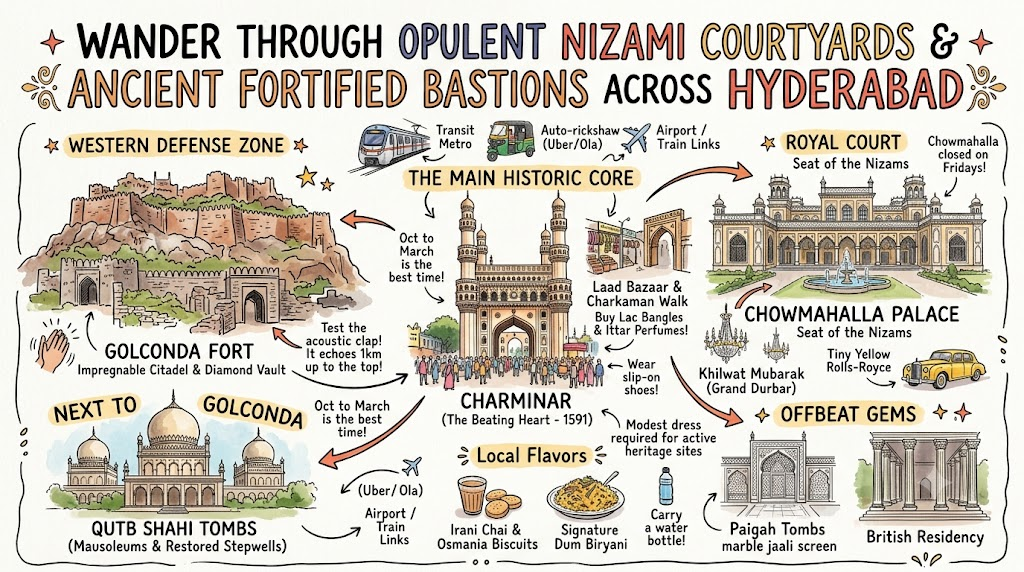
The primary travel circuit balances the vibrant kinetic energy of the southern Old City with the fortified granite citadels of the western corridor. Moving through this circuit allows travelers to witness how royal bastions, sacred mosques, and aristocratic palaces knit seamlessly into modern daily commerce.
| Category | Fast Facts & Overview |
|---|---|
| Geographic State | Telangana, Southern Deccan Plateau |
| Best Travel Months | October to March (pleasant, cool dry season) |
| Core Heritage Circuits | Old City Citadel, Golconda-Ibrahim Bagh, Residency & Moazzam Jahi |
| Primary Connectivity | International Airport (RGIA), 3 Major Railway Terminals, Hyderabad Metro |
| Signature Local Delicacies | Dum Biryani, Haleem, Irani Chai, Osmania Biscuits, Double Ka Meetha |
| Traditional Keepsakes | Lac bangles, freshwater pearls, Bidriware metalwork, Pochampally ikats |
Best Places or Experiences
Charminar
Erected in 1591 by Muhammad Quli Qutb Shah to commemorate the eradication of a devastating plague, the Charminar remains the beating heart and architectural anchor of Hyderabad. Its four grand arches align perfectly with the cardinal directions, supporting an exquisite upper-floor mosque and four soaring 48.7-meter minarets adorned with delicate stucco moldings.
Standing directly beneath the central vault gives you an unforgettable perspective on early Deccani town planning. The surrounding four gateways, known as the Char Kaman, originally partitioned the royal square from public markets, creating an enduring pedestrian hub where brass merchants, perfumers, and jewelers continue ancestral trades.
- Location: Old City, Charminar Zone; approximately 18 km from Rajiv Gandhi International Airport and 4 km from Hyderabad Deccan Railway Station.
- Why it is worth visiting: The definitive architectural signature of Hyderabad that captures late 16th-century Persian-influenced Deccan brilliance.
- Best things to do: Climb the spiraling stairs to the upper gallery balcony; photograph the intricate stucco floral medallions on the ceiling arches; explore the historic Charkaman arches framing the square.
- Best time to visit: 7:30 AM to 9:00 AM for quiet photography, or 6:30 PM when the monument is illuminated against the evening sky.
- Ideal for whom: History enthusiasts, street photographers, cultural storytellers, and architectural scholars.
- Travel tip: Wear slip-on shoes for quick removal if entering adjacent prayer areas, and visit during weekday mornings to bypass heavy vehicle blockades.
Golconda Fort
Carved atop a 400-foot granite hill, Golconda Fort served as the impregnable stronghold of the Kakatiyas before becoming the fortified imperial jewel of the Qutb Shahi sultans. Renowned worldwide as the trade vault for fabled diamonds like the Koh-i-Noor and Hope Diamond, the fortress spans four distinct forts enclosed by an 11-kilometer outer wall.
The site is an acoustic and engineering miracle. A single handclap beneath the Fateh Darwaza dome echoes with crystal clarity at the Bala Hissar pavilion located nearly a kilometer uphill, functioning as an ancient military warning siren. Walking up through its tiered defenses reveals hidden water tanks, royal audience halls, and ancient ammunition reserves.
Ramparts of Golconda Fort.
- Location: Ibrahim Bagh, Western Zone; roughly 11 km west of Charminar and 14 km from central Secunderabad.
- Why it is worth visiting: Unmatched acoustic engineering and the historic epicenter of the global medieval diamond trade.
- Best things to do: Test the handclap acoustic relay from Fateh Darwaza to the summit; hike to the top Baradari for panoramic views of Hyderabad’s skyline; watch the evening sound and light presentation.
- Best time to visit: 8:00 AM to 10:30 AM during morning hours, or 4:00 PM to catch the sunset from the highest bastion.
- Ideal for whom: Active hikers, defense architecture fans, history buffs, and panoramic viewpoint seekers.
- Travel tip: The ascent involves over 360 uneven granite steps; wear shoes with good grip and carry plenty of drinking water.
Chowmahalla Palace
Modeled after the Shah of Iran’s palace in Tehran, Chowmahalla Palace served as the ceremonial seat of the Asaf Jahi dynasty, where the Nizams entertained visiting monarchs and British royalty. Spanning two expansive courtyards, the complex features a breathtaking synthesis of Baroque, Persian, and Rajasthani architecture framed by lush green lawns and marble fountains.
The centerpiece is the Khilwat Mubarak (Grand Durbar Hall), held up by towering Mughal arches and illuminated by 19 colossal Belgian crystal chandeliers. Here sits the royal marble throne (Takht-e-Nishan), offering an unfiltered view into what was once one of the wealthiest sovereign estates in the world.
Courtyard at Chowmahalla Palace.
- Location: Motigalli, Khilwat; roughly 1 km southwest of Charminar in the Old City.
- Why it is worth visiting: The most lavishly preserved royal residence illustrating the opulence and daily court life of the Nizams.
- Best things to do: Marvel at the 19 Belgian chandeliers in the Khilwat Mubarak; inspect the vintage garage featuring the 1912 yellow Rolls-Royce Silver Ghost; explore the royal textile and armory galleries.
- Best time to visit: 10:00 AM to 12:30 PM for the best interior natural lighting across the pillared halls.
- Ideal for whom: Aristocratic history lovers, design enthusiasts, textile scholars, and families.
- Travel tip: The palace remains strictly closed on Fridays; plan your itinerary accordingly.
Qutb Shahi Tombs
Resting within the landscaped Ibrahim Bagh gardens near Golconda, the Qutb Shahi Necropolis contains the mausoleums of seven dynasty rulers who governed the Deccan for over a century and a half. These domed structures stand on elevated terraces, blending Persian pointed arches, Pathan structural discipline, and delicate Hindu lotus motifs into a cohesive architectural language.
Recent conservation initiatives by the Aga Khan Trust for Culture have restored their intricate plasterwork, stepwells, and Turkish-style baths (Hamam). Walking along the peaceful gravel paths past these domed structures evokes a quiet sense of reverence, standing in marked contrast to the dense, busy streets of the surrounding city.
- Location: Ibrahim Bagh, near Golconda Fort; approximately 12 km west of downtown Hyderabad.
- Why it is worth visiting: One of the most complete and architecturally intact royal necropolises in the entire Islamic world.
- Best things to do: Walk inside the Sultan Muhammad Quli Qutb Shah tomb to admire its high dome; inspect the restored 16th-century royal Turkish Hamam; stroll through the heritage baolis (stepwells).
- Best time to visit: 3:30 PM to 5:30 PM when the setting sun bathes the cream-colored plaster domes in a golden glow.
- Ideal for whom: Solitary explorers, heritage conservation lovers, photographers, and couples looking for quiet paths.
- Travel tip: Carry an umbrella or wide-brim hat, as the open garden pathways between mausoleum plinths offer minimal shade.
Laad Bazaar & Charkaman Heritage Walk
Branching west directly off the Charminar, Laad Bazaar has operated as Hyderabad’s foremost traditional market lane since the 16th century. Named after “laad” (lacquer), this tightly packed corridor is lined with open-fronted wooden workshops where craftsmen hand-set mirror glass, stones, and crystals into resin bangles using traditional charcoal fires.
Beyond bangles, the adjoining alleyways around the four imperial gateways (Charkaman) conceal traditional perfumers (ittar shops) decanting pure rose and sandalwood distillates from Belgian glass decanters. The lively sensory tapestry of shopkeepers calling out, the clinking of glass bangles, and the sweet fragrance of jasmine garlands delivers an authentic glimpse of living Deccani trade culture.
- Location: Extends west from Charminar; Old City trading core.
- Why it is worth visiting: The premier living market heritage walk in Telangana, preserving centuries-old artisanal handicrafts.
- Best things to do: Watch master artisans mold hot lacquer into glittering bangles; sample and purchase traditional non-alcoholic ittar (perfumes); hunt for antique zardozi fabrics and hand-embroidered laces.
- Best time to visit: 4:00 PM to 8:00 PM when the alleyways come alive with evening trade and lantern glow.
- Ideal for whom: Cultural shoppers, textile enthusiasts, street photographers, and souvenir hunters.
- Travel tip: Vehicles cannot access this narrow bazaar; arrive on foot from the Charminar pedestrian plaza and be prepared to bargain politely.
Offbeat Exploration: Hidden Gems Tourists Miss
Paigah Tombs
Tucked inside the residential quietude of Santoshnagar lies the Paigah Tombs necropolis, the resting place of the noble Paigah family who were fierce loyalists and matrimonial kin to the Nizams. The architecture here is unmatched across India: delicate lime-mortar filigree, intricate marble screens (jalis), and geometric plaster cutouts that combine Greek, Moroccan, Persian, and Rajasthani aesthetics. Light filters through these pierced marble partitions to cast changing geometric shadows on the tombs throughout the afternoon.
British Residency (Koti Women’s College)
Constructed between 1803 and 1806 by British Resident James Achilles Kirkpatrick, this palatial neoclassical mansion witnessed the historic cross-cultural romance chronicled in William Dalrymple’s White Mughals. Featuring a grand Corinthian portico, expansive colonnades, and a massive timber papier-mâché ceiling in its grand ballroom, the grounds also conceal a miniature model of the palace Kirkpatrick built for his purdah-observing wife, Khair-un-Nissa. The recently restored structure offers an essential look into late 18th-century diplomatic intrigues in the Deccan.
Badshahi Ashurkhana
Erected in 1594 by Muhammad Quli Qutb Shah just three years after the Charminar, this royal house of mourning for Shia Muharram rituals preserves some of South Asia’s finest Persian enameled mosaic tilework. The vibrant blue, yellow, and green glazed tiles depict floral panels, calligraphy, and ceremonial emblems that have retained their rich sheen for over four centuries. Because tourist buses rarely turn down its narrow alleyway, it remains one of the quietest and most rewarding cultural heritage stops in the Old City.
Detailed Practical Guidance for Travelers
| Destination | Standard Entry Fee | General Timings | Best Local Food Options Nearby | Recommended Nearby Attractions |
|---|---|---|---|---|
| Charminar | ₹25 (Indians), ₹300 (Foreigners) | 9:00 AM – 5:30 PM (Daily) | Nimrah Cafe & Bakery (Irani Chai, Osmania biscuits); Shadab (Mutton Biryani) | Mecca Masjid, Laad Bazaar, Charkaman Arches |
| Golconda Fort | ₹25 (Indians), ₹300 (Foreigners) | 8:30 AM – 5:30 PM (Daily) | Hotel Rumaan (Biryani, kebabs); Street fruit and tender coconut carts | Qutb Shahi Tombs, Taramati Baradari |
| Chowmahalla Palace | ₹100 (Indians), ₹400 (Foreigners) | 10:00 AM – 5:00 PM (Closed Fridays) | Subhan Bakery (Osmania biscuits); Nayab Hotel (Bheja Fry, Roti) | Nizam Museum, Purani Haveli |
| Qutb Shahi Tombs | ₹20 (Indians), ₹100 (Foreigners) | 9:30 AM – 4:30 PM (Daily) | Paradise Food Court (Tolichowki branch); Pista House (Shawarma) | Golconda Fort, Dargah Hazrat Hussain Shah Wali |
| Paigah Tombs | Free Entry | 10:00 AM – 5:00 PM (Daily) | Sohail Hotel (Malai Bun, Biryani); Local bakery stands | Raymond’s Tomb, Malakpet Racecourse |
| British Residency | Free / Nominal ₹20 heritage token | 10:00 AM – 4:00 PM (College hours) | Gokul Chaat (Koti, savory chaat); Famous Ice Cream (Mozamjahi Market) | Mozamjahi Market, State Central Library |
Logistics & On-Ground Navigation
Local Transport Options
- Hyderabad Metro: Fast, fully air-conditioned, and punctual. The Green Line (terminating near MGBS) is ideal for walking toward the Old City perimeter, while the Red Line connects central rail terminals.
- Auto-Rickshaws: Plentiful across all neighborhoods. Insist on the meter, or use ride-hailing apps like Ola or Uber Auto to lock in a fair price before stepping in.
- TSRTC City Buses: Highly economical, though often packed during peak office rush hours. The 9M and 65 series routes run frequently between Koti, Secunderabad, and Charminar.
- Ride-Sharing Cabs: Uber and Ola operate extensively throughout the city. They are your best option when traveling between Golconda, Hitec City, and central hotels late in the evening.
Budget Planning
- Backpacker / Budget Tier: Budget roughly ₹1,200 to ₹1,800 per day. This covers clean heritage hostel dorms or budget lodges (₹700–₹1,000), metro and bus transit (₹150), monument tickets (₹100), and generous street-food meals of biryani, samosas, and chai (₹350).
- Mid-Range / Comfort Tier: Budget approximately ₹4,500 to ₹7,500 per day. This comfortably covers quality 3-star or 4-star boutique hotels (₹3,000–₹5,000), dedicated Uber rides across distant circuits (₹800), full monument admissions and camera passes (₹400), and dining at established culinary institutions (₹1,500).
Safety and Inclusivity Tips
- For Families: The wide pedestrian plaza around Charminar and the manicured lawns of Chowmahalla and Qutb Shahi Tombs are very stroller-friendly. Keep young children close in the crowded, high-energy lanes of Laad Bazaar.
- For Couples: Hyderabad is welcoming and progressive. Public heritage sites are comfortable for couples, though dressing modestly (covering shoulders and knees) shows respect for traditional Old City sensibilities.
- General Safety: Violent crime against travelers is remarkably low. Watch out for uneven stone steps, loose paving slabs, and swift two-wheeler traffic when stepping off sidewalks in narrow alleys.
Strategic Travel Planning Guardrails
Travel Planning Tips for Hyderabad
- Prioritize Winter Visits: Plan your trip between November and February when daytime highs hover around a comfortable 28°C and mornings stay crisp.
- Carry Modest Layers: Many active heritage sites, including Mecca Masjid and Badshahi Ashurkhana, require covered knees and shoulders; carrying a lightweight scarf is very practical.
- Rely on Digital Payments via UPI: UPI QR codes are accepted by almost every fruit cart, chai counter, and ticket kiosk, but keep ₹500 to ₹1,000 in small cash notes handy for narrow market stalls.
- Book Guide Services through Official Desks: Only hire government-certified guides at the Golconda Fort and Chowmahalla entry pavilions to ensure historically accurate narratives.
- Hydration is Vital: Even during mild winter afternoons, the dry Deccan sun can deplete your energy; always carry a refillable water bottle.
- Check Weekly Closures: Remember that Chowmahalla Palace is closed on Fridays, while the Salar Jung Museum is closed on Saturdays.
Common Mistakes to Avoid
- Don’t Rush the Monuments in Midday Sun: Avoid climbing the steep, exposed granite stairs of Golconda Fort between 12:00 PM and 3:00 PM when the stone absorbs and radiates intense heat.
- Don’t Assume All Biryani Tastes the Same: Skipping storied heritage eateries like Shadab, Nayab, or Cafe Bahar in favor of generic hotel buffets deprives you of the region’s authentic culinary heritage.
- Don’t Attempt Opposing Zones in One Afternoon: Trying to visit Golconda Fort, Charminar, and Hitec City on the same afternoon will leave you stuck in heavy cross-city traffic.
- Don’t Rely Solely on Big Taxis in Old Alleys: Do not take a large car into the core of Laad Bazaar; you will get gridlocked. Disembark at the perimeter and walk.
- Don’t Overlook Small Monuments: Focusing only on Charminar while skipping the restored Qutb Shahi Tombs or the Paigah Tombs leaves out some of the city’s finest architecture.
Suggested Itinerary Blueprints
1. Day Quick Dash (The Nizam Royal Loop)
Designed for travelers with just 24 hours to spare. Begin promptly at 8:00 AM at Charminar for crowd-free photography, followed by an Irani chai and Osmania biscuit breakfast at Nimrah Cafe. Stroll through Laad Bazaar to explore Chowmahalla Palace at its 10:00 AM opening. Savor an authentic mutton biryani lunch at Hotel Shadab, rest during the early afternoon, and spend your late afternoon exploring Golconda Fort, wrapping up with the sunset from the top ramparts.
2. Day Deep-Dive (Dynastic Chronicles)
- Day 1 (The Qutb Shahi Trail): Dedicate the morning to the vast citadel of Golconda Fort. After a regional lunch in Tolichowki, spend a relaxed afternoon walking through the beautifully restored gardens of the Qutb Shahi Tombs. Conclude with an evening stroll around Durgam Cheruvu cable-stayed bridge for a taste of the modern Deccan skyline.
- Day 2 (The Asaf Jahi Core): Spend your morning exploring the Charminar, Mecca Masjid, and the grand halls of Chowmahalla Palace. Enjoy a traditional lunch of paya and naan at Hotel Nayab, followed by an afternoon admiring the enameled tile mosaics at Badshahi Ashurkhana and sunset shopping along Laad Bazaar. GetYourGuide
3. Complete Weekend Travel Plan (The Grand Deccan Circle)
- Friday: Arrive and check into your hotel. Head to the Koti British Residency to admire its neoclassical colonnades, then explore the Indo-Saracenic stone architecture of Moazzam Jahi Market. Finish the evening with fruit ice cream at Famous Ice Cream and a hearty dinner at Cafe Bahar.
- Saturday: Start early at Golconda Fort, climb to the Bala Hissar summit, and proceed directly to the Qutb Shahi Tombs. Enjoy an Andhra-style thali for lunch, rest during the afternoon heat, and head to Hussain Sagar Lake by 5:00 PM for a boat ride to the monolithic Buddha statue. GetYourGuide
- Sunday: Dive straight into the Old City heritage core: Charminar, Mecca Masjid, and Chowmahalla Palace. After a classic dum biryani feast, take an auto-rickshaw to the quieter, intricately carved Paigah Tombs for afternoon light photography, finishing with souvenir pearl and bangle shopping at Laad Bazaar. The Hyderabad History Project
Common Tourist Mistakes to Avoid
Geographic Blunders
Attempting to cross from the eastern heritage enclaves of the Old City to the tech-centric western towers of Hitec City during the 5:00 PM to 8:00 PM weekday rush is an exhausting mistake. Group your days strictly by zone: keep Golconda and the tombs together, devote a dedicated day to the Old City, and reserve central lakes and modern quarters for their own outings.
Commercial Traps
Spending limited travel time inside contemporary shopping malls instead of exploring the historic markets misses the city’s character. While modern malls offer familiar international brands, they lack the craftsmanship of Laad Bazaar’s lac workshops or the pearl merchants of the historic Patthargatti stone arcades.
Neglecting Modern/Alternative Zones
Hyderabad is not just its royal past; it also features a thriving contemporary culture. Skipping the leafy, artistic lanes of Jubilee Hills and Banjara Hills means missing out on third-wave specialty roasteries, contemporary art galleries, indie fashion boutiques, and relaxed microbreweries built into natural granite outcrops.
Transport Overpayment
Hailing unmetered auto-rickshaws directly outside tourist monument gates often leads to high tourist markups. Instead, open a ride-hailing app on your smartphone to check the baseline fare, or walk 100 meters away from the main ticket booths before flagging down an auto.
Luxury Dining Bias
Confining your meals solely to high-end hotel restaurants prevents you from experiencing Hyderabad’s genuine culinary soul. The true flavors of slow-cooked dum biryani, crisp Osmania biscuits, spiced mirchi bajji, and simmered marag live inside heritage establishments and bustling street stalls where recipes have been refined over generations.
Frequently Asked Questions
1. Is it safe to take an early morning heritage walk through the Old City?
Yes, walking through the Old City around sunrise is one of the safest and most enjoyable experiences in Hyderabad. Streets are peaceful, local tea stalls are firing up their brass samovars, and vendors are sweeping their storefronts. Keep normal urban awareness regarding pockets and personal items, but the local hospitality is consistently warm and welcoming.
2. What is the dress code for visiting religious heritage monuments in Hyderabad?
While secular palaces like Chowmahalla have relaxed dress codes, active religious sites such as Mecca Masjid and Badshahi Ashurkhana require modest attire. Both men and women should keep their knees and shoulders fully covered. Women may be asked to cover their heads with a scarf, and shoes must be removed at the courtyard entrance.
3. How much time is needed to properly explore Golconda Fort without rushing?
Set aside at least three to four hours to explore Golconda Fort thoroughly. The climb from the lower gates through the royal residences to the top Baradari involves hundreds of stone steps and numerous side chambers. Rushing the site in under two hours means missing the remarkable acoustic secrets and sweeping views of the city.
4. Are all tourist monuments in Hyderabad open on Fridays?
No, and this detail catches many first-time visitors by surprise. Chowmahalla Palace is closed on Fridays, while the Salar Jung Museum is closed on Saturdays. Additionally, Mecca Masjid restricts non-Muslim tourist visits during Friday afternoon congregational prayers, making Thursday or the weekend better for full Old City sightseeing.
5. How do I distinguish genuine Hyderabad pearls from cheap synthetic replicas?
Authentic freshwater and saltwater pearls possess subtle irregularities in shape, feel cool against the skin, and show delicate natural luster under bright light. A reliable physical test is rubbing two pearls gently together: real pearls produce faint friction and microscopic calcium powder, whereas smooth plastic or glass beads slip effortlessly with no resistance.
6. Is the drinking water at roadside food stalls safe for international visitors?
It is wiser to stick to bottled mineral water or purified, filtered water from established dining outlets. Skip open roadside ice and tap water carafes. However, thoroughly boiled and piping-hot beverages like Irani chai, along with freshly cracked tender coconuts, are safe, hydrating, and widely available across every corner of the city.
7. Which local dish should vegetarians prioritize in a city famous for meat biryani?
While Hyderabad is famous for mutton dishes, its vegetarian culinary traditions are just as flavorful. Make sure to try Bagara Baingan (small brinjals cooked in a rich sesame, peanut, and tamarind gravy), Khatti Dal, and fragrant Hyderabadi Veg Dum Biryani. The city also boasts fantastic South Indian breakfast spots serving crisp dosas and soft idlis.
8. Can I buy monument entry tickets directly with cash at the gates?
Most major Archaeological Survey of India (ASI) sites, including Charminar and Golconda Fort, strongly prefer digital ticketing via QR codes scanned on your phone at entry gates. While small physical ticket counters still exist, they often run short of change. Having a functioning digital connection or UPI-linked payment app makes entry much faster.
9. What makes Irani chai fundamentally different from regular Indian masala chai?
Irani chai is brewed using a unique, two-part layered technique. Strong black tea leaves simmer for hours inside a sealed brass or copper container to create a potent, dark decoction. This concentrate is then poured into a small glass and topped with rich, slow-boiled milk sweetened with condensed milk, producing a silky, decadent drink.
10. What is the most scenic photography spot across the entire heritage circuit?
The highest pavilion of Golconda Fort (the Bala Hissar Baradari) offers an incredible panoramic vista, especially when the late-afternoon sun catches the ancient stone ramparts against the skyline. For ornate architecture, the courtyard of Chowmahalla Palace facing the Khilwat clock tower provides perfect symmetry and classic royal framing.
11. Is public transport easy to use for solo women travelers in Hyderabad?
Yes, Hyderabad is considered one of the safer metropolitan cities in India for solo women travelers. The Hyderabad Metro features dedicated coaches for female passengers, clearly marked stations, and helpful transit police. For late-night travel, book rides through app-based services like Uber or Ola so your journey is tracked via GPS.
12. When is the best time of year to experience the culinary heritage of Old City?
While winter offers the most pleasant sightseeing weather, visiting during the holy month of Ramzan is an incredible culinary adventure. The Old City stays illuminated and vibrant throughout the night, with hundreds of street vendors serving fresh Haleem—a slow-cooked stew of wheat, barley, meat, and lentils—cooked in large wood-fired cauldrons.
Conclusion
Traveling through Hyderabad offers an experience far richer than standard sightseeing vacations. Here, history is not preserved in sterile silence; it thrives as a vibrant, living presence woven into morning prayers, ringing hammers in the bangle bazaars, and simmering cauldrons of spiced tea. Choosing this journey means slowing your pace to match the enduring rhythm of the Deccan, leaving you with memories of royal courts, warm conversations, and a culture that remains genuinely unforgettable.
