Introduction
Most modern itineraries rush travelers through sterile observation decks, cookie-cutter beach resorts, or commercialized tourist corridors that feel completely detached from real human history. Hyderabad offers the exact antidote to this sanitized travel fatigue.
Stepping through the arched portals of Old Hyderabad delivers an immediate sensory jolt of genuine antiquity. The air carries notes of slow-roasted spices, attar, and toasted Osmania biscuits, pulling you into a lived-in imperial culture that has flourished unbroken across four centuries.
Why Hyderabad is a must-visit city
Hyderabad stands as a monumental crossroads where North Indian Mughal finesse meets deep South Indian Dravidian resilience and Persian court elegance. Once the global epicenter of diamond trading and the seat of the Asaf Jahi Nizams—once the wealthiest sovereigns on earth—the Deccan capital balances its royal past alongside an ultra-modern technology metropolis.
Navigating the urban fabric is remarkably seamless for modern explorers. Rajiv Gandhi International Airport (RGIA) connects directly to major international hubs, while extensive arterial expressways, a clean elevated metro network, and iconic suburban rail corridors effortlessly bridge centuries in minutes. Whether you are an independent culture enthusiast, a food-first backpacker, or an intergenerational family, the city’s hospitality infrastructure accommodates every pace.
The essential travel circuit forms an intuitive loop: the timeless southern heritage core around the Musi River, the rugged medieval ramparts guarding the western ridge, and the relaxed artistic lakefront districts of central Hyderabad.
| Travel Dimension | Key Metric / Profile |
| Geographic Zone | Deccan Plateau, Telangana |
| Ideal Visiting Window | October to March (Crisp mornings, pleasant evenings) |
| Primary Transit Hubs | Hyderabad Deccan (Nampally), Secunderabad Junction, RGIA Airport |
| Heritage Anchor | Asaf Jahi & Qutb Shahi Dynastic Architecture |
| Core Culinary Signatures | Dum Biryani, Haleem, Mirchi ka Salan, Irani Chai |
| Average Heritage Circuit Pace | 2 to 4 Days for deep cultural exploration |
Best Places or Experiences
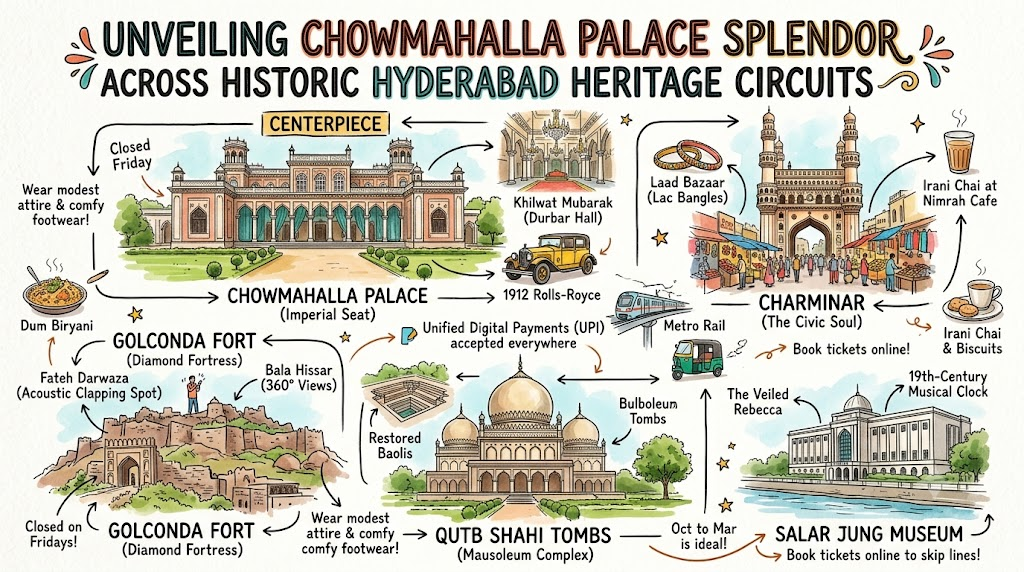
Chowmahalla Palace
Conceived in 1750 by Nizam Salabat Jung and completed under Nizam Afzal-ud-Daula by 1869, Chowmahalla Palace served as the official seat of the Asaf Jahi dynasty. Deriving its name from the Persian words Chahar (four) and Mahalat (palaces), the compound synthesis blends neoclassical European columns, ornate Persian stucco flourishes, and delicate Rajasthani jharokhas.
The centerpiece, Khilwat Mubarak (the grand Durbar Hall), suspends 19 massive Belgian crystal chandeliers beneath a soaring frescoed ceiling. Here rests the pure white marble Takht-e-Nishan (royal throne), radiating the quiet dignity of Deccan sovereign power across expansive manicured lawns and historic courtyards.
- Location: Motigalli, Khilwat, Old City (1.2 km southwest of Charminar; 16 km from RGIA Airport)
- Why it is worth visiting: It is the finest restored living showcase of Asaf Jahi royal protocol and domestic palace architecture in India.
- Best things to do: Inspect the immaculate 1912 vintage yellow Rolls-Royce Silver Ghost in the southern courtyard; view the royal arms and coronation robes inside the Khilwat galleries; sit beside the central marble fountain garden during late afternoon.
- Best time to visit: 3:30 PM to 5:00 PM on weekdays for gentle photography light and fewer school tour crowds.
- Ideal for whom: Architecture connoisseurs, royal history researchers, and heritage photographers.
- Travel tip: The palace complex is closed to visitors every Friday; book standard entry tickets at the counter to bypass third-party online markups.
Charminar & Laad Bazaar
Commissioned in 1591 by Sultan Muhammad Quli Qutb Shah to commemorate the eradication of a devastating plague, the Charminar stands as the undeniable civic and cultural soul of Hyderabad. Crafted from granite, lime, mortar, and pulverized marble, the square structure features four towering 48.7-meter minarets sheltering a historic rooftop mosque and panoramic viewing galleries.
Radiating directly west from the monument’s grand arches lies Laad Bazaar, a bustling, fragrance-filled market corridor that has operated continuously for centuries. Master craftsmen handcraft traditional lac bangles studded with glittering stones directly before your eyes amid displays of pure silver zari and velvet textiles.
- Location: Charminar Road, Char Kaman, Old City (Centered in the historic urban core)
- Why it is worth visiting: The ultimate symbol of 16th-century Deccan urbanism and the liveliest artisanal bazaar in South India.
- Best things to do: Climb the spiral staircase into the monument’s first tier for an aerial street perspective; shop for authentic lac bangles customized to your wrist size; sip a steaming cup of Irani chai at Nimrah Cafe right across the eastern arch.
- Best time to visit: 8:30 AM for quiet architectural appreciation, or 7:00 PM for peak market atmosphere.
- Ideal for whom: Solo explorers, cultural shoppers, and street documentary photographers.
- Travel tip: Wear shoes that slip off easily if you plan to visit the adjoining Mecca Masjid, and keep bags secured in dense market crowds.
Golconda Fort
Perched upon a 120-meter-high granite hill, Golconda Fort developed from an early Kakatiya mud outpost into one of the world’s most formidable medieval citadels under the Qutb Shahi rulers. Renowned globally as the vault of legendary treasures—including the Koh-i-Noor and Hope diamonds—the fortress was designed with military genius to withstand extended artillery sieges.
The fort’s acoustic engineering remains an acoustic marvel: a single handclap beneath the grand dome of the Fateh Darwaza entrance canopy echoes clearly to the Bala Hissar pavilion over a kilometer away atop the citadel. Walking its staircases takes you past royal granaries, hidden escape sally ports, and ancient freshwater supply canals.
- Location: Ibrahim Bagh, Western Hyderabad (11 km west of Charminar; 9 km from Banjara Hills)
- Why it is worth visiting: An unmissable masterclass in medieval acoustics, defensive hydraulic engineering, and Deccan military architecture.
- Best things to do: Test the acoustic communication relay at Fateh Darwaza; hike the 380 stone steps to the summit for a 360-degree city view; watch the evening sound and light presentation detailing the 1687 Mughal siege.
- Best time to visit: 8:00 AM to 10:30 AM before the granite rocks heat up under midday sun.
- Ideal for whom: Active hikers, defense history enthusiasts, and panoramic landscape photographers.
- Travel tip: Hire an authorized ASI guide near the ticket window; self-guided walks miss the disguised acoustic arches and subterranean passages.
Qutb Shahi Tombs (Ibrahim Bagh)
Resting in peaceful gardens just north of Golconda Fort, this serene necropolis preserves the resting places of the seven founding Qutb Shahi monarchs. Unlike many dynastic tombs scattered across disparate territories, this complex honors an entire imperial lineage within a single, cohesive royal park.
The architecture combines domed Persian elegance with carved Hindu lotus motifs and delicate balustrades. The soaring, bulbous domes rise from square granite terraces, surrounded by ongoing world-class conservation efforts that have restored water channels, orchards, and ornate floral stucco reliefs to their original 16th-century brilliance.
- Location: Ibrahim Bagh, near Golconda Fort, Hyderabad (2 km north of Golconda’s outer wall)
- Why it is worth visiting: The only heritage site in the world where an entire historic dynasty rests in a single landscaped royal compound.
- Best things to do: Walk the shaded arcades of Muhammad Quli Qutb Shah’s grand mausoleum; examine the restored stepwells (baolis); wander through the on-site interpretation center.
- Best time to visit: 4:00 PM to 6:00 PM when golden hour illuminates the pale domes against open Deccan skies.
- Ideal for whom: Slow travelers, historians, and artists seeking quiet contemplation.
- Travel tip: Pair this directly with an early-morning tour of Golconda Fort to save travel time across the city’s western corridor.
Salar Jung Museum
Overlooking the southern banks of the Musi River, the Salar Jung Museum houses one of the world’s largest private one-man art collections, gathered by Nawab Mir Yousuf Ali Khan (Salar Jung III). Devoting his immense personal fortune to art preservation, he assembled over 40,000 artifacts from across Europe, the Middle East, East Asia, and the Indian subcontinent.
The exhibits span rare jade daggers owned by Mughal emperors, antique Persian carpets, ivory carvings, and Japanese porcelain. Its crowning masterpieces include the veiled marble sculpture Rebecca by Giovanni Benzoni and the double-faced wooden statue of Mephistopheles and Margaretta, both showcasing astounding craft.
- Location: Salar Jung Marg, Darulshifa (1.5 km northeast of Charminar, along the Musi River)
- Why it is worth visiting: An astonishing window into global art patronage assembled by a single connoisseur.
- Best things to do: Stand in the central courtyard at the top of the hour to watch the 19th-century musical mechanical clock chime; study the translucent drapery carved into the Veiled Rebecca; explore the jade and blade weaponry gallery.
- Best time to visit: 10:00 AM on a weekday morning to enjoy the sprawling wings before midday tour buses arrive.
- Ideal for whom: Art lovers, decorative collectors, and families with curious children.
- Travel tip: Deposit oversized backpacks and professional camera rigs at the cloakroom; mobile phone photography is permitted inside most display wings.
Offbeat Exploration: Hidden Gems Tourists Miss
Paigah Tombs
Tucked inside a quiet residential lane in Pisalbanda, the Paigah Tombs hold the remains of the noble Paigah family—the fierce generals and matrimonial allies of the Nizams. Constructed between the late 18th and early 20th centuries, these mausoleums feature astonishing craftsmanship: delicate, pierced stucco screens (jali) resembling fine ivory lace, paired with marble inlays and Corinthian-inspired capitals.
Badshahi Ashurkhana
Built in 1594 by Muhammad Quli Qutb Shah, this royal mourning house dedicated to the memory of Imam Hussain is located just north of the High Court. While easily missed behind its modest entry gates, its interior walls feature some of South Asia’s best-preserved 17th-century Persian enamel tile mosaics, glowing in deep lapis lazuli, turquoise, yellow, and emerald tones.
Khajaguda Rock Formations
For an escape into nature, head to the natural granite formations of Khajaguda on the edge of the financial district. Estimated to be over 2.5 billion years old, these massive, balanced boulders frame quiet caves and a hidden reservoir, making it a beloved gathering spot for local boulderers and sunset seekers.
Detailed Practical Guidance for Travelers
| Destination | Standard Entry Fee | General Timings | Best Local Food Options Nearby | Recommended Nearby Attractions |
| Chowmahalla Palace | ₹100 (Indians), ₹400 (Foreigners) | 10:00 AM – 5:00 PM (Closed Friday) | Shadab Hotel (Biryani), Milan Juice Centre | Charminar, Mecca Masjid, Laad Bazaar |
| Charminar | ₹25 (Indians), ₹300 (Foreigners) | 9:00 AM – 5:30 PM (Daily) | Nimrah Cafe (Chai & Biscuits), Subhan Bakery | Laad Bazaar, Gulzar Houz, Mecca Masjid |
| Golconda Fort | ₹25 (Indians), ₹300 (Foreigners) | 9:00 AM – 5:30 PM (Daily) | Chicha’s Masab Tank, Shah Ghouse (Tolichowki) | Qutb Shahi Tombs, Taramati Baradari |
| Qutb Shahi Tombs | ₹20 (Indians), ₹100 (Foreigners) | 9:00 AM – 4:30 PM (Closed Friday) | Mandar Restaurant (Tolichowki for Talawa Gosht) | Golconda Fort outer moats, Durgam Cheruvu |
| Salar Jung Museum | ₹50 (Indians), ₹500 (Foreigners) | 10:00 AM – 5:00 PM (Closed Friday) | Hotel Nayab (Paya & Naan), Grand Hotel Abids | Badshahi Ashurkhana, State Central Library |
| Paigah Tombs | Free entry (Donations welcome) | 10:00 AM – 5:00 PM (Daily) | Pista House (Charminar Branch, 3 km away) | Raymond’s Tomb, Malwala Palace ruins |
Logistics & On-Ground Navigation
Local Transport Options
- Metro Rail: The elevated Hyderabad Metro operates three primary corridors (Red, Blue, and Green lines). It provides cheap, air-conditioned transit across the city center, connecting Hitec City, Secunderabad, and MG Bus Station efficiently.
- Auto-Rickshaws: Abundant on every street corner. Insist on the meter or negotiate firmly prior to boarding; booking via rideshare apps like Uber Auto or Ola ensures clear, upfront pricing.
- App-Based Cabs: Uber and Ola operate extensively across greater Hyderabad. They remain the most comfortable choice for crossing town from central or western hotel hubs into Old City heritage spots.
- RTC City Buses: The TSRTC bus system connects nearly every neighborhood, though navigating crowded routes requires patience during rush hours.
Budget Planning
- Backpacker / Budget Tier (₹1,500 – ₹2,200 per day): Accommodations in clean heritage guesthouses or hostels near Abids or Banjara Hills; travel via metro and shared autos; dining on authentic biryani, dosas, and Irani cafe breakfasts.
- Mid-Range / Comfort Tier (₹4,500 – ₹8,000 per day): Boutique hotel stays in Jubilee Hills or Somajiguda; dedicated app cab transfers for day circuits; guided heritage walking tours and dining at established specialty restaurants.
Safety and Inclusivity Tips
- For Families: The walking corridors at Chowmahalla Palace and Salar Jung Museum are spacious and stroller-friendly, though Golconda Fort involves steep, unpaved stone steps requiring sturdy footwear.
- For Couples: Hyderabad is welcoming and modern, though modest dress (covered shoulders and knees) is respectful when touring Old City monuments and sacred sites.
- General Safety: Keep valuables secured against opportunistic pickpockets in crowded evening markets around Charminar and Laad Bazaar; drink filtered or bottled water exclusively.
Strategic Travel Planning Guardrails
Travel Planning Tips for Hyderabad
- Book Heritage Tickets Electronically: Avoid long ticket counter lines at Golconda Fort and Charminar by booking directly via the Archaeological Survey of India (ASI) portal using your smartphone.
- Embrace Unified Digital Payments (UPI): From high-end silk boutiques to small street tea stalls, UPI (Google Pay, PhonePe) is ubiquitous; keep ₹500 to ₹1,000 in small cash notes for local bazaar stalls.
- Respect Friday Heritage Closures: Major monuments including Chowmahalla Palace and Salar Jung Museum close to the public every Friday; reserve Fridays for exploring Golconda Fort, local cafes, or the modern western districts.
- Pace Around Deccan Midday Heat: Even in winter, Deccan afternoons bring warm sunshine; schedule open-air climbs (Golconda, Charminar) in the early morning and indoor museums during midday.
- Hydrate and Acclimatize to Deccan Spices: Hyderabadi culinary traditions feature assertive green chilies; if your spice tolerance is low, request mild preparations or balance meals with sweet Qubani ka Meetha.
Common Mistakes to Avoid
- Overloading a Single Day: Attempting to combine western Hitec City, Golconda Fort, and the deep Old City in a single eight-hour span leads to spending hours stuck in cross-city traffic.
- Relying Exclusively on Street-Hailed Autos Without Fix-Fare Apps: Flagging unmetered autos outside monument gates often means paying inflated tourist fares; always cross-reference via rideshare apps first.
- Skipping Historic Irani Bakeries: Don’t limit your meals solely to hotel dining rooms; missing a morning breakfast of piping hot Bun Maska and sweet chai at a neighborhood Irani cafe bypasses the true civic heart of the city.
- Wearing Impractical Footwear: Don’t wear slick leather soles or open flip-flops to Golconda Fort; centuries of foot traffic have polished the historic granite stairs slick.
- Assuming Biryani is Identical Everywhere: Avoid nondescript highway stalls; seek out renowned institutions like Shadab, Cafe Bahar, or Shah Ghouse for authentic slow-cooked dum preparations.
Suggested Itinerary Blueprints
1. Day Quick Dash (The Imperial Heritage Sprint)
- Target Audience: Business travelers, layover visitors, and fast-paced explorers.
- Morning (8:30 AM – 11:30 AM): Beat the heat at Golconda Fort, ascending to the Bala Hissar pavilion and testing the acoustics at Fateh Darwaza.
- Midday (12:00 PM – 2:30 PM): Head to Hotel Shadab for an authentic mutton biryani lunch, followed by a walk through the grand halls and chandeliers of Chowmahalla Palace.
- Late Afternoon to Evening (3:00 PM – 6:30 PM): Photograph Charminar, browse the bangle stalls of Laad Bazaar, and finish with Irani chai and Osmania biscuits at Nimrah Cafe.
2. Day Deep-Dive (Dynastic Legacies & Cultural Treasures)
- Day 1: The Asaf Jahi Legacy: Begin at Salar Jung Museum at opening, followed by lunch at Hotel Nayab. Spend the afternoon exploring Chowmahalla Palace, ending with shopping across Laad Bazaar beneath the illuminated arches of Charminar.
- Day 2: The Qutb Shahi Strongholds: Dedicate the morning to exploring Golconda Fort and its upper citadels. After a nearby lunch in Tolichowki, spend a tranquil afternoon walking the restored garden pavilions of the Qutb Shahi Tombs, catching sunset at Khajaguda Rock Formations.
3. Complete Weekend Travel Plan (The Grand Nizamian Circuit)
- Friday (The Cultural Mosaic): Arrive and settle in. Tour the ancient Persian tile art at Badshahi Ashurkhana, wander through the serene Paigah Tombs, and enjoy an evening dinner around Banjara Hills.
- Saturday (The Medieval Bastions): Start early at Golconda Fort, followed by an afternoon tour of the Qutb Shahi Tombs. Head to Hussain Sagar Lake at dusk to see the Buddha statue, followed by modern Telugu dining in Jubilee Hills.
- Sunday (The Royal Heart of Hyderabad): Spend your final morning admiring the art collections of Salar Jung Museum. Head deep into the Old City to explore Chowmahalla Palace, concluding with golden-hour photography and street eats around the Charminar perimeter.
Common Tourist Mistakes to Avoid
- Geographic Blunders: Don’t book accommodations in far-flung suburban IT corridors like Gachibowli or Hitec City if your main focus is Old City heritage. Cross-city traffic during peak hours can add an hour or more to each journey; choose central bases like Banjara Hills, Begumpet, or Abids instead.
- Commercial Traps: Don’t spend precious afternoon hours inside generic suburban shopping malls buying mass-produced goods. The Old City’s historic markets, like Laad Bazaar for bangles, Perfume Market near Moti Chowk for traditional attar, and Shilparamam for regional handlooms, offer far richer craftsmanship.
- Neglecting Modern/Alternative Zones: Don’t focus exclusively on ancient monuments and overlook the city’s contemporary creative culture. Neighborhoods like Jubilee Hills and Film Nagar feature leafy bylanes, art galleries, artisanal roasteries, and independent bistros showcasing the energetic spirit of modern Hyderabad.
- Transport Overpayment: Avoid accepting the first flat-rate fare quoted by auto drivers parked right outside monument gates. Simply walk 100 meters down the street to flag a metered ride, or book through an app to ensure transparent pricing.
- Luxury Dining Bias: Sticking exclusively to five-star hotel buffets deprives you of Hyderabad’s legendary culinary soul. The city’s greatest dishes—piping hot Marag soup, soft naan, slow-cooked Haleem, and Dum Biryani—are perfected in heritage kitchens like Shadab, Nayab, and Shah Ghouse.
Frequently Asked Questions
1. Is photography permitted inside the halls of Chowmahalla Palace?
Yes, visitors are permitted to take personal, non-commercial still photographs inside the courtyards and exhibition halls. A nominal camera fee applies at the ticket booth for standalone DSLR and mirrorless equipment, while mobile phone photography is covered by the general ticket. Tripods, lighting gear, and commercial video shoots are strictly prohibited without prior written clearance.
2. Which metro station is closest to Chowmahalla Palace and Charminar?
The closest operational metro hub to the Old City heritage district is the MG Bus Station (MGBS) interchange, connecting both the Red and Green lines. From MGBS, the monuments are roughly 2.5 kilometers away; you can take a five-minute auto-rickshaw or rideshare directly to the gates of Chowmahalla Palace or Charminar.
3. What is the dress code for exploring the monuments of Old Hyderabad?
While there is no strict formal dress code for Chowmahalla Palace or Golconda Fort, modest attire is strongly recommended throughout the Old City. Shoulders and knees should remain covered when entering functioning places of worship, including Mecca Masjid and Badshahi Ashurkhana. Carrying a lightweight scarf or dupatta is useful for religious monuments.
4. How many hours are required to explore Chowmahalla Palace comfortably?
You should set aside at least two to two and a half hours to tour Chowmahalla Palace thoroughly without rushing. This provides ample time to view the Durbar Hall (Khilwat Mubarak), browse the royal crockery and weapon collections, stroll through the courtyards, and view the vintage car collection in the southern pavilion.
5. What is the single best time of year to visit Hyderabad for sightseeing?
The most pleasant season for exploring Hyderabad runs from late October through early March. During these winter months, daytime temperatures hover comfortably between 20°C and 28°C with minimal humidity, creating ideal conditions for climbing Golconda Fort and taking walking tours through Old City markets without intense summer heat.
6. Are credit cards and mobile digital payments accepted across the city?
Major credit cards and Indian UPI mobile payment options are accepted at ticket counters, restaurants, and larger retail shops across the city. However, smaller market vendors in Laad Bazaar, local street food stalls, and auto-rickshaw drivers often rely on cash or direct UPI transfers, so carrying small paper notes is wise.
7. Can travelers with mobility challenges easily access Chowmahalla Palace?
Chowmahalla Palace is one of the more accessible heritage properties in the region, featuring flat paved paths across the central gardens and gentle ramps leading into the main halls. Certain elevated viewing pavilions and historical stairwells remain inaccessible to wheelchairs, but the primary ground-level halls and vintage car exhibits can be navigated comfortably.
8. Where can you find authentic Hyderabadi Biryani near the heritage sites?
Hotel Shadab near the Madina Circle, just a short walk north of Charminar, is a legendary destination for authentic, fragrant Dum Biryani. Another exceptional culinary landmark nearby is Hotel Nayab, renowned for its slow-cooked mutton biryani, spiced paya, and fresh lukhmi pastries, delivering authentic local flavors favored by generations of residents.
9. Is Golconda Fort physically challenging to climb for senior travelers?
Climbing to the highest point of Golconda Fort (the Bala Hissar citadel) involves ascending more than 360 uneven granite steps without handrails along certain stretches. While younger and active travelers manage it comfortably, visitors with limited mobility, knee trouble, or heart conditions may prefer touring the lower defensive gates and garden pavilions.
10. What is the difference between Chowmahalla Palace and Falaknuma Palace?
Chowmahalla Palace was the official ceremonial and administrative seat of the Nizams, located within the historic city walls and open daily to the public as a museum. Falaknuma Palace, situated atop a hill four kilometers south, served as a private royal retreat and now functions as a luxury heritage hotel accessible only to registered guests and patrons with verified dining reservations.
11. Is Hyderabad safe for solo women travelers exploring the city?
Hyderabad is widely recognized as one of the safer and more welcoming metropolitan centers in India. Standard travel awareness applies: dress respectfully in traditional market areas, book app-based cabs for late-night journeys across town, and stay within well-lit, active avenues after dark. Local women frequent the bazaars until late into the evening.
12. Why are Chowmahalla Palace and Salar Jung Museum closed on Fridays?
Under longstanding cultural and governmental conventions, select major museums and Asaf Jahi heritage sites close on Fridays to accommodate congregational prayers at the adjoining historic mosques of the Old City. When planning your weekly travel schedule, reserve Fridays for open monuments like Golconda Fort, lakefront walks, or modern city excursions.
Conclusion
Visiting Hyderabad goes far beyond merely checking famous monuments off a checklist; it is an immersive step into a living, breathing Deccan world. Standing beneath the crystal chandeliers of Chowmahalla Palace, feeling the breeze along the high ramparts of Golconda Fort, and sharing sweet Irani chai amid the evening energy of the Charminar market connects you to a timeless royal heritage that will stay with you long after your journey ends.
