Introduction
Most travel itineraries reduce Hyderabad to simmering pots of dum biryani, glittering pearl bazars, and crowded strolls around Charminar. While that regal Nizami heritage is undeniably magnetic, an entirely different world awaits beyond the city limits. Just past the neon hum of the IT corridors lies a rugged Deccan wilderness sculpted over two billion years.
Instead of queuing up at overrun commercial viewpoints, outdoor enthusiasts can scale towering monolithic granites, paddle through morning mist on placid reservoirs, and trek under dense deciduous canopies. The rugged terrain surrounding Hyderabad delivers raw adventure and deep authenticity. It connects travelers with ancient geological formations, centuries-old rock bastions, and the untamed rhythms of the Deccan Plateau.
Verdant canopy across Ananthagiri Hills.
Why Hyderabad is a must-visit city
Hyderabad sits comfortably on the Deccan Plateau, serving as the central crossroads between North and South India. Its distinct geography features rolling granite hills, expansive scrub forests, and network reservoirs fed by ancient river basins. For adventure travelers, this unique topography creates natural amphitheaters for bouldering, rappelling, and wild camping.
The city connects seamlessly to outdoor hubs via the Nehru Outer Ring Road (ORR), well-maintained national highways (NH 44, NH 65, and NH 163), and multiple railway junctions. Modern hospitality options range from quiet rural farmstays to high-end glamping retreats. Whether backpacking solo or planning an off-grid family outing, Hyderabad serves as a smooth, accessible launchpad into nature.
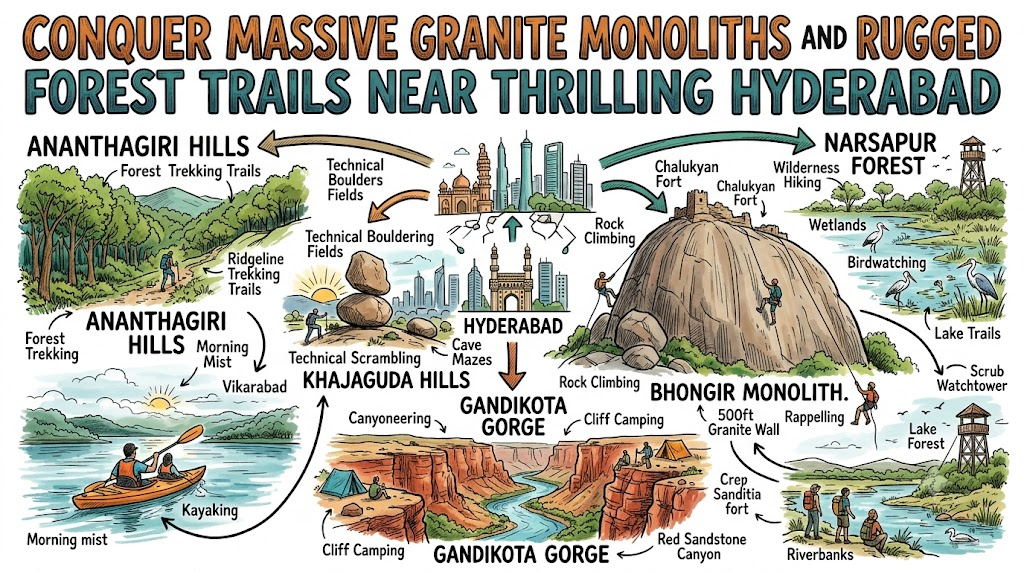
The surrounding adventure circuit spans several dynamic zones:
- The Western Eco-Belt (Vikarabad & Ananthagiri): Celebrated for thick forests, ridgeline trekking, and reservoir kayaking.
- The Eastern Monolithic Ridge (Bhongir & Yadadri): World-famous among climbers for sheer granite wall ascents.
- The Northern Scrub Trails (Medak & Pocharam): Ideal for wildlife safaris, night camping, and birdwatching.
- The Southern Canyons & Backwaters (Gandikota & Nagarjuna Sagar): Dramatic gorges, river expeditions, and off-grid escapades.
| Region / Hub | Primary Landscape | Signature Thrill | Distance from City Center |
|---|---|---|---|
| Vikarabad Belt | Dense deciduous forest & hills | Forest trekking, open-water kayaking | 75–85 km West |
| Bhongir Monolith | Single granite dome (egg-shaped) | Steep rock climbing, 300-ft rappelling | 50 km East |
| Narsapur Forest | Wetland, scrub, granite boulders | Guided night hiking, lake bouldering | 55 km North |
| Khajaguda Hills | Pre-Cambrian balance rock fields | Technical urban bouldering, scrambling | Within city limits (West) |
| Gandikota Gorge | Red sandstone cliffs & riverbed | Canyoneering, cliff camping, kayaking | 380 km South-West |
Best Places or Experiences
1. Trekking and Kayaking in Ananthagiri Hills & Kotepally
Ananthagiri Hills serves as the primary green lung of western Telangana and the historical birthplace of the Musi River. Dense scrub forests wrap around undulating slopes, presenting trails that weave through thick coffee plantations, ancient cave temples, and freshwater springs.
A short drive deeper into the valley brings you to the glassy expanse of Kotepally Reservoir. Early mornings here feature tranquil water surrounded by low hills, providing the perfect playground for silent paddle adventures before the midday warmth sets in.
Kayaking on Kotepally Reservoir.
- Location: Vikarabad District, approximately 82 km west of Hyderabad central.
- Why it is worth visiting: It is the closest dense forest canopy to the capital, pairing technical hill treks with tranquil lake paddling.
- Best things to do: Paddle a tandem kayak across Kotepally Reservoir, hike the untamed trail to the underground freshwater spring near Sri Anantha Padmanabha Swamy Temple, and pitch an overnight tent on the forest clearing ridge.
- Best time to visit: July to February; head out at 06:00 AM to hike before midday heat and catch misty water reflections.
- Ideal for whom: Weekend trekkers, nature photographers, and active friend groups.
- Travel tip: Kotepally water equipment rentals halt quickly if wind speeds kick up; reserve your life jacket and kayak at the lakeside outpost before 09:00 AM.
2. Rock Climbing and Rappelling at Bhongir Fort
Bhongir stands tall as one of the most imposing geological wonders in southern India—a massive, monolithic granite dome rising abruptly from the Deccan plains. Carved into its sheer face is a legendary 10th-century Chalukyan fort, featuring weathered steps cut straight into the granite alongside deep defensive stone ramparts.
For rock climbers and mountaineers, Bhongir presents world-class multi-pitch friction climbing and towering rappel drops. Standing atop its windy summit offers panoramic 360-degree vistas across rural Telangana, while the vertical descent tests nerve and footwork on bare, sun-baked granite.
- Location: Yadadri Bhuvanagiri District, 50 km east along the Hyderabad-Warangal Highway.
- Why it is worth visiting: It ranks among India’s largest unbroken single-rock formations, featuring a sheer climbing gradient exceeding 500 feet.
- Best things to do: Conquer the steep exposed climb to the hilltop citadel, attempt an organized 300-foot vertical rope rappel with certified instructors, and explore the ancient ruined armory and water-harvesting cisterns.
- Best time to visit: October to February; arrive by 06:30 AM before the bare stone turns scorching under direct sun.
- Ideal for whom: Adrenaline junkies, rock climbing enthusiasts, and fitness trekkers.
- Travel tip: Wear shoes with high rubber friction; the polished stone slopes lack handholds and can prove slick even when completely dry.
3. Bouldering and Scrambling at Khajaguda Hills
Tucked right along the edge of Hyderabad’s glittering financial hub, Khajaguda is a natural rock-climbing sanctuary hidden in plain sight. These weathered pre-Cambrian granite boulders have sat balanced against one another for billions of years, creating an intricate maze of caves, squeeze chimneys, and natural climbing problems.
Locals and visiting climbers gather here at dawn to test their finger strength against technical friction slabs and drop-offs. The dramatic visual contrast between primeval stone formations and towering corporate glass skyscrapers across the horizon makes Khajaguda an unforgettable urban adventure spot.
- Location: Puppalaguda / Manikonda boundary, just 3 km from the Gachibowli financial district.
- Why it is worth visiting: It provides instant access to genuine Deccan bouldering problems without leaving the city boundary.
- Best things to do: Work on technical V1–V4 bouldering problems, navigate the narrow cave passages threading beneath the primary boulders, and catch the fiery sunset over the city skyline.
- Best time to visit: Year-round during early mornings (05:30 AM to 08:30 AM) or late afternoons (04:30 PM to 06:30 PM).
- Ideal for whom: Solo boulderers, climbing groups, and city professionals seeking dawn movement.
- Travel tip: Carry your own chalk bag and crash pad; there are no commercial gear rental huts stationed at the hill base.
4. Wilderness Hiking and Lake Circuit at Narsapur Forest
The Narsapur Forest Range encompasses thousands of acres of protected woodland, marsh, and seasonal streams just north of the metropolis. Far from the manicured lawns of suburban theme parks, Narsapur offers an authentic scrub forest escape, complete with natural trails lined with tamarind trees, date palms, and dense undergrowth.
At the core of the reserve lies the secluded Narsapur Lake, a scenic water body frequented by resident wetland birds and migratory waterfowl. Hiking routes around the perimeter require careful navigation across mud banks, low granite outcrops, and scrub canopies that stay pleasantly cool in winter mornings.
- Location: Medak District, roughly 54 km north of Secunderabad via the Medak Highway.
- Why it is worth visiting: It is the premier wild scrub-forest trek near the city, offering genuine biodiversity away from paved trails.
- Best things to do: Hike the 7-km lake boundary trail, watch for painted storks and purple herons from the shoreline, and scale the forest department watchtower for endless woodland views.
- Best time to visit: August to January; morning hours deliver crisp air, dew-soaked trails, and peak bird activity.
- Ideal for whom: Birders, cross-country trail runners, and eco-conscious hiking groups.
- Travel tip: Monkeys along the temple trail near the entrance can be aggressive toward food; pack snacks securely inside your backpack.
5. High-Octane Go-Karting at Chicane Circuit & Shamshabad
When the craving for adventure shifts from natural trails to motorsport speed, Hyderabad delivers some of the longest and most competitive outdoor karting tracks in the country. Facilities around Shamshabad feature professional asphalt circuits engineered with sweeping chicanes, hairpin bends, and high-speed straights designed to test racecraft.
These floodlit circuits operate deep into the night, allowing drivers to escape the daytime heat. Sitting inches off the asphalt in twin-engine go-karts, pulling hard lateral Gs through tight turns, delivers an immediate, raw shot of adrenaline.
- Location: Shamshabad / Rajiv Gandhi International Airport zone, approximately 25 km south of the city center.
- Why it is worth visiting: It houses genuine asphalt sprint tracks built to international karting specifications, far superior to shopping-mall drift tracks.
- Best things to do: Race high-output 7-bhp and 9-bhp professional karts, challenge friends to timed lap sessions, and experience high-speed night racing under the floodlights.
- Best time to visit: Year-round; evening hours between 06:00 PM and 11:00 PM offer cooler track temperatures and prime racing conditions.
- Ideal for whom: Speed lovers, corporate groups, and competitive friend squads.
- Travel tip: Wear closed-toe shoes and snug-fitting athletic clothing; loose apparel is strictly prohibited on the circuit pit lanes.
6. Canyoneering and Cliff Camping at Gandikota
Often hailed as the Grand Canyon of India, Gandikota is a breathtaking natural chasm carved through the Erramala Hills by the Penna River. Towering layered red sandstone cliffs drop steeply into the deep riverbed below, flanked by the sprawling ruins of a 12th-century stone fortress.
For true adventure travelers willing to take an extended weekend run from Hyderabad, Gandikota offers an unmatched landscape for rock scrambling, cliff-edge wild camping, and river canyon exploration. Waking up in a tent suspended high above the winding river as morning light turns the red gorge fiery orange is an extraordinary Deccan experience.
The majestic Penna River gorge at Gandikota.
- Location: Kadapa District, roughly 380 km southwest of Hyderabad (via NH 44 and Gooty).
- Why it is worth visiting: It features India’s most dramatic red-sandstone canyon, pairing geological splendor with deep medieval history.
- Best things to do: Camp directly along the cliff perimeter under clear night skies, boulder along the riverbed floor, and scramble through the towering granaries and mosque arches of the ruined fort.
- Best time to visit: November to February; summer turns this rocky canyon into a blazing furnace.
- Ideal for whom: Serious adventure travelers, overland road-trippers, and astrophotographers.
- Travel tip: Keep a safe margin from unfenced cliff drop-offs, especially in the evening when sudden canyon gusts can surprise you.
Offbeat Exploration: Hidden Gems Tourists Miss
Rachakonda Fort Trail & Secret Boulders
Hidden away in the scrub hills southeast of Hyderabad, Rachakonda Fort remains blissfully untouched by mainstream tourism. Constructed in the 14th century by the Velama dynasty, this forgotten stone citadel is built directly into sheer rock faces. The trail leads through overgrown forest tracks, hidden gateways, and stone pillars, offering an untamed playground for scrambling and solitary exploration.
Moula Ali Hill Dawn Scramble
While nearby urban hilltops draw noisy crowds, the weathered dome of Moula Ali Hill on the eastern edge of Secunderabad provides a tranquil early-morning ascent. Climbing its 450-plus stone-hewn steps before first light rewards you with a cool morning breeze, sweeping panoramas over the waking twin cities, and secluded granite alcoves perfect for outdoor yoga and balance work.
Koilkonda Fort and Koilsagar Dam
Situated roughly 130 km southwest of the city, Koilkonda requires hikers to navigate a series of seven historic defensive gates and rugged, boulder-strewn footpaths to reach the windy citadel. After descending the fort, an unpaved country track leads directly to Koilsagar Dam, an expansive, uncrowded water body bordered by dramatic rocky knolls ideal for off-grid camping.
Detailed Practical Guidance for Travelers
| Destination | Standard Entry Fee | General Timings | Best Local Food Options Nearby | Recommended Nearby Attractions |
|---|---|---|---|---|
| Ananthagiri Hills | Free entry | 24 Hours open (Daylight for trails recommended) | Telangana thali & spicy country chicken at Haritha Resort | Bugga Ramalingeswara Swamy Temple, Kotepally Lake |
| Kotepally Reservoir | Free entry; ₹200–₹350 per kayak | 08:30 AM – 06:00 PM | Steaming sweet corn, Mirchi Bajji, and local egg omelets at lakeside stalls | Vikarabad Reserve Forest, Grassland Viewpoint |
| Bhongir Fort | ₹25 for adults; Climbing permits separate | 09:00 AM – 05:00 PM | Rayalaseema mess food and tiffins at Bhongir town center | Kolanupaka Jain Temple (22 km away), Yadagirigutta |
| Khajaguda Hills | Free entry | 05:30 AM – 06:30 PM | Dosa carts and Irani Chai cafes along Khajaguda Main Road | Durgam Cheruvu Cable Bridge, Malkam Cheruvu Park |
| Narsapur Forest | ₹30 per adult | 08:00 AM – 05:30 PM | Traditional dhabas along Medak Highway serving hot Jowar Rotis | Medak Cathedral, Pocharam Wildlife Sanctuary |
| Chicane / Shamshabad Karting | ₹600–₹1,200 per race session | 11:00 AM – 11:00 PM | Midnight Arabian Mandi and shawarma joints along Airport Road | Escape Water Park, Himayat Sagar Viewpoints |
| Gandikota Gorge | Free entry to gorge; ₹25 for inner fort complex | 06:00 AM – 06:00 PM | Spicy Andhra meals and Gongura mutton at local village messes | Belum Caves (60 km north), Mylavaram Dam |
Logistics & On-Ground Navigation
Local Transport Options
- Self-Drive Cars and Motorbikes: Renting a vehicle or driving your own car/motorcycle offers the greatest freedom for reaching trailheads at Ananthagiri, Narsapur, and Bhongir before dawn.
- Suburban Passenger Trains (MMTS & South Central Railway): Inexpensive local trains run regularly from Secunderabad and Kacheguda to Bhongir and Vikarabad stations, where shared auto-rickshaws can take you to the trailheads.
- TSRTC Express Buses: Telangana State Road Transport Corporation runs reliable buses from central terminals like MGBS (Mahatma Gandhi Bus Station) and JBS (Jubilee Bus Station) straight to regional towns.
- App-Based Taxis (Ola/Uber): Convenient for getting to within-city spots like Khajaguda Hills and Shamshabad Karting. Avoid taking one-way cabs to distant spots like Vikarabad, as drivers often cancel return trips.
Budget Planning
- Backpacker / Scrambler Tier (₹1,000 – ₹1,800 per day):
- Travel via local passenger trains or state express buses.
- Stay in basic town lodges, eco-camping tents, or shared dormitory rooms.
- Dine on regional breakfast tiffins (idli, wada, dosa) and local meals at roadside dhabas.
- Mid-Range / Comfort Adventure Tier (₹3,500 – ₹6,500 per day):
- Travel via private self-drive hatchbacks or air-conditioned rented SUVs.
- Stay at lakeside resorts, government Haritha properties, or organized glamping camps.
- Hire certified outdoor adventure guides, book kayak rentals, and enjoy comfortable family restaurants.
Safety and Inclusivity Tips
- For Families: Stick to well-monitored adventure sites like Kotepally Reservoir and daytime nature trails in Ananthagiri. Keep young children well away from unfenced cliff edges at Bhongir and Gandikota.
- For Couples: Early morning treks at Ananthagiri and Bhongir are safe, welcoming, and popular with active duos. Avoid pitching solitary tents in isolated forest clearings without an organized camping group.
- General Safety & Terrain Awareness: Deccan granite becomes intensely hot by early afternoon and turns slippery during sudden monsoon rains. Always carry at least 2 liters of drinking water per person, wear a hat, and pack a basic first-aid kit with antiseptic wipes and blister tape.
Strategic Travel Planning Guardrails
Travel Planning Tips for Adventure Trips
- Chase the Dawn: Plan every outdoor trek to begin between 05:30 AM and 06:30 AM to beat the intense midday sun and enjoy tranquil, uncrowded landscapes.
- Always Carry Cash: Rural stalls, trail entry booths, and lakeside kayak vendors frequently lose internet connectivity, rendering UPI and card machines useless.
- Dress for Deccan Granite: Wear tough, tear-resistant trekking pants and thick-soled shoes with aggressive tread to handle sharp thorny scrub and abrasive granite rock.
- Respect Local Village Boundaries: Forest tracts border rural pastoral grazing fields; always close gate latches behind you and respect sacred groves and temple compounds.
- Pre-Book Adventure Gear: Reputable rock climbing ropes, harnesses, and safety gear must be arranged through verified mountaineering clubs in Hyderabad before heading out.
Common Mistakes to Avoid
- Underestimating Hydration Needs: The dry heat of the Deccan plateau dehydrates you quickly; never start a rock climb or trail run without ample electrolyte reserves.
- Leaving Trash in Nature: Scrub ecosystems are fragile; pack out all plastic bottles, energy bar wrappers, and food scraps from the trails.
- Climbing Granite Midday: Starting an ascent at Bhongir or Khajaguda after 11:00 AM exposes you to baking stone temperatures that can burn bare hands.
- Assuming Reservoirs are Swimming Pools: Lakes like Kotepally and Koilsagar conceal deep silt pockets and submerged brush; avoid swimming without an approved life vest.
- Relying Solely on Digital Maps: Mobile network reception drops in deep gorges and forest valleys; download your trail routes for offline use beforehand.
Suggested Itinerary Blueprints
1. Day Quick Dash (The Eastern Granite Challenge)
- Target Audience: Weekend climbers, day-trippers, and fitness enthusiasts.
- 05:30 AM: Depart Hyderabad via the Warangal Highway (NH 163) toward Bhongir.
- 06:45 AM – 09:30 AM: Scale the monolithic steps of Bhongir Fort; take on the summit rappelling route with certified guides.
- 10:00 AM: Enjoy breakfast tiffins (spicy upma and puri) in Bhongir town.
- 11:00 AM – 01:00 PM: Take a brief cultural detour to admire the intricately carved stone temple complex at Kolanupaka.
- 01:30 PM: Enjoy a traditional Telangana highway meal before returning to Hyderabad by mid-afternoon.
2. Day Deep-Dive (The Western Hills & Water Circuit)
- Day 1 (Vikarabad Trails & Camp):
- 06:00 AM: Drive west via the Chevella road to Ananthagiri Hills.
- 08:00 AM – 11:30 AM: Trek the forest trail from the temple down through the natural valley spring.
- 01:00 PM: Check into a local eco-resort or campsite for a hot meal and rest.
- 03:30 PM – 06:00 PM: Head to Kotepally Reservoir for open-water kayaking and an evening sunset stroll.
- 08:00 PM: Settle in for a bonfire and stargazing under the clear forest skies.
- Day 2 (Grasslands & Ridge Run):
- 06:30 AM: Wake up for an early trail run across the Vikarabad grassland viewpoints.
- 09:30 AM: Enjoy a country-style breakfast featuring warm millet bread and fresh eggs.
- 11:30 AM: Pack camp and take the scenic backroads through Chevella, stopping for a leisurely farmhouse lunch on the return trip.
3. Complete Weekend Travel Plan (The Grand Canyon & Cave Loop)
- Friday Afternoon: Drive south along NH 44 toward Kurnool and Kadapa; arrive in Jammalamadugu by late evening and settle in.
- Saturday (The Great Gorge Exploration):
- 06:00 AM: Reach Gandikota Gorge to witness the sunrise lighting up the red sandstone canyon.
- 08:30 AM: Explore the ruins of Gandikota Fort, Ranganatha Swamy Temple, and the historic Granary.
- 02:00 PM: Head down into the gorge for bouldering and flatwater kayaking along the Penna River.
- 06:00 PM: Pitch your tent along the cliff plateau for an overnight camp under the stars.
- Sunday (Subterranean Wonders & Return):
- 07:30 AM: Pack camp and drive to the subterranean passages of Belum Caves.
- 09:30 AM – 12:00 PM: Navigate through the limestone formations, sinkholes, and underground galleries.
- 01:30 PM: Enjoy an authentic Andhra spice meal before jumping back onto NH 44 for a smooth drive home to Hyderabad.
Common Tourist Mistakes to Avoid
Geographic Blunders
Attempting to combine Ananthagiri Hills in the far west with Bhongir Fort in the far east on the same calendar day is a classic mistake. Hyderabad’s urban sprawl requires nearly three hours of cross-city driving through traffic, leaving you exhausted behind the wheel rather than enjoying the trail. Stick to one geographical corridor per day trip.
Commercial Traps
Spending entire weekends at crowded, artificial “adventure theme parks” on the city outskirts is another common misstep. These parks charge hefty entry tickets for predictable, tame ziplines while genuine, ancient granite rock faces and pristine natural reservoirs sit virtually empty and free just 20 minutes farther down the highway.
Neglecting Modern/Alternative Zones
Many visitors focus entirely on either heritage monuments or far-flung wilderness, overlooking the quiet green corridors and urban lakes of western Hyderabad. Spots around the Gandipet backwaters, Botanical Gardens trails, and Khajaguda crags offer refreshing outdoor workouts just minutes from the city’s lively open-air cafes.
Transport Overpayment
Hiring unmetered auto-rickshaws or booking unregulated private taxis from transit hubs without establishing the fare beforehand regularly results in inflated prices. Use app-based fare estimates as your benchmark, confirm pricing before starting your trip, or opt for suburban trains to outer hubs like Bhongir and Vikarabad.
Luxury Dining Bias
Limiting your meals to air-conditioned hotel dining rooms deprives you of Telangana’s flavorful rural cuisine. Some of the most memorable post-trek meals come from modest highway dhabas and family mess stalls, where freshly made Jowar Rotis, fiery Natu Kodi Pulusu (country chicken curry), and hot Mirchi Bajji are served fresh from the pan.
Frequently Asked Questions
1. Which adventure activity is closest to central Hyderabad?
Khajaguda Hills is the most accessible adventure spot, located just 3 km from the Gachibowli financial district. It features ancient pre-Cambrian granite boulders that provide fantastic natural bouldering problems, rock scrambling paths, and cave crawling routes suitable for early morning or late afternoon workouts without leaving the city limits.
2. Is prior experience required for rock climbing at Bhongir Fort?
No prior technical climbing experience is needed if you join an organized excursion with licensed adventure operators. Professional teams provide certified climbing ropes, harnesses, helmets, and expert instruction for the 300-foot vertical rappel and rock ascents, though a good level of baseline physical fitness is strongly recommended.
3. Can visitors rent kayaks directly on-site at Kotepally Reservoir?
Yes, kayak rentals are available on-site at Kotepally Reservoir through local tourism operators. Both single and tandem kayaks are offered on a first-come, first-served basis, with standard rates running between ₹200 and ₹350 per boat. Life jackets are mandatory and provided directly with every rental session.
4. Are the hiking trails in Ananthagiri Hills safe for solo travelers?
The primary trails linking the Anantha Padmanabha Swamy Temple to the valley water springs are very safe and frequented by morning walkers. Solo trekkers venturing into deeper, unmarked forest clearings should stick to daylight hours, download offline map trails, and notify their lodge or friends of their route beforehand.
5. What is the best season for outdoor camping near Hyderabad?
The ideal window for wilderness camping runs from October through February. During these cooler months, nighttime temperatures drop into a comfortable range of 14°C to 19°C with clear, rain-free skies. In contrast, summer nights remain uncomfortably warm, while monsoon rains can make granite surfaces slick and hazardous.
6. Do I need official government permits to trek in Narsapur Forest?
Basic day hiking along the standard lake boundary trails does not require an advance permit, though visitors must pay a nominal entry fee of ₹30 at the forest department barrier. Organized group treks entering protected interior conservation zones must notify and obtain clearance from the Medak District Forest Office.
7. How far is Gandikota Gorge, and is it viable as a day trip from Hyderabad?
Gandikota sits roughly 380 km southwest of Hyderabad, requiring a 7 to 8-hour drive each way. Because of the travel time, it is not suitable for a single-day trip. It is best enjoyed as a 2-day or 3-day weekend expedition combined with the limestone caverns at Belum Caves.
8. What style of footwear is best for hiking Deccan granite landscapes?
Wear trail runners or hiking shoes equipped with deep lugged rubber outsoles. The granite slabs around Bhongir and Khajaguda become slick when covered with loose gravel, and smooth-soled running sneakers lack the lateral grip needed to maintain purchase on steep rock friction surfaces.
9. Are there night trekking opportunities available around Hyderabad?
Yes, several certified outdoor adventure clubs in Hyderabad organize controlled night hikes and bouldering sessions at Khajaguda, Moula Ali, and the outer scrub hills of Narsapur. Unguided night hiking into unfamiliar forest reserves is strongly discouraged due to disorienting terrain, open wells, and active nocturnal wildlife.
10. What emergency and medical facilities exist near Vikarabad adventure spots?
Vikarabad town, situated roughly 6 km from Ananthagiri Hills, houses primary community health centers and private clinics capable of handling heat exhaustion, minor sprains, and cuts. For serious trauma or complex medical emergencies, patients must be transferred back to tertiary multi-specialty hospitals in Hyderabad via the Chevella Highway.
11. Is open-water swimming permitted at Kotepally and Koilsagar reservoirs?
Unassisted, open-water swimming without an approved personal flotation device is prohibited across both reservoirs. These agricultural water bodies feature irregular drop-offs, thick underwater weeds, and deep silt beds that present hidden hazards. Water enthusiasts should enjoy the lakes safely from inside rented kayaks.
12. How much cash should I carry for an adventure day trip outside the city?
Travelers should carry roughly ₹1,500 to ₹2,500 in physical cash per vehicle. While roadside vendors and highway restaurants around outer Telangana increasingly accept UPI digital payments, remote forest checkpoints, rural parking stalls, and lakeshore vendors frequently lose cellular connectivity without warning.
Conclusion
Trading Hyderabad’s bustling city streets for the sun-drenched granite boulders of the Deccan Plateau reconnects you with the earth in a way an ordinary vacation cannot match. Scaling ancient, wind-sculpted granite monoliths, feeling the cool morning mist on a silent kayak run, and watching the sunrise illuminate red sandstone canyons builds grit and quiet awe. Beyond the biryani and the palaces, Hyderabad’s wild backyard rewards every traveler brave enough to step off the paved road and embrace the thrill of the trail.
