Introduction
When most people map out their dream vacation to India, their minds instantly drift toward the hyper-commercialized sands of Goa or the heavily trodden Golden Triangle circuit. While those destinations have their merits, they often come with the exhausting baggage of intense crowds, aggressive street hawkers, and sanitized cultural experiences designed purely for mass tourism. If you are yearning for a travel chapter defined by raw authenticity, deep ancestral roots, and a living history that dances through the air alongside the aroma of slow-cooked spices, you need to look toward the Deccan plateau. Hyderabad, the legendary City of Nizams, offers an intensely rewarding alternative where ancient stone fortresses, jaw-dropping Persian architecture, and an unbroken line of multi-faith heritage stand strong against the frantic rush of the modern tech world.
Stepping into Old Hyderabad is akin to opening a heavily embellished, centuries-old storybook. It is a sensory explosion where the calls to prayer from monumental 16th-century mosques blend seamlessly with the chaotic clatter of bangle markets, and where royal palaces still echo with the whispered opulence of the world’s wealthiest past dynasty. This is not a city that puts its history behind velvet ropes; it is a place where people still live, work, pray, and feast within the literal shadows of monumental achievements. For the traveler who measures a journey by the depth of its cultural connections rather than the checkmarks on a generic bucket list, Hyderabad stands ready to alter your perspective on South Asian heritage.
Why Hyderabad is a must visit city
Hyderabad serves as a massive, irreplaceable bridge between the distinct cultural identities of Northern and Southern India. Historically governed by the visionary Qutb Shahi dynasty and later by the incredibly wealthy Asaf Jahi Nizams, the region developed a unique, hyper-localized cultural ecosystem known as the Ganga-Jamuni tehzeeb (a harmonious fusion of Hindu and Muslim traditions). Geographically anchoring the rugged Deccan landscape, its defensive granite hills birthed legendary fortifications, while its global trade monopolies in premium diamonds and exquisite natural pearls funded architectural marvels that rivaled Isfahan and Istanbul.
Navigating your way to and through this cultural powerhouse is remarkably straightforward, making it an incredibly accessible playground for every tier of explorer. The city is anchored by the world-class Rajiv Gandhi International Airport, while major rail stations like Secunderabad, Hyderabad (Nampally), and Kacheguda offer flawless connectivity to the rest of the subcontinent. On the ground, the Outer Ring Road and extensive elevated highways link the historic old core with the glitzy IT corridors. Whether you are a solo backpacker tracking down cheap street food, a couple looking for heritage luxury, or a family exploring royal corridors, the city’s legendary Deccani hospitality ensures a smooth, deeply welcoming travel circuit.
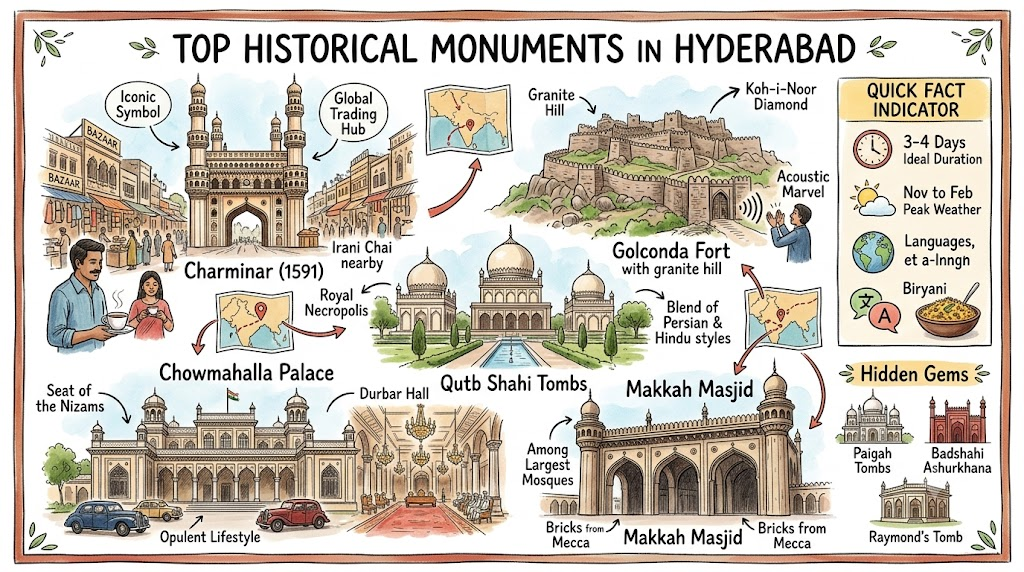
| Quick Fact Indicator | Regional Detail & Traveler Data |
|---|---|
| Ideal Trip Duration | 3 to 4 Full Days for a complete heritage and culinary layout |
| Peak Weather Window | November to February (Pleasant daytime temperatures averaging 22°C) |
| Primary Languages Spoken | Telugu, Deccani Urdu, Hindi, and English |
| Signature Souvenirs | Hand-drilled Basra Pearls, Laad Bazaar Lac Bangles, Bidriware metalcraft |
| Core Culinary Pillars | Hyderabadi Mutton Biryani, Haleem, Qubani ka Meetha, Irani Chai |
Best Places or Experiences
Charminar
Built in 1591 by Sultan Muhammad Quli Qutb Shah to mark the cessation of a devastating plague, the Charminar is the absolute, undisputed beating heart of Hyderabad. This monumental structure stands as a sublime triumph of Indo-Islamic architecture, characterized by its four soaring, 56-meter-tall minarets that gracefully frame a grand, elevated mosque on the top floor. The monument was brilliantly planned to serve as the structural centerpiece of a sprawling global trading hub, with four structural arches opening directly into the historic cardinal directions of the old city grid.
As you stand at the base of this massive granite and lime-mortar marvel, the intricate stucco work and delicate balconies reveal the incredible craftsmanship of Persian architects who migrated to the Deccan court. The surrounding air is constantly alive with the vibrant energy of the historic Laad Bazaar, creating a sensory experience that seamlessly bridges the architectural genius of the 16th century with the daily hustle of modern local life. It is not merely an architectural relic; it is the definitive living room of the city.
The Iconic Charminar at Twilight.
- Location: Charminar Road, Old City, Hyderabad. Approximately 4 km from Nampally Railway Station.
- Why it is worth visiting: It is the ultimate global symbol of Hyderabad, showcasing unmatched artistic synthesis and serving as the focal point of local identity.
- Best things to do: Climb the narrow winding stairs to the upper balcony for a panoramic view of the old city, photograph the massive structural arches framing the sky, and sample hot Irani Chai at Nimrah Café located right across the plaza.
- Best time to visit: 7:00 AM to 8:30 AM to catch the soft morning light before the crushing crowds arrive, or 7:00 PM to see it brilliantly illuminated.
- Ideal for whom: Architectural purists, history buffs, street photographers, and first-time cultural travelers.
- Travel tip: Be prepared for heavy crowding and intense traffic congestion; keep your personal belongings highly secure in the surrounding markets.
Golconda Fort
Perched majestically on a 120-meter-high granite hill, Golconda Fort is a sprawling, awe-inspiring medieval fortress complex that once guarded the world’s most lucrative diamond trading vaults. Originally built as a mud fort by the Kakatiya rulers, it was dramatically expanded by the Qutb Shahi kings into an acoustic and military masterpiece protected by three massive concentric fortification walls stretching across a 10 km perimeter. This legendary stronghold successfully withstood a brutal, eight-month siege by the Mughal Emperor Aurangzeb before finally falling due to internal treachery.
The engineering inside Golconda is nothing short of jaw-dropping. The fortress features a highly sophisticated acoustic signaling system where a single handclap at the main Fateh Darwaza entry gate can be clearly heard at the Bala Hissar pavilion located at the very peak of the mountain. Walking through the ruins, you will encounter grand royal apartments, ancient assembly halls, weapon armories, and advanced water-harvesting systems that gravity-fed the upper levels of the royal palace.
The Majestic Ramparts of Golconda Fort.
- Location: Ibrahim Bagh, Western Hyderabad. Roughly 11 km away from the city center.
- Why it is worth visiting: It stands as one of India’s most formidable and technologically advanced medieval military structures, once home to the Koh-i-Noor diamond.
- Best things to do: Test the incredible acoustic handclap system at the main entrance, undertake the 360-step trek to the topmost Bala Hissar pavilion for endless city views, and attend the evening sound and light show detailing the fort’s epic history.
- Best time to visit: 3:30 PM to 6:30 PM to avoid the punishing midday sun and to catch the sunset from the highest ramparts.
- Ideal for whom: Trekking enthusiasts, military history buffs, and families seeking an active exploration day.
- Travel tip: Hire an official government-certified guide at the entry gate to properly understand the complex acoustic secrets and secret escape tunnels.
Qutb Shahi Tombs
Located just a stone’s throw north of Golconda’s outer walls, the Qutb Shahi Tombs represent one of the most significant and structurally concentrated royal necropolises in the entire world. Set within a beautifully landscaped, tranquil heritage park, these grand monuments serve as the final resting places for seven legendary monarchs of the founding dynasty. The architectural style here is utterly unique to the region, utilizing a blend of Persian, Hindu, and Pathan motifs where massive, bulbous domes sit elegantly atop double-tiered arcaded galleries built from solid grey granite.
The sheer scale of these structures varies beautifully from understated royal pavilions to the towering, imposing monument of Muhammad Quli Qutb Shah. Extensive, multi-year conservation efforts have successfully restored the intricate lime stucco detailing, ancient stepwells, and remnants of the brilliant blue and green turquoise tiles that once covered these grand structures. Unlike the chaotic energy of the nearby fort, the tombs offer a deeply peaceful, contemplative atmosphere where history speaks in a quiet whisper.
The Regal Domes of the Qutb Shahi Necropolis.
- Location: Ibrahim Bagh, Hyderabad. Located approximately 1 km from the main exit of Golconda Fort.
- Why it is worth visiting: It is an architectural masterclass that provides an uninterrupted visual timeline of an entire royal dynasty’s artistic evolution.
- Best things to do: Explore the massive stepwells hidden within the park grounds, photograph the beautiful geometric shadows created by the arcaded galleries, and visit the on-site museum showcasing excavated royal artifacts.
- Best time to visit: October through February, specifically during late afternoons when the golden hour light turns the grey granite into a warm amber hue.
- Ideal for whom: Solitude seekers, landscape photographers, art historians, and architecture students.
- Travel tip: The heritage park is highly expansive; ensure you wear comfortable, sturdy walking shoes and carry adequate drinking water.
Chowmahalla Palace
Constructed over a span of a century starting in 1750, Chowmahalla Palace served as the official seat of the Asaf Jahi dynasty and the grand venue where the Nizams entertained visiting royalty and global dignitaries. The name literally translates to “Four Palaces,” and the complex is a stunning mirror of neoclassical European architecture blended with traditional Islamic palace layouts. It features pristine white facades, manicured lawns, soothing cooling fountains, and grand ceremonial courtyards that transport you instantly into an era of unfathomable royal privilege.
The undisputed showstopper of the palace is the Khilwat Mubarak, a magnificent, columned grand durbar hall adorned with pure marble platforms and nineteen massive, shimmering crystal chandeliers imported directly from Belgium. The surrounding palace wings have been meticulously converted into world-class galleries that display a jaw-dropping collection of royal finery, priceless weapons, vintage photographs, and an unmatched collection of pristine royal carriages—including a priceless, custom-built 1912 yellow Rolls-Royce silver ghost.
The Grand Durbar Hall of the Nizams.
- Location: Khilwat, Motigalli, Old City, Hyderabad. Situated barely 1 km southwest of the Charminar.
- Why it is worth visiting: It offers an uncompromised, inside look at the ultra-luxurious, opulent lifestyle of the Nizams, who were widely considered the wealthiest individuals of their era.
- Best things to do: Stand beneath the massive crystal chandeliers of the Khilwat Mubarak, marvel at the incredible vintage car collection in the rear courtyard, and study the meticulously preserved royal clothing and weapon galleries.
- Best time to visit: 10:00 AM sharp as the gates open to experience the grand halls in pristine peace before school tours and tourist groups arrive.
- Ideal for whom: Luxury lifestyle enthusiasts, vintage car lovers, couples, and family vacationers.
- Travel tip: Flash photography is strictly prohibited inside the delicate textile and weapon galleries to protect the ancient artifacts from degrading.
Makkah Masjid
Commissioned by Sultan Muhammad Quli Qutb Shah and finally completed by Aurangzeb in 1694, Makkah Masjid stands as one of the largest and most spiritually revered mosques in India, capable of hosting over 10,000 worshippers at a single time. The mosque receives its name from a deeply historic foundation event: the central arches were constructed using bricks made from soil transported directly from the holy city of Mecca. The main prayer hall is a towering architectural feat, carved out of a single, massive piece of solid local granite over a grueling period of five decades by thousands of master stone artisans.
As you step into the vast, open-air brick courtyard, you are greeted by a massive reflecting pool and the soothing sights of thousands of pigeons taking flight against the backdrop of soaring minarets. The entrance arches feature beautiful, hand-carved Quranic inscriptions, while a serene arched corridor at the edge of the courtyard houses the marble graves of the Asaf Jahi Nizams. The sheer spatial scale and profound silence of the inner sanctuary offer a powerful spiritual contrast to the noisy markets running right outside its high perimeter walls.
- Location: Ghansi Bazaar, Hyderabad. Directly adjacent to the southwestern flank of the Charminar.
- Why it is worth visiting: It is an epic monument of immense spiritual importance and structural scale, containing bricks forged from the soil of Islam’s holiest site.
- Best things to do: Admire the towering, solid-granite architectural pillars, spend a few quiet moments sitting by the expansive courtyard pool, and observe the beautiful geometric calligraphic carvings on the main facade.
- Best time to visit: Early morning on non-Friday weekdays to avoid massive congregational prayer rushes and to experience absolute quiet.
- Ideal for whom: Spiritual travelers, structural engineers, and culturally respectful explorers.
- Travel tip: Dress modestly; both men and women must ensure their shoulders and knees are fully covered. Women are strictly required to carry a headscarf to enter the complex.
Offbeat Exploration: Hidden Gems Tourists Miss
Paigah Tombs
Tucked away inside a quiet, unassuming residential neighborhood in Santoshnagar, the Paigah Tombs represent an absolute pinnacle of hidden architectural brilliance. The Paigah nobles were fiercely loyal aristocrats who stood second only to the Nizams in terms of power and wealth, and their final resting places are works of absolute devotion. Constructed out of pure, gleaming white marble, these stunning tombs are defined by incredibly complex, geometric lime-mortar screens (jaalis) that create a mesmerizing play of light and shadow that rivals the finest Mughal structures. The architecture here is a flawless, rare stylistic blend of Asaf Jahi, Rajput, Moorish, and classic European design elements that you will not find anywhere else in India.
Badshahi Ashurkhana
Located near the High Court building, the Badshahi Ashurkhana is a deeply historic royal house of mourning constructed in 1593 by the city’s founders to commemorate the martyrdom of Imam Hussain. While the exterior looks modest from the street, stepping inside reveals a breathtaking visual explosion: the walls are entirely covered in brilliant, vibrant mosaic tile work featuring intricate Persian designs and rich calligraphic expressions. The stunning colors of these centuries-old enameled tiles have remained remarkably bright and undimmed by time, standing as an irreplaceable, highly spiritual monument to the city’s rich Shia heritage that the vast majority of mainstream tourists completely bypass.
Raymond’s Tomb
Located atop a scenic hillock in Asman Garh, this simple yet deeply evocative 7-meter-high black granite obelisk honors Michel Joachim Marie Raymond, a charismatic French military general who commanded the Nizam’s army in the late 18th century. Raymond was so deeply loved by the local population for his kindness, bravery, and absolute respect for local customs that they affectionately called him “Musa Rahim.” Today, the tranquil hilltop monument offers a peaceful, reflective escape from the urban crawl below, offering a fascinating look into the unexpected European military alliances that shaped the destiny of the Deccan plateau.
Detailed Practical Guidance for Travelers
The major historic landmarks of Hyderabad are spread out across both the old historic core and the western expansions. To help you plan your days efficiently and budget accurately, here is a complete logistical breakdown:
| Destination | Standard Entry Fee | General Timings | Best Local Food Options Nearby | Recommended Nearby Attractions |
|---|---|---|---|---|
| Charminar | ₹40 (Indian Nationals) / ₹300 (Foreign Nationals) | 9:30 AM to 5:30 PM | Nimrah Café (Irani Chai & Osmania Biscuits), Hotel Shadab (Biryani) | Laad Bazaar, Makkah Masjid, Chowmahalla Palace |
| Golconda Fort | ₹25 (Indian Nationals) / ₹300 (Foreign Nationals) | 9:00 AM to 5:30 PM | Claps Café (Snacks), local stalls selling fresh coconut water | Qutb Shahi Tombs, Taramati Baradari |
| Qutb Shahi Tombs | ₹20 (Indian Nationals) / ₹250 (Foreign Nationals) | 9:30 AM to 4:30 PM | Traditional Deccani eateries in the nearby Tolichowki area | Golconda Fort, Hathiyan ka Jhad (Ancient Baobab Tree) |
| Chowmahalla Palace | ₹100 (Indian Nationals) / ₹400 (Foreign Nationals) | 10:00 AM to 5:00 PM (Closed on Fridays) | Milan Juice Centre (Mulberry Cream), Shah Ghouse Café | Charminar, Nizam’s Museum, Badshahi Ashurkhana |
| Makkah Masjid | Free Entry for all visitors | 6:00 AM to 8:00 PM | Pista House (Seasonal Haleem), traditional street vendors | Charminar, Laad Bazaar pearl markets |
Logistics & On-Ground Navigation
Local Transport Options
- The Hyderabad Metro Rail: This is by far the fastest, cleanest, and most predictable option to travel across long distances between the modern tech hubs (Hitech City) and the older commercial centers.
- Auto-Rickshaws: Excellent for navigating short distances through the incredibly narrow, winding alleys of the Old City. Always ensure you agree firmly on a price before stepping in, or insist on using the official digital fare card.
- App-Based Ride-Hailing (Uber / Ola / Rapido): Highly reliable and affordable for booking both air-conditioned cars and quick motorbike taxis. This is the safest bet to avoid any stressful language barriers or fare arguments.
- MMTS Suburban Trains: A highly economical rail network linking the twin cities of Hyderabad and Secunderabad, ideal for budget-conscious travelers moving during non-peak hours.
Budget Planning
Pro Tip: Always carry a mix of payment methods. While high-end establishments and entry gates accept digital payments smoothly, the authentic street vendors and auto-rickshaws in the Old City strictly prefer hard cash.
- Budget / Backpacking Tier (₹1,500 – ₹2,500 per day): This allows you to stay in highly rated hostel dorms or budget guesthouses, travel exclusively via Metro and shared auto-rickshaws, dine at legendary local street-side Irani cafés, and easily cover all monument entry fees.
- Mid-Range / Comfort Tier (₹4,500 – ₹7,500 per day): This tier opens up comfortable 3-star or 4-star boutique heritage hotels, lets you use private app-based cabs for door-to-door transit, dine at historic sit-down restaurants, and hire private certified guides at every major monument.
Safety and Inclusivity Tips
- For Families: The major monuments are highly welcoming, but the intense midday heat can quickly exhaust children. Stick to early morning visits and make use of the smooth golf carts available for elderly family members inside the vast grounds of Chowmahalla Palace.
- For Couples: Hyderabad is generally conservative yet very polite. Enjoy romantic sunset views from the high ramparts of Golconda Fort or the lawns of Qutb Shahi Tombs, but refrain from overt public displays of affection to respect local cultural norms.
- General Safety: The city ranks as one of India’s safest urban spaces for domestic and international travelers alike. However, the old markets around Charminar are prone to intense pocket-picking crowds; keep your backpacks zipped and worn on your front in these tight spaces.
Strategic Travel Planning Guardrails
Travel Planning Tips for Hyderabad
- Secure Air-Conditioned Transport: If you are exploring the old city monuments during the warmer months, always book an air-conditioned cab to help you recuperate between walking tours.
- Embrace Digital Unified Payments Interface (UPI): Download app options that support local Indian QR code payments, as almost every small vendor uses them, though keeping backup physical cash remains vital in crowded bazaars.
- Mind the Friday Closures: Keep in mind that several historic monuments—especially Chowmahalla Palace—remain strictly closed to visitors on Fridays due to holy congregational prayers.
- Hydration is Non-Negotiable: The dry Deccan air can cause rapid dehydration; always carry a reusable water bottle and leverage the widely available, safe local coconut water vendors.
- Dress Culturally Respectfully: Loose, lightweight cotton clothing that covers your shoulders and knees will keep you cool while ensuring you are permitted entry into active religious spaces like Makkah Masjid.
Common Mistakes to Avoid
- Over-packing Your Itinerary: Do not try to combine distant modern zones like Shilparamam with Old City heritage sights on the same morning; the crosstown traffic will ruin your schedule.
- Squeezing Out the Street Vendors: Never spend your entire vacation dining inside generic, high-end hotel buffets; the true culinary genius of Hyderabad lives in its legendary street-level biryani joints.
- Accepting Flat Auto Rates blindly: Avoid jumping into an auto-rickshaw right outside a major monument gate without checking a ride-hailing app first to see the actual standard price baseline.
- Rushing the Fort Exploration: Do not schedule less than three hours for Golconda Fort; rushing through this massive mountain stronghold will leave you exhausted and missing its acoustic secrets.
- Skipping the Local Craft Houses: Avoid buying mass-produced plastic souvenirs; look for authentic, government-certified emporiums to purchase true, heritage-grade Bidriware metalwork or hand-made bangles.
Suggested Itinerary Blueprints
1. Day Quick Dash (The Heritage Express)
Designed strictly for business travelers or short layovers, this route hits the most critical historic landmarks efficiently. Start at 7:30 AM at the Charminar to catch the empty streets, immediately walking across to admire the scale of Makkah Masjid. Grab an early lunch of authentic Biryani at Hotel Shadab, then hail a cab directly to Chowmahalla Palace to spend your afternoon exploring the dazzling royal durbar halls. End your evening experiencing the brilliant sound and light show at Golconda Fort.
2. Day Deep-Dive (The Royal Deccan Circuit)
- Day 1: Dedicate this entire day to the historic core. Explore Charminar and Makkah Masjid in the morning, followed by a detailed walk through Chowmahalla Palace. Spend your late afternoon getting lost in the colorful pearl and bangle alleys of Laad Bazaar, ending with hot Irani Chai at Nimrah.
- Day 2: Head west out to the monumental Golconda Fort early in the morning to finish the summit climb before the heat peaks. Have a relaxed lunch in Tolichowki, then spend your afternoon exploring the deeply serene Qutb Shahi Tombs. End your trip tracking down the hidden geometric architecture of the Paigah Tombs.
3. Complete Weekend Travel Plan (The Ultimate Nizam Trail)
- Friday: Start your weekend exploring the modern cultural facets. Visit the incredible collections inside the Salargunj Museum (housing the world’s largest one-man artifact collection). In the evening, watch the sunset over Hussain Sagar Lake and admire the massive monolithic Buddha statue.
- Saturday: Head deep into history. Spend the morning at Golconda Fort and the afternoon exploring the pristine architecture of the Qutb Shahi Tombs. Conclude the evening with an upscale dinner in the trendy, artistic cafés of Jubilee Hills.
- Sunday: Hit the old city circuit. Start at Charminar, explore Makkah Masjid, and marvel at Chowmahalla Palace. Spend your late afternoon chasing down the hidden tiles of Badshahi Ashurkhana and picking up authentic souvenirs at Laad Bazaar.
Common Tourist Mistakes to Avoid
- Geographic Blunders: Trying to explore the high-tech corporate offices of Hitech City and the ancient arches of the Charminar back-to-back on the exact same afternoon is an exercise in traffic frustration. These zones are completely opposite sides of the city; keep your days segregated by geographic zones.
- Commercial Traps: Spending your limited vacation evenings walking through gleaming, generic westernized shopping malls in Gachibowli rather than walking through the aromatic, historic streetscapes of Laad Bazaar or the old city alleyways where real culture thrives.
- Neglecting Modern/Alternative Zones: Forgetting that Hyderabad has a phenomenal modern creative movement; missing out on the quiet, leafy residential lanes of Filmnagar and Banjara Hills, which host phenomenal modern art galleries and stunning artisanal craft cafes.
- Transport Overpayment: Accepting random, inflated flat-rate quotes from unregistered transport drivers waiting outside tourist gates. Always pull out your smartphone and reference apps like Uber or Ola to understand the genuine fair rate baseline.
- Luxury Dining Bias: Believing that safe, delicious food only exists inside premium multi-star hotels. Skipping the historic, street-level culinary vendors who have spent generations mastering Mutton Biryani or Irani Chai deprives you of the city’s true cultural soul.
Frequently Asked Questions
1. Is it safe to explore the Old City of Hyderabad late at night?
Yes, the areas surrounding Charminar stay vibrant, well-lit, and heavily crowded past midnight with families and food lovers. Standard urban awareness applies, but violent crime is incredibly rare.
2. Can international credit cards be used easily at all monument ticket counters?
While major monuments under the Archaeological Survey of India (ASI) support online international card portals, technical glitches are common. It is highly recommended to carry physical Indian Rupees for entry fees.
3. What should I wear when visiting the Makkah Masjid?
Visitors must dress modestly. Sleeveless tops, shorts, and tight clothing are banned; women must fully cover their heads with a scarf or shawl before stepping past the outer security checkpoints.
4. How many days are honestly required to see the top historical monuments?
A minimum of 3 full days is ideal to thoroughly experience the major forts, palaces, and hidden gems without exhausting yourself in the local traffic.
5. Are drone cameras permitted for photography inside Golconda Fort?
No, operating drones inside or around Golconda Fort and other protected national monuments is strictly illegal without prior written permission from the Ministry of Civil Aviation and the ASI.
6. Which local restaurant serves the most authentic Hyderabadi Mutton Biryani?
Legendary establishments like Hotel Shadab, Shah Ghouse, and Café Bahar are widely considered by locals to offer the most authentic, traditionally spiced versions of the dish.
7. Is the Golconda Fort climb difficult for travelers with mobility issues?
Yes, reaching the topmost pavilion involves ascending over 360 uneven stone steps without handrails in certain sections. However, the lower courtyards are relatively flat and manageable.
8. What exactly makes Hyderabadi Haleem different, and when is it available?
Hyderabadi Haleem is a rich, slow-cooked stew made of meat, wheat, lentils, and pure ghee. It holds a protected Geographical Indication (GI) tag and is prepared almost exclusively during the holy month of Ramadan.
9. Are local tour guides available at Chowmahalla Palace, and what do they charge?
Yes, certified local guides are available near the ticketing counter. Standard rates vary between ₹300 to ₹500 for a detailed one-hour walking tour of the grand palace complex.
10. Can I easily find clean, western-style public restrooms near the historical sites?
Inside ticketed areas like Chowmahalla Palace and the Qutb Shahi Tombs, facilities are well-maintained. However, public restrooms in the open street markets around Charminar can be highly challenging.
11. What are the best authentic items to purchase inside the historic Laad Bazaar?
The market is world-famous for its traditional handmade lacquer bangles studded with sparkling stones, natural freshwater pearls, and intricate local semi-precious jewelry.
12. Is the metro system connected directly to Rajiv Gandhi International Airport?
As of mid-2026, construction on the Airport Metro line extension is progressing rapidly, but currently, travelers use the highly reliable, air-conditioned Pushpak Airport Liner buses to connect from the nearest metro hubs.
Conclusion
Choosing to step off the predictable, over-beaten tourist trails of the world to explore the deep, majestic history of Hyderabad is a choice that rewards the soul of an explorer. As you stand on the high, wind-swept ramparts of Golconda Fort watching the modern city skyline glimmer in the distance, or as you watch the sunset light paint the grand ancient domes of the Qutb Shahi kings, you quickly realize that this region offers something far deeper than mere sightseeing. It offers a profound, living masterclass in cultural resilience, architectural genius, and a shared communal harmony that has stood unbroken for over four centuries. You will leave this grand city not just with a camera roll full of beautiful monuments, but with the warm memory of Deccani smiles, the lingering taste of royal spices, and the unmistakable feeling that you have touched the true, uncompromised heart of India’s grand royal past.
