Introduction
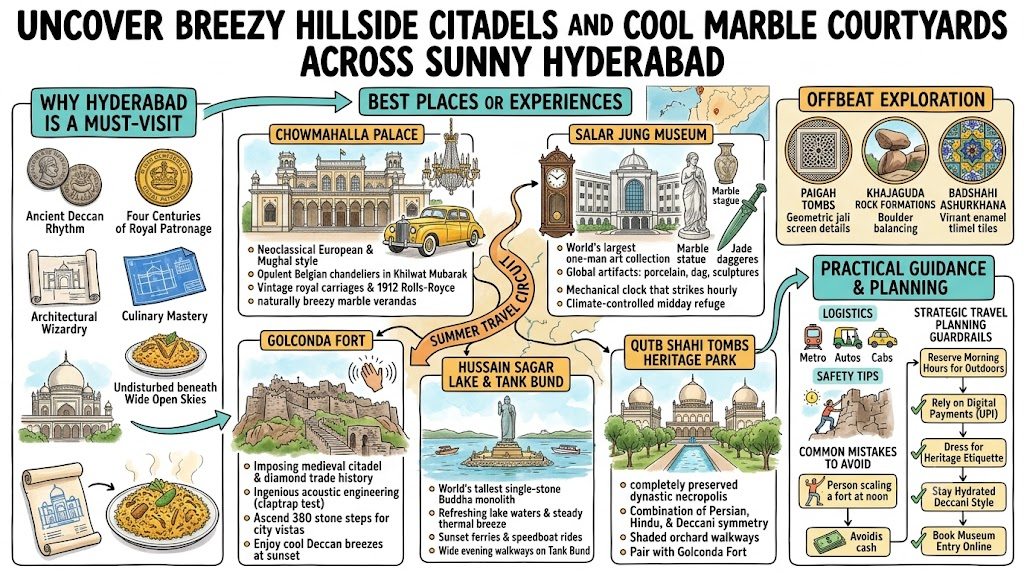
Most peak-season travelers flock blindly to packed hill stations, trading urban traffic jams for overcrowded mountain ridges and inflated resort tabs. Hyderabad offers something fundamentally deeper: an ancient Deccan rhythm where four centuries of royal patronage, architectural wizardry, and culinary mastery thrive undisturbed beneath wide open skies.
Visiting during the warmer months reveals an authentic, unhurried side of the metropolis rarely glimpsed during the winter tourist rush. By planning indoor palace explorations at midday and enjoying balmy lakeside breezes at dusk, you unlock a soulful city rooted in genuine Hyderabadi tehzeeb (refined etiquette).
Charminar glowing at twilight.
Why Hyderabad is a must-visit city
Hyderabad occupies an irreplaceable chapter in global heritage as the epicenter of legendary Golconda diamond wealth and the enduring legacy of the Nizams. Geographically nestled on the Deccan Plateau, the landscape is punctuated by prehistoric granite boulder formations, dramatic medieval ramparts, and sprawling heritage water bodies. Today, seamless multi-lane expressways, the modern Rajiv Gandhi International Airport, three major railway terminals, and an expansive elevated Metro rail make the city effortlessly accessible for solo backpackers, couples, and traveling families alike.
The urban travel circuit divides naturally into two distinct worlds: the atmospheric Old City south of the Musi River, and the breezy, contemporary corridors of Banjara Hills and HITEC City to the northwest. This dynamic contrast allows travelers to pivot seamlessly between serene marble courtyards, climate-controlled museum galleries, and vibrant evening food districts.
| Category | Key Detail |
|---|---|
| Geographic Zone | Deccan Plateau, Telangana, South India |
| Primary Transit Hubs | RGIA Airport (HYD), Secunderabad (SC), Hyderabad Deccan (Nampally) |
| Signature Heritage Style | Qutb Shahi, Asaf Jahi, Indo-Saracenic & European Rococo |
| Culinary Identity | Deccani Biryani, Haleem, Irani Chai & Osmania Biscuits |
| Summer Daylight Rhythm | Crisp mornings (6 AM–10 AM), shaded midday museums, active night bazaars |
Best Places or Experiences
Chowmahalla Palace
Once the seat of the Asaf Jahi dynasty, Chowmahalla Palace served as the grand stage where the Nizams entertained visiting British royalty and international dignitaries. Built over a century, the palace complex synthesizes neoclassical European facades, opulent Mughal domes, and delicate Persian stucco craftsmanship across expansive green courtyards.
The heart of the palace is the Khilwat Mubarak, a regal durbar hall boasting nineteen magnificent Belgian crystal chandeliers suspended beneath soaring ceilings designed to stay naturally cool. Strolling through the sprawling estate reveals pristine vintage royal landaus, an immaculately preserved 1912 yellow Rolls-Royce Silver Ghost, and intimate archival galleries displaying royal porcelain and ceremonial attire.
Chowmahalla Palace courtyard.
- Location: Motigalli, Old City; roughly 15 km south of Secunderabad Junction and 4 km from Hyderabad Deccan Station.
- Why it is worth visiting: Unrivaled Asaf Jahi royal architecture featuring naturally breezy marble verandas and world-renowned vintage carriage galleries.
- Best things to do: Stand beneath the 19 Belgian chandeliers in Khilwat Mubarak, inspect the Nizam’s 1912 Rolls-Royce, and explore the royal clock tower courtyard.
- Best time to visit: Late morning between 10:30 AM and 1:30 PM to escape peak outside heat within the thick-walled galleries.
- Ideal for whom: Architecture admirers, photographers, cultural purists, and families.
- Travel tip: > Photography with professional DSLR gear requires an extra fee at the ticket window; stick to smartphone cameras to avoid hassle and extra charges.
Salar Jung Museum
Perched along the southern banks of the Musi River, Salar Jung Museum houses the world’s largest one-man art collection, compiled largely by Mir Yousuf Ali Khan (Salar Jung III). Spanning 38 expansive indoor galleries across three multi-story wings, this climate-controlled sanctuary provides an enriching midday refuge from the summer sun.
The collection covers centuries of global artistry, from Japanese cloisonné vases and Ming dynasty porcelain to intricate Indian jade daggers owned by Mughal emperors. Its crowning masterpiece is the remarkable 19th-century double-sided wooden sculpture of Mephistopheles and Margaretta, carved with mind-bending precision from a single block of sycamore wood.
Salar Jung Museum complex.
- Location: Dar-ul-Shifa; around 3 km from Charminar and 14 km from HITEC City.
- Why it is worth visiting: An astonishing repository of 43,000 artifacts and 50,000 rare books, presenting an unmatched global cross-section of decorative arts.
- Best things to do: Watch the mechanical musical clock strike on the hour in the central foyer, study the veiled Rebecca marble statue, and examine Aurangzeb’s gem-encrusted jade dagger.
- Best time to visit: Arrive at 11:00 AM and spend the hottest afternoon hours wandering through the cool indoor wings.
- Ideal for whom: History buffs, solo explorers, curious students, and fine-art collectors.
- Travel tip: Wear slip-on walking shoes; exploring the eastern and western wings thoroughly requires walking over 4 kilometers of corridors.
Golconda Fort
Golconda Fort stands as an imposing medieval citadel forged across centuries by the Kakatiya and Qutb Shahi dynasties. Rising dramatically 400 feet above the surrounding rocky plains, its granite outer walls stretch across a fortified 10-kilometer perimeter that withstood epic imperial Mughal sieges.
The fort’s acoustic engineering remains a genuine wonder: a handclap beneath the Fateh Darwaza entrance dome rings out clearly at the Bala Hissar pavilion located nearly a kilometer away atop the hill. While ascending the 380 stone steps in midsummer is strenuous during peak sunlight, late afternoons treat visitors to panoramic city vistas, cooler Deccan breezes, and atmospheric sunset shadows across ruined palace halls.
Golconda Fort ramparts.
- Location: Ibrahim Bagh; situated 11 km west of Hyderabad center and 9 km from Jubilee Hills.
- Why it is worth visiting: Legendary diamond trade history (the source of the Koh-i-Noor and Hope diamonds) combined with ingenious acoustic military defense design.
- Best things to do: Test the acoustic clap trap at Fateh Darwaza, climb to the rooftop Bala Hissar for twilight skyline views, and attend the evening sound and light presentation.
- Best time to visit: 4:30 PM to 6:30 PM when the stone steps cool down and the setting sun bathes the granite ramparts in golden light.
- Ideal for whom: Active trekkers, military history enthusiasts, and sunset photographers.
- Travel tip: Carry an insulated refillable water bottle; there are no vendor stalls once you climb past the middle gateway.
Hussain Sagar Lake & Tank Bund
Commissioned in 1563 by Ibrahim Quli Qutb Shah, Hussain Sagar Lake forms the geographic and emotional heart connecting the twin cities of Hyderabad and Secunderabad. Anchored in the center stands the monolithic 18-meter-tall granite statue of Gautama Buddha, sculpted by skilled temple artisans and erected upon the Gibraltar Rock island.
Even on warm days, the lake basin generates a steady, cooling thermal breeze as evening descends over the city. A brief speedboat transfer delivers you directly to the Buddha island platform, while the newly modernized Tank Bund promenade offers wide walking pathways lined with heritage statues, kinetic lighting, and sweeping water views.
- Location: Tank Bund Road; roughly 6 km north of Charminar and 3 km from Secunderabad Station.
- Why it is worth visiting: The world’s tallest single-stone Buddha monolith set against refreshing open lake waters and wide evening walkways.
- Best things to do: Board a sunset ferry from Lumbini Park out to the Buddha platform, stroll the pedestrian-friendly Tank Bund boulevard, and enjoy fresh roasted spiced corn along the water.
- Best time to visit: 5:30 PM to 8:30 PM to enjoy the cooler evening air and illuminated lakeside skyline.
- Ideal for whom: Couples, families with young children, and evening strollers.
- Travel tip: Board the mechanized speedboats rather than large passenger ferries if you prefer skipping long waiting lines at the jetty.
The Qutb Shahi Tombs Heritage Park
Nestled in the shadow of Golconda’s outer battlements, the Qutb Shahi Tombs complex represents the final resting grounds of seven Sultanate monarchs. Each mausoleum features a square base crowned by a domed superstructure, combining Persian squinches, Hindu pillar carvings, and Deccani geometric symmetry.
The tombs sit within the Ibrahim Bagh heritage park, recently revitalized with lush sunken gardens, restored water channels, and tranquil walking avenues. These shaded orchard walkways offer a serene escape from traffic noise, where towering domed chambers stay naturally cool throughout the midday hours.
- Location: Fort Road, Tolichowki; approximately 1.5 km north of Golconda Fort gate.
- Why it is worth visiting: One of India’s most completely preserved dynastic necropolises, set within manicured Persian-style Charbagh gardens.
- Best things to do: Admire the delicate blue-green tile remnants on Sultan Muhammad Quli Qutb Shah’s tomb, explore the restored hamam (royal bathhouse), and photograph geometric arches.
- Best time to visit: Early morning between 8:00 AM and 10:30 AM when birds gather across the garden fountains.
- Ideal for whom: Solitude seekers, heritage architecture buffs, and sketchbook artists.
- Travel tip: > Pair this site directly with Golconda Fort in the morning to save commuting across cross-city traffic later in the day.
Offbeat Exploration: Hidden Gems Tourists Miss
Paigah Tombs
Tucked deep inside the residential lanes of Pisalbanda, the Paigah Tombs hold the remains of the noble Paigah aristocracy, who were fierce dynastic allies and relatives to the Nizams. Constructed with lime plaster and inlaid marble, the mausoleums feature intricately carved geometric jali (lattice screens) that filter sunlight into lace-like shadow patterns. The peaceful courtyards remain delightfully uncrowded, offering an intimate glimpse of Deccani craftsmanship free from large tour groups.
Khajaguda Rock Formations
Perched on the edge of the western financial district, the Khajaguda Hills feature 2.5-billion-year-old natural granite formations, balancing boulders, and hidden cavern pockets. It serves as an open-air haven for local bouldering communities and early risers. Climbing atop the smooth boulders at dawn offers panoramic views of modern high-rises emerging from morning mists beside the historic Dargah of Shah Khaja Rasheeduddin Aulia.
Badshahi Ashurkhana
Situated a short walk north of the Charminar, this 1594-CE royal mourning hall was commissioned by Muhammad Quli Qutb Shah. Its interior walls are adorned with brilliantly colored Persian enamel tiles that retain their vibrant lapis lazuli, turquoise, and amber glazes after four centuries. Because most visitors rush past toward the bazaars, this quiet sanctuary remains one of the city’s best-kept secrets.
Detailed Practical Guidance for Travelers
| Destination | Standard Entry Fee | General Timings | Best Local Food Options Nearby | Recommended Nearby Attractions |
|---|---|---|---|---|
| Chowmahalla Palace | ₹100 (Indians), ₹400 (Foreigners) | 10:00 AM – 5:00 PM (Closed Fridays) | Shadab Hotel (Biryani), Nimrah Cafe (Irani Chai) | Charminar, Laad Bazaar, Mecca Masjid |
| Salar Jung Museum | ₹50 (Indians), ₹500 (Foreigners) | 10:00 AM – 5:00 PM (Closed Fridays) | Nayab Hotel (Bheja Fry, Paya, Khichdi) | Badshahi Ashurkhana, State Central Library |
| Golconda Fort | ₹25 (Cashless/UPI), ₹300 (Foreigners) | 9:00 AM – 5:30 PM (Daily) | Chicha’s (Tala Hua Gosht), Pista House | Qutb Shahi Tombs, Taramati Baradari |
| Hussain Sagar / Tank Bund | Free (Park entry ₹20, Boat ₹100–₹400) | 8:00 AM – 10:00 PM (Daily) | Paradise Circle (Biryani), Minerva Coffee Shop | Birla Mandir, Lumbini Park, NTR Gardens |
| Qutb Shahi Tombs | ₹40 (Adults), ₹100 (Foreigners) | 9:30 AM – 5:30 PM (Daily) | Shah Ghouse Tolichowki (Shawarma & Biryani) | Golconda Fort, Khajaguda Hills |
| Paigah Tombs | Free (Donations appreciated) | 10:00 AM – 4:30 PM (Closed Fridays) | Subhan Bakery (Osmania Biscuits), Rumaan Restaurant | Raymond’s Tomb, Falaknuma Palace viewpoint |
Logistics & On-Ground Navigation
Local Transport Options
- Hyderabad Metro Rail: Clean, air-conditioned, and efficient, the Metro connects Miyapur to LB Nagar (Red Line) and Nagole to Raidurg (Blue Line), offering an ideal escape from midday street traffic.
- Auto-Rickshaws: Abundant across every corner; always insist on the fare meter or agree firmly upon a negotiated price before getting in.
- App-Based Cabs & Autos: Uber, Ola, and Rapido operate reliably throughout the city and eliminate fare negotiations, especially during peak commute hours.
- Self-Drive & City Cabs: Pre-booking an air-conditioned cab for an 8-hour/80-kilometer charter is the most comfortable way to manage cross-city sightseeing.
Budget Planning
- Backpacker / Budget Tier: Budget ₹1,200 to ₹1,800 per day. This comfortably covers dormitory stays in Banjara Hills or Abids, public transit via Metro and TSRTC buses, street food, and standard monument admissions.
- Mid-Range / Comfort Tier: Budget ₹3,500 to ₹6,500 per day. This covers boutique hotel accommodations, air-conditioned app cabs, sit-down dinners at legacy restaurants, and guided heritage walks.
Safety and Inclusivity Tips
- For Families: The wide, shaded lawns of Chowmahalla Palace and the interactive halls of Birla Science Museum are stroller-friendly and safe for kids.
- For Couples: Evening boat rides across Hussain Sagar and sunset strolls around Golconda’s upper battlements offer relaxed, safe settings.
- General Safety: Keep valuables secured when navigating crowded lanes around Charminar, and drink only bottled or filtered water from verified eateries.
Strategic Travel Planning Guardrails
Travel Planning Tips for Hyderabad
- Reserve Morning Hours for Outdoors: Schedule outdoor hill climbs and fortress explorations between 7:00 AM and 10:00 AM before surface stones heat up.
- Rely on Digital Payments: Almost every vendor—from fruit juice carts to monument counters—prefers seamless UPI payments (Google Pay, PhonePe); keep a small cash reserve (₹500 in small bills) for remote corners.
- Dress for Heritage Etiquette: Wear breathable cotton garments that cover shoulders and knees when touring active religious sites like Mecca Masjid.
- Stay Hydrated Deccani Style: Beat the afternoon dry heat with fresh tender coconut water (nariyal pani) and cooling sweetened buttermilk (majjiga) available at roadside kiosks.
- Book Museum Entry Online: Use official government ticket portals or scan on-site QR codes to bypass long ticket-booth queues in the midday sun.
Common Mistakes to Avoid
- Scaling Golconda at Noon: Attempting the 380 exposed granite stairs of Golconda Fort between noon and 3 PM leads quickly to exhaustion; save it for late afternoon.
- Skipping Midday Gallery Sanctuaries: Wandering open street markets during the peak heat instead of taking shelter inside the cool halls of Salar Jung Museum.
- Relying Solely on Cash: Assuming ticket counters have change for large 500-rupee notes; digital UPI QR codes are faster everywhere.
- Ignoring Old City Distances: Underestimating transit times between modern Cyberabad (HITEC City) and the Old City during weekday evening rush hours.
- Passing on Irani Chai Breaks: Skipping quick rest stops at heritage cafes for sweet Irani chai and salty Osmania biscuits, which provide an ideal pick-me-up.
Suggested Itinerary Blueprints
1. Day Quick Dash (The Heritage Express)
Target Audience: Time-pressed business travelers and transit visitors seeking the essential highlights.
Begin at 8:30 AM with early morning street photography around the Charminar before crowds arrive, sipping Irani chai at Nimrah Cafe. At 10:00 AM, walk 500 meters to explore the royal courtyards of Chowmahalla Palace. By 1:00 PM, retreat into the air-conditioned dining room of Shadab for a traditional mutton dum biryani lunch. Finish your afternoon from 2:30 PM to 5:00 PM browsing the treasures inside the Salar Jung Museum, wrapping up with a relaxed sunset drive along the Tank Bund waterfront.
2. Day Deep-Dive (Old World Charm to Modern Skyline)
Target Audience: Weekend explorers who want to balance historic dynasties with contemporary culture.
- Day 1: Imperial Roots: Spend your morning exploring the monumental Golconda Fort and the neighboring Qutb Shahi Tombs. Head into the Old City for lunch at Hotel Nayab, followed by a shaded afternoon exploring Chowmahalla Palace and an evening shopping for lac bangles along Laad Bazaar.
- Day 2: Art, Parks & Lakeside Skyline: Start with a 7:30 AM boulder walk through Khajaguda Hills. By 10:30 AM, browse the modern exhibits at the State Gallery of Art in Madhapur. Enjoy a relaxed lunch at a boutique café in Jubilee Hills, explore the calm marble halls of Birla Mandir in the late afternoon, and finish with a sunset speedboat cruise on Hussain Sagar Lake.
3. Complete Weekend Travel Plan (The Grand Deccani Loop)
Target Audience: Travelers looking for an immersive three-day exploration of culture, food, and architecture.
- Friday: Arrive and settle into your hotel. Spend your late afternoon wandering through the historic Badshahi Ashurkhana, followed by a sunset walk on Tank Bund and an authentic Deccani dinner at Jewel of Nizam.
- Saturday: Dedicate your morning (8:00 AM to 12:30 PM) to exploring Golconda Fort and the revitalized Qutb Shahi Tombs park. Head indoors for an unhurried, late lunch at Chicha’s in Lakdikapul, then spend your evening enjoying city views from the hilltop Birla Mandir before dinner in Banjara Hills.
- Sunday: Dive into the treasures of Salar Jung Museum starting at 10:00 AM. Stroll through the lace-like stone screens of the Paigah Tombs by 2:30 PM, then end your trip with an evening tea and heritage walk around the illuminated Charminar arches.
Common Tourist Mistakes to Avoid
Geographic Blunders
A frequent logistical slip is booking a morning tour at Golconda Fort in the west, scheduling a 1:00 PM lunch in distant Secunderabad to the north, and trying to return to the Old City by 3:30 PM. Hyderabad spans a large metropolitan footprint; bunch your itinerary geographically into the Old City cluster, the Central Lake cluster, and the Western Hilly/HITEC cluster to avoid losing hours to traffic.
Commercial Traps
Many first-time visitors spend entire afternoons trapped in generic, glass-paneled shopping malls in Somajiguda or Kondapur purchasing mass-produced crafts. Head instead to the centuries-old alleys of Laad Bazaar for authentic hand-crafted stone bangles, or source handwoven Pochampally Ikats directly from government-certified weavers’ emporiums.
Neglecting Modern Alternative Zones
Focusing exclusively on Mughal-era relics often means missing Hyderabad’s vibrant modern renaissance. Neighborhoods like Jubilee Hills (Road No. 10 & 36) and Banjara Hills host contemporary art spaces, tranquil public parks, homegrown specialty coffee roasters, and serene artisan courtyards tucked into leafy residential lanes.
Transport Overpayment
Hailing unmetered auto-rickshaws directly outside the gates of major tourist monuments often leads to inflated fares. Instead, walk 100 meters away from monument exits and use ride-hailing apps like Uber, Ola, or Rapido to lock in transparent, metered fares.
Luxury Dining Bias
While five-star palace hotels serve polished royal buffets, insulating yourself from street-level culinary vendors deprives you of the city’s true soul. The real culinary magic happens over steaming cauldrons of dum biryani at local institutions like Shadab, crisp dosa varieties at Ram Ki Bandi at 3:00 AM, and frothy cups of Zafrani chai at neighborhood corner joints.
Frequently Asked Questions
1. Is Hyderabad pleasant to explore during the summer months?
Yes, provided you adapt your schedule to the local climate. Days feature dry, sunny weather that is easy to navigate by reserving outdoor activities for breezy mornings and late evenings. The hottest midday hours (12:00 PM to 4:00 PM) are best spent inside expansive, climate-controlled sanctuaries like the Salar Jung Museum, Chowmahalla Palace, and lively cafes.
2. How do I travel smoothly between the Old City and modern HITEC City?
The most reliable option is the Hyderabad Metro Rail. Board the Blue Line at Raidurg or HITEC City, transfer smoothly to the Red Line at Ameerpet interchange, and alight at MGBS Station. This lets you bypass notorious road congestion at peak hours and reach the Old City’s historic sites in under 45 minutes.
3. What are the strict visiting rules and dress codes for Mecca Masjid?
Mecca Masjid welcomes all respectful visitors outside designated prayer congregations. Both men and women should wear modest attire covering shoulders and knees; women are required to drape a scarf over their heads. Shoes must be deposited with the entrance caretakers for a nominal tip before stepping onto the cool stone courtyard.
4. Where can I find genuine Hyderabadi pearl jewelry without getting scammed?
Avoid purchasing pearls from informal sidewalk touts around monument gates. Instead, visit long-standing, reputed jewelers clustered along the Patthergatti market boulevard or established showrooms like Mangatrai and Jagdamba. Always request a formal authenticity certificate specifying whether the pearls are freshwater, cultured, or natural sea gems.
5. How much time should I set aside to visit Golconda Fort properly?
Plan for at least 2.5 to 3 hours to do the fort justice. This provides ample time to test the acoustics at Fateh Darwaza, walk the royal residential quarters, and climb the stone stairs up to the Bala Hissar pavilion without rushing. Hiring an official, certified guide at the entrance gate brings the fortress’s hidden military engineering to life.
6. Which authentic dishes must I sample beyond traditional Hyderabadi Biryani?
Do not miss Mirchi ka Salan (spiced chili-peanut gravy), Tala Hua Gosht (crispy spiced fried mutton paired with soft rumali roti), Khatti Dal, Bheja Fry, and Double ka Meetha (rich saffron bread pudding). Finish breakfast runs with a plate of button idlis submerged in sambar alongside a piping hot glass of filter coffee.
7. Are digital wallet payments widely accepted by street vendors across Hyderabad?
Digital payments are universal across the city. Almost all street-side chai cafes, juice stalls, bangle artisans, and auto drivers display standard UPI QR codes (supporting PhonePe, Google Pay, and Paytm). Still, keeping ₹300 to ₹500 in smaller cash currency is sensible for occasional remote network blackouts.
8. What makes Salar Jung Museum an ideal spot during the summer?
The museum houses 38 vast, naturally insulated and air-conditioned galleries spread across three large multi-level buildings. It offers a cool, comfortable refuge during peak midday heat, with clean amenities, resting benches, cafeteria facilities, and hours of engaging historical exhibits to explore out of the direct sun.
9. Can I easily take photographs inside Chowmahalla Palace?
Yes, casual smartphone photography is welcomed throughout the courtyards and exhibition halls. If you bring professional equipment like DSLRs, mirrorless bodies, or tripods, you will need to purchase an explicit camera permit at the entrance ticket counter. Commercial video shoots require advance written permissions from palace administrators.
10. What is the smartest way to tour the Qutb Shahi Tombs and Golconda Fort together?
Because the two heritage complexes sit just 1.5 kilometers apart, pair them together on the same morning. Tour the tombs between 8:30 AM and 10:30 AM while the surrounding gardens are peaceful, head into an air-conditioned local restaurant for lunch, and then explore Golconda Fort around 4:00 PM for sunset.
11. Is Hyderabad a safe travel destination for solo women travelers?
Hyderabad is widely considered one of India’s safest and most welcoming metropolitan centers. Women traveling solo find the city easy to navigate using the metro rail (which offers dedicated women’s coaches) and app-based cabs. Standard urban precautions apply: avoid poorly lit alleys late at night and choose vetted accommodations in central districts.
12. Why is Irani Chai culturally unique to Hyderabad?
Introduced by Zoroastrian Persian immigrants in the early 20th century, Hyderabadi Irani Chai is prepared differently from regular household chai. Black tea decoction brews continuously in a sealed copper samovar while milk simmers separately for hours until thick and creamy. They are combined directly in the cup, yielding a rich, silky beverage traditionally enjoyed with Osmania biscuits.
Conclusion
Choosing Hyderabad over well-trodden, crowded holiday destinations rewards the traveler with a living encounter across centuries of royal refinement. From the cool marble verandas of historic palaces and the awe-inspiring acoustic gates of ancient forts to lively night markets perfumed with roasting spices, the city welcomes you with genuine, open-hearted warmth. It is a journey that nourishes your cultural curiosity and satisfies your culinary soul long after your bags are unpacked.
