Introduction
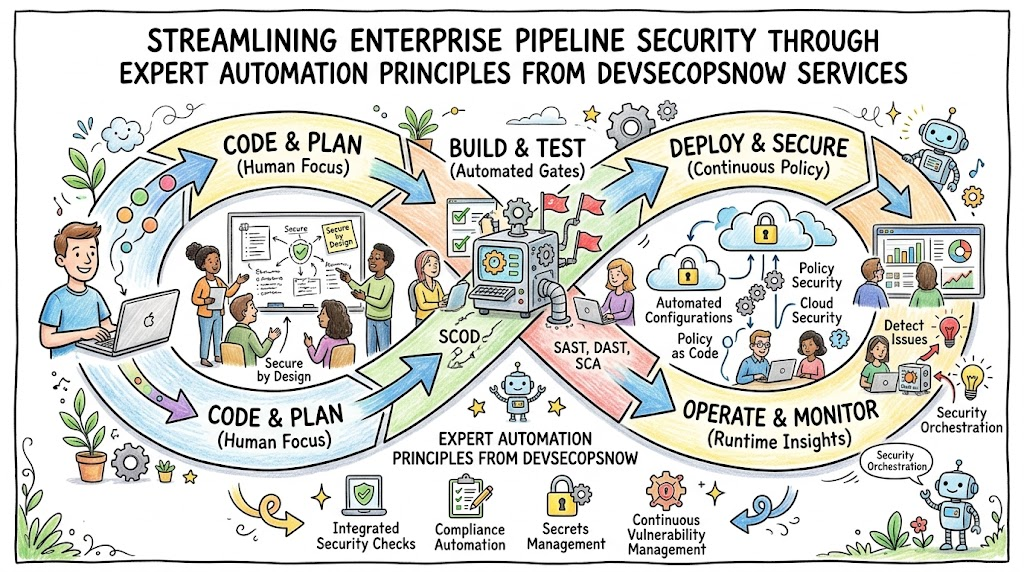
Modern software engineering organizations rely heavily on rapid development cycles to maintain competitive advantages in rapidly shifting markets. As enterprise teams adopt cloud environments, containers, Kubernetes, microservices, APIs, open-source libraries, and automated CI/CD pipelines, system complexity grows exponentially. Traditional end-stage security testing—where security teams evaluate applications right before production releases—creates severe release bottlenecks, delays features, and frequently misses deep architecture vulnerabilities. DevSecOps resolves this structural conflict by systematically integrating security engineering, policy controls, and continuous compliance checks throughout every stage of the software development lifecycle. By shifting security practices left and automating guardrails, organizations achieve rapid release velocity alongside resilient security postures. This guide explores core engineering principles, security architecture, infrastructure controls, container safety, supply chain security, and strategic execution models required for building modern, secure application environments with DevSecOpsNow.
Understanding DevSecOps
DevSecOps represents a fundamental evolution in software engineering that unifies software development, security engineering, and IT operations into a single continuous delivery framework. Rather than treating security as an isolated oversight function, DevSecOps establishes shared responsibility across all engineering teams, embedding security controls directly into day-to-day development workflows. Security checks shift left into code commits, pull requests, and automated pipeline builds, ensuring continuous security feedback without manual gates slowing down engineers. Key security activities include static application security testing (SAST) for source code analysis, dynamic application security testing (DAST) for running applications, and software composition analysis (SCA) for open-source risk evaluation. Additionally, teams implement automated secrets scanning, Infrastructure as Code (IaC) verification, container image scanning, Software Bill of Materials (SBOM) generation, policy-as-code enforcement, and continuous runtime monitoring across cloud workloads.
Why Organizations Are Adopting DevSecOps
Modern application architectures rely heavily on decentralized tooling and cloud-native infrastructure, combining version control platforms like Git with continuous integration engines like GitHub Actions, GitLab CI, or Jenkins. Engineering teams deploy containerized workloads managed by Docker and Kubernetes, provision infrastructure dynamically through Terraform, and host microservices across AWS, Azure, and Google Cloud while pulling dependencies from open-source registries. This high level of automation and architectural complexity makes manual security audits virtually impossible to execute at scale. Organizations adopt DevSecOps to achieve early vulnerability detection during initial code commit stages, significantly lowering remediation costs and efforts. Automated security testing improves cross-team collaboration, reduces friction between developers and security teams, increases infrastructure-wide compliance visibility, and enables rapid response times when patch management or vulnerability remediation becomes necessary.
DevSecOps Consulting Services
Navigating the transition toward a mature security posture requires strategic vision, technical expertise, and tailored engineering frameworks. Engaging specialized DevSecOps Consulting Services helps organizations evaluate their current development environments, inspect existing CI/CD pipelines, and design resilient security architectures aligned with business goals. Professional consultants analyze existing workflows, recommend optimal toolchains, evaluate cloud security posture, and structure robust Kubernetes protection mechanisms while establishing security governance and regulatory compliance frameworks. Consultants build an actionable, step-by-step transformation roadmap that balances developer velocity with stringent risk mitigation controls. Organizations typically seek consulting expertise when scaling engineering operations, transitioning to cloud-native paradigms, responding to complex compliance audits, or seeking to eliminate persistent security friction between development and security teams.
DevSecOps Implementation Services
Moving from security strategy to execution requires integrating automated controls directly into the developer workflow. DevSecOps Implementation Services transform architectural plans into concrete pipeline integrations, automated policies, and resilient operational guardrails across the entire software delivery lifecycle.
Static Application Security Testing – SAST
Static Application Security Testing (SAST) analyzes application source code, binaries, and bytecodes for security flaws without executing the software itself. By embedding SAST tools into Git repositories and pull request checks, engineers identify common coding vulnerabilities such as SQL injections, cross-site scripting (XSS), buffer overflows, and improper input validations early in development. Early identification ensures developers receive immediate remediation advice directly within their primary integrated development environment, preventing vulnerable code from ever reaching shared branch repositories or production build environments.
Dynamic Application Security Testing – DAST
Dynamic Application Security Testing (DAST) evaluates running applications from an outside-in perspective, simulating real-world external attack vectors against staging or testing environments. DAST tools analyze application behavior, testing for authentication bugs, session management issues, broken access controls, server misconfigurations, and complex injection vulnerabilities that static analysis cannot observe. Running automated DAST checks within automated deployment workflows ensures that API endpoints, web applications, and live service configurations remain secure against common web vulnerabilities before production traffic reaches them.
Software Composition Analysis – SCA
Modern applications consist heavily of third-party open-source libraries, packages, and public dependencies, making open-source risk management critical for enterprise security. Software Composition Analysis (SCA) automatically scans project dependency manifests to identify known security vulnerabilities, outdated packages, unmaintained libraries, and restrictive open-source license compliance risks. By tracking both direct and transitive dependencies across development builds, SCA tools prevent supply chain attacks, generate alerts when zero-day vulnerabilities emerge, and provide targeted upgrade guidance to keep application software stacks secure.
Secrets Scanning
Hardcoded credentials, API tokens, cloud access keys, database passwords, and private SSH keys committed into version control systems represent one of the primary breach vectors in enterprise IT. Automated secrets scanning tools monitor commit histories, code revisions, configuration files, and pull requests to detect exposed sensitive parameters before code reaches central repositories. Implementing real-time developer pre-commit hooks along with automated pipeline secret scanners prevents credential leakage, enables automated secret revocation workflows, and ensures overall cloud infrastructure access control.
Infrastructure as Code Security
Infrastructure as Code (IaC) templates constructed in Terraform, CloudFormation, ARM, or Bicep allow engineering teams to provision cloud resources dynamically, but misconfigurations can expose entire networks. IaC security tools scan infrastructure code prior to deployment, flagging permissive security groups, unencrypted storage buckets, public network exposures, and missing access control policies. Automating IaC security validation within CI/CD pipelines guarantees that cloud environments meet organizational compliance standards and security baselines before actual physical resources are created or modified.
Container Security
Containerization accelerates application deployment, yet unvetted container images present significant security risks, including unpatched operating system libraries and embedded vulnerabilities. Container security encompasses base image scanning, registry scanning, digital image signing, and runtime container isolation checks. By integrating automated container vulnerability scanners into image registries and build steps, teams ensure that only verified, minimal, and secure container images are deployed into orchestration systems, effectively reducing the overall runtime attack surface.
Kubernetes Security
Managing containerized workloads at scale requires specialized controls across cluster access, networking, and runtime environments. Utilizing Kubernetes Security Consulting Services allows enterprises to harden container orchestration platforms, resolve security misconfigurations, and enforce strict governance policies across production deployments.
Role-Based Access Control
Role-Based Access Control (RBAC) dictates user and service account permissions within a Kubernetes cluster, enforcing the principle of least privilege across all operations. Misconfigured RBAC bindings can allow compromised pods or unauthorized accounts to gain cluster-admin privileges, exposing the host infrastructure. Hardening RBAC involves scoping service accounts, restricting cluster-wide admin roles, auditing API server access logs, and periodically pruning unused namespace permissions to minimize potential privilege escalation pathways.
Network Policies
By default, Kubernetes allows open, unsegmented network communication between all pods across all cluster namespaces, creating internal exposure if a single workload is breached. Implementing Kubernetes Network Policies establishes micro-segmentation controls that define explicit ingress and egress traffic rules for workloads based on labels and namespaces. Restricting pod-to-pod communication ensures that compromised application pods cannot scan internal cluster networks, access unauthorized databases, or communicate with rogue external command-and-control servers.
Admission Controls
Admission controllers act as gatekeepers for the Kubernetes API server, validating, mutating, and intercepting deployment requests before objects are persisted into cluster state. Utilizing policy engines like Open Policy Agent (OPA) Gatekeeper or Kyverno allows security teams to enforce operational guardrails automatically across all incoming workloads. Admission controls enforce policies such as preventing root execution, mandating resource limits, restricting unapproved image registries, and requiring mandatory deployment metadata tagging.
Secrets Management
Kubernetes stores native secrets as base64-encoded strings within its etcd datastore, which does not provide true encryption at rest by default. Secure secrets management involves enabling envelope encryption for etcd, restricting secret access via fine-grained RBAC, and integrating external enterprise secret stores like HashiCorp Vault or cloud key management services. Injecting secrets dynamically into running pods via memory-backed volumes avoids storing sensitive credentials in persistent storage or container environment variables.
Container Image Security
Securing images within Kubernetes requires strict verification processes that guarantee image provenance, integrity, and safety before execution occurs on cluster nodes. Organizations implement automated image signing using digital signature tools like Cosign, paired with admission controllers that reject unsigned or unverified images. Restricting image pulls exclusively to trusted private registries, running daily vulnerability scans on stored registry images, and banning generic tags ensures consistent, immutable, and secure container deployments.
Kubernetes Configuration Security
Kubernetes manifest configurations directly govern node security, capability grants, file system privileges, and host network exposures for running applications. Hardening cluster configurations involves enforcing strict Security Contexts, disabling container privilege escalation, mounting root filesystems as read-only, and dropping unnecessary Linux kernel capabilities. Automating manifest scanning during pipeline integration ensures that misconfigured deployment files are rejected long before they are applied to production cluster environments.
Runtime Security
Runtime security provides continuous real-time monitoring of active container processes, system calls, network sockets, and file modifications within running Kubernetes pods. Advanced runtime security tools leverage extended Berkeley Packet Filters (eBPF) to detect anomalous behaviors, unexpected shell executions, unauthorized privilege escalations, or malicious file accesses as they occur. Immediate runtime visibility allows security teams to automatically isolate compromised pods, terminate malicious processes, and gather forensic data for incident response analysis.
Cluster Access Management
Securing administrative access to the Kubernetes control plane is critical for preventing unauthorized cluster takeover and infrastructure tampering. Implementing strong access management involves disabling public API server endpoints, mandating multi-factor authentication via single sign-on (SSO) identity providers, and enforcing short-lived session tokens. Additionally, security teams must audit API server audit logs in real time, apply node authorization controls, and restrict direct SSH access to underlying worker and control plane instances.
Cloud Security
Securing multi-cloud environments demands uniform identity structures, robust encryption protocols, continuous compliance tracking, and automated configuration management. Partnering with professional Cloud Security Consulting Services ensures that organizations maintain hardened cloud configurations across public, private, and hybrid enterprise clouds.
Identity and Access Management
Identity and Access Management (IAM) forms the primary security perimeter within modern cloud platforms, governing user authentication, service access, and resource authorization. Implementing robust IAM requires enforcing the principle of least privilege, eliminating permanent admin credentials, utilizing temporary security tokens, and mandating multi-factor authentication (MFA) across all identity accounts. Regular access reviews, role-based separation of duties, and automated policy analyzers help prevent policy drift and overly permissive access assignments.
Cloud Network Security
Cloud network security relies on logical isolation, virtual private clouds (VPCs), segmented subnets, and tightly configured security groups to safeguard cloud resources. Implementing zero-trust network architectures requires restricting public IP exposure, utilizing private service endpoints, deploying web application firewalls (WAF), and inspecting transit traffic using virtual appliance firewalls. Continuous network flow log monitoring enables real-time threat detection, identifying unauthorized port scans or abnormal data egress patterns immediately.
Cloud Configuration Security
Cloud misconfigurations—such as unencrypted storage buckets, open database ports, and publicly accessible snapshots—remain a leading cause of enterprise cloud security breaches. Configuration security involves applying hardened baseline benchmarks, enforcing organizational policy guardrails, and tracking resource changes continuously across cloud accounts. Automated configuration drift detection alerts engineering teams when manual changes violate security standards, enabling rapid auto-remediation before vulnerabilities can be exploited.
Encryption
Protecting data integrity and confidentiality across cloud platforms requires pervasive encryption implementation across data-at-rest and data-in-transit states. Encryption at rest safeguards databases, object storage, block volumes, and backups using cryptographically secure key management systems (KMS) with automated key rotation policies. Encryption in transit ensures that all internal and external network communication is enforced using modern TLS protocols, preventing data interception or tampering across cloud networks.
Logging and Monitoring
Comprehensive cloud log collection provides necessary visibility for threat detection, operational troubleshooting, audit compliance, and incident forensics. Centralizing cloud control plane logs, network flow records, database access logs, and application events into a security information and event management (SIEM) system ensures real-time visibility. Automated log analysis paired with threat intelligence feeds allows security teams to identify suspicious authentication attempts, unauthorized policy changes, and potential security incidents rapidly.
Infrastructure as Code Security
Extending security checks into cloud infrastructure templates guarantees that security requirements are satisfied prior to resource provisioning. IaC security scanning tools analyze code definitions for misconfigurations, weak encryption settings, insecure network mappings, and missing compliance tags. Integrating these automated checks into version control merge requests prevents non-compliant infrastructure changes from being executed, reducing cloud security risk through proactive prevention.
Workload Security
Cloud workload security protects serverless functions, virtual machines, containerized services, and database instances running across public cloud providers. Implementing workload security involves installing lightweight agent security sensors, applying automated OS patch management, establishing host firewalls, and enforcing strict application whitelisting. Continuous vulnerability management combined with runtime process monitoring safeguards computing workloads against malware execution, remote code execution, and lateral movement attacks.
Cloud Security Posture Management
Cloud Security Posture Management (CSPM) tools continuously monitor multi-cloud environments to identify security risks, configuration drifts, and regulatory non-compliance issues automatically. CSPM solutions benchmark cloud configurations against industry security standards like CIS, NIST, ISO 27001, and PCI-DSS, providing centralized compliance dashboards and risk scoring. Automated remediation workflows enable teams to fix identified compliance gaps instantly, ensuring continuous security posture alignment across expanding cloud footprints.
Software Supply Chain Security
Modern application pipelines handle software assembly from multiple external sources, creating significant risk if upstream dependencies, build tools, or artifact repositories are compromised. Leveraging comprehensive Software Supply Chain Security Services allows organizations to systematically verify dependency integrity, harden CI/CD infrastructure, secure package registries, enforce cryptographic code signing, and maintain immutable artifact provenance throughout the software lifecycle.
Software supply chain protection requires securing every link in the software delivery process, starting from external open-source dependency ingestion down to final production deployment. Build environments must be strictly isolated, preventing rogue scripts from tampering with compiled binaries or injecting malicious code into build outputs. Enforcing cryptographic checksum verification, code signing, and container image attestation ensures that code running in production matches the exact source code verified and approved during development testing.
Understanding Software Bill of Materials
A Software Bill of Materials (SBOM) is a nested inventory listing all software components, third-party libraries, modules, licenses, and dependencies that constitute an application build. Adopting SBOM practices provides complete visibility into software component supply chains, enabling organizations to rapidly search, identify, and address newly discovered vulnerabilities across their entire application ecosystem.
When zero-day vulnerabilities emerge in widespread open-source packages, having an accessible, machine-readable SBOM allows security teams to query their software portfolio instantly rather than spending days manually inspecting individual codebases. Beyond vulnerability management, SBOMs support software license compliance audits and fulfill regulatory requirements mandated for modern enterprise software procurement and government software delivery
CI/CD Pipeline Security
Continuous Integration and Continuous Deployment (CI/CD) pipelines serve as the central execution engines for enterprise software delivery, making them high-value targets for malicious actors. Securing CI/CD infrastructure requires applying strict identity authentication, enforcing branch protection rules, isolating build runners, and encrypting stored pipeline secrets. Implementing automated security scanners within pipeline steps guarantees that unvetted code, insecure dependencies, or non-compliant infrastructure definitions cannot bypass security controls or reach target production environments.
Pipeline access must be restricted through least-privilege role assignments, while pipeline configuration files themselves should remain immutable and subject to mandatory peer code reviews. Dedicated ephemeral build runners should be destroyed and recreated after each job execution to prevent persistent malware contamination across pipeline runs. Detailed audit logging of pipeline executions, manual release approval workflows, and automated artifact signature checks guarantee complete accountability and verification from initial commit down to live system deployment.
Policy-as-Code
Policy-as-code enables engineering teams to define, automate, manage, and enforce security guardrails using machine-readable configuration files stored directly within version control systems. By expressing compliance requirements as executable code using frameworks like Open Policy Agent (OPA) or Kyverno, security rules are evaluated automatically during code development, pipeline testing, and cluster admission phases.
- Container Execution Controls: Restrict containers from executing with root permissions or acquiring elevated host kernel capabilities.
- Cloud Storage Security: Enforce mandatory server-side encryption and block public read access across all cloud storage buckets automatically.
- Trusted Registry Mandates: Mandate that container deployments pull images exclusively from approved enterprise registries with verified digital signatures.
- Kubernetes Operational Safety: Require that all Kubernetes pod specifications define explicit memory and CPU resource limits alongside readiness probes.
- Network Segmentation Enforcement: Reject infrastructure provisioning requests that define permissive ingress network rules or open sensitive management ports publicly.
Automating policy enforcement eliminates manual security reviews, prevents human configuration errors, establishes audit-ready compliance tracking, and delivers consistent security governance across multi-cloud and containerized environments.
DevSecOps Assessment
Evaluating organizational security maturity requires a comprehensive analysis of existing tools, delivery processes, architectural designs, and team culture. Engaging professional DevSecOps Assessment Services provides engineering leaders with an objective evaluation of their software delivery pipeline security, cloud configurations, container environments, and governance models.
A structured assessment inspects application security testing coverage, secrets management practices, dependency tracking, vulnerability remediation workflows, and developer security awareness. The output provides a detailed maturity gap analysis paired with an actionable, risk-prioritized transformation roadmap that helps organizations systematically address security vulnerabilities while optimizing overall delivery velocity.
DevSecOps Maturity Model
Achieving DevSecOps excellence is an incremental process that evolves from reactive manual security audits toward fully automated, continuous engineering capabilities. Evaluating maturity across key dimensions—people, process, technology, automation, governance, and cross-team collaboration—helps organizations chart their transformational progress effectively.
| Maturity Level | Core Characteristics & Capabilities | Primary Operational Focus |
| Level 1: Initial | Manual security reviews, ad-hoc testing, security operating in silos, late-stage security testing causing deployment delays. | Reacting to high-priority security findings late in the release cycle. |
| Level 2: Developing | Basic automated scanning implemented (SAST/SCA), initial developer security awareness, security integrated into primary Git workflows. | Establishing initial automated pipeline checks and developer visibility. |
| Level 3: Integrated | Security testing embedded into CI/CD pipelines, automated secrets scanning, IaC security checks active, structured vulnerability triage. | Eliminating common code vulnerabilities automatically during build stages. |
| Level 4: Automated | Policy-as-code enforcement active, container/Kubernetes security scanning automated, SBOM generation, risk-based vulnerability prioritization. | Scaling automated security controls across all application environments. |
| Level 5: Optimized | Continuous runtime monitoring, automated threat response, real-time security metrics, strong security culture with continuous learning. | Maintaining continuous security alignment, optimization, and resilient delivery. |
Advancing along the maturity curve requires continuous alignment between engineering velocity and automated security guardrails, ensuring security scale matches organizational growth.
Vulnerability Management
Vulnerability management is a continuous lifecycle process that extends beyond simple security scanning to encompass systematic risk identification, prioritization, remediation, and verification across the enterprise software ecosystem.
- Discovery: Automated scanning tools continuously detect flaws across source code, third-party libraries, container images, IaC scripts, and cloud workloads.
- Classification: Findings are categorized based on vulnerability type, affected system components, and associated Common Vulnerabilities and Exposures (CVE) parameters.
- Risk Prioritization: Security issues are evaluated using CVSS severity scores, active exploit availability, system network exposure, business criticalities, and sensitive data access context.
- Remediation: Engineering teams apply patch updates, code fixes, dependency upgrades, or configuration adjustments to resolve identified security flaws.
- Verification: Automated rescanning processes confirm that implemented security patches successfully resolved vulnerabilities without introducing secondary system regressions.
- Reporting: Centralized reporting dashboards track remediation SLA compliance, vulnerability trends, and overall enterprise risk reduction metrics.
Prioritizing vulnerabilities based on contextual business risk rather than raw severity counts prevents developer alert fatigue and ensures engineering effort remains focused on resolving actionable, high-impact security threats.
DevSecOps Managed Services
Maintaining enterprise-grade security engineering requires continuous pipeline monitoring, policy updates, tool maintenance, and operational oversight that can strain internal engineering resources. Utilizing DevSecOps Managed Services provides organizations with dedicated security engineering expertise to oversee, optimize, and maintain their automated security delivery infrastructure continuously.
Managed security specialists manage security tool suites, monitor pipeline scanning performance, triage incoming vulnerability alerts, update policy-as-code rules, and assist developer teams with patch remediation guidance. Additionally, managed services providers execute continuous cloud and Kubernetes monitoring, maintain regulatory compliance reporting, and fine-tune automated scanners to minimize false positive results. This ongoing operational support allows internal engineering teams to remain focused on delivering core business software features while maintaining a strong, expert-led security posture.
Penetration Testing
While automated scanning tools identify known security flaws efficiently, they cannot replicate the complex logic flaws, chaining mechanics, and creative reasoning used by real-world attackers. Specialized Penetration Testing Services complement automated pipeline security checks by executing controlled, simulated cyberattacks against applications, cloud environments, APIs, and infrastructure.
- Web Application Testing: Identifies complex business logic flaws, authentication bypasses, broken authorization controls, and session state vulnerabilities.
- API Security Analysis: Evaluates REST, GraphQL, and SOAP endpoints for improper data exposure, missing rate limits, and broken object-level authorization.
- Cloud Infrastructure Auditing: Tests cloud environment resilience against IAM privilege escalation, misconfigured network perimeters, and exposed storage services.
- Container & Kubernetes Audits: Evaluates container break-out risks, cluster API access vulnerabilities, node isolation controls, and misconfigured RBAC roles.
- External Network Probing: Scans external network interfaces to discover unpatched services, exposed management ports, and perimeter security vulnerabilities.
Combining automated continuous security testing within CI/CD pipelines with periodic manual penetration testing ensures comprehensive security coverage against both automated vulnerability scans and sophisticated targeted attack techniques.
DevSecOps Training
Building a resilient security architecture requires equipping development and operations teams with practical security skills, threat modeling principles, and tool-handling capabilities. Participating in structured DevSecOps Training enables software professionals to master secure coding practices, automated pipeline security integration, cloud security hardening, and container management principles.
Training curricula cover essential security practices, including secure SDLC principles, automated SAST/DAST/SCA scanning, cloud configuration safety, Kubernetes security management, infrastructure-as-code hardening, secrets protection, SBOM generation, supply chain security, and policy-as-code enforcement. Hands-on learning modules ensure that engineers gain practical experience in configuring security tools, triaging vulnerability alerts, and resolving security flaws directly within real-world development environments.
Corporate DevSecOps Training
Tailoring security education to specific engineering roles maximizes training impact and accelerates security adoption across enterprise organizations. Implementing role-based Corporate DevSecOps Training programs ensures that developers, DevOps specialists, platform engineers, cloud architects, and security leads master security concepts relevant to their daily workflows.
Role-based corporate training combines hands-on interactive lab exercises with custom enterprise application scenarios, allowing engineering teams to practice identifying and fixing real-world security vulnerabilities. Bridging skill gaps across development and security departments fosters a collaborative security culture, reduces friction, and establishes long-term alignment across engineering organizations.
Example DevSecOps Pipeline
An automated DevSecOps pipeline enforces security validations systematically throughout every phase of the software delivery lifecycle, preventing insecure code from reaching production.
- Developer Commit: The developer commits code changes to the version control repository, triggering pre-commit hooks.
- Secrets Scan: Automated scanners inspect the code commit immediately for hardcoded API keys, passwords, or credentials.
- SAST: Static analysis engines scan the raw source code to identify potential application vulnerabilities and security flaws.
- Dependency Scan: SCA tools evaluate open-source package manifests to flag known library vulnerabilities and licensing issues.
- Build Image: The application build engine compiles source code and constructs immutable container deployment images.
- Container & IaC Scan: Vulnerability scanners inspect container image layers while IaC tools validate infrastructure templates.
- DAST: Automated dynamic testing runs targeted attack simulations against deployed staging application endpoints.
- Policy Validation: Policy-as-code admission controllers verify that deployment manifests comply with organizational security baselines.
- Production: Validated, signed application artifacts deploy automatically to production cloud or Kubernetes environments.
- Runtime Monitoring: Continuous runtime security sensors monitor live container processes, system calls, and network connections.
Automating these security checks within pipeline execution steps guarantees that application deployments remain secure, compliant, and fully verified.
DevSecOps Implementation Roadmap
Transforming enterprise security delivery requires a practical, phased implementation strategy that systematically introduces tools, automation, and governance without disrupting operational engineering velocity.
- Phase 1: Discovery & Strategy: Assess existing software delivery workflows, identify toolchains, evaluate cloud environments, and define key security transformation goals.
- Phase 2: Baseline Security Controls: Deploy automated secrets scanning, enable central repository branch protection, and establish basic secure coding guidelines across teams.
- Phase 3: Pipeline Integration: Embed automated SAST, SCA dependency checking, and container image scanning directly into primary CI/CD workflows.
- Phase 4: Infrastructure & Cloud Hardening: Implement Infrastructure as Code (IaC) security checks, standardize cloud IAM policies, and configure baseline network isolation rules.
- Phase 5: Policy Automation & Governance: Deploy policy-as-code controls across CI/CD pipelines and Kubernetes clusters to automate security compliance checks.
- Phase 6: Runtime Protection & Monitoring: Deploy real-time container runtime security sensors, centralize audit logging, and configure automated threat alerts.
- Phase 7: Optimization & Culture: Establish role-based training, track security performance metrics, refine alert thresholds, and foster a continuous security culture across teams.
Executing a structured roadmap allows organizations to achieve sustainable security improvements, lower risk, and optimize deployment speeds progressively.
Common DevSecOps Challenges
Adopting DevSecOps practices can introduce operational hurdles, cultural friction, and technical complexities that require thoughtful mitigation strategies.
- Security Alert Overload: Excessively strict scanning configurations generate high volumes of false positives, causing developer alert fatigue. Recommendation: Fine-tune scanning policy rules, focus initially on critical vulnerabilities, and integrate inline remediation guidance within developer tools.
- Developer Resistance: Developers may view newly introduced security checks as intrusive barriers that slow down feature delivery. Recommendation: Shift security checks left into familiar IDE workflows, automate security feedback, and recognize developer security champions.
- Tool Fragmentation: Deploying multiple disconnected security tools creates operational silos and inconsistent security visibility. Recommendation: Consolidate security platforms, centralize risk reporting dashboards, and standardize tooling across engineering departments.
- Lack of Security Ownership: Unclear responsibilities lead to unresolved vulnerability backlogs and delayed security patch updates. Recommendation: Define clear cross-team SLA expectations, establish shared security metrics, and embed security leads within engineering squads.
- Skills Gaps: Engineering teams may lack deep knowledge in cloud security, container isolation, or automated policy enforcement. Recommendation: Invest in structured, hands-on role-based training programs and engage external consulting support during transformation phases.
- Poor Tool Integration: Standalone security scanners that operate outside primary CI/CD pipelines cause manual overhead and release delays. Recommendation: Integrate automated security tools directly into version control pull requests and automated pipeline steps.
- Excessive Pipeline Delays: Slow-running security scans degrade pipeline performance and frustrate engineering teams. Recommendation: Execute lightweight scans during pull requests, defer comprehensive deep scans to asynchronous night builds, and optimize pipeline caching.
- Inconsistent Security Policies: Disconnected security rules across development, staging, and production environments create compliance gaps. Recommendation: Implement policy-as-code frameworks to enforce uniform, version-controlled security guardrails across all environments.
Proactively addressing these operational challenges ensures smoother security integration, improved cross-team collaboration, and sustained delivery performance.
DevSecOps Metrics
Measuring DevSecOps effectiveness requires tracking key performance indicators that evaluate risk reduction, remediation speed, security coverage, and pipeline performance across the enterprise.
| Metric | Primary Purpose & Strategic Value |
| Mean Time to Remediate (MTTR) | Measures the average time required to patch and resolve identified security vulnerabilities. |
| Critical Vulnerability Volume | Tracks the total count and trend of unresolved critical and high-severity findings across codebases. |
| Security Test Coverage | Measures the percentage of application repositories and CI/CD pipelines containing active security checks. |
| Secrets Detected | Monitors the frequency of exposed credentials flagged during pre-commit and repository scanning checks. |
| Dependency Risk Score | Evaluates overall open-source library vulnerability exposure and outdated dependency usage across projects. |
| Policy Violation Count | Tracks the volume of non-compliant infrastructure or container requests rejected by policy engines. |
| Secure Deployment Rate | Measures the percentage of production software releases that successfully pass all automated security checks. |
Monitoring these metrics delivers clear operational visibility, highlights workflow bottlenecks, demonstrates compliance posture, and drives continuous security capability improvements.
Choosing a DevSecOps Service Model
Selecting the appropriate service engagement model depends on an organization’s internal technical capabilities, existing security maturity, resource bandwidth, and strategic transformation goals.
- DevSecOps Consulting Services: Ideal for organizations needing strategic guidance, enterprise security architecture design, toolchain selection, and customized transformation planning.
- DevSecOps Assessment Services: Recommended for businesses seeking an objective evaluation of their existing pipeline security, cloud posture, container maturity, and compliance alignment.
- DevSecOps Implementation Services: Best for teams requiring expert engineering assistance to integrate automated security scanners, policy-as-code guardrails, and pipeline checks.
- DevSecOps Managed Services: Designed for enterprises wanting ongoing security management, pipeline monitoring, vulnerability triage, and policy maintenance support.
- Cloud Security Consulting Services: Essential for organizations migrating workloads, hardening public cloud configurations, or establishing multi-cloud governance frameworks.
- Kubernetes Security Consulting Services: Suited for businesses scaling containerized microservices that need hardened cluster RBAC, admission controls, and runtime security.
- Software Supply Chain Security Services: Critical for companies needing to secure software build environments, verify open-source dependencies, and generate SBOM inventory files.
- Penetration Testing Services: Recommended for organizations requiring controlled, real-world attack simulations to uncover complex application logic flaws and perimeter vulnerabilities.
- DevSecOps Training: Beneficial for individual engineering professionals looking to build practical skills in secure coding, CI/CD security, and cloud automation.
- Corporate DevSecOps Training: Designed for enterprise teams needing customized, hands-on role-based instruction to upskill developers, DevOps, and cloud engineers.
Matching strategic business needs with the appropriate service model ensures efficient resource allocation, accelerated security adoption, and long-term risk mitigation.
Frequently Asked Questions
1. What is the main difference between DevOps and DevSecOps?
DevOps focuses on integrating software development and IT operations to accelerate delivery speed, velocity, and release frequency. DevSecOps builds directly upon this foundation by embedding automated security controls, compliance checks, and threat testing continuously throughout every phase of the pipeline. This ensures security moves alongside rapid development releases.
2. How does shifting left improve software delivery security?
Shifting left moves security testing earlier into the software development lifecycle, such as local IDE coding and pull request builds. Identifying vulnerabilities early allows developers to fix code flaws instantly before integration, significantly reducing remediation costs, preventing complex rework, and eliminating release-blocking security bottlenecks prior to production.
3. What tools are typically used in a DevSecOps pipeline?
A robust pipeline uses SonarQube for static analysis, Dependency-Check or Snyk for dependency scanning, GitGuardian for secrets detection, OWASP ZAP for dynamic testing, Trivy for container scanning, Terraform Docs or Checkov for infrastructure code, and Open Policy Agent for policy automation. These tools automate security enforcement continuously.
4. How does Software Composition Analysis protect open-source software?
Software Composition Analysis continuously inspects application package manifests and dependencies against public vulnerability databases. It identifies known security flaws, outdated open-source libraries, and licensing compliance risks across direct and transitive dependencies, allowing engineering teams to patch or update vulnerable components before software builds are deployed.
5. Why is policy-as-code important for container and cloud security?
Policy-as-code defines security rules in version-controlled configuration files, enabling automated, consistent enforcement across pipelines and cloud environments. It prevents human configuration errors, blocks non-compliant infrastructure or container requests during admission control, and maintains continuous, auditable security governance without requiring manual code reviews.
6. What is an SBOM and why do organizations need it?
A Software Bill of Materials is a comprehensive, machine-readable inventory listing all software components, third-party modules, libraries, and licenses present in an application build. It provides complete supply chain transparency, enabling security teams to instantly locate components when new zero-day vulnerabilities emerge across enterprise software.
7. How do Kubernetes security services protect containerized applications?
Kubernetes security services harden cluster access through strict RBAC, isolate pod traffic using network policies, validate deployments via admission controllers, encrypt secrets at rest, and monitor system processes using runtime eBPF tools. These layered controls prevent unauthorized cluster access, container breakouts, and lateral network movement.
8. Can automated scanning tools replace manual penetration testing?
No, automated tools excel at finding known code flaws and misconfigurations rapidly, but they cannot identify complex business logic flaws, authorization bypasses, or creative attack chains. Manual penetration testing simulates real-world attacker techniques, providing essential, deep-level validation that complements automated continuous security pipeline checks effectively.
9. How do organizations prevent security alert fatigue among developers?
Alert fatigue is prevented by fine-tuning security scanner thresholds, eliminating low-risk false positives, prioritizing vulnerabilities using CVSS and business contextual exposure, and delivering actionable remediation guidance directly within developer IDEs. Focusing on actionable, high-priority flaws ensures developer engagement and efficient bug resolution.
10. What metrics best measure the success of a DevSecOps initiative?
Key metrics include Mean Time to Remediate, volume of critical open vulnerabilities, security test coverage percentage across pipelines, secret exposure commit rates, policy violation counts, and secure deployment pass rates. Tracking these indicators highlights operational trends, remediation performance, and overall risk reduction.
11. What is the role of secrets management in cloud pipelines?
Secrets management secures API keys, database credentials, tokens, and certificates used by applications and deployment automation. It eliminates hardcoded credentials in source code, enforces centralized storage with envelope encryption, automates key rotation, and dynamically injects short-lived access credentials into running application containers securely.
12. How does corporate DevSecOps training help enterprise engineering teams?
Corporate training provides role-based, hands-on instruction tailored specifically for developers, DevOps engineers, platform leads, and cloud leads. It bridges skill gaps, aligns engineering workflows with secure coding standards, reduces friction between security and development squads, and fosters a sustainable, proactive security culture across the enterprise.
Conclusion
DevSecOps transforms traditional cybersecurity from a late-stage operational barrier into an automated, continuous, and collaborative engineering capability embedded directly across the software development lifecycle. By automating security controls within CI/CD pipelines, hardening cloud and Kubernetes environments, securing software supply chains, enforcing policy-as-code, and managing vulnerabilities through risk-based prioritization, modern organizations achieve rapid delivery velocity without compromising system security. Realizing these benefits requires balancing automated technology suites with continuous skills development, cross-team collaboration, and structured operational maturity models. As application architectures increase in complexity, adopting a proactive DevSecOps approach ensures enterprise software systems remain resilient, compliant, and secure against evolving digital threat landscapes.
