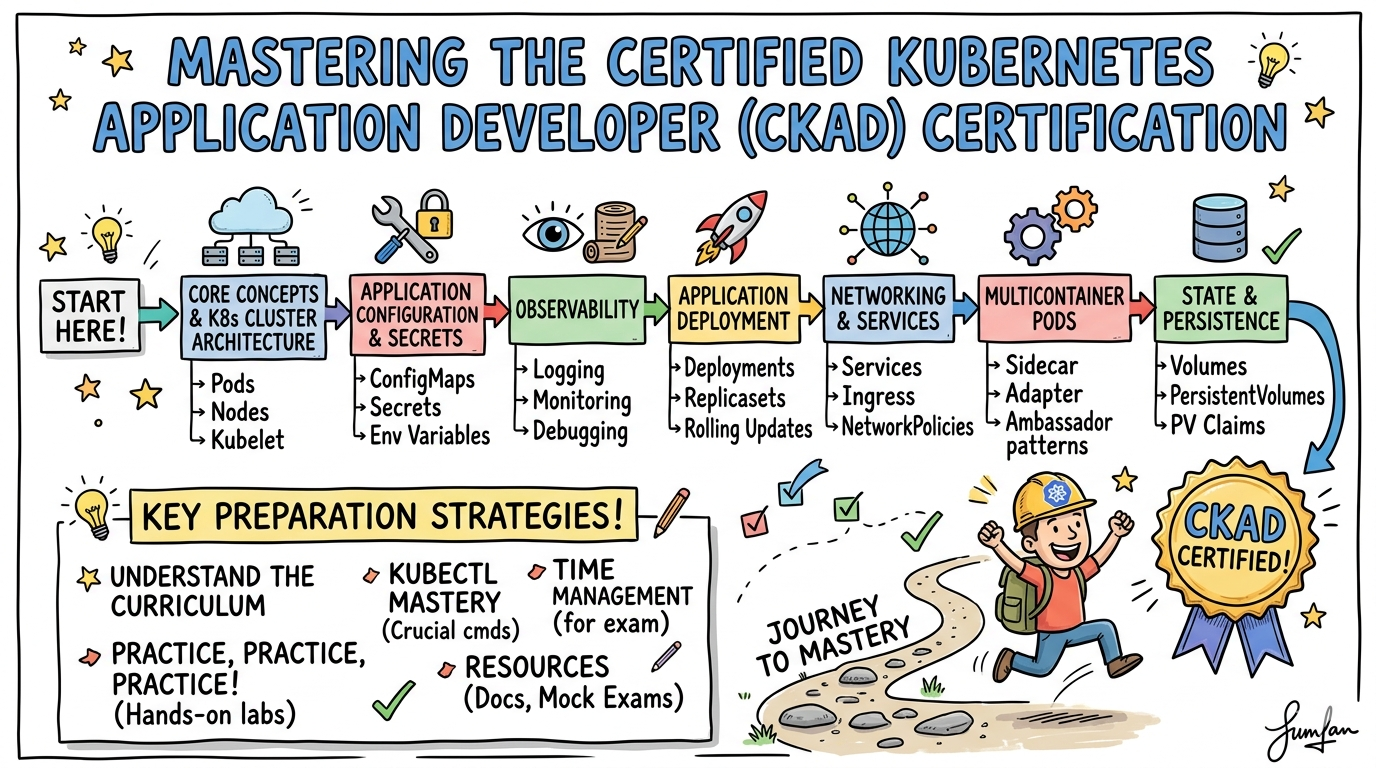
Introduction
The cloud-native ecosystem has transformed how software is built, deployed, and scaled, making container orchestration an essential skill for modern technical professionals. The Certified Kubernetes Application Developer (CKAD) program stands as a premier validation for engineers who design, build, configure, and expose applications using Kubernetes. This comprehensive guide is designed for software engineers, platform specialists, and engineering leaders who want to navigate the complexities of containerized environments and make informed decisions about professional development. By focusing on practical, hands-on mastery rather than theoretical memorization, establishing a clear learning path in this domain helps technical professionals align their technical capabilities with global enterprise infrastructure needs. To accelerate this learning journey, professionals can explore tailored training resources through specialized platforms such as DevOpsSchool or dive into advanced infrastructure intelligence programs via aiopsschool.
What is the Certified Kubernetes Application Developer (CKAD)?
The Certified Kubernetes Application Developer (CKAD) is a performance-based certification exam developed by the Cloud Native Computing Foundation (CNCF) in collaboration with The Linux Foundation. Unlike traditional multiple-choice examinations, this program tests the analytical and hands-on operational capability of a candidate within a live, command-line environment. It exists to certify that an engineer can actively design, build, monitor, and deploy cloud-native applications within a Kubernetes cluster. The framework prioritizes core operational skills such as defining application resources, configuring core primitives, and troubleshooting runtime issues in high-availability environments. For global enterprises, having certified professionals ensures that development teams adhere to standard, secure, and highly efficient cloud-native architectural practices.
Who Should Pursue Certified Kubernetes Application Developer (CKAD)?
This program is primarily architected for application developers, software engineers, and systems developers who are responsible for packaging and running code in cloud-native environments. Additionally, Site Reliability Engineers (SREs), DevOps practitioners, and platform engineers leverage this training to bridge the gap between pure application logic and infrastructure operations. Security professionals and data engineers who interact with containerized pipelines find immense value in understanding how application workloads behave natively inside a cluster. Whether you are an engineer based in India’s booming technology hubs or working within a distributed global enterprise, managing containerized applications is no longer an optional skill but a core requirement for scalable engineering operations. Technical managers and architects also pursue this path to effectively lead engineering teams through complex cloud migrations.
Why Certified Kubernetes Application Developer (CKAD)
Enterprise adoption of microservices architectures has made Kubernetes the operating system of the modern cloud. The value of this certification lies in its absolute focus on hands-on competence, ensuring that an engineer can perform under pressure in real production scenarios. Tools, wrappers, and cloud providers may introduce proprietary frameworks, but the underlying Kubernetes primitives remain consistent across all cloud environments, including AWS, Azure, Google Cloud, and on-premises infrastructure. Investing time into this validation ensures long-term career resilience by decoupling an engineer’s worth from specific cloud vendor ecosystems. Ultimately, it provides a measurable return on investment for both the individual, who gains elite technical credibility, and the enterprise, which minimizes production downtime through robust engineering practices.
Certified Kubernetes Application Developer (CKAD) Certification Overview
The program is delivered via the official training frameworks and hosted on devopsschool to provide comprehensive preparation for the rigorous evaluation. The assessment approach is completely practical, requiring candidates to solve complex infrastructure and deployment problems directly inside a terminal within a specified timeframe. The Cloud Native Computing Foundation maintains strict ownership of the curriculum, ensuring it reflects the latest updates and security patches of the upstream Kubernetes project. The exam structure challenges candidates to manipulate YAML manifests, configure application security contexts, and debug faulty workloads. This practical evaluation ensures that anyone who passes the exam possesses the actual skills needed to manage enterprise workloads on day one.
Certified Kubernetes Application Developer (CKAD) Certification Tracks & Levels
The journey through the cloud-native application development ecosystem is structured to take professionals from core foundational awareness to highly specialized operational capabilities. At the foundational level, engineers focus on understanding microservices design, containerization basics, and fundamental cluster communication models. The professional level, where this specific certification sits, demands full operational command over application architecture, storage persistence, and workload observability. Advanced and specialized tracks branch outward into highly targeted domains such as GitOps deployment methodologies, cloud-native security policies, and advanced service mesh architectures. Aligning these levels with clear career goals allows engineers to systematically transition from standard application development into sophisticated platform engineering roles.
Complete Certified Kubernetes Application Developer (CKAD) Certification Table
| Track | Level | Who it’s for | Prerequisites | Skills Covered | Recommended Order |
| Application Development | Professional | Software Developers, DevOps Engineers | Container Basics, Linux CLI | Workload Deployment, Storage, Network | First Cloud-Native Step |
| Cluster Administration | Professional | Systems Administrators, SREs | Basic Networking, Linux Administration | Cluster Setup, Logging, Security | Concurrent with Development |
| Cloud Security | Advanced | DevSecOps, Security Engineers | Strong Kubernetes Core Knowledge | Cluster Hardening, Supply Chain | After Achieving Professional Level |
Detailed Guide for Each Certified Kubernetes Application Developer (CKAD) Certification
Certified Kubernetes Application Developer (CKAD) – Application Developer Level
What it is
This level validates an engineer’s ability to design, build, configure, and expose cloud-native applications within an active Kubernetes cluster environment. It confirms proficiency in utilizing core primitives to achieve application scalability, high availability, and operational resilience.
Who should take it
This is designed for software engineers, cloud application developers, and DevOps professionals who possess at least six months of hands-on experience running containerized workloads and interacting with command-line tools.
Skills you’ll gain
- Proficient management of application blueprints and multi-container deployment patterns.
- Configuration of persistent volumes, storage classes, and stateful application workloads.
- Implementation of application security contexts, service accounts, and secret management.
- Advanced troubleshooting of pod initialization failures and runtime deployment errors.
Real-world projects you should be able to do
- Design and deploy a multi-tier microservices application utilizing custom configuration parameters and secure credentials.
- Implement a rolling update strategy for an active production service with zero-downtime configuration rollbacks.
- Configure network policies to isolate sensitive database workloads from public-facing web layers.
Preparation plan
- 7–14 Days: Focus deeply on mastering the imperative commands of the command-line interface to generate resource blueprints rapidly without manual drafting.
- 30 Days: Build complex scenarios covering all core primitives, focusing extensively on storage integration, network policy configurations, and decoupling application secrets.
- 60 Days: Execute full-length, timed mock simulations to build the speed, accuracy, and muscle memory required to debug complex cluster issues under pressure.
Common mistakes
- Spending excessive time manually writing complex configuration templates instead of using built-in command generation parameters.
- Misunderstanding the precise scope of specific namespaces, leading to resource misplacement during deployment validations.
- Neglecting to practice rapid troubleshooting methodologies, resulting in deep time losses on minor configuration syntax errors.
Best next certification after this
- Same-track option: Certified Kubernetes Administrator
- Cross-track option: Certified Kubernetes Security Specialist
- Leadership option: Cloud Native Certified Infrastructure Architect
Choose Your Learning Path
DevOps Path
The DevOps methodology demands a deep integration between application architecture and automated infrastructure delivery mechanisms. Within this pathway, engineers learn to wrap deployment configurations into declarative manifests that can be managed seamlessly through version control systems. The focus centers on building reliable continuous integration and continuous deployment pipelines that interact natively with container orchestrators. By mastering resource constraints, health checks, and rolling updates, professionals ensure that application code moves smoothly from local workstations to production clusters without manual intervention.
DevSecOps Path
Security within containerized environments cannot be an afterthought and must be baked directly into the application design phase. This path guides engineers through the implementation of strict security contexts, least-privilege service accounts, and encrypted secret distribution. Professionals learn to audit container images for known vulnerabilities before they are scheduled onto active nodes in the cluster. Furthermore, this pathway emphasizes the creation of strict network isolation policies to ensure that compromised application workloads cannot move laterally across enterprise networks.
SRE Path
Site Reliability Engineering prioritizes system availability, performance optimization, and scalable observability across distributed enterprise applications. Engineers pursuing this path focus on configuring advanced liveness, readiness, and startup probes to automate self-healing application behaviors. They master log collection architectures, metric aggregation strategies, and distributed tracing configurations to maintain visibility into application health. This structured focus helps teams manage error budgets effectively and drastically reduce the mean time to resolution during critical production incidents.
AIOps / MLOps Path
Deploying artificial intelligence and machine learning pipelines requires scalable computational scheduling and sophisticated resource orchestration models. This path enables professionals to manage heavy compute workloads, GPU allocation profiles, and complex batch processing jobs inside a cluster environment. Engineers learn to host model inference services that scale dynamically based on incoming real-time request traffic volumes. This alignment ensures that data science models are translated into highly resilient, low-latency web services capable of serving production demands.
DataOps Path
Modern data pipelines require high throughput, stateful persistence, and flawless synchronization between distributed data processing nodes. This specialized path focuses on the deployment of distributed databases, caching systems, and real-time streaming engines within automated container environments. Professionals learn to handle persistent volume claims, dynamic storage provisioning, and stateful application sets without risking data corruption during node transitions. This expertise allows organizations to run complex data engineering workflows on elastic cloud infrastructure safely.
FinOps Path
Cloud cost management requires deep visibility into how application workloads consume cluster compute, memory, and storage infrastructure resources. This pathway trains professionals to define accurate resource requests and limits to avoid over-provisioning and wasted enterprise infrastructure budgets. Engineers learn to implement horizontal and vertical auto-scalers that adjust infrastructure scale based on actual historical utilization patterns. This ongoing discipline ensures that organizations maximize their technical processing output while keeping cloud expenditure fully optimized.
Role → Recommended Certified Kubernetes Application Developer (CKAD) Certifications
| Role | Recommended Certifications |
| DevOps Engineer | Certified Kubernetes Application Developer, GitOps Fundamentals |
| SRE | Certified Kubernetes Application Developer, Certified Kubernetes Administrator |
| Platform Engineer | Certified Kubernetes Administrator, Service Mesh Professional |
| Cloud Engineer | Certified Kubernetes Application Developer, Multi-Cloud Architect |
| Security Engineer | Certified Kubernetes Security Specialist, DevSecOps Expert |
| Data Engineer | Certified Kubernetes Application Developer, Cloud Data Professional |
| FinOps Practitioner | Certified Kubernetes Application Developer, FinOps Certified Professional |
| Engineering Manager | Certified Kubernetes Application Developer, Cloud-Native Leadership |
Next Certifications to Take After Certified Kubernetes Application Developer (CKAD)
Same Track Progression
Upon mastering application development mechanics, the logical progression is to transition into cluster administration and architectural infrastructure management. Pursuing deeper infrastructure credentials allows an engineer to move from managing individual application workloads to designing, provisioning, and maintaining high-availability enterprise environments. This شامل learning cluster upgrades, backup restorations, master node component troubleshooting, and deep operating system level integration.
Cross-Track Expansion
To build a highly resilient, cross-functional engineering profile, professionals should expand their expertise into specialized security and continuous delivery domains. Obtaining advanced validations in cloud-native security ensures that you can protect enterprise assets across the entire software development lifecycle, from code commit to runtime execution. This expansion enables engineers to act as technical bridges between separate infrastructure, security, and pure software engineering teams.
Leadership & Management Track
For experienced professionals looking to transition away from pure tactical implementation toward technical leadership, focusing on enterprise architecture governance is vital. Leadership training paths emphasize cloud-native cost optimization strategies, vendor evaluation matrixes, and organizational change management frameworks. This prepares technical leaders to guide global corporations through large-scale cloud transformations while aligning infrastructure choices directly with high-level business growth objectives.
Training & Certification Support Providers for Certified Kubernetes Application Developer (CKAD)
DevOpsSchool provides a premium, highly structured environment tailored for professionals seeking rigorous hands-on practice. The curriculum focuses heavily on real-world scenarios, giving candidates deep exposure to terminal operations and imperative commands. Their expert mentorship ensures that engineers develop the speed and confidence needed to clear live practical examinations successfully.
Cotocus specializes in intensive boot camps designed to help engineering teams master container workflows quickly. Their training frameworks offer immersive laboratory environments that simulate actual production outages and complex configuration problems. This method forces candidates to develop deep, long-term diagnostic capabilities that extend far beyond simple certification prep.
Scmgalaxy offers an extensive repository of community-driven resources, technical blueprints, and practice labs for modern engineers. Their educational methodology emphasizes deeply understanding the source configurations and automation systems that drive container environments. It serves as an excellent resource hub for building sustainable technical competence.
BestDevOps focuses on delivering highly tailored cloud-native learning paths for both individual engineers and large enterprise teams. Their training structures align closely with modern corporate infrastructure demands, bridging the gap between standard testing patterns and actual production deployments.
devsecopsschool ensures that secure coding and infrastructure protection principles are integrated directly into all training modules. Their coursework helps engineers learn to identify configuration vulnerabilities early, ensuring that application deployment configurations are inherently secure by default before touching production.
sreschool centers its entire instructional methodology on the core pillars of reliability, scalability, performance monitoring, and rapid troubleshooting under pressure. Their practical labs simulate high-traffic production workloads, training engineers to build resilient, self-healing infrastructure setups that maintain high availability.
aiopsschool bridges the gap between advanced artificial intelligence architectures and modern cloud infrastructure management tools. Their courses focus on preparing professionals to manage automated, intelligent operations that optimize application scaling and predict system anomalies natively.
dataopsschool focuses exclusively on the unique infrastructure requirements of complex data delivery pipelines and large-scale analytical systems. Their instructional design helps professionals learn to deploy high-throughput, stateful data solutions efficiently inside automated container environments.
finopsschool delivers specialized education centered around cloud financial management, resource optimization, and infrastructure cost transparency. Their programs teach engineers to structurally balance application performance requirements against strict corporate cloud expenditure boundaries.
Frequently Asked Questions (General)
- What is the primary benefit of earning a performance-based technical certification?Unlike traditional multiple-choice tests, a performance-based certification proves that an engineer can execute actual tasks in a live environment, giving employers immediate confidence in their practical capabilities.
- How long does it typically take to prepare for a professional-level cloud-native examination?For an engineer with consistent exposure to command-line interfaces and basic container concepts, a dedicated timeline of thirty to sixty days is usually sufficient for preparation.
- Are there any hard academic or professional prerequisites required before taking these exams?There are no formal academic degrees required to sit for these examinations, making them highly accessible to self-taught developers and transitioning professionals.
- How do hands-on certifications affect career trajectories for software engineers?They act as a major differentiator in competitive job markets, shifting the focus from theoretical discussions to immediate, verifiable operational competence.
- Why do modern organizations prioritize container orchestration skills during engineering hiring?As businesses scale their microservices architectures, they require professionals who can manage resource consumption, minimize downtime, and automate complex deployments.
- What is the validity period of these professional cloud-native credentials?Most high-tier cloud-native certifications remain valid for three years, keeping pace with the rapid updates and evolutionary changes of the technology.
- Can these certifications help traditional system administrators move into DevOps roles?Yes, they serve as an ideal bridge by validating the modern automation and application management skills required in agile engineering teams.
- How important is terminal speed and command-line familiarity during practical exams?It is highly critical because candidates face strict time limits and must generate configuration files rapidly without relying on graphic user interfaces.
- What strategies help candidates avoid failing time-constrained practical evaluations?Practicing imperative command shortcuts, utilizing documentation efficiently, and learning to skip highly complex, low-point tasks until the end of the test.
- Do these certifications cover proprietary vendor tools or open-source standards?They focus primarily on open-source cloud-native standards, giving professionals universal skills that apply across all public and private cloud ecosystems.
- How should an engineer balance preparation with an intense, full-time work schedule?By dedicating small, consistent blocks of time daily to focused terminal practice rather than attempting to cram large amounts of theory over weekends.
- Is investment in these professional credentials justified for early-career developers?Absolutely, because it provides a clear, structured roadmap for mastering complex architecture paradigms that would otherwise take years to learn on the job.
FAQs on Certified Kubernetes Application Developer (CKAD)
- What specific areas of application management does the examination emphasize?The evaluation focuses heavily on designing core deployment manifests, managing application configurations through maps and secrets, establishing persistent storage connections, and defining strict multi-tier network communication isolation policies within the cluster environment.
- Can I use external bookmarks or search engines during the live practical test?No, candidates are strictly limited to utilizing the official documentation site within the integrated examination browser tab, making deep familiarity with the structural layout of the official reference docs highly critical for success.
- How does this program differ fundamentally from the administrator track?The developer track concentrates on configuring, deploying, monitoring, and scaling specific application workloads, whereas the administrator track focuses on cluster setup, master node components, operating system upgrades, and global security configurations.
- What version of the container orchestration platform is used during the evaluation?The exam environment is regularly updated to align closely with the recent stable releases of the upstream project, ensuring that professionals are tested on modern, relevant platform features.
- Is deep programming knowledge in a specific language required to pass?No specific language profile is tested, as the examination focuses on how application binaries are packaged, configured, resource-constrained, and scaled inside the cluster orchestrator using configuration manifests.
- What is the passing score and how long is the test duration?Candidates must achieve a minimum score of sixty-six percent within a strict two-hour window, requiring highly optimized problem-solving speed and precise command syntax execution during the session.
- How can I simulate the actual environment for practice purposes?Engineers can utilize lightweight local cluster distributions such as Minikube or Kind on their personal workstations to practice imperative command generations and manifest troubleshooting scenarios effectively.
- Does the program include concepts relating to continuous delivery tools?While the exam focuses on core cluster primitives and native deployment strategies, the architectural principles mastered form the absolute foundation for advanced continuous delivery automation.
Final Thoughts: Is Certified Kubernetes Application Developer (CKAD) Worth It?
Navigating professional development requires separating brief technology trends from fundamental architectural shifts. The mastery of cloud-native application deployment represents a permanent evolution in how enterprise software is managed and delivered globally. Pursuing this verification demands rigorous discipline, intense terminal practice, and a commitment to deep, hands-on troubleshooting. However, the clarity gained by understanding how distributed systems operate under pressure provides immense professional confidence. For any engineer or technical leader looking to build resilient, scalable systems and eliminate the guesswork from cloud operations, dedicating the effort to master this domain remains an exceptionally high-value career investment.
